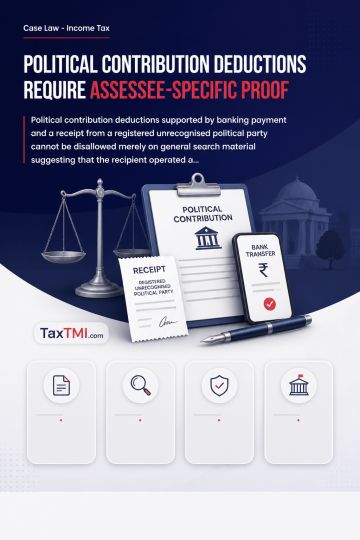
Political contribution deductions require assessee-specific proof before cash-back allegations can justify disallowance or unexplained-money additions...
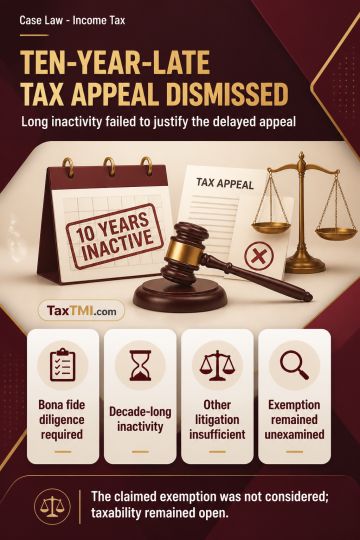
Condonation of delay requires sufficient cause founded on bona fide diligence and circumstances beyond the litigant's control. Voluntarily offering a receipt to tax, accepting the intimation, and remaining inactive for more than a decade did not meet that standard; awaiting litigation concerning another entity's registration, mistaken belief about registration, later legal developments, difficulty locating records, and professional consultation were insufficient. The inordinate delay in filing the first appeal was therefore not condoned, and the appeal was dismissed without considering the claimed exemption. The taxability of the one-time benefit remained open.
Condonation of delay requires sufficient cause founded on bona fide diligence and circumstances beyond the litigant's control. Voluntarily offering a receipt to tax, accepting the intimation, and remaining inactive for more than a decade did not meet that standard; awaiting litigation concerning another entity's registration, mistaken belief about registration, later legal developments, difficulty locating records, and professional consultation were insufficient. The inordinate delay in filing the first appeal was therefore not condoned, and the appeal was dismissed without considering the claimed exemption. The taxability of the one-time benefit remained open.
Note: It is a system-generated summary and is for quick reference only.
 TaxTMI
  TaxTMI
 of 4884