Section 153C requires person-specific search authority and year-specific incriminating material for unabated assessments while preventing unsupported ...
Equivalent-value attachment can reach pre-existing assets, but jointly owned property remains protected beyond the accused's attributable proceeds of ...
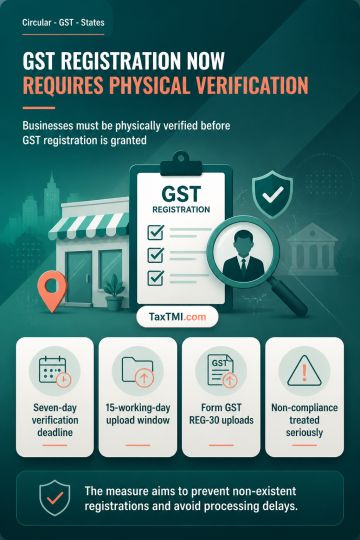
Pre-registration physical verification becomes mandatory to prevent non-existent business registrations and support timely GST registration processing...
Page of 4886
Press 'Enter' after typing page number.
841 to 860 of 97714 Results
❮
❯
❯❯
0 / 200
Expand Note
Add to Folder
No Folders have been created
+
Are you sure you want to delete "My most important" ?
Restricted second-hand parts of capital goods imported without...
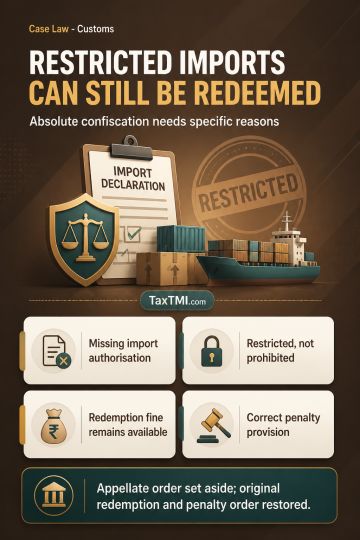
Restricted second-hand goods remain redeemable when absolute confiscation lacks specific reasons, and penalties must follow the applicable import provision.
Contents
Summary
Note
Bookmark
Share
✓ Copied successfully !
Print
Print Options
For full text, please login
Login to TaxTMI
Verification Pending
The Email Id has not been verified. Click on the link we have sent on
Restricted second-hand parts of capital goods imported without the required authorisation may be confiscated, but restriction alone does not justify absolute confiscation without specific reasons. Where the goods are restricted rather than prohibited, redemption on payment of fine remains available. Penalty for importing such goods was treated under the provision applicable to improper import; enhancement under a separate provision operating on different premises was not sustainable. The appellate order directing absolute confiscation and enhancing the penalty was set aside, while the original order allowing redemption and imposing the applicable import penalty was restored.
Restricted second-hand parts of capital goods imported without the required authorisation may be confiscated, but restriction alone does not justify absolute confiscation without specific reasons. Where the goods are restricted rather than prohibited, redemption on payment of fine remains available. Penalty for importing such goods was treated under the provision applicable to improper import; enhancement under a separate provision operating on different premises was not sustainable. The appellate order directing absolute confiscation and enhancing the penalty was set aside, while the original order allowing redemption and imposing the applicable import penalty was restored.
Note: It is a system-generated summary and is for quick reference only.
 TaxTMI
  TaxTMI
 of 4886