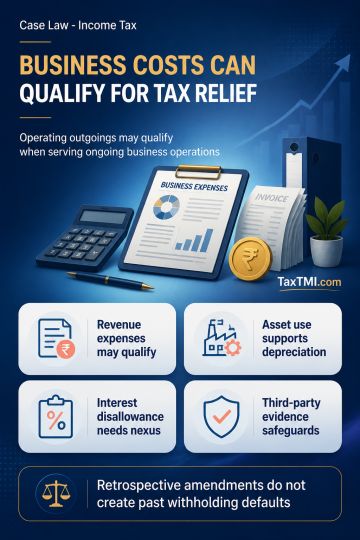
Business expenditure and depreciation rules allow operational outgoings while limiting disallowances for personal elements and unsupported third-party...
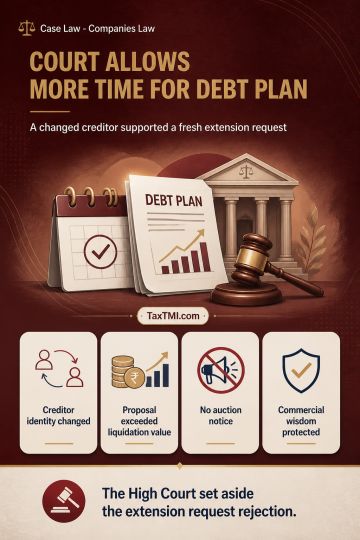
Compromise-and-arrangement extensions may accommodate debt assignment where creditor commercial judgment supports value maximisation and avoids proced...
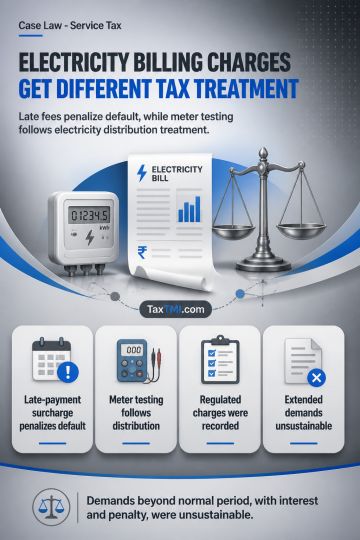
Delayed-payment surcharge is not taxable tolerance consideration where it penalises default, while meter testing follows electricity distribution trea...
Sufficient cause for delayed revenue income-tax appeals requires bona fides, due diligence and a credible explanation; otherwise limitation bars appea...
Inverted-duty-structure refunds remain available for unchanged-rate apparel supplies despite trader status and require tax-period-specific computation...
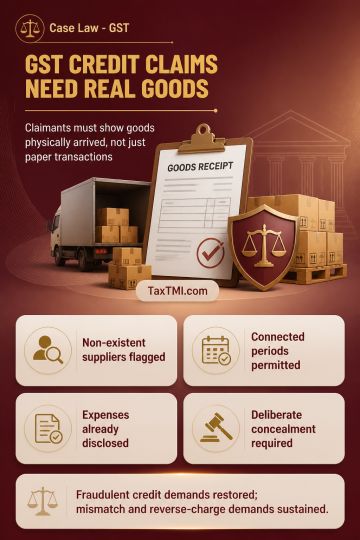
Input tax credit claimed on invoices issued by non-existent suppliers may attract Section 74 where the notice sets out foundational facts indicating fraud, wilful misstatement or suppression. The claimant must establish actual receipt and physical movement of goods; invoices and banking records alone do not prove transaction genuineness. A consolidated notice may cover multiple financial years because the statutory wording permits proceedings for connected periods. Conversely, reverse charge liability cannot be pursued under Section 74 merely from omissions when relevant expenses were disclosed in accounts and financial statements; deliberate non-disclosure is required. Input tax credit mismatch and reverse charge demands were sustained under Section 73 with consequential interest and penalty, while fraudulent credit demands were restored under Section 74.
Input tax credit claimed on invoices issued by non-existent suppliers may attract Section 74 where the notice sets out foundational facts indicating fraud, wilful misstatement or suppression. The claimant must establish actual receipt and physical movement of goods; invoices and banking records alone do not prove transaction genuineness. A consolidated notice may cover multiple financial years because the statutory wording permits proceedings for connected periods. Conversely, reverse charge liability cannot be pursued under Section 74 merely from omissions when relevant expenses were disclosed in accounts and financial statements; deliberate non-disclosure is required. Input tax credit mismatch and reverse charge demands were sustained under Section 73 with consequential interest and penalty, while fraudulent credit demands were restored under Section 74.
Note: It is a system-generated summary and is for quick reference only.
 TaxTMI
  TaxTMI
 of 4886