Effective hearing in GST adjudication requires actual opportunity to respond; ineffective service through a former auditor invalidated ex parte procee...
Third-party search material requires special assessment route, rendering general reassessment notices without jurisdiction when it forms the proceedin...
Transfer-pricing adjustments must be confined to international associated-enterprise transactions, while functionally dissimilar comparables remain ex...
Insolvency moratorium bars income-tax revision proceedings against corporate debtors until the moratorium ends, preserving merits for later determinat...
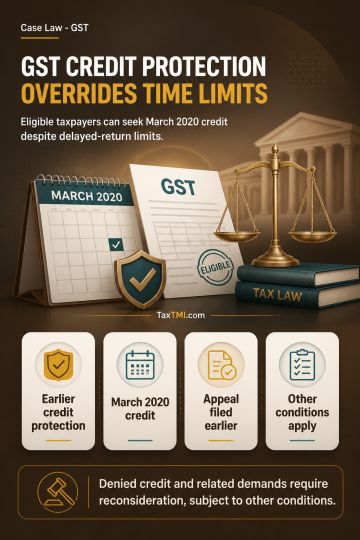
Section 16(5) of the CGST Act, inserted retrospectively, grants input tax credit to taxpayers who furnished returns by its prescribed cut-off date, notwithstanding the time limit in Section 16(4). A circular cannot restrict that statutory entitlement. A notification requiring a rectification application within a specified period does not govern a taxpayer who had already filed an appeal against the assessment order before the amendment. Denial of March 2020 input tax credit and consequential demands therefore require reconsideration under Section 16(5), subject to other eligibility conditions.
Section 16(5) of the CGST Act, inserted retrospectively, grants input tax credit to taxpayers who furnished returns by its prescribed cut-off date, notwithstanding the time limit in Section 16(4). A circular cannot restrict that statutory entitlement. A notification requiring a rectification application within a specified period does not govern a taxpayer who had already filed an appeal against the assessment order before the amendment. Denial of March 2020 input tax credit and consequential demands therefore require reconsideration under Section 16(5), subject to other eligibility conditions.
Note: It is a system-generated summary and is for quick reference only.
 TaxTMI
  TaxTMI
 of 4886