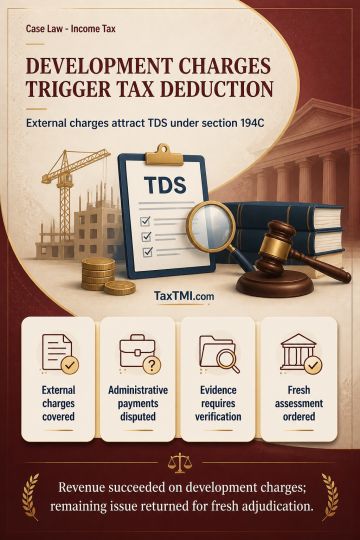
External development charges trigger TDS under section 194C, while disputed administrative payments require factual verification and fresh adjudicatio...
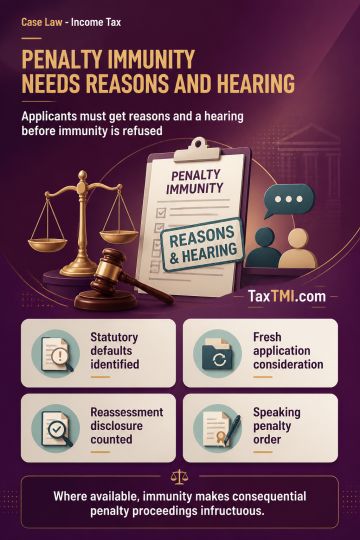
Section 270AA penalty immunity requires identified statutory defaults and a hearing before rejection; reassessment disclosure may constitute under-rep...
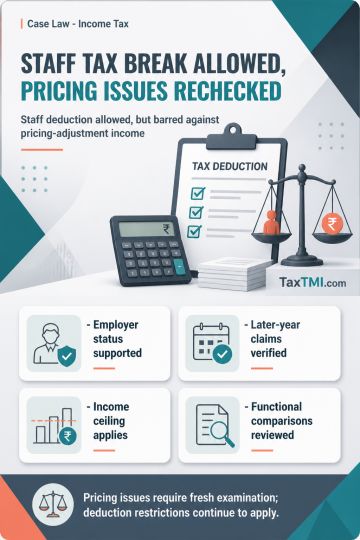
Section 80JJAA employee-cost deduction allowed for deployed staff but barred against transfer-pricing income enhancement, with pricing issues remanded...
Transfer-pricing methodology protects commercially genuine associated-enterprise payments, while pre-2016 secondary adjustments and related notional i...
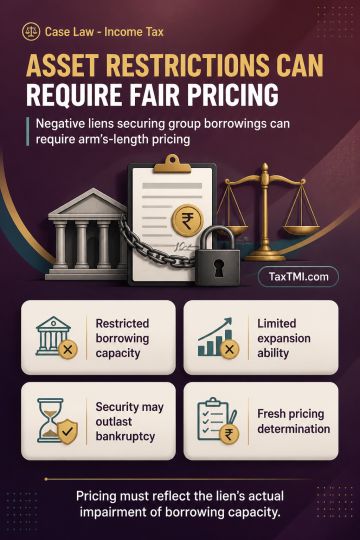
Negative liens over operating assets can constitute international transactions requiring arm's-length pricing reflecting restricted borrowing and expa...
Cross-examination rights in Customs Broker revocation inquiries require witness examination; procedural denial may be cured through fresh adjudication...
Year-end estimated expenditure provisions, where invoices, precise liabilities and payees remain unascertained, do not amount to credit of an ascertainable sum to an identified payee under the mercantile system. Tax-deduction obligations therefore arise only when liabilities crystallise, with tax deducted where applicable upon receipt of invoices; reversal of the provisions in the succeeding year supports that treatment. A demand for tax-deduction default cannot be sustained merely on creation of such provisions. Further, where the same non-deduction has already led to disallowance of expenditure, it cannot also support a tax-deduction default demand; consequential interest fails with the principal demand.
Year-end estimated expenditure provisions, where invoices, precise liabilities and payees remain unascertained, do not amount to credit of an ascertainable sum to an identified payee under the mercantile system. Tax-deduction obligations therefore arise only when liabilities crystallise, with tax deducted where applicable upon receipt of invoices; reversal of the provisions in the succeeding year supports that treatment. A demand for tax-deduction default cannot be sustained merely on creation of such provisions. Further, where the same non-deduction has already led to disallowance of expenditure, it cannot also support a tax-deduction default demand; consequential interest fails with the principal demand.
Note: It is a system-generated summary and is for quick reference only.
 TaxTMI
  TaxTMI
 of 4888