Separate business unit compliance for non-SEBI-regulated debenture trustee activities receives an extended implementation timeline amid regulatory rev...
Input Service Distributor credit rules assign eligibility, reversals and refund treatment to recipients while excluding transfer invoices from turnove...
Related-party creditor exclusion bars CoC participation where lender rights show policy-making involvement, and post-CIRP assignment cannot cure ineli...
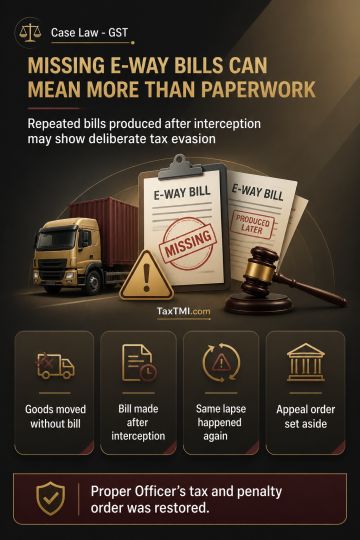
Transportation of taxable goods without an E-Way Bill is treated as substantive non-compliance where the bill is generated only after interception and the same lapse recurs. An E-Way Bill forms part of the statutory mechanism for monitoring taxable-goods movement; its absence alongside a manually issued invoice may permit subsequent account manipulation. Post-interception production, combined with repetition in a similar transaction, indicates a deliberate course of conduct and intention to evade tax rather than a technical or procedural breach. On that basis, tax and penalty proceedings were sustained, the first appellate order was set aside, and the Proper Officer's tax and penalty order was restored.
Transportation of taxable goods without an E-Way Bill is treated as substantive non-compliance where the bill is generated only after interception and the same lapse recurs. An E-Way Bill forms part of the statutory mechanism for monitoring taxable-goods movement; its absence alongside a manually issued invoice may permit subsequent account manipulation. Post-interception production, combined with repetition in a similar transaction, indicates a deliberate course of conduct and intention to evade tax rather than a technical or procedural breach. On that basis, tax and penalty proceedings were sustained, the first appellate order was set aside, and the Proper Officer's tax and penalty order was restored.
Note: It is a system-generated summary and is for quick reference only.
 TaxTMI
 TaxTMI