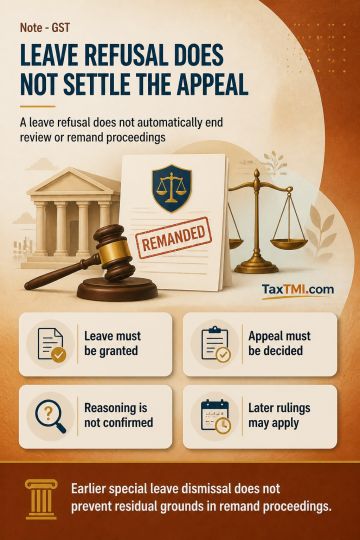
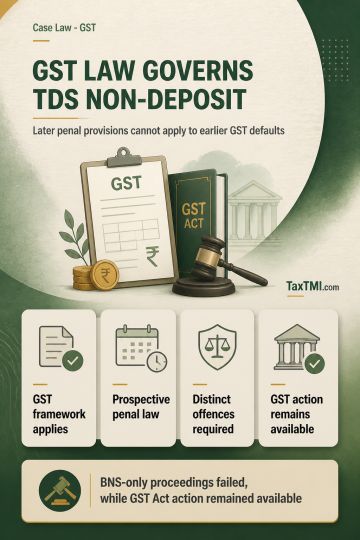
GST/TDS non-deposit arising from payments for Gram Sabha works falls primarily within the U.P. Goods and Services Tax Act, 2017, which provides a complete mechanism for determination of default, interest, penalty, prosecution and compounding. General penal provisions cannot be invoked unless allegations independently establish a distinct offence, such as dishonest misappropriation, forgery, cheating or wrongful gain. Substantive penal law applies prospectively: a penal provision introduced after the alleged 2017-18 default cannot create or alter the applicable offence. Proceedings based solely on Section 316(5) BNS were therefore unsustainable, while action under the GST Act remained available.
GST/TDS non-deposit arising from payments for Gram Sabha works falls primarily within the U.P. Goods and Services Tax Act, 2017, which provides a complete mechanism for determination of default, interest, penalty, prosecution and compounding. General penal provisions cannot be invoked unless allegations independently establish a distinct offence, such as dishonest misappropriation, forgery, cheating or wrongful gain. Substantive penal law applies prospectively: a penal provision introduced after the alleged 2017-18 default cannot create or alter the applicable offence. Proceedings based solely on Section 316(5) BNS were therefore unsustainable, while action under the GST Act remained available.
Note: It is a system-generated summary and is for quick reference only.
 TaxTMI
  TaxTMI
 of 4897