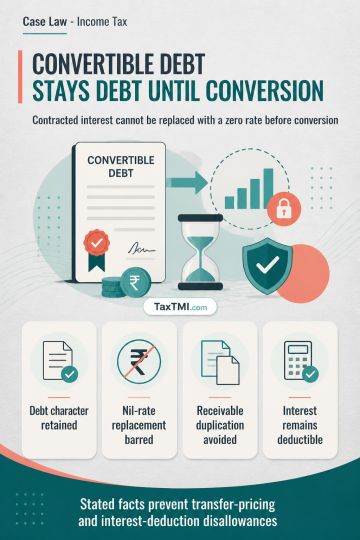
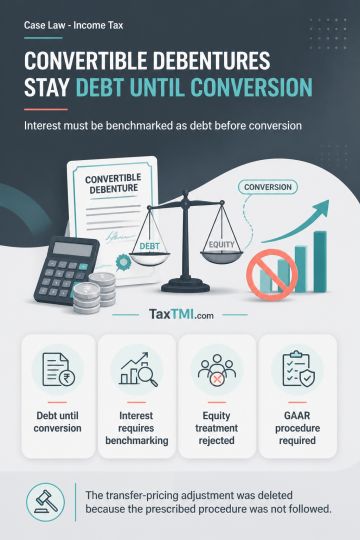
Compulsorily convertible debentures remain debt before conversion, preventing transfer-pricing and interest-deduction disallowances on the stated fact...
Stock-in-trade transfer taxability follows possession and consideration, not later conveyance registration, limiting deemed-value provisions to the ac...
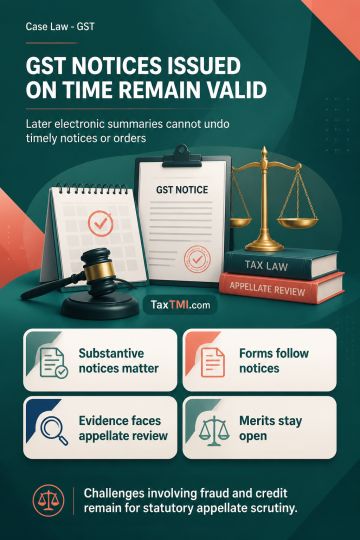
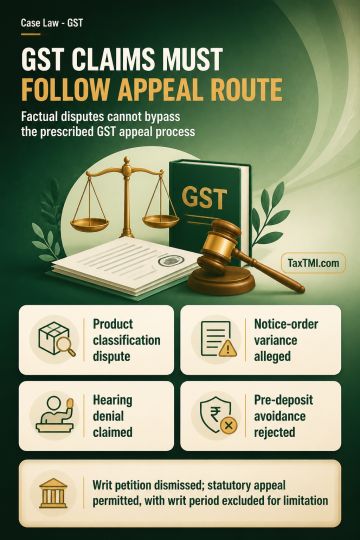
Alternative statutory remedy under GST bars writ challenge where classification, notice variance, and hearing disputes require factual appellate revie...
Tax-audit obligations do not arise where turnover remains below...
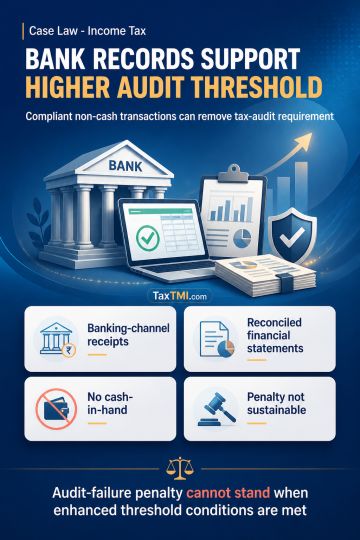
Enhanced tax-audit threshold applies where banking records establish compliant non-cash receipts and payments, eliminating penalty exposure for audit failure.
Contents
Summary
Note
Bookmark
Share
✓ Copied successfully !
Print
Print Options
For full text, please login
Login to TaxTMI
Verification Pending
The Email Id has not been verified. Click on the link we have sent on
Tax-audit obligations do not arise where turnover remains below the enhanced threshold available to taxpayers whose cash receipts and cash payments stay within prescribed limits. Financial statements, bank statements and reconciliation may establish that operational revenue was received through banking channels; differences between bank credits and reported revenue may be attributable to GST and tax deducted at source. Absence of opening or closing cash-in-hand, supported by these records and the tax audit report, can demonstrate that no disqualifying cash transactions occurred. Consequently, penalty for failure to obtain a tax audit is not sustainable where the enhanced threshold applies.
Tax-audit obligations do not arise where turnover remains below the enhanced threshold available to taxpayers whose cash receipts and cash payments stay within prescribed limits. Financial statements, bank statements and reconciliation may establish that operational revenue was received through banking channels; differences between bank credits and reported revenue may be attributable to GST and tax deducted at source. Absence of opening or closing cash-in-hand, supported by these records and the tax audit report, can demonstrate that no disqualifying cash transactions occurred. Consequently, penalty for failure to obtain a tax audit is not sustainable where the enhanced threshold applies.
Note: It is a system-generated summary and is for quick reference only.
 TaxTMI
  TaxTMI
 of 4886