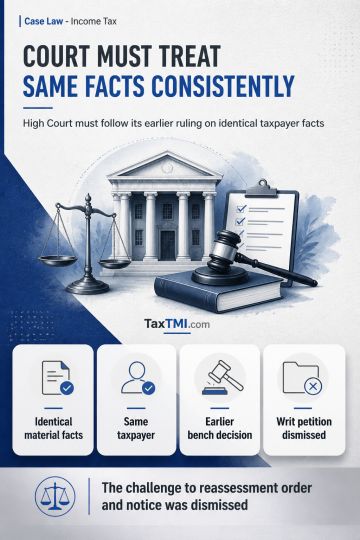
Judicial discipline requires consistent reassessment treatment where identical facts were decided for the same taxpayer in the preceding assessment ye...
Overseas university admission-facilitation services supplied to...
Intermediary service classification fails where overseas admission facilitation is supplied independently, preserving export treatment and small-provider exemption.
Contents
Summary
Note
Bookmark
Share
✓ Copied successfully !
Print
Print Options
For full text, please login
Login to TaxTMI
Verification Pending
The Email Id has not been verified. Click on the link we have sent on
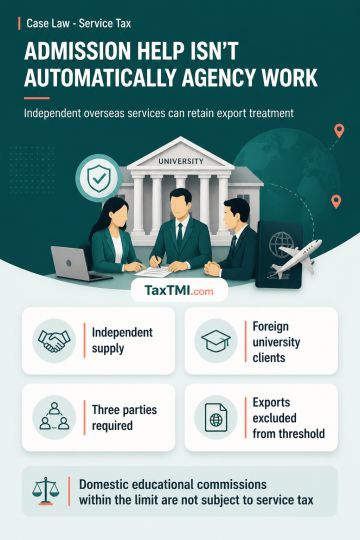
Overseas university admission-facilitation services supplied to foreign universities do not constitute intermediary services merely because the provider is described as an agent and receives commission. Intermediary status requires three parties and two distinct supplies: a main supply and a separate ancillary facilitation supply. Where the provider supplies the principal service on its own account, without a tripartite arrangement or multiple supplies, the service qualifies as export of services. For the small service provider exemption, exported-service value is excluded from the aggregate-value threshold; consequently, commission from domestic educational institutions within the prescribed limit is not subject to service tax.
Overseas university admission-facilitation services supplied to foreign universities do not constitute intermediary services merely because the provider is described as an agent and receives commission. Intermediary status requires three parties and two distinct supplies: a main supply and a separate ancillary facilitation supply. Where the provider supplies the principal service on its own account, without a tripartite arrangement or multiple supplies, the service qualifies as export of services. For the small service provider exemption, exported-service value is excluded from the aggregate-value threshold; consequently, commission from domestic educational institutions within the prescribed limit is not subject to service tax.
Note: It is a system-generated summary and is for quick reference only.
 TaxTMI
  TaxTMI
 of 4888