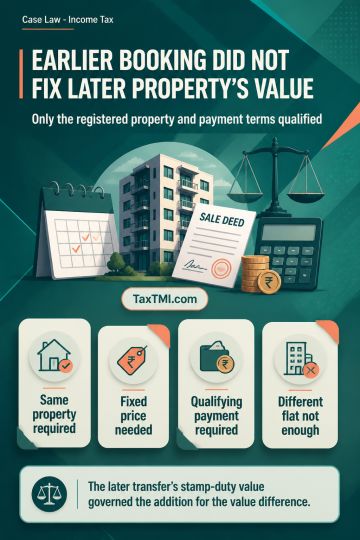
Agreement-date stamp valuation requires the same registered property, fixed consideration, and qualifying payment; an unrelated prior booking cannot a...
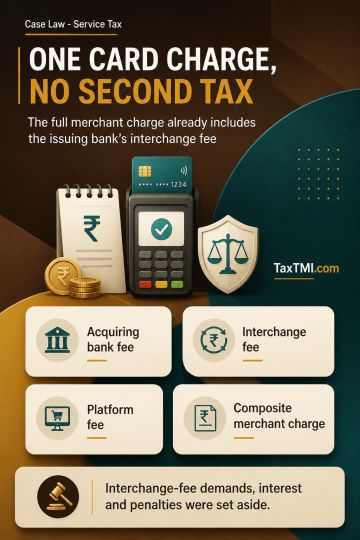
Merchant discount rate in credit-card transactions is a composite charge comprising the acquiring bank fee, issuing bank interchange fee and platform fee. Where service tax has been paid on the entire merchant discount rate, subsequent allocation of the interchange fee to the issuing bank does not create a separately taxable service. A further levy on that retained interchange fee would amount to double taxation, particularly where there is no revenue loss. Service-tax demands on interchange fee, along with consequential interest and penalties, were therefore unsustainable and set aside.
Merchant discount rate in credit-card transactions is a composite charge comprising the acquiring bank fee, issuing bank interchange fee and platform fee. Where service tax has been paid on the entire merchant discount rate, subsequent allocation of the interchange fee to the issuing bank does not create a separately taxable service. A further levy on that retained interchange fee would amount to double taxation, particularly where there is no revenue loss. Service-tax demands on interchange fee, along with consequential interest and penalties, were therefore unsustainable and set aside.
Note: It is a system-generated summary and is for quick reference only.
 TaxTMI
  TaxTMI
 of 4891