Road restoration charges constitute taxable services when requested for commercial pipeline activity, requiring reverse-charge GST from the business r...
Interest on delayed release of requisitioned cash includes statutory pre-assessment interest and restitutionary compensation for unlawful post-assessm...
Incomplete inventory records justify rejecting accounts, while profit estimation requires relevant comparable material and interest falls under other ...
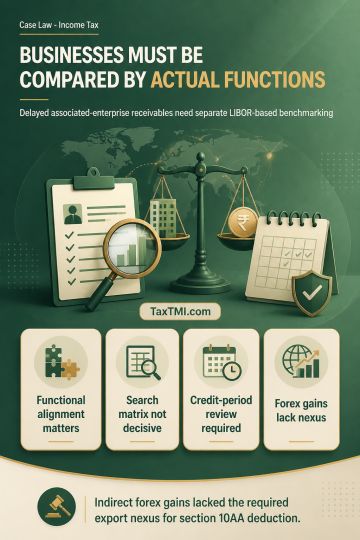
Transfer-pricing comparability requires functional alignment; delayed associated-enterprise receivables need separate LIBOR-based benchmarking, while ...
Extended reassessment limitation in search cases requires asset-linked escaped income, invalidating additions based only on unexplained money or expen...
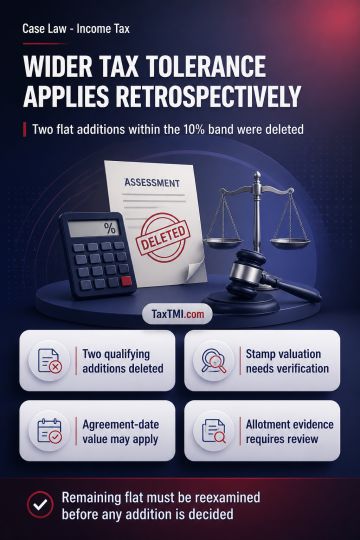
Enhanced tolerance band under section 43CA applies retrospectively, deleting qualifying deemed-sale additions while disputed stamp valuation requires ...
Page of 4910
Press 'Enter' after typing page number.
21 to 40 of 98196 Results
❮
❯
❯❯
0 / 200
Expand Note
Add to Folder
No Folders have been created
+
Are you sure you want to delete "My most important" ?
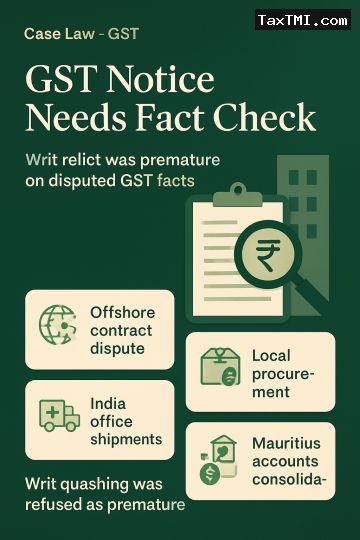
Interference with a show cause notice is unwarranted unless it is ex facie without jurisdiction. Here, the GST dispute over an offshore construction contract turned on factual questions, including local procurement, shipments from the India office, and consolidation of Mauritius site accounts in the Indian company's financials. Those features had a bearing on the territorial applicability of GST, so the notice was not patently without jurisdiction and could not be quashed in writ proceedings as premature. The cited advance-ruling decision was distinguished because it did not arise from a writ challenge to a notice on disputed facts.
Interference with a show cause notice is unwarranted unless it is ex facie without jurisdiction. Here, the GST dispute over an offshore construction contract turned on factual questions, including local procurement, shipments from the India office, and consolidation of Mauritius site accounts in the Indian company's financials. Those features had a bearing on the territorial applicability of GST, so the notice was not patently without jurisdiction and could not be quashed in writ proceedings as premature. The cited advance-ruling decision was distinguished because it did not arise from a writ challenge to a notice on disputed facts.
Note: It is a system-generated summary and is for quick reference only.
 TaxTMI
  TaxTMI
 of 4910