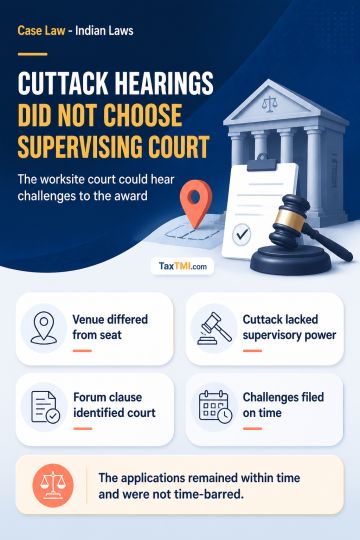
Juridical seat versus arbitral venue determines supervisory court jurisdiction, while timely award challenges remain within the prescribed limitation ...
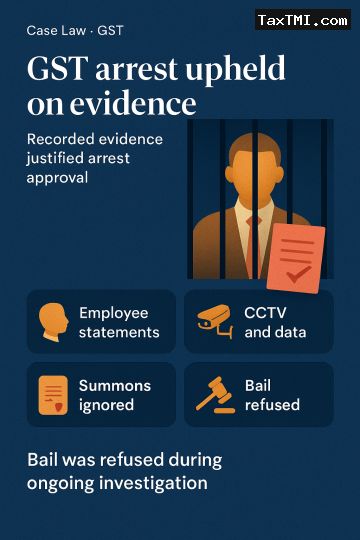
Approval for arrest under the CGST Act does not require final adjudication of tax liability; it is enough that recorded material creates a reason to believe that an offence under section 132 has been committed. The approving authority relied on employee and recipient statements, transporter data, CCTV footage, melting reports, tally data and seized records, so the arrest approval was not mechanical. In assessing bail, the accused's failure to answer summons, failure to produce promised particulars and retraction of an earlier statement led the court to find that he was unlikely to cooperate without custodial interrogation. Given the stage of investigation, alleged gravity and antecedents, bail was refused.
Approval for arrest under the CGST Act does not require final adjudication of tax liability; it is enough that recorded material creates a reason to believe that an offence under section 132 has been committed. The approving authority relied on employee and recipient statements, transporter data, CCTV footage, melting reports, tally data and seized records, so the arrest approval was not mechanical. In assessing bail, the accused's failure to answer summons, failure to produce promised particulars and retraction of an earlier statement led the court to find that he was unlikely to cooperate without custodial interrogation. Given the stage of investigation, alleged gravity and antecedents, bail was refused.
Note: It is a system-generated summary and is for quick reference only.
 TaxTMI
  TaxTMI
 of 4881