Supervisory permanent establishment requires project-wise duration and qualifying construction nexus; offshore supplies and salary reimbursements rema...
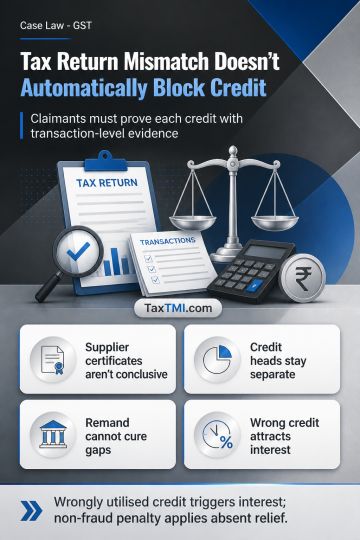
Wrongful availment of input tax credit, where credit exceeded GSTR-2A and was utilised in GSTR-3B, was treated as prima facie suppression of facts with intent to evade tax, supporting invocation of the extended limitation under GST. The Court also noted an apparent failure to discharge reverse charge liability on commissions from foreign booking agencies. The limitation challenge was rejected as covered by the earlier Madras High Court ruling in Tata Play Limited, and the Court further observed that, for the relevant assessment years, even the period for passing orders under the lesser limitation regime had not expired. The writ petitions were dismissed, with liberty to pursue the statutory appeal on merits.
Wrongful availment of input tax credit, where credit exceeded GSTR-2A and was utilised in GSTR-3B, was treated as prima facie suppression of facts with intent to evade tax, supporting invocation of the extended limitation under GST. The Court also noted an apparent failure to discharge reverse charge liability on commissions from foreign booking agencies. The limitation challenge was rejected as covered by the earlier Madras High Court ruling in Tata Play Limited, and the Court further observed that, for the relevant assessment years, even the period for passing orders under the lesser limitation regime had not expired. The writ petitions were dismissed, with liberty to pursue the statutory appeal on merits.
Note: It is a system-generated summary and is for quick reference only.
 TaxTMI
  TaxTMI
 of 4891