Loading...

⚠ ✕
❮ Top
☎ Help
☰
×

By creating an account you can:

Logo TaxTMI
Call Us / Help / Feedback✕

Contact Us At :

✉ E-mail: [email protected]

✆ To Call / Whatsapp, Check Contact Us

FAQs :

To know Frequently Asked Questions, Check FAQs

Most Asked Video Tutorials :

For more tutorials, Check Video Tutorials

Submit Feedback/Suggestion :

Email :
Please provide your email address so we can follow up on your feedback.
Category :
Description :
Min 15 characters 0/2000
Make Most of Text Search ✕
  1. Checkout this video tutorial: How to search effectively on TaxTMI.
  2. Put words in double quotes for exact word search, eg: "income tax"
  3. Avoid noise words such as : 'and, of, the, a'
  4. Sort by Relevance to get the most relevant document.
  5. Press Enter to add multiple terms/multiple phrases, and then click on Search to Search.
  6. Text Search
  7. The system will try to fetch results that contains ALL your words.
  8. Once you add keywords, you'll see a new 'Search In' filter that makes your results even more precise.
  9. Text Search
╳
Add to...
You have not created any category. Kindly create one to bookmark this item!
✕
Create New Category
Hide
Title :
Description :
❮❮ Hide
❮ Default View
Expand ❯❯
Close ✕
🔎 Filters / Advanced Search ❯
TEXT

Press 'Enter' to add multiple search terms. Rules for Better Search

Search In
Main Text + AI Text ❯
  • Main Text
  • Main Text + AI Text
  • AI Text
Law:
---- All Laws---- ❯
  • ---- All Laws----
  • Income Tax
  • Direct Taxes
  • Benami Property
  • Central GST Laws
  • SGST - State GST Laws
  • Customs
  • FTP - Foreign Trade Policy
  • SEZ - Special Economic Zone
  • FEMA - Foreign Exchange Management
  • Companies Law
  • SEBI - Securities & Exchange Board of India
  • IBC - Insolvency and Bankruptcy
  • Law of Competition
  • PMLA - Money-Laundering
  • Indian Laws
  • Bill / Finance Bills
  • Wealth Tax
  • Service Tax
  • Central Excise
  • VAT / Sales Tax
Month:
---- All Months ---- ❯
  • ---- All Months ----
  • January
  • February
  • March
  • April
  • May
  • June
  • July
  • August
  • September
  • October
  • November
  • December
Year:
---- All Years ---- ❯
  • ---- All Years ----
  • 2026
  • 2025
  • 2024
  • 2023
  • 2022
  • 2021
  • 2020
  • 2019
  • 2018
  • 2017
  • 2016
  • 2015
  • 2014
  • 2013
  • 2012
  • 2011
Sort By: ?
In Sort By 'Default', exact matches for text search are shown at the top, followed by the remaining results in their regular order.
Relevance Default Date
☰   Show Results ❯
    Deemed stay on disputed interest recovery applies after full tax payment while appellate proceedings remain pending.
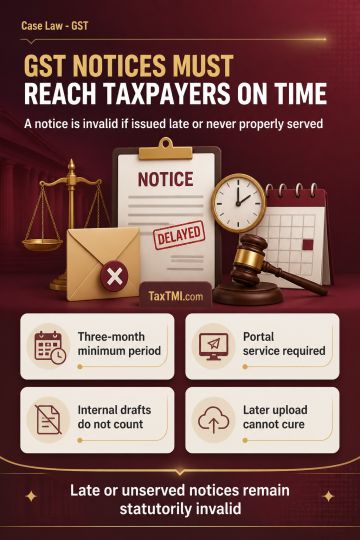
    GST show-cause notice limitation requires timely portal service; internal generation and later upload cannot cure statutory invalidity.
    Condonation of delay requires consideration of a taxpayer's explanation; failure to do so restores the GST appeal for merits.
    Consideration of delay-condonation grounds required before rejecting GST appeals on limitation; merits review follows upon compliance with conditions.
    Pre-trial detention in GST fake-invoice prosecutions cannot continue after investigation absent risks to trial integrity.
    Pre-arrest reasons for arrest must be communicated, and later constitutional rulings generally apply to earlier arrests.
    Input tax credit cannot be denied solely because a supplier's registration was retrospectively cancelled; eligibility requires evidence review.
    Transitional CENVAT credit permits full unavailed capital-goods credit, while TRAN-1 invoice omissions require verification of supporting records.
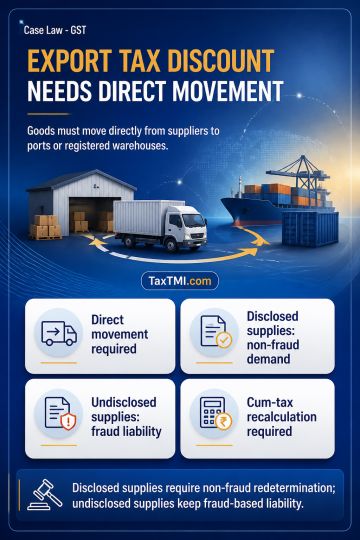
    Merchant-export concession requires direct movement; disclosed supplies face non-fraud GST demand while undisclosed supplies retain fraud-based liabil...
    Section 74 suppression demands require pleaded foundational facts, while undisclosed rental income supports extended-period GST liability.
    Zero-rated export turnover includes invoices issued in the refund period even where goods are exported later.
    Actual receipt of goods governs input tax credit, while duplicate penalties require statutory justification and procedural fairness.
    Technical e-way bill discrepancies cannot support GST penalties where transactions are reported, tax paid, and evasion intent is absent.
    Prospective refund restrictions cannot defeat pre-existing input tax credit claims merely because the refund application was filed later.
    Statutory GST appeal limits bar excess delay condonation, while restoring registration prevents departmental challenge to the implemented order.
    Limitation for Tribunal appeals begins on receipt of the reasoned order, while sufficient cause can justify condonation.
    Refund adjustment during pending tax appeals requires prior intimation and binding recovery instructions; improper recovery attracts interest-bearing ...
    Joint development transfer triggers capital gains for property-owning association, while valuation must reflect consideration at the transfer date.
    Book rejection for missing stock records requires rational profit estimation and fresh cash-credit verification, with reassessment directed.
    Characterisation of flat-sale receipts as business income defeats capital-gains treatment and the residential-property reinvestment deduction.
❮
❯
❯❯
Maximize Maximize Maximize
0 / 200
Expand Note
Add to Folder

No Folders have been created

+

Are you sure you want to delete "My most important" ?

NOTE:

Highlights
Showing Results for :
Reset Filters
Results Found:
Show All Summaries Hide All Summaries

Highlights

Back

All Highlights

Showing Results for :
Reset Filters
No Records Found

Highlights

Back

All Highlights

For e-filed appeals under Section 61 of the IBC, limitation is...

E-filing limitation under IBC counts from the filing date itself, even after office hours, and delay was condoned.

Contents
Summary
Note

Note

-

Bookmark

Print

Print

IBC June 2, 2026 Case Laws AT
For e-filed appeals under Section 61 of the IBC, limitation is computed from the date of e-filing, in line with the NCLAT's 24.12.2022 directions issued under the NCLAT Rules, 2016. The Tribunal rejected reliance on Delhi High Court e-filing rules because no material showed they applied to NCLAT. It applied the Supreme Court's view that a statutory day runs for 24 hours from midnight, so filing after office hours does not shift the filing date to the next working day. An appeal e-filed at 9.00 p.m. on the 45th day was therefore within the condonable period, and the 15-day delay was condoned.

Topics

Acts Income Tax