 TaxTMI







 28 Nov 2026

Delayed Payment of GST Under Reverse Charge Raises an Important Question About Input Tax Credit
A professional colleague recently raised an interesting query with the author regarding the applicability of Section 16(4) of the CGST Act, 2017 to Input Tax Credit (ITC) arising from payment of GST under the Reverse Charge Mechanism (RCM). The query concerned an invoice dated March 2023, for which the recipient discharged the GST liability under RCM in March 2026. The moot question was whether the registered recipient could avail the corresponding ITC in FORM GSTR-3B for March 2026, notwithstanding the expiry of three years from the date of the original invoice. At first glance, one may be inclined to conclude that since GST under RCM was paid in March 2026, the corresponding ITC should also become available in that month.
However, the issue requires a careful examination of Section 16(4), Section 31(3)(f), Rule 36(1)(b), Circular No. 211/5/2024-GST dated 26.06.2024, and Rule 47A inserted with effect from 01.11.2024. The answer primarily depends on whether the supplier was registered or unregistered under GST on the date of receipt of the supply, and, in the latter situation, when the registered recipient actually issued the self-invoice. The date of payment of GST under RCM does not, by itself, determine the statutory time limit for availing the corresponding ITC. Interestingly, the same supply received in March 2023 and the same payment of GST under RCM in March 2026 may produce entirely different legal consequences depending on the relevant tax-paying document.
Section 16(4) Applies Equally to GST Paid Under the Reverse Charge Mechanism
Section 16(1) of the CGST Act, 2017 entitles a registered person, subject to prescribed conditions and restrictions, to take credit of input tax charged on supplies of goods or services, or both, used or intended to be used in the course or furtherance of business. Further, the definition of "input tax" under Section 2(62) expressly includes tax payable under the reverse charge provisions. Consequently, GST discharged under RCM is eligible for ITC, subject to fulfilment of the applicable statutory conditions, including the restrictions prescribed under Sections 16 and 17. The fact that the tax has been paid directly by the recipient, rather than the supplier, does not take such credit outside the statutory framework governing the availment of ITC.
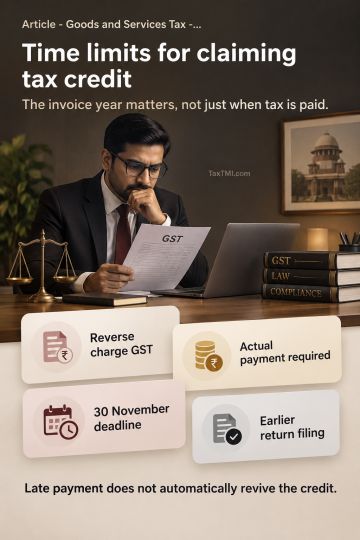
Section 16(4) prohibits a registered person from claiming ITC on an invoice or debit note after the thirtieth day of November following the end of the financial year to which it pertains, or after the date of furnishing the relevant annual return, whichever is earlier. The provision does not provide a general exemption from this time restriction merely because the GST liability has been discharged under RCM. Consequently, payment of GST under RCM after the applicable limitation period expires does not automatically revive the corresponding ITC entitlement.
It is therefore necessary to distinguish between two independent statutory requirements. While actual payment of GST under RCM is an essential condition for availing the corresponding ITC, such payment does not necessarily determine the financial year relevant for computing the limitation under Section 16(4). The relevant financial year must be identified with reference to the applicable invoice. Where the supplier is registered, the recipient ordinarily relies on the supplier's tax invoice. Where the supplier is unregistered, the relevant document is the self-invoice issued by the registered recipient under Section 31(3)(f). This distinction forms the basis of the controversy under consideration.
Delayed Payment of GST Cannot Revive Time-Barred ITC Where the Supplier Is Registered
Where a registered person receives goods or services from another GST-registered person and the transaction attracts GST under RCM, the supplier is responsible for issuing the tax invoice under Section 31. Rule 46(p) requires the tax invoice to indicate whether the tax is payable on a reverse charge basis. In such circumstances, the registered recipient is not required to issue a separate self-invoice under Section 31(3)(f), as that provision applies to specified inward supplies from unregistered suppliers. The tax invoice issued by the registered supplier is the relevant document for determining the time limit under Section 16(4).
In the query under consideration, if the supplier was registered under GST and issued the tax invoice in March 2023, the invoice would pertain to FY 2022-23. Accordingly, the normal statutory time limit for availing ITC expired on 30.11.2023, or on the date of furnishing the annual return for FY 2022-23, whichever was earlier. The subsequent discharge of GST liability under RCM in March 2026 would not alter the financial year to which the original tax invoice pertains. Therefore, the recipient would not be entitled to avail the corresponding ITC in FORM GSTR-3B for March 2026 merely because the tax was actually discharged in that month.
Illustration 1: Harpreet Limited received legal consultancy services from a GST-registered firm of advocates in March 2023 for Rs. 5,00,000, attracting GST under RCM at 18%, amounting to Rs. 90,000. The firm issued its tax invoice on 15.03.2023. However, Harpreet Limited inadvertently failed to discharge its GST liability under RCM until March 2026. Although the company subsequently paid Rs. 90,000 along with applicable interest, it could not avail the corresponding ITC because the normal statutory time limit under Section 16(4) had already expired. Thus, apart from interest liability arising from delayed payment, the company would also suffer the financial consequence of losing ITC of Rs. 90,000, in the absence of an applicable statutory relaxation.
Circular Dated 26 June 2024 Recognises the Financial Year of Self-Invoicing for Computing ITC Limitation
A materially different legal position arises when the registered recipient receives goods or services from an unregistered supplier and is liable to discharge GST under Section 9(3) or Section 9(4) of the CGST Act. Section 31(3)(f) requires such a registered recipient to issue a self-invoice for the relevant inward supply. Further, Rule 36(1)(b) recognises the invoice issued under Section 31(3)(f), namely a self-invoice, as a valid document for availing ITC, subject to actual payment of GST. An important controversy arose when taxpayers, upon discovering their RCM liability for earlier financial years, issued the requisite self-invoices and discharged tax along with interest. Certain departmental formations sought to deny ITC by computing the limitation from the financial year in which the underlying supply had originally been received.
To resolve this controversy and ensure uniform implementation of the statutory provisions, the CBIC issued Circular No. 211/5/2024-GST dated 26.06.2024, clarifying the applicability of Section 16(4) to RCM supplies received from unregistered persons. The CBIC clarified that the relevant financial year for computing the statutory time limit is the year in which the registered recipient issues the invoice under Section 31(3)(f). Consequently, where the recipient subsequently issues the requisite self-invoice and discharges GST under RCM, the limitation under Section 16(4) is computed with reference to that self-invoice, subject to fulfilment of the other statutory conditions. The Circular also clarifies that delayed discharge of GST attracts applicable interest and delayed issuance of the invoice may attract penal consequences under Section 122 of the CGST Act, 2017.
Illustration 2: Aayra Limited received legal consultancy services from an unregistered advocate in March 2023 for Rs. 5,00,000, attracting GST under RCM amounting to Rs. 90,000. Neither the requisite self-invoice nor the corresponding RCM liability was accounted for at that time. Upon discovering the omission in March 2026, Aayra Limited issued the self-invoice for the first time and discharged GST of Rs. 90,000 along with applicable interest. Applying the principle clarified in Circular No. 211/5/2024-GST, the relevant financial year for computing the limitation under Section 16(4) would ordinarily be FY 2025-26. Accordingly, ITC should be admissible in FORM GSTR-3B for March 2026, subject to fulfilment of the other statutory conditions and the position concerning Rule 47A discussed below. The normal outer time limit for availing such credit would be 30.11.2026 or the date of furnishing the annual return for FY 2025-26, whichever is earlier.
Rule 47A Introduces a Mandatory Thirty-Day Time Limit for Issuing Self-Invoices from 1 November 2024
An important legislative development following the issuance of Circular No. 211/5/2024-GST was the insertion of Rule 47A of the CGST Rules, 2017, through Notification No. 20/2024-Central Tax dated 08.10.2024, with effect from 01.11.2024. The Rule requires a registered person liable to discharge GST under Section 9(3) or Section 9(4) and required to issue an invoice under Section 31(3)(f) to do so within thirty days of receipt of the relevant supply. Simultaneously, Section 31(3)(f) has been amended to provide for issuance of the invoice within the prescribed period. Thus, Rule 47A establishes a specific statutory period for issuing self-invoices.
This development assumes considerable significance in the present controversy because the supply was received in March 2023, whereas the self-invoice is proposed to be issued in March 2026. Rule 47A came into force only on 01.11.2024, substantially after receipt of the underlying supply. Since Notification No. 20/2024-Central Tax does not expressly provide for retrospective operation, there is a strong legal basis for maintaining that the thirty-day period introduced through Rule 47A cannot retrospectively govern supplies received in March 2023. Nevertheless, even before the insertion of Rule 47A, Section 31(3)(f), as it then stood, required issuance of the self-invoice on the date of receipt of the supply. Thus, delayed issuance of a self-invoice was not necessarily free from statutory consequences under the earlier legal framework either.
In the author's view, the subsequent insertion of Rule 47A should not, by itself, deprive a taxpayer of the benefit of Circular No. 211/5/2024-GST in respect of supplies received before 01.11.2024. The Circular expressly contemplated situations involving delayed issuance of self-invoices and distinguished ITC entitlement from the consequences of delayed compliance. However, for supplies received on or after 01.11.2024, registered recipients must comply with the thirty-day requirement. Whether a belated self-invoice issued in contravention of Rule 47A would necessarily result in denial of ITC is a separate interpretative issue, particularly because Rule 47A prescribes the time limit for issuing invoices rather than expressly prescribing forfeiture of ITC. The insertion of Rule 47A cannot be interpreted as granting taxpayers an unrestricted option to postpone self-invoicing or payment of GST under RCM.
The Subsequent Payment of GST Does Not Extend Limitation Where the Self-Invoice Has Already Been Issued
Another serious situation must be distinguished from the preceding illustration. If the registered recipient had already issued the requisite self-invoice in March 2023 but failed to discharge the corresponding GST liability under RCM until March 2026, the financial year relevant for computing the limitation under Section 16(4) would remain FY 2022-23. Circular No. 211/5/2024-GST determines the relevant financial year based on the issuance of the self-invoice, not on the subsequent payment of GST. Consequently, the benefit clarified in the Circular cannot be invoked merely because the supplier was unregistered and the tax was paid after a substantial delay.
Illustration 3: Anish Limited received services from an unregistered Goods Transport Agency (GTA) in March 2023, attracting GST under RCM. The company duly issued the self-invoice on 20.03.2023 for freight charges of Rs. 10,00,000, attracting GST of Rs. 50,000 at 5%. However, due to an accounting oversight, the GST liability under RCM remained unpaid until March 2026. Since the relevant self-invoice had already been issued in FY 2022-23, the normal statutory time limit for availing ITC expired on 30.11.2023, or the date of furnishing the relevant annual return, whichever was earlier. Consequently, payment of Rs. 50,000 under RCM in March 2026 would not revive the company's entitlement to the corresponding ITC.
Identical Dates of Payment of GST Under RCM Can Produce Different ITC Consequences
A comparative analysis of the three illustrations underscores the importance of identifying the relevant invoice before examining ITC entitlement. Harpreet Limited received services from a registered supplier, whereas Aayra Limited and Anish Limited received services from unregistered suppliers. Although all three companies discharged their respective GST liabilities under RCM in March 2026 in respect of services received in March 2023, only Aayra Limited would be eligible to avail ITC, subject to fulfilment of the other statutory conditions, under the principle clarified by the CBIC, since it issued the requisite self-invoice for the first time in FY 2025-26. In contrast, the relevant invoices of Harpreet Limited and Anish Limited pertained to FY 2022-23. Thus, the financial year to which the relevant tax invoice or self-invoice pertains, rather than the financial year in which GST under RCM is actually paid, determines the normal statutory time limit for availing ITC under Section 16(4).
Delayed Payment of GST and Delayed Issuance of Self-Invoices Have Independent Statutory Consequences
The availability of ITC under Circular No. 211/5/2024-GST must not be construed as permitting the recipient to defer payment of GST under RCM until the self-invoice is issued. The time of supply for transactions attracting GST under RCM is determined in accordance with Section 12(3) for goods and Section 13(3) for services, applying the relevant statutory provisions for the period concerned. Consequently, the liability to discharge GST must be determined independently of the date on which the recipient issues the self-invoice. Where the liability arose earlier but was discharged later, interest under Section 50 would ordinarily be payable.
Further, Circular No. 211/5/2024-GST recognises that delayed issuance of a self-invoice may attract penal consequences under Section 122. However, the sustainability and quantum of any penalty must be examined with reference to the applicable statutory provisions, the nature of the contravention, and the circumstances of the particular case. A taxpayer cannot claim immunity from interest or penalty merely because the GST paid under RCM subsequently qualifies for ITC. Similarly, a potential revenue-neutral situation does not automatically extinguish the original statutory liability to discharge GST within the prescribed period.
GST professionals should, therefore, carefully examine the supplier's registration status, original commercial documents, date of receipt of supply, applicable time-of-supply provisions, date of actual issuance of the self-invoice, and evidence of payment of GST. The genuine date of issuance of the relevant invoice must be established from contemporaneous records. An invoice already issued in an earlier financial year cannot simply be replaced by a fresh invoice to revive an expired ITC entitlement. Equally, the availability of credit must be independently examined under Sections 16 and 17, including any applicable restrictions on blocked credits.
The Financial Year of Invoicing Holds the Key to ITC Entitlement Under Reverse Charge
The financial year to which the supplier's tax invoice or the recipient's self-invoice pertains is generally determinative for computing the limitation period under Section 16(4). Circular No. 211/5/2024-GST provides significant relief for belated self-invoicing of supplies received from unregistered persons, particularly those received before the introduction of Rule 47A on 01.11.2024.
Delayed payment of GST under RCM cannot revive an already time-barred ITC claim, but delayed issuance of a self-invoice for an earlier supply may have a different legal consequence. This distinction is essential to correctly determine ITC entitlement without overlooking the independent liability to interest and potential penalties.
***