 TaxTMI





 14 Nov 2026

My wife once bought me a book with a practical purpose: I should learn a method of reading and pass it on to our son. I took a shorter route. Without reading the book myself, I handed it over to him. Through sheer lethargy, I transferred the book along with the responsibility of learning from it.
I have forgotten the name of that book. But the small domestic incident has stayed with me, especially because of what followed. My son became a good reader. When he joined law school, his approach to reading and learning began to influence mine. The father who was supposed to teach found himself learning from the son.
Gopikrishna's legal education at NALSAR, from where he graduated in 2005, belongs to his own journey. Yet it also became a turning point in mine. His influence helped me approach reading with greater attention and curiosity. It contributed to the habits that enabled me to write papers for tax journals. A parent may help shape a child's future; sometimes, quietly, the child reshapes the parent's mind.
Looking back, I recognise the value of the method I had so casually passed on: SQ3R-Survey, Question, Read, Recite and Review. I think of it as a method I discovered thirty years late. The delay is mine; the usefulness of the method remains.
For someone engaged in tax appeals, these five steps offer a practical discipline. A case file can contain hundreds of pages, yet its decisive weakness may lie in one unexamined assumption, one missing document or one paragraph read without its context. Reading every page is necessary. Understanding how the pages fit together requires something more.
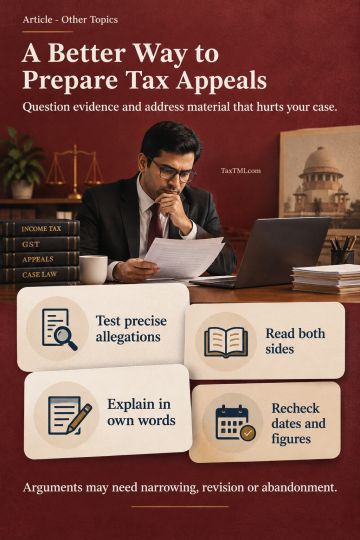
Survey: see the case as a whole. Before settling down to detailed reading, look at the notice, the reply, the order, the documents and the relief sought. Identify the period, the transactions, the amounts and the central dispute. This first survey provides a map. Without it, the reader may become absorbed in a minor controversy while overlooking the issue on which the case turns.
Question: make the file answer you. What precisely is alleged? Which facts are admitted, and which remain disputed? What evidence supports the conclusion? Has the order answered the defence? Does the cited judgment address the same issue? Questions give reading a purpose. They also expose the danger of beginning with a preferred conclusion and searching only for passages that support it.
Read: follow both sides of the reasoning. Read the material closely, including the parts that make the case difficult. A favourable sentence in a judgment must be understood against its facts and the question decided. An inconvenient document deserves as much attention as a helpful one. The strength of an argument depends partly on how honestly its weaknesses have been examined.
Recite: explain the case in your own words. Close the file and state the dispute, the reasoning in the order and the answer to it. This need not be a formal exercise. A brief oral explanation or a short note may be enough. If the argument cannot be explained without repeatedly borrowing the language of the documents, some part of it may still be unclear. The effort to explain reveals gaps that silent reading can conceal.
Review: return to the record. Test the explanation against the documents. Recheck the dates, figures, passages and references. Ask whether a submission has been overstated or an adverse fact left unanswered. Review may require an argument to be narrowed, rewritten or abandoned. That willingness to revise is part of preparation.
SQ3R also has a lesson for anyone deciding an appeal. Surveying the record, questioning assumptions, reading the competing submissions, explaining the conclusion and reviewing its basis can improve the quality of a decision. The exercise loses its value if every step is directed towards confirming an answer already chosen. A disciplined reader must remain open to being persuaded.
After years in the Department and later in legal practice, I can appreciate how much depends on the quality of our attention. Familiarity with a subject can help us see quickly. It can also tempt us to stop looking too soon. A simple reading method reminds us to pause, ask and examine again.
My wife deserves her place at the beginning of this account. She bought the book and intended something useful to come of it. My son deserves his place in what followed. Through his reading and legal education, he helped bring that lesson back to me.
I handed him a book without reading it. In time, he helped me become a better reader.