 TaxTMI
 TaxTMI





 04 Nov 2026

Clients who close their books monthly see problems within weeks. Clients who close once a year discover them in the audit file. Here is how to move a client from one to the other.
When Britain slid into a sharp downturn in 1772, orders for fine pottery collapsed. Josiah Wedgwood, already celebrated for his tableware, did something unusual for the era: he sat down with his records and worked out, line by line, what each product actually cost to make.
He found several popular lines were far less profitable than he'd assumed. Historians who have studied his papers also note that the exercise exposed serious irregularities in how his clerks handled money.
Wedgwood had no accounting software - only the discipline to examine his numbers when it mattered. Most businesses today have the software and still don't look.
Same problem, different visibility
Picture two clients of similar size.
Client A gets its books updated whenever the accountant finds time. Bank entries go in batches; reconciliations happen just before tax deadlines. The owner sees a P&L once a year, months after year-end.
Client B closes its books by the tenth working day of each month. Bank, debtors, creditors, stock and tax accounts are reconciled, and the owner receives a short report: profit, cash, overdue collections, key ratios and anything unusual.
In March both run into trouble - a major customer stops paying, material costs jump and a salesperson starts giving unauthorised discounts.
Client B spots it in April's report and acts in May. Client A finds out the following year, when the damage is already baked into the annual accounts.
Identical problem. Different visibility. Very different outcome.
The uncomfortable reality
For many SMEs, accounting is a compliance chore performed for the tax department, the bank or the auditor - so it's done late, in bulk and with minimum effort.
Books that are accurate once a year are useful once a year.
Year-end accounts record history. Month-end accounts point to the next decision.
When targets replace the close
A monthly close also guards against self-deception. In 2015, an independent committee investigating the Japanese conglomerate Toshiba found operating profit had been overstated by roughly 150 billion over several years, with investigators describing intense top-down pressure to hit profit "challenges" and results adjusted to fit.
A disciplined close - reconciliations, supporting evidence, independent review - can't make manipulation impossible. It does make the gap between reality and reports far harder to widen quietly, month after month.
The Ten-Day Close
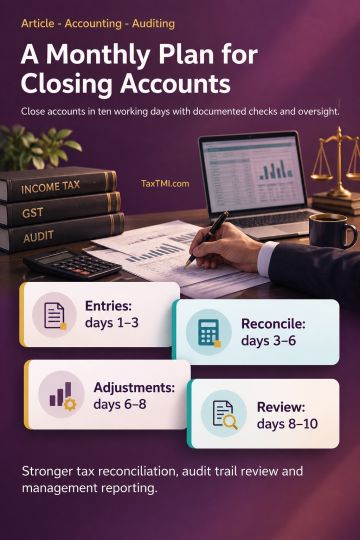
The monthly close is a fixed, repeatable routine for converting raw entries into figures management can rely on. For small and growing businesses, a practical structure is the Ten-Day Close, in five stages.
Before month-end: Prepare
- Circulate a close timetable listing each task, its working day and its owner.
- Chase departments for supplier bills, expense claims and delivery notes before the cut-off.
Days 1-3: Capture
- Book all sales invoices, purchase bills, payroll and expenses.
- Post bank and card transactions.
- Record stock movements and counts where relevant.
Days 3-6: Reconcile
- Bank and cash: tie every account to statements and investigate unmatched items.
- Debtors: reconcile customer ledgers, review ageing and chase disputes.
- Creditors: reconcile key supplier statements and find unrecorded liabilities.
- Tax accounts: match GST output and input to returns and supplier data; TDS deducted to deposits and returns; other statutory dues to challans.
- Payroll and contributions: match salary records with PF, ESI and professional-tax deposits.
- Inventory: tie the stock ledger to physical counts or system quantities.
- Related parties: confirm balances match in both sets of books.
- Loans: agree outstanding principal and interest to the lender's statement.
Days 6-8: Adjust
- Provide for costs already incurred where no invoice has arrived.
- Carry forward income received ahead of the period it relates to.
- Book depreciation and amortisation.
- Review provisions for doubtful debts, warranties and slow-moving stock.
Days 8-10: Review and Report
- Set actual results against budget and earlier months.
- Dig into any variance that looks odd.
- Produce a single-page management summary with short notes.
- Hold a short review meeting with the owner or leadership team.
In a nutshell
Essence: capture, reconcile, adjust, review, report - within ten working days every month - and accounting becomes an early-warning system rather than an annual post-mortem.
What the monthly MIS should contain
Short enough to actually be read:
- Revenue, gross margin and operating profit against budget and last year.
- Cash balance with a 13-week outlook.
- Debtors ageing and the top overdue customers.
- Creditors and upcoming statutory dues.
- Stock levels and slow movers.
- Three to five operating measures specific to the business.
- A brief list of risks, issues and actions, each with an owner.
Why the close lifts everything else
- Fewer audit surprises - monthly reconciliations make year-end audits quicker and cheaper.
- Cleaner tax compliance - matching books with GST and TDS returns monthly catches mismatches before notices do.
- Better credit - lenders trust businesses that produce reliable numbers quickly.
- Earlier fraud detection - odd payments, unexplained journals and duplicate vendors stand out under monthly review.
- Better decisions - pricing, hiring, purchasing and expansion rest on current facts.
Why closes stall - and the fixes
| Failure | Fix |
| No calendar or ownership | Publish a close calendar with a named owner for every task |
| Operating teams hand in paperwork late | Fix cut-off dates and write them into managers' KRAs |
| Excessive reliance on manual spreadsheets | Switch to bank feeds, standing journals and in-system reconciliations |
| Reconciliations done but nobody checks them | Insist on a reviewer's sign-off for each key reconciliation |
| The owner doesn't read the report | Hold a fixed 30-minute monthly review, without exception |
Start modestly: close by day 15 for three months, then day 12, then day 10.
For practitioners: offering the close as a service
- Package it. A fixed monthly fee covering reconciliations, GST/TDS matching and a one-page MIS is easier to sell than ad-hoc bookkeeping.
- Use the GSTR-2B match as a monthly control. Reconcile input tax credit with supplier filings before claiming, and follow up defaulting suppliers early.
- Review the audit trail. Confirm the client's software edit log is enabled and scan it for back-dated or deleted entries during the close.
- Agree a document cut-off in the engagement letter. Late client documents are the most common reason closes slip; make the dependency explicit.
- Turn the close into year-end readiness. Monthly working papers mean statutory and tax audits become reviews, not reconstructions.
Indicators of success
- Close days - working days to final monthly numbers falling towards ten or fewer.
- Post-close adjustments - fewer corrections after reports go out.
- Reconciliation completeness - every bank, ledger and control account reconciled each month.
- Usage - managers discuss the report and act on it.
Outlook: the coming decade
Automation and AI are pushing finance teams towards a "continuous close": bank feeds, automatic matching and AI-drafted commentary make near-daily updates possible. But speed without review breeds confident errors. Successful finance teams will close faster and review smarter - machines for processing, people for judgement.
Immediate actions by role
- CFO or engagement partner: publish a close calendar with an owner for each step.
- Accountants: identify the three reconciliations that hold up the close most often and remove the underlying causes.
- Department heads: deliver expense details, accrual inputs and other data by the cut-off.
- Owner: go through the monthly pack within two days and raise at least three questions.
Illustration from a smaller enterprise
Take an illustrative Rs. 15 crore distributor whose owner receives monthly accounts roughly 45 days after month-end - too late to act on anything. Banks are reconciled quarterly and stock counted once a year.
The accountant introduces a simple ten-day close: daily bank entries, weekly debtor updates, a monthly check of the top 50 stock items and a one-page report on sales, margin, cash and overdue debtors. Within three months the owner spots a margin drop in one product line caused by an unrecorded supplier price increase - and reprices that same month. Under the old routine the loss would have run for a year.
The objection we hear most - and our response
The objection: "We're small, with one part-time accountant. A monthly close is a big-company luxury. Our CA does everything at year-end."
The answer: Small businesses need a monthly close more, because they have less room for error - and the close scales down. For a small firm it might mean a bank reconciliation, a debtor and creditor review, a GST and TDS check and a one-page report: four to six hours a month. Year-end work then becomes a review rather than a reconstruction, often at lower fees. Annual accounting explains how a business died. Monthly accounting helps it stay alive.
Technology and judgement
Today's accounting systems, bank feeds and AI aids can pair transactions, propose journals, highlight oddities and prepare draft reconciliations at unprecedented speed. But someone still has to ask: does this number make sense? Why did this cost jump? Will this customer really pay? Automation speeds the close; review gives it meaning.
Practitioners' FAQ
"Is a ten-day close realistic for a small business?"
Yes - with daily bank entries, monthly reconciliations and a simple calendar.
"What's the minimum monthly report?"
Sales, gross margin, operating expenses, profit, cash position and overdue debtors.
"Why close monthly if GST or TDS is filed quarterly?"
Monthly numbers support decisions; filing frequency is a separate requirement.
Position as at October 2026: In India, companies must use accounting software with an audit trail (edit log) that cannot be disabled, and auditors report on it. GST returns are increasingly locked against later editing, and income-tax systems match books with third-party data. A monthly reconciliation discipline is now the practical minimum for staying compliant.
Pitfalls
- Posting entries without supporting documents.
- Carrying unreconciled differences forward "to check later."
- Using suspense accounts as permanent homes.
- Producing long reports nobody reads.
- Treating the close as the accountant's job alone.
Half-hour action exercise
Look at last month and answer:
1. When exactly did we learn last month's profit?
2. Are all bank accounts reconciled up to month-end?
3. Do we know overdue debtors, customer by customer, today?
4. Have GST and TDS figures been matched to the books?
Assign an owner and a calendar day for every "no," then measure next month's close duration and try to beat it.
Summary for busy professionals
- Closing monthly converts the accounts from a yearly compliance chore into a management instrument used every month.
- Run the Ten-Day Close - capture, reconcile, adjust, review, report - inside roughly ten working days.
- Reconcile bank, debtors, creditors, tax, payroll, stock, related parties and loans every month.
- A one-page MIS on cash, margin, debtors, statutory dues and risks drives better decisions.
- The close also guards against self-deception by making reality-to-report gaps hard to grow unnoticed.
A business that knows its numbers every month suffers far fewer expensive surprises every year.
References
- Anthony Hopwood, "Archaeology of Accounting Systems," Accounting, Organizations and Society (1987) - on Josiah Wedgwood's costing.
- Nancy F. Koehn, Brand New: How Entrepreneurs Earned Consumers' Trust from Wedgwood to Dell (Harvard Business School Press, 2001).
- Toshiba Corporation, Independent Investigation Committee report summary (July 2015).
- Companies (Accounts) Rules, 2014 (India), as amended - audit trail requirements. mca.gov.in