 TaxTMI
 TaxTMI


 03 Nov 2026

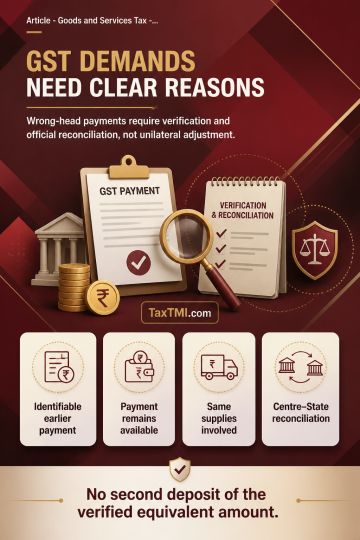
A Return Mismatch Cannot Replace the Legal Foundation of a Tax Demand
A discrepancy between figures disclosed in GST returns may warrant departmental scrutiny, but it cannot, by itself, establish tax evasion, short payment, or wrongful availment of input tax credit. Before confirming a demand, the Department must identify the transactions causing the discrepancy, explain the alleged statutory violation, and give the taxpayer a meaningful opportunity to respond. Equally important is whether tax already deposited under an incorrect GST head can be disregarded merely because the taxpayer subsequently discovers that the supply was wrongly classified as inter-State or intra-State.
These questions arose before the GST Appellate Tribunal, Ghaziabad Bench, in M/s. Fiberhome India Private Limited Versus Lalit Mishra, Additional Commissioner, Noida & Ors. - 2026 (10) TMI 1842 - GSTAT GHAZIABAD. The Division Bench, comprising Dr Sanjay Kumar Chandhariyavi, Member (Judicial), and Ms Sungita Sharma, Member (Technical), examined the validity of a demand raised under Section 73 of the CGST Act, 2017, based on differences between returns and the treatment of IGST paid on supplies subsequently identified as intra-State.
The Tribunal set aside the disputed CGST and SGST demands and the consequential penalty because the show cause notice lacked essential factual particulars. It also directed the jurisdictional proper officer to arrange the appropriation of the IGST already paid towards the corresponding CGST and SGST liabilities through reconciliation between the Centre and the State. The judgment reinforces two important principles: a tax demand must rest on clearly disclosed allegations, and a verified tax payment cannot be ignored merely because it was made under an incorrect head.
An Earlier IGST Payment Became the Centre of a Later CGST and SGST Dispute
M/s Fiberhome India Private Limited provided information and communication network solutions, optical communication services, and data networking construction services. During the financial year 2017-18, the company issued certain invoices to Bharat Sanchar Nigam Limited (BSNL), treating the transactions as inter-State supplies and discharging GST under the IGST head. During the subsequent annual reconciliation, the company discovered that the supplies should have been classified as intra-State transactions attracting CGST and SGST.
To correct the classification, the company amended the relevant invoice particulars in Form GSTR-1 during FY 2018-19. These amendments reflected CGST and SGST liabilities in that year, although the company maintained that it had already deposited the corresponding tax as IGST in the preceding year. The Department subsequently compared GSTR-1 with GSTR-3B and identified differences of approximately Rs. 3,30,834 under each of CGST and SGST. It treated these differences as unpaid output tax rather than examining whether they represented reclassification of supplies on which tax had already been paid.
Following scrutiny proceedings initiated through Form GST ASMT-10 dated 07.10.2023, the taxpayer submitted its explanation on 25.11.2023. A show cause notice dated 27.12.2023 was thereafter issued under Section 73. The adjudication order dated 30.04.2024 confirmed CGST of Rs. 3,30,834 and SGST of Rs. 3,30,834, aggregating Rs. 6,61,668, together with interest of Rs. 6,55,052 and penalty of Rs. 66,166. The proposed ITC demand of Rs. 3,00,911 was dropped. In the first appeal, the Commissioner deleted interest by applying Section 77(2), but maintained the tax and penalty, giving rise to the appeal before the Tribunal.
A Show Cause Notice Must Explain the Allegation and Not Merely State the Amount
Section 73(1) permits recovery of tax not paid or short paid, or ITC wrongly availed or utilised, in cases not involving fraud, wilful misstatement or suppression of facts with intent to evade tax. However, a valid show cause notice must disclose the factual and legal grounds of the proposed demand, enabling the taxpayer to respond effectively.
The Tribunal found that the notice merely compared aggregate figures in GSTR-1, GSTR-3B and GSTR-2A without identifying the relevant invoices, suppliers, recipients or transactions. Although it alleged short payment of tax, improper passing of credit and supplier defaults, the notice provided no supporting particulars. A general reference to Section 16(2)(c) could not substitute for the missing factual foundation.
The Tribunal clarified that knowledge of the amount demanded does not necessarily imply knowledge of the case to be answered. While every mismatch notice need not reproduce individual invoices, it must adequately explain the alleged discrepancies through accessible particulars. The substantial omissions in the present notice deprived the taxpayer of a meaningful opportunity to respond.
An Adjudication Order Cannot Repair the Defects of an Inadequate Notice
Sections 75(4), 75(6) and 75(7) of the CGST Act respectively safeguard the right to a personal hearing, require a reasoned adjudication order, and prohibit confirmation of demands exceeding the amount or going beyond the grounds specified in the show cause notice.
The Tribunal relied on four Supreme Court decisions. Commissioner of Central Excise, Bangalore Versus Brindavan Beverages (P) Ltd. and Ors. - 2007 (6) TMI 4 - Supreme Court, establishes that the show cause notice forms the foundation of departmental proceedings; COMMISSIONER OF CUSTOMS, MUMBAI Versus TOYO ENGINEERING INDIA LIMITED - 2006 (8) TMI 184 - Supreme Court, prohibits introducing grounds beyond the notice; GORKHA SECURITY SERVICES Versus GOVT. OF NCT OF DELHI & ORS. - 2014 (8) TMI 1081 - Supreme Court, requires disclosure of the grounds and proposed action; and ORYX FISHERIES PRIVATE LIMITED Versus UNION OF INDIA - 2010 (10) TMI 660 - Supreme Court, emphasises fair and open-minded consideration of the taxpayer's explanation.
Applying these principles, the Tribunal found that the notice merely disclosed aggregate return mismatches without identifying the relevant transactions or substantiating the alleged supplier defaults. It also failed to explain the CGST and SGST differences arising from amendments to invoices on which IGST had already been paid. Neither subsequent adjudication nor appellate proceedings could cure these fundamental deficiencies. Accordingly, the Court set aside the disputed demand.
Payment Under the Wrong GST Head Does Not Automatically Discharge the Correct Liability
The second controversy concerned IGST paid on supplies initially treated as inter-State but later found to be intra-State. The taxpayer sought to adjust the IGST already deposited against the corresponding CGST and SGST liabilities, whereas the Department insisted on payment under the correct heads, followed by a refund of IGST.
The Tribunal examined Section 77(2) of the CGST Act, which grants relief from interest on CGST and SGST in such cases, and Section 19(1) of the IGST Act, which provides for refund of IGST paid under the wrong head. It distinguished Section 77(1) of the CGST Act and Section 19(2) of the IGST Act, which address the reverse situation.
The Tribunal held that payment of IGST does not automatically discharge CGST and SGST liabilities, nor do these provisions authorise unilateral adjustment between different GST heads. However, where the earlier IGST payment is identifiable, remains available, and relates to the same supplies, the competent authorities must appropriate it towards the corresponding CGST and SGST liabilities through proper reconciliation between the Centre and the State, without insisting on a second deposit of the verified equivalent amount.
Procedural Requirements Should Facilitate Correction Rather Than Defeat Genuine Payments
The Department relied on Union of India v. Bharti Airtel Limited, (2021) 13 SCC 1, to emphasise compliance with statutory return and ledger procedures. The Tribunal acknowledged that this decision did not authorise retrospective re-adjustment of returns or unilateral adjustment between different GST heads. However, it distinguished such unauthorised adjustments from official recognition of tax already paid on the same supplies.
The Tribunal also referred to CBIC v. Aberdare Technologies Private Limited on the correction of genuine errors; MANGALORE CHEMICALS & FERTILIZERS LTD. Versus DEPUTY COMMISSIONER - 1991 (8) TMI 83 - Supreme Court, which distinguished substantive conditions from procedural requirements; and STATE OF PUNJAB AND ANOTHER Versus SHAMLAL MURARI & ANR - 1975 (10) TMI 105 - Supreme Court, which recognised that procedure should facilitate justice rather than defeat it.
Applying these principles, the Tribunal directed the competent authorities to appropriate the IGST already paid towards the corresponding CGST and SGST liabilities, subject to verification and reconciliation of the relevant transactions, and without allowing any duplicate tax benefit. It did not confer any independent right upon the taxpayer to transfer amounts between GST heads unilaterally.
Revenue Neutrality Must Be Established Through Documentary Verification
The taxpayer argued that payment of IGST had already protected Government revenue. Referring to Nirlon Ltd. Versus Commissioner of Central Excise, Mumbai - 2015 (5) TMI 101 - Supreme Court, the Tribunal recognised the relevance of revenue neutrality but held that it could not be presumed merely because tax had been deposited under another head.
The Tribunal required verification of the disputed supplies, taxable values, applicable rates, original IGST payments, and corresponding CGST and SGST liabilities. It was also necessary to ensure that the IGST had not already been refunded, adjusted elsewhere, or otherwise restored to the taxpayer.
Once these facts were verified, official appropriation of the available IGST would prevent an unnecessary second deposit while ensuring proper allocation of revenue between the Centre and the State. Revenue neutrality was therefore a matter of documentary proof, not an automatic consequence of payment under the wrong tax head.
A Penalty Cannot Survive When the Underlying Demand Has No Valid Foundation
The adjudicating authority had imposed a penalty of Rs. 66,166 under Section 73(9), corresponding to the confirmed CGST and SGST demand. The taxpayer challenged the penalty on the ground that the disputed liability arose from a correction of the tax head and that the Government had already received the corresponding tax. The Tribunal examined whether the penalty could survive independently when the underlying demand was unsustainable because of a defective show cause notice.
The Tribunal referred to Union of India Versus M/s Rajasthan Spinning & Weaving Mills AND Commissioner of Customs and Central Excise Versus M/s. Lanco Industries Ltd.-2009 (5) TMI 15 - Supreme Court, which set out the requirement to establish the statutory conditions for imposing a penalty. It clarified that the absence of fraud does not automatically exclude a penalty under Section 73. Equally, the provision does not impose a penalty merely because a taxpayer has made a corrective accounting entry. The relevant statutory conditions and the factual foundation of the alleged default must be established.
In the present case, the Tribunal had already held that the show cause notice failed to disclose the essential facts supporting the demand. Consequently, the penalty arising from that demand could not survive independently. A penalty cannot be sustained on allegations that were never adequately disclosed in the proceedings giving rise to it. The Tribunal therefore set aside the penalty of Rs. 66,166 while maintaining the relief already granted, namely, the dropping of interest and the separate ITC proposal.
A Defective Show Cause Notice Invalidates the Demand While Verified Tax Payments Must Be Recognised
The GSTAT allowed the appeal and set aside the CGST and SGST demands of Rs. 3,30,834 each, together with the penalty of Rs. 66,166, holding that they could not survive on the basis of a deficient show cause notice. The Tribunal maintained the earlier relief from interest of Rs. 6,55,052 under Section 77(2) and dropped the proposed ITC demand of Rs. 3,00,911.
The Tribunal further directed the jurisdictional proper officer to arrange the appropriation of the IGST already paid towards the corresponding CGST and SGST liabilities through reconciliation between the Centre and the State, subject to verification of the original payment and prevention of duplicate benefit. The authorities were prohibited from insisting on a second deposit of the verified equivalent amount merely to complete the appropriation.
Thus, while the demand and penalty were set aside for want of a legally sufficient notice, the separate direction for official appropriation ensured recognition of tax already paid without permitting unilateral adjustment between different GST heads.
A Fair Tax Demand Requires Clear Allegations and Proper Recognition of Tax Already Paid
The judgment reinforces two fundamental principles of GST administration. First, a tax demand must be founded on a show cause notice containing sufficient factual particulars to enable the taxpayer to respond effectively. Secondly, tax already deposited under an incorrect head must receive appropriate consideration through lawful reconciliation rather than being disregarded merely because of a classification error.
The Tribunal's approach balances statutory compliance with procedural fairness. While taxpayers cannot unilaterally adjust payments between different GST heads, the authorities must recognise verified payments and avoid unnecessary duplication of tax collection.
The enduring legal principle is that procedural safeguards cannot be sacrificed in the pursuit of revenue, nor should technical errors result in recovery of tax already received by the Government.