 TaxTMI
 Login
 TaxTMI
Login
Loading...
OCR  Drafter New
TaxTMI AI Drafter helps Chartered Accountants, Tax Advocates and GST Consultants prepare legal replies to notices, appeals, legal opinions, objections, stay applications, writ petitions and written submissions in the fields of GST, Income Tax, Customs and other tax laws through a controlled, issue-wise AI drafting workflow.
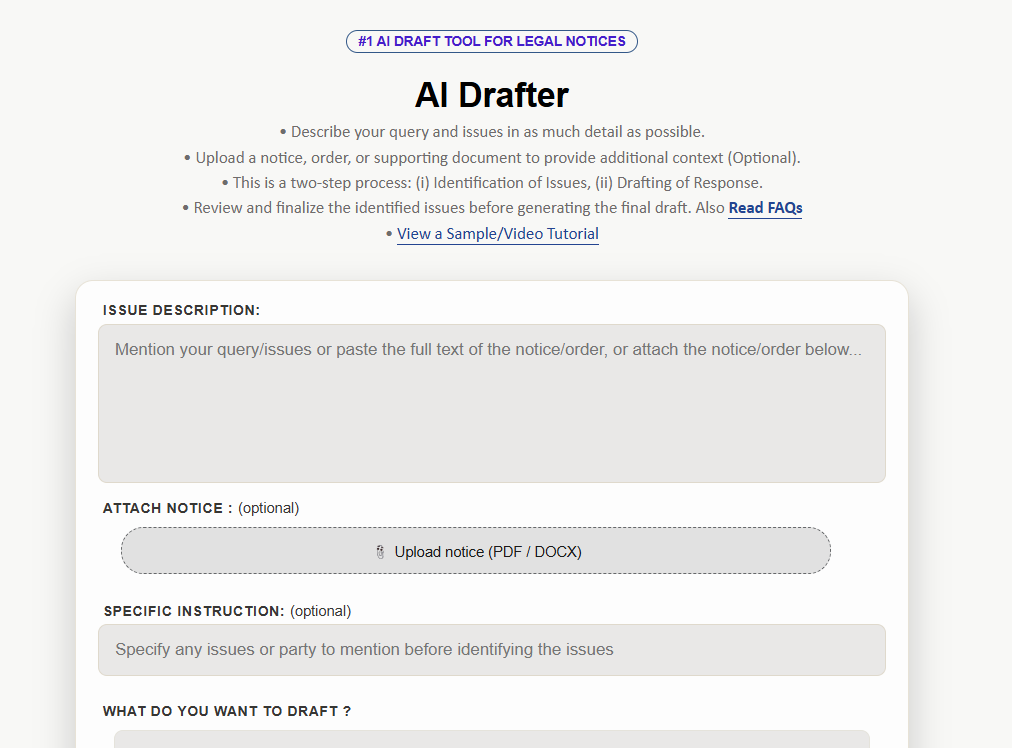
Unlike a general chatbot, TaxTMI AI Drafter first identifies issues, lets the user review and edit them, searches relevant legal material, and then generates the final draft with issue-wise submissions.
Enter facts, notice details, disputed demand, assessment issue, client instructions or background of the case.
Attach a PDF or DOCX notice, order, assessment document, appellate order or supporting paper.
Choose reply to notice, appeal, legal opinion, letter, writ petition, stay application, objection or application.
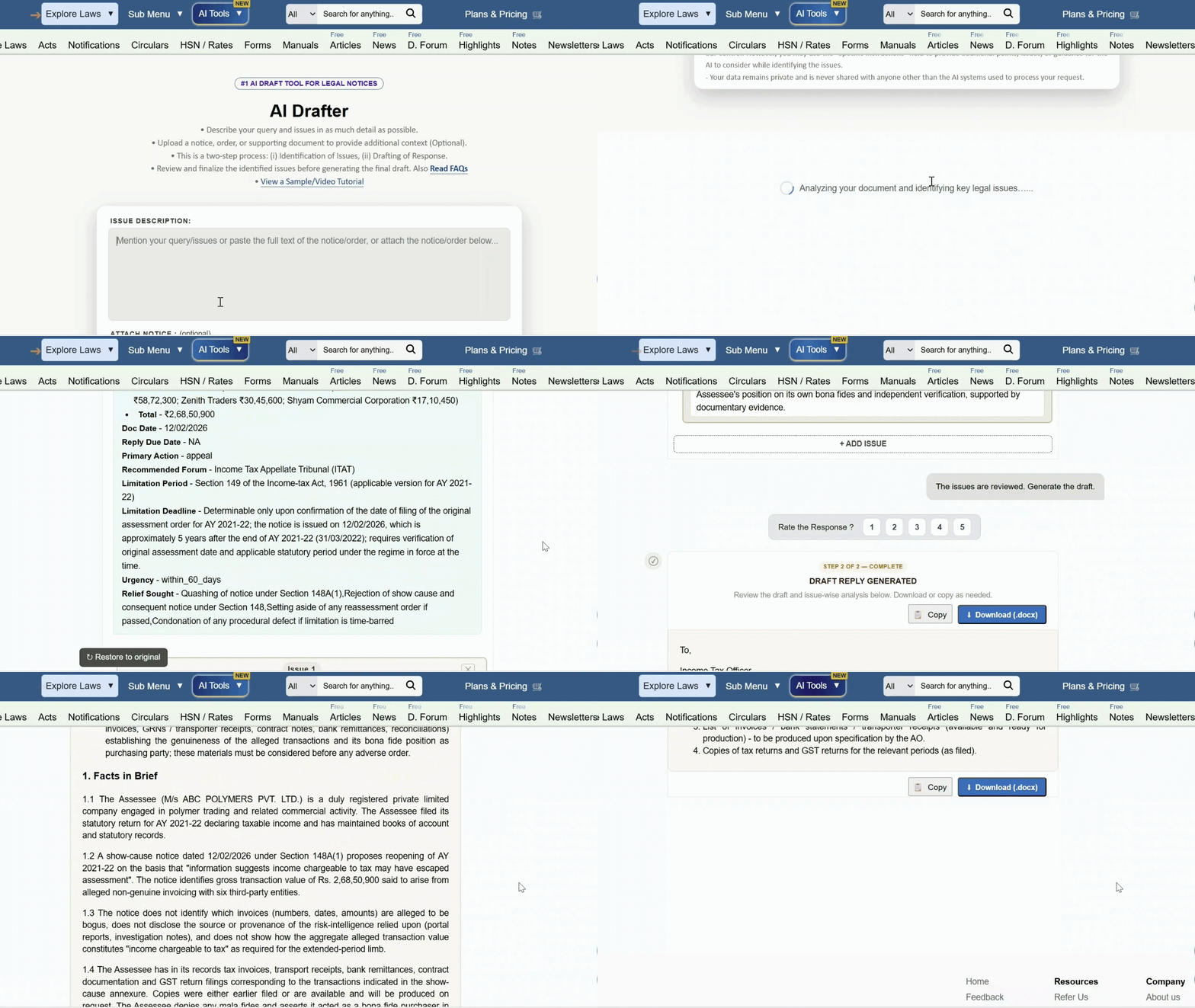
The AI extracts factual and legal issues such as limitation, natural justice, jurisdiction, penalty or evidence.
Add missing issues, remove irrelevant issues, rearrange priorities and include your own possible replies or additional facts. This important step helps the AI prepare a more relevant, focused and effective final draft.
Create a structured professional draft with facts, issue-wise submissions, legal support and prayer.
Export the final draft as an editable Microsoft Word document, for easy filing, formatting or sharing with your client.
Upto 3 drafts are on us.
150 AI Credits added to your account. Valid for 30 Days.
TaxTMI AI Drafter is useful for professionals and teams who regularly deal with tax notices, departmental replies, assessment orders, appellate proceedings, written submissions and legal opinions.
When a general-purpose AI drafts a legal argument, it may generate text that sounds like a citation — with a case name, year and court. But in legal and tax drafting, a wrong citation, non-existent case law or incorrect interpretation can create serious professional risk.
TaxTMI AI Drafter works differently. Before generating issue-wise submissions, it searches the actual TaxTMI database of verified Indian tax rulings, statutory materials, notifications, circulars and legal updates.
This makes TaxTMI AI Drafter especially useful for AI legal drafting of notices, replies, appeals, legal opinions, objections, stay applications, writ petitions and written submissions in GST, Income Tax, Customs and other Indian tax law matters.
Tax matters, constitutional questions and landmark rulings
All major High Courts across India
Delhi, Mumbai, Chennai, Kolkata and other benches
Income Tax, GST, Customs, FEMA and more
CBDT, CBIC and departmental clarifications
Updated regularly · taxtmi.com/database
General AI tools can write text. Research platforms can find cases. TaxTMI AI Drafter combines tax-focused drafting workflow, issue review and legal research support for Indian tax professionals.
| Feature | ChatGPT / Claude | Other AI Draft Tools | TaxTMI AI Drafter |
|---|---|---|---|
| Main purpose | General AI writing and reasoning | General legal drafting for Indian lawyers | Specialized tax drafting and litigation support |
| GST & Income Tax focus | Prompt dependent; no built-in tax knowledge | Broad legal coverage; not tax-specialized | Built for GST, Income Tax, Customs and tax litigation |
| Issue identification | User identifies all issues manually | Limited; user-guided | Auto-identifies and classifies issues from uploaded facts and notices |
| Issue review before drafting | No structured review step | Not available | Add, edit, delete and reorder issues before drafting |
| Issue-wise research | Prompt dependent; no integrated research | Research and drafting are separate | Integrated research per issue before draft generation |
| Case laws & provisions | Hallucination risk; needs verification | Source-backed via legal database | Verified case laws, notifications, circulars and provisions from own corpus |
| Drafting workflow | Prompt → Draft | Research → Draft | Facts → Issues → Review → Research → Draft |
| Draft structure | Depends on prompting skills | Template and workflow driven | Structured around facts, issues, legal analysis and conclusions |
| Document types | Any format if prompted correctly | Plaints, petitions, notices, contracts | Reply, appeal, writ, stay, objection, opinion, application, letter |
| Transparency of sources | No sources; output unverifiable | Citations linked to database | Every case law and provision linked to TaxTMI's verified corpus |
| Usable output without edits | 20–40% for Indian tax matters | 60–70% for general legal matters | 80-90% for Indian tax appellate matters |
| Download as Word file | No native export | Yes | Yes |
| Upload notice or order | Yes (Plus plan) | Yes — PDF reference | Yes — drives issue extraction and draft generation |
| Time saved vs manual drafting | 1–2 hours (templates only) | 3–5 hours (general legal) | 6 hours - several days |
| Time it takes | 3-5 minutes | 2-15 minutes (Mostly templates, No reasoning) | 10-20 minutes (Customized + reasoning) |
| Best suited for | General writing, brainstorming, templates | General writing, templates | More Robust Replies, appeals, writs, objections, opinions and representations |
TaxTMI AI Drafter is a specialized AI legal drafting tool for Indian tax professionals. It is useful for Chartered Accountants, Tax Advocates, GST Consultants and Income Tax Practitioners who prepare replies, appeals, objections, submissions, stay applications, writ petitions and legal opinions.
Unlike general AI tools, TaxTMI AI Drafter follows a controlled, issue-wise drafting workflow. It helps convert facts, notices, orders, assessment findings and client instructions into a structured first draft for professional review.
Move faster from facts and notice allegations to a structured first draft.
Identify multiple factual and legal grounds before preparing the final draft.
Designed specifically for GST, Income Tax, Customs and allied legal matters.
Retrieve relevant case laws, statutory provisions, notifications and circulars.
Generate structured replies, appeals, objections, legal opinions and applications.
Review, edit and refine issues before generating the final draft.
“The issue-wise drafting flow is very useful. Instead of directly generating a long draft, it first identifies the disputed points, which helps us control the final reply.”
“For GST notice replies, it saves a lot of time. The draft comes with proper structure, facts, submissions and prayer, which can then be reviewed and refined.”
“The best part is that it is made for tax matters. General AI tools need too much prompting, but TaxTMI AI Drafter understands notice reply and appeal drafting format better.”
“We use it for preparing initial appeal drafts and objections. It gives a strong starting point and helps juniors understand how issues should be arranged.”
“The ability to edit, add or delete issues before the final draft is extremely practical. It keeps the professional in control instead of blindly relying on AI.”
“For income tax assessment matters, the draft format is very helpful. It covers facts, grounds, submissions and case-law style arguments in a professional manner.”
“TaxTMI AI Drafter feels like a drafting assistant made for Indian tax professionals. It is especially useful where the matter has multiple issues and each issue needs a separate legal submission.”
Yes. It can assist in drafting replies to notices involving ITC mismatch, demand, penalty, registration cancellation, valuation, classification and procedural defects.
Yes. It can assist with appeal grounds, statement of facts, issue-wise submissions and legal arguments against assessment or appellate orders.
For tax drafting, the main advantage is workflow. TaxTMI AI Drafter identifies issues first, allows user review, searches relevant tax materials and then generates an issue-wise draft.
Yes. You can upload a notice, order or supporting document to provide additional context for the AI draft.
Yes. You can add, edit, delete and rearrange the issues before the final draft is generated. This helps keep professional control over the drafting process.
Yes. AI-generated drafts should always be reviewed by a qualified professional before submission or filing.
Yes. Every response includes hyperlinked citations that links directly to the source judgment, statute, or article in TaxTMI so you can verify each point. All the responses are fetched from the vast database of TMI with over 9 lakh+ documents.