 TaxTMI
Login

Login
Loading...
Press 'Enter' to add multiple search terms. Rules for Better Search
 of 127

Press 'Enter' after typing page number.
of 127 Press 'Enter' after typing page number.


No Folders have been created
Are you sure you want to delete "My most important" ?
NOTE:
of 127 Press 'Enter' after typing page number.





 of 127
Press 'Enter' after typing page number.

All TMI Notes
of 127 Press 'Enter' after typing page number.
of 127 Press 'Enter' after typing page number.
All TMI Notes
 Get Daily Updates

Note

Bookmark

Share


Download

This commentary provides doctrinal analysis and practical insights on the legal issue discussed below. The judgment is analysed in the context of its factual background, issues framed, and conclusions reached by the Court.
2026 (11) TMI 355 - GSTAT PUNE
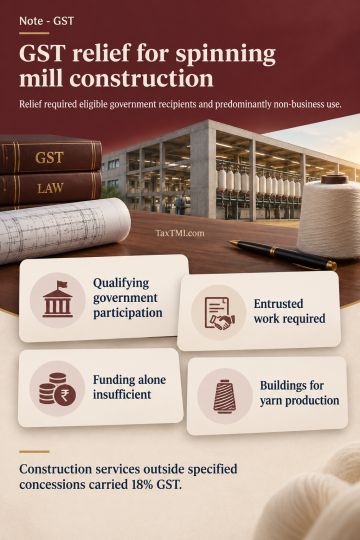
The concessional GST rate for construction supplied to a Government Entity depends on the precise notification entry, not merely on governmental funding or supervision. For works supplied to co-operative spinning mills, two distinct questions arise: whether the recipient satisfies the notified definition of a Government Entity, and whether the intended use of the construction falls within the concessional description.
In 2026 (11) TMI 355 - GSTAT PUNE, the tribunal rejected a contractor's claim to the aggregate 12% rate for factory buildings and allied works supplied to four co-operative spinning mills during the disputed financial year. It held that Government Entity status had not been established and, independently, that the buildings were intended for industry and commerce. Either conclusion defeated the claim under Sl. No. 3(vi)(a) of Notification No. 11/2017-Central Tax (Rate).
The decision is significant for its separation of governmental involvement in a project from governmental establishment of its recipient, and of a welfare-oriented institutional purpose from the industrial use of its buildings.
Section 9(1) of the Central Goods and Services Tax Act, 2017 levies central tax on intra-State supplies on the value determined under Section 15, at rates "not exceeding twenty per cent., as may be notified by the Government on the recommendations of the Council". The notified rate therefore governs the statutory liability; a project-sanctioning department's approval of a tax reimbursement component does not independently determine that rate.
Section 2(119) defines a works contract as a contract for specified activities, including building and construction, concerning immovable property, "wherein transfer of property in goods (whether as goods or in some other form) is involved in the execution of such contract". Classification as a works contract, however, does not by itself establish entitlement to a particular concessional rate.
Recipient identification is equally important. Under Section 2(93)(a), where consideration is payable, the recipient is "the person who is liable to pay that consideration". Governmental sponsorship, approval or funding must consequently be distinguished from the contractual obligation to receive and pay for the supply.
For the disputed period, Sl. No. 3(vi) of Notification No. 11/2017-Central Tax (Rate), as substituted by Notification No. 24/2017-Central Tax (Rate) and subsequently amended, covered specified construction services supplied to the Central Government, State Government, Union Territory, local authority, Governmental Authority or Government Entity. The central tax rate was 6%, producing aggregate GST of 12% with the corresponding State tax.
The relevant limb, item (a), covered "a civil structure or any other original works meant predominantly for use other than for commerce, industry, or any other business or profession". The present claim therefore required proof of both an eligible recipient and the prescribed non-commercial or non-industrial predominant use.
Notification No. 31/2017-Central Tax (Rate) inserted paragraph 4(x), defining a Government Entity as "an authority or a board or any other body including a society, trust, corporation", either "set up by an Act of Parliament or State Legislature" or "established by any Government", followed by the requirement of "90 per cent. or more participation by way of equity or control, to carry out a function entrusted by the Central Government, State Government, Union Territory or a local authority". The relationship between these limbs and the participation requirement was material to the tribunal's analysis.
The same notification imposed a transaction-specific condition: services supplied to a Government Entity "should have been procured by the said entity in relation to a work entrusted to it" by the specified governmental bodies. Establishment, governmental participation and procurement for an entrusted work are therefore distinct matters.
Notification No. 17/2018-Central Tax (Rate), issued under Section 11(3), inserted an Explanation with effect from 27 July 2018: for item (vi), "business" excludes activities undertaken by the Central Government, State Government or a local authority "in which they are engaged as public authorities". Government Entities and Governmental Authorities are not included in that exclusion.
The general statutory definition also supports a functional inquiry. Section 2(17) includes trade, commerce and manufacture "whether or not it is for a pecuniary benefit", and acquisition of goods and services connected with the commencement of business.
The residual construction-services entry at Sl. No. 3(xii), substituted by Notification No. 1/2018-Central Tax (Rate), covered construction services outside the specified preceding entries at 9% central tax. The tribunal applied that entry, resulting in aggregate GST of 18%.
The dispute required several questions to be kept separate:
These are cumulative inquiries, not interchangeable descriptions of governmental involvement. Proof that a project was Government-sponsored does not necessarily prove that its recipient was Government-established. Similarly, proof of Government Entity status does not eliminate the separate end-use restriction in item (a).
The tribunal examined the tender documents, agreements, work orders, invoices and payment arrangements together. The societies appeared as employers or owners, executed the agreements and received the invoices. The governmental committee approved tenders and negotiated prices, while the relevant department sanctioned and supervised the projects.
Those facts supported the conclusion that the societies received the supplies. Governmental control over project implementation did not make the approving committee or department the recipient. This is consistent with the consideration-based test in Section 2(93)(a): the source of project finance and the identity of the person contractually liable for the supply are separate questions.
The tribunal distinguished a body "set up by an Act" from one registered under a generally applicable enactment. Registration under co-operative societies legislation supplies the legal framework for incorporation; it does not, without more, establish that the legislature itself created the particular society.
The alternative route-being "established by any Government"-also required evidence of governmental establishment of the recipient. Financial assistance for establishing a spinning mill as a project was not equivalent to governmental constitution of the society owning it. For the society whose constitutive records were produced, registration preceded its selection for governmental financial assistance. For the remaining societies, the necessary evidence of constitution was not produced.
The holding is evidentiary and definition-specific. It does not establish that a co-operative society can never be a Government Entity. Indeed, the definition expressly includes a society. What failed was proof that these recipients satisfied the notified criteria.
The appellant relied on sanction, tender approval, funding and monitoring. The tribunal treated these as evidence of control over the projects, not sufficient evidence that Government established the societies.
Importantly, it did not decide whether governmental participation met the 90% equity-or-control threshold. Certain financial-assistance materials bore on that issue, but the parties had not addressed them for that purpose. The claim failed in any event because governmental establishment was not demonstrated.
Accordingly, the decision should not be read as a finding that Government held less than 90% participation, or as prescribing a universal method for quantifying control. Nor does it convert "equity or control" into a requirement to establish both. Establishment and qualifying participation remain separate requirements under the governmental-establishment route.
The works were described as construction of main factory buildings and allied works. The available objects included producing yarn, purchasing cotton, processing it and selling the finished goods. These features objectively established an industrial and commercial intended use.
The expression "meant predominantly for use" directs attention to the purpose for which the completed structure is built. It is not confined to whether the contractor's construction activity itself constitutes the recipient's ongoing business. The appellant's distinction between a one-time capital construction contract and subsequent commercial operation could not neutralise the end-use condition.
The social objectives of employment generation and upliftment of disadvantaged communities did not alter that conclusion. An industrial undertaking may pursue beneficial social outcomes while remaining industrial in its operational character. Section 2(17)'s inclusion of manufacture irrespective of pecuniary benefit reinforces why a welfare purpose does not automatically establish non-business use.
The appellant maintained that the works had been entrusted under a Government scheme. The tribunal did not decide that contention because Government Entity status had not been established. Independently, the industrial-use finding already defeated item (a).
The procurement proviso must therefore be treated as an additional condition, not an alternative gateway. Even substantiated entrustment cannot dispense with eligible-recipient status or the stipulated nature of the works.
The references to GST in committee minutes and approved prices were treated as decisions concerning the tax component the societies would bear. They were not determinations that the supplies satisfied Sl. No. 3(vi).
The tribunal also distinguished the regularity of official documents from their legal effect. Accepting that a departmental minute was regularly issued does not confer authority upon it to alter a rate notified under Section 9(1). Contractual tax allocation and statutory tax liability operate on different legal planes.
The Supreme Court authority concerning the corresponding service-tax definition of Governmental Authority construed the word "or" between the statutory-establishment and governmental-establishment limbs disjunctively. The participation condition attached to the latter limb did not qualify the former. The tribunal explained that this assisted bodies created by their own statutes, but not societies merely registered under general legislation. Accepting the alternative character of "equity or control" likewise did not dispense with governmental establishment.
In the separately considered High Court authority concerning a Government-established society, its governing framework placed the district's senior administrative officer at its head and other governmental officers in its governing body. Those constitutive features supported Government Entity status. The spinning-mill evidence was materially different: the available bye-laws provided for member-elected directors. The comparison demonstrates why the society's actual founding and governance framework matters more than its nomenclature or receipt of grants.
The High Court authority concerning works for a religious institution held that reduced taxation remained dependent on whether the executed works fell within the notified descriptions, notwithstanding the institution's recognised governmental classification. That factual question was remitted there. Here, the tribunal found the existing record sufficient to determine industrial use. The authority therefore supported separate examination of recipient status and the nature of the works, rather than automatic concession.
The appellate advance ruling concerning works for a power-distribution utility was discussed separately. As characterised in the proceedings, the concession was denied because of the commercial nature of the relevant activity. The appellant's attempt to distinguish an existing commercial utility from a mill awaiting commercial production failed: the intended industrial use of a newly constructed mill remained decisive.
A distinct ruling concerning rentable commercial warehousing was also considered. Its comparative relevance lay in the proposed use of the completed asset. The fact that a construction project precedes revenue-generating operations does not, by itself, make its intended use non-business.
In 2020 (12) TMI 899 - AUTHORITY FOR ADVANCE RULING, ODISHA, the recipient educational institution qualified as a Government Entity, but the project was not accepted as one composite supply. The works were independently identifiable and separately remunerated. This engaged Section 2(30), which requires supplies to be "naturally bundled and supplied in conjunction with each other in the ordinary course of business".
Qualifying educational and institutional works received concessional treatment, while identified residential works and services outside the relevant entries did not. The relevance is methodological: neither governmental recipient status nor inclusion in one project permits a uniform concessional rate without examining each legally distinct supply.
In 2019 (1) TMI 1369 - AUTHORITY FOR ADVANCE RULING, JHARKHAND, complete governmental equity supported Government Entity status. The works were then tested against the separate entry for contracts involving predominantly earthwork-more than 75% of contract value-and the 5% aggregate rate was allowed.
This ruling does not relax item (vi)(a). It shows that eligibility must be tested against the particular entry invoked. Evidence supporting one classification cannot transfer that entry's benefit to factory construction governed by different conditions.
In 2018 (9) TMI 854 - AUTHORITY FOR ADVANCE RULING, MAHARASHTRA, a sub-contractor's works formed part of railway original works and property in the goods passed to the employer. The railway-specific description supported aggregate GST of 12%.
The ruling illustrates classification by the substantive notified description. It does not justify replacing the express recipient and end-use conditions governing the spinning-mill claim with a broad assertion that the overall project was Government-sponsored.
In 2023 (5) TMI 1067 - APPELLATE AUTHORITY FOR ADVANCE RULING, UTTAR PRADESH, a statutory water and sewerage body qualified as a Governmental Authority but not as a local authority. Its statutory creation and public functions did not establish the required local-authority attributes, including the relevant municipal or local fund relationship. Consequently, supplies were not eligible for the later concession restricted to specified governmental recipients and local authorities.
The comparison reinforces that Government Entity, Governmental Authority and local authority are not interchangeable categories. Its later-period conclusion does not retrospectively determine the spinning-mill dispute.
Notification No. 15/2021-Central Tax (Rate) specified a narrower recipient formulation from 1 January 2022; its publication record also notes supersession by Notification No. 22/2021-Central Tax (Rate) from that date. These later instruments provide temporal context only. The tribunal tested the disputed supplies under the earlier entry and did not apply the later restriction retrospectively.
Circular No. 152/08/2021-GST clarifies that the non-business construction limb does not extend to commercial or industrial works merely because the recipient is governmental. It expressly states that the public-authority business exclusion "does not apply to Governmental Authority or Government Entity". Its ropeway example illustrates the same distinction between recipient status and the asset's intended use.
Advance rulings remain subject to Section 103(1), which makes them binding only on the applicant and the concerned or jurisdictional officer in respect of that applicant. Their comparative relevance should not be mistaken for general binding effect.
The principal practical implication is the need for separate evidentiary support for each notification requirement. A concession claim is strengthened by an organised record addressing:
The burden of establishing the concession rests on its claimant. A record rich in funding approvals may still leave a decisive gap concerning governmental establishment. Equally, proving recipient eligibility may achieve nothing under item (a) where the construction is demonstrably intended for industrial production.
Contract drafting must distinguish the statutory rate from the amount of GST reimbursable by the customer. An approved reimbursement percentage does not cap the supplier's liability. The tribunal also rejected cum-tax recomputation because the invoices and sales records treated the contract receipts as exclusive of tax; limited recovery from the customer did not establish an inclusive price.
Procedurally, the tribunal examined the end-use condition after it had been raised in the appellant's additional grounds and specifically discussed at the hearing. The outcome should not be understood as dispensing with a hearing on a decisive issue. It demonstrates the importance of addressing every substantive condition of the entry claimed.
The concession for works supplied to Government Entities is not a general preference for Government-assisted projects. For the spinning-mill supplies, governmental establishment of the recipients was not proved, and the factory buildings were independently outside the non-industrial-use description. The 18% aggregate rate therefore applied.
The enduring doctrinal distinction is between the character of the recipient, the source and extent of governmental involvement, and the intended use of the constructed asset. Those inquiries must remain separate, evidence-based and tied to the notification governing the relevant supply period.
Full Text:
