 TaxTMI
Login

Login
Loading...
Press 'Enter' to add multiple search terms. Rules for Better Search
 of 127

Press 'Enter' after typing page number.
of 127 Press 'Enter' after typing page number.


No Folders have been created
Are you sure you want to delete "My most important" ?
NOTE:
of 127 Press 'Enter' after typing page number.
of 127 Press 'Enter' after typing page number.

All TMI Notes
of 127 Press 'Enter' after typing page number.
of 127 Press 'Enter' after typing page number.
All TMI Notes
 Get Daily Updates

Note

Bookmark

Share


Download

This commentary provides doctrinal analysis and practical insights on the legal issue discussed below. The judgment is analysed in the context of its factual background, issues framed, and conclusions reached by the Court.
2026 (10) TMI 1257 - CESTAT KOLKATA
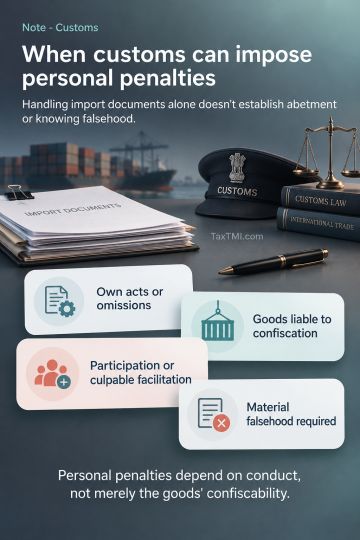
Confiscability of imported goods does not, by itself, establish the personal liability of every intermediary who handled the import documents. Penalty for abetment under Section 112(a) of the Customs Act, 1962 requires examination of the intermediary's own conduct. Section 114AA separately requires proof of knowing or intentional involvement with materially false or incorrect declarations, statements or documents.
In 2026 (10) TMI 1257 - CESTAT KOLKATA, the tribunal upheld deletion of both penalties against an intermediary whose involvement was confined to introducing persons and forwarding documents to a licensed Customs Broker. The decision illustrates the distinction between participation in the documentary chain and proved participation in the underlying customs contravention.
Section 111 of the Customs Act, 1962 identifies improperly imported goods liable to confiscation. Relevant statutory categories include dutiable or prohibited goods concealed in a conveyance under clause (e), goods of that description concealed in a package under clause (i), and, under clause (m), goods which do not correspond "in respect of value or in any other particular" with the entry made under the Act. These provisions supply the confiscation framework; they do not independently establish an intermediary's penal liability.
Section 112(a) of the Customs Act, 1962 applies to any person who, in relation to goods, "does or omits to do any act which act or omission would render such goods liable to confiscation under section 111, or abets the doing or omission of such an act". The provision therefore distinguishes a person whose own act or omission creates the confiscation exposure from a person alleged to have abetted that conduct.
The penalty originally imposed on the respondent intermediary was under Section 112(a)(i). For goods in respect of which a prohibition is in force under the Act or another law, clause (i) prescribes a penalty "not exceeding the value of the goods or five thousand rupees, whichever is the greater". The tribunal did not determine the quantum because the foundation of personal liability failed.
Section 112(b), by contrast, concerns specified dealings with goods which the person "knows or has reason to believe are liable to confiscation under section 111". Although the notice also proposed action under that provision, no penalty under Section 112(b) was imposed. Its relevance here is the express distinction in statutory language, not an additional ground of liability.
Section 114AA of the Customs Act, 1962 provides: "If a person knowingly or intentionally makes, signs or uses, or causes to be made, signed or used, any declaration, statement or document which is false or incorrect in any material particular, in the transaction of any business for the purposes of this Act", that person is liable to a penalty not exceeding five times the value of goods.
The operative requirements are cumulative: identifiable documentary conduct, material falsity or incorrectness, a connection with business for customs purposes, and the prescribed knowledge or intention. The provision reaches a person who causes a document to be used, even without personally preparing or signing it. Conversely, mere physical transmission does not dispense with proof of the mental element.
Section 17(1) of the Customs Act, 1962 requires an importer entering goods under Section 46 to "self-assess the duty, if any, leviable on such goods", subject to the stated statutory exception. Section 46(4) of the Customs Act, 1962 requires the importer to make and subscribe to a declaration concerning the truth of the bill of entry and produce the supporting invoice and prescribed documents.
Section 46(4A) additionally requires the importer to ensure "the accuracy and completeness" of the information, "the authenticity and validity" of supporting documents, and compliance with applicable restrictions or prohibitions. These duties explain why an importer's declaration cannot automatically be attributed to a document-forwarding intermediary. They do not, however, immunise an intermediary whose own abetment or knowing documentary misconduct is proved.
The first issue is whether strict liability for an act rendering goods confiscable also eliminates the culpability inherent in an allegation of abetment. The two inquiries should not be conflated. Where the department relies on a person's own operative act or omission, the direct limb of Section 112(a) requires examination. Where it relies on assistance given to another person's contravention, it must establish the ingredients of abetment.
The second issue concerns the meaning of "uses" and "causes to be ... used" in Section 114AA. These expressions prevent liability from being confined to the document's author. Nevertheless, their breadth remains qualified by "knowingly or intentionally" and "false or incorrect in any material particular". A false import description and an intermediary's handling of that description are distinct evidentiary propositions.
The third issue is evidentiary. Proof of abetment need not invariably take the form of an admission or direct evidence of a fraudulent agreement. Conduct and corroborated circumstances may establish intentional assistance. Equally, suspicion arising from professional involvement, contacts or presence at examination cannot substitute for a reasoned connection with the contravention.
The respondent intermediary was neither the importer, the declarant nor the Customs Broker. Documents passed through a chain of intermediaries before reaching the licensed broker. Examination disclosed areca nuts concealed behind bags of ammonium chloride, although the invoice described the goods as ammonium chloride. The investigation identified other persons as having planned and financed the concealment, and the actual beneficiary stated that he did not know the respondent intermediary.
The respondent intermediary argued that he had neither stuffed, shipped, invoiced, declared nor financed the goods. He also submitted that the concealment and misdeclaration were already complete before his involvement. The important distinction is that these were submissions concerning the causal and temporal limits of his role; the tribunal's operative reasoning rested on the department's failure to prove involvement or knowledge.
The tribunal expressly separated confiscability from personal liability. Its questions were whether the respondent intermediary had committed or abetted an act attracting Section 112(a), and whether he had knowingly or intentionally engaged in the documentary conduct covered by Section 114AA. It upheld the first appellate authority's negative findings on both questions and dismissed the department's appeal.
The department produced no evidence establishing the respondent intermediary's knowledge of the offending import or beneficial involvement. Introducing one person to another did not establish participation in the import arrangement. The outcome was therefore evidence-specific, rather than a categorical exemption for intermediaries.
The respondent intermediary was present during examination and communicated the discovery to another person, advising that person to approach customs authorities. Awareness acquired when concealment is discovered does not, without further evidence, establish earlier knowledge or intentional facilitation. Documentary handling must likewise be evaluated against what the intermediary knew when undertaking the relevant act.
Absence of beneficial ownership or financial gain supported the factual conclusion, but neither Section 112(a)'s abetment limb nor Section 114AA makes personal enrichment an indispensable statutory condition. An unpaid facilitator may still incur liability if the required conduct and culpability are established.
In 2024 (2) TMI 98 - DELHI HIGH COURT, imports were made using forged WPC licences. The court held that confiscation under Section 111(d) did not require mens rea and that Section 112(a) operated on a strict-liability basis where the importers' acts rendered the goods confiscable. It contrasted Section 112(b)'s knowledge requirement with Section 114AA's knowing or intentional documentary misconduct. The relevance is that absence of knowledge is not a universal defence to every application of Section 112(a). The inquiry must first identify the conduct and statutory limb relied upon.
In 2019 (11) TMI 72 - DELHI HIGH COURT, the issue was whether a Customs House Agent's processing of forged exemption certificates justified penalties. The investigation did not establish active involvement or conscious participation in the forgery. The court upheld deletion of penalties under Sections 112(b) and 114AA because the requisite knowledge was absent. For Section 112(a), it distinguished the broader operation of the provision from liability specifically founded on abetment, which required material establishing participation or culpable facilitation. This distinction directly supports scrutiny of the respondent intermediary's individual role.
A coherent reading of these authorities distinguishes direct causative conduct from alleged abetment. The strict-liability analysis does not justify treating every person in a documentary chain as an abettor. Nor does the abetment analysis establish a universal mens rea requirement for the entire provision.
In 2018 (3) TMI 121 - CESTAT BANGALORE, penalties against a Chartered Engineer, Customs House Agent and local representative were examined. The tribunal required clear, cogent evidence of specific conduct establishing abetment; filing a bill of entry or performing a limited professional role was insufficient by itself. Customs officers had participated in examination, and the adjudication lacked reliable evidence of knowing assistance. Section 114AA liability against the Chartered Engineer also failed for want of material showing the making or use of a false document. The decision illustrates that professional participation cannot replace proof of statutory ingredients.
In 2010 (5) TMI 36 - DELHI HIGH COURT, the person penalised monitored postal parcels, informed an intermediary, failed to report missing mandatory declarations and received payments. Statements and surrounding circumstances supported intentional assistance. The court explained abetment through instigation, conspiracy or intentional aiding and upheld liability on a preponderance of probabilities. Unlike neutral forwarding, the coordinated conduct supplied an evidentiary basis for inferring participation. The decision also confirms that customs penalty proceedings do not require proof beyond reasonable doubt.
In 2015 (3) TMI 820 - DELHI HIGH COURT, abetment findings rested on statements supported by call-detail records, transport evidence, airline records and other documentary material. The court upheld the inference of knowledge, intention and common interest on a preponderance of probabilities. The significance lies in corroboration: communications were not considered in isolation but as part of an interconnected factual record. Its rejection of a cross-examination challenge was also contextual, involving disclosed material, belated requests and corroborative evidence; it does not establish that procedural objections are invariably immaterial.
In 2015 (1) TMI 260 - CESTAT MUMBAI, export-related penalties under Section 114(iii) failed because the evidence established, at most, inadequate examination or dereliction of duty, not knowing assistance in fraudulent exports. Telephone records and supervisory statements did not establish the alleged abetment. The tribunal also considered the absence of material rebutting good faith in the context of Sections 155 and 106. Its relevance is analogical: negligent performance and culpable assistance are different concepts, although the statutory setting concerned exports and customs officers.
In 2005 (10) TMI 159 - CESTAT, NEW DELHI, a customs inspector admitted certifying conformity without examining the export goods. Re-examination disclosed a materially different consignment, and the record included an intermediary connection and findings concerning consideration for favourable reports. The tribunal upheld the Section 114 penalty and rejected the asserted Section 155 protection. Unlike mere deficient diligence, an affirmative certification unsupported by the examination it purported to record supplied concrete misconduct. The decision does not make personal financial benefit a universal ingredient of abetment.
In 2010 (4) TMI 661 - CESTAT, CHENNAI, an export-overvaluation penalty was founded on alleged facilitation by a Customs House Agent. Regulations 13 and 19 of the Customs House Agents Licensing Regulations, 2004 imposed advisory, due-diligence and supervisory duties. The adjudicating authority also invoked Section 147 on an agency-deeming basis, treating the exporter's acts as attributable to the agent unless disproved. Nevertheless, the tribunal found no evidence of knowing facilitation or reason to believe that valuation requirements were being violated and set aside the Section 117 penalty. Regulatory obligations did not cure the evidentiary deficiency in the abetment allegation.
In 2013 (6) TMI 589 - GUJARAT HIGH COURT, prohibited non-basmati rice was exported in place of declared basmati rice. The court found no evidence that the Customs House Agent knew of the substitution or connived in it. Customs examination and the resulting Let Export Order were relevant circumstances, while a stuffing-related trade-notice requirement did not justify presumed complicity. The Section 114(i) penalty was set aside. The principle assists documentary intermediaries, but customs clearance itself is not conclusive immunity where contrary evidence proves knowing participation.
In 1975 (1) TMI 23 - MADRAS High Court, fabricated or inflated invoices supported false income-tax returns. Section 277 of the Income-tax Act, 1961 required proof that the maker knew or believed the verification to be false, or did not believe it to be true. Liability was sustained against the knowledgeable signatory partner and attributed to the firm through that authorised partner; another partner was relieved for want of proof connecting him to knowing verification or document use. The analogy supports individualised culpability, but the criminal standard applied there must not displace the customs adjudicatory standard.
In 2015 (2) TMI 175 - CESTAT BANGALORE, misdeclaration attracted a sustained Section 114A penalty, but the additional Section 114AA penalty was deleted because no separate activity justified it beyond the conduct already penalised. Its relevance is the need for an independently articulated foundation for documentary liability. It does not establish a blanket prohibition on concurrent penalties under Sections 112(a) and 114AA; the respondent intermediary's case failed on proof of the respective ingredients, not a general rule against cumulation.
The administrative treatment is consistent with the statutory distinctions. Paragraph 5.1 of Offences and Penal Provisions - CBEC's Customs Manual 2025 reproduces Section 112's direct-conduct, abetment and knowing-dealing categories. Paragraph 8.1 of Offences and Penal Provisions - CBEC's Customs Manual 2025 retains Section 114AA's expressions "knowingly or intentionally" and "false or incorrect in any material particular", together with the ceiling of five times the value of goods. Neither formulation substitutes documentary proximity for the statutory requirements.
The decisions support a provision-specific and person-specific approach to adjudication:
Document provenance, transmission records and contemporaneous instructions may help distinguish neutral handling from knowing facilitation. Presence during examination should be assessed according to what it proves about knowledge at the relevant time, not treated as retrospective proof of complicity.
At the appellate stage, a challenge to reasoned exoneration requires engagement with the evidentiary findings. In the respondent intermediary's case, the department did not identify material establishing the missing involvement or knowledge. Repetition of the allegation that an intermediary facilitated clearance did not answer that deficiency.
Section 112(a) and Section 114AA address connected but distinct misconduct. The direct limb of Section 112(a) cannot be equated with its abetment limb, while Section 114AA expressly requires knowing or intentional documentary conduct. The tribunal's decision establishes no general immunity for intermediaries. Its central lesson is narrower: confiscable goods, false import documents and participation in a commercial chain do not, without the necessary evidentiary connection, establish personal penal liability.
Full Text:
