Loading...

⚠ ✕
❮ Top
☎ Help
☰
×

By creating an account you can:

Logo TaxTMI
Call Us / Help / Feedback✕

Contact Us At :

✉ E-mail: [email protected]

✆ To Call / Whatsapp, Check Contact Us

FAQs :

To know Frequently Asked Questions, Check FAQs

Most Asked Video Tutorials :

For more tutorials, Check Video Tutorials

Submit Feedback/Suggestion :

Email :
Please provide your email address so we can follow up on your feedback.
Category :
Description :
Min 15 characters 0/2000
Make Most of Text Search ✕
  1. Checkout this video tutorial: How to search effectively on TaxTMI.
  2. Put words in double quotes for exact word search, eg: "income tax"
  3. Avoid noise words such as : 'and, of, the, a'
  4. Sort by Relevance to get the most relevant document.
  5. Press Enter to add multiple terms/multiple phrases, and then click on Search to Search.
  6. Text Search
  7. The system will try to fetch results that contains ALL your words.
  8. Once you add keywords, you'll see a new 'Search In' filter that makes your results even more precise.
  9. Text Search
╳
Add to...
You have not created any category. Kindly create one to bookmark this item!
✕
Create New Category
Hide
Title :
Description :
❮❮ Hide
❮ Default View
Expand ❯❯
Close ✕
🔎 Filters / Advanced Search ❯
TEXT

Press 'Enter' to add multiple search terms. Rules for Better Search

Search In
Main Text + AI Text ❯
  • Main Text
  • Main Text + AI Text
  • AI Text
Law:
---- All Laws---- ❯
  • ---- All Laws----
  • Benami Property
  • Bill
  • Central Excise
  • Companies Law
  • Customs
  • DGFT
  • FEMA
  • GST
  • GST - States
  • IBC
  • Income Tax
  • Indian Laws
  • Money Laundering
  • SEBI
  • SEZ
  • Service Tax
  • VAT / Sales Tax
Types:
---- All Types ---- ❯
  • ---- All Types ----
  • Act Rules
  • Case Laws
  • Circulars
  • Manuals
  • News
  • Notifications
Sort By: ?
In Sort By 'Default', exact matches for text search are shown at the top, followed by the remaining results in their regular order.
Relevance Default Date
☰   Show Results ❯
    Case Laws Income Tax
    Faceless Assessment and Jurisdiction: Reconciling JAO Roles with NFAC u/ss 144B & 151A (JAO / FAO)
    Summons, Searches and Show Cause Notices - Parallel GST Adjudications: Defining 'Proceedings' u/s 6(...
    Consolidated SCNs, Cross-Examination and the Limits of Writ Relief in GST Adjudication
    Act Rules Income Tax
    Comparison of SCHEDULE XVI "PERMITTED MODES OF INVESTMENT OR DEPOSITS" between the Income-Tax Act, 2...
    Act Rules Income Tax
    Comparison of SCHEDULE-XV "DEDUCTION IN RESPECT OF LIFE INSURANCE PREMIA, CONTRIBUTION TO PROVIDENT ...
    Act Rules Income Tax
    Comparison of SCHEDULE XIV "INSURANCE BUSINESS" between the Income-Tax Act, 2025 (as passed) and the...
    Act Rules Income Tax
    Comparison of SCHEDULE XI "RECOGNISED PROVIDENT FUNDS" between the Income-Tax Act, 2025 (as passed) ...
    Act Rules Income Tax
    Comparison of SCHEDULE X "DEDUCTION FOR SITE RESTORATION FUND FOR COMPUTING INCOME UNDER THE HEAD "P...
    Act Rules Income Tax
    Comparison of SCHEDULE IX "DEDUCTION FOR TEA DEVELOPMENT ACCOUNT, COFFEE DEVELOPMENT ACCOUNT AND RUB...
    Act Rules Income Tax
    Comparison of SCHEDULE VIII "INCOME NOT TO BE INCLUDED IN THE TOTAL INCOME OF POLITICAL PARTIES AND ...
    Act Rules Income Tax
    Comparison of SCHEDULE VII "PERSONS EXEMPT FROM TAX" between the Income-Tax Act, 2025 (as passed) an...
    Act Rules Income Tax
    Comparison of SCHEDULE VI "INCOME NOT TO BE INCLUDED IN TOTAL INCOME OF CERTAIN ELIGIBLE PERSONS IN ...
    Act Rules Income Tax
    Comparison of SCHEDULE V "INCOME NOT TO BE INCLUDED IN TOTAL INCOME OF CERTAIN ELIGIBLE PERSONS INCL...
    Act Rules Income Tax
    Comparison of SCHEDULE IV "INCOME NOT TO BE INCLUDED IN TOTAL INCOME OF ELIGIBLE NON-RESIDENTS, FORE...
    Act Rules Income Tax
    Comparison of SCHEDULE III "INCOME NOT TO BE INCLUDED IN TOTAL INCOME OF ELIGIBLE PERSONS" between t...
    Act Rules Income Tax
    Comparison of SCHEDULE II "INCOME NOT TO BE INCLUDED IN TOTAL INCOME" between the Income-Tax Act, 20...
    Act Rules Income Tax
    Comparison of SCHEDULE I "CONDITIONS FOR CERTAIN ACTIVITIES NOT TO CONSTITUTE BUSINESS CONNECTION IN...
    Act Rules Income Tax
    Comparison of section 536 "Repeal and savings." between the Income-Tax Act, 2025 (as passed) and the...
    Act Rules Income Tax
    Comparison of section 524 "Presumption as to assets, books of account, etc." between the Income-Tax ...
    Act Rules Income Tax
    Comparison of section 515 "Appearance by authorised representative." between the Income-Tax Act, 202...
❮
❯
❯❯
Maximize Maximize Maximize
0 / 200
Expand Note
Add to Folder

No Folders have been created

+

Are you sure you want to delete "My most important" ?

NOTE:

Notes
Showing Results for :
Reset Filters
Results Found:
Show All Summaries Hide All Summaries
Case Laws Income Tax
Show AI Summary
Concurrent jurisdiction between JAO and faceless authorities affirmed; JAO may initiate reassessment followed by faceless assessment.
The faceless scheme and RMS produce information that may be surfaced to the JAO, permitting the JAO to conduct the pre-notice inquiry and form satisfaction to issue a notice initiating reassessment; thereafter records may be transmitted for faceless assessment via automated allocation, embodying a two-stage model that preserves both JAO initiation authority and central faceless assessment.
Case Laws GST
Show AI Summary
GST enforcement: summons/searches are investigative; show cause notices mark formal proceedings and define subject matter.
Issuance of summons, searches and seizures are investigative steps and do not constitute initiation of proceedings; formal adjudicatory commencement is principally the issuance of a show cause notice which defines the subject matter. The subject matter is determined from the show cause notice, and a twofold test-identity of liability on the same facts and identity or overlap of relief sought-governs whether two proceedings are the same. Cross-empowerment permits intelligence-based action by either authority, but parallel adjudications on identical subject matter are barred; authorities must coordinate and share information.
Case Laws GST
Show AI Summary
GST: consolidated SCNs valid for connected-period fraud, cross-examination limited unless prejudice shown.
The adjudicating authority must consider representations and hearings under section 74(9), but the right to cross-examination in SCN proceedings is not absolute and requires demonstrable prejudice to vitiate adjudication. Sections 73 and 74 allow consolidated SCNs across periods when connected fraudulent invoice chains exist. Orders must remain within the grounds and amounts specified in the SCN, and writ jurisdiction should be declined where an efficacious statutory appeal under section 107 is available absent exceptional circumstances.
Act Rules Income Tax
Show AI Summary
Permitted Modes of Investment: clarifies eligible instruments for registered non profit funds under section 350 compliance.
The schedule lists closed, enumerated permitted modes of investment for monies under section 350, privileging government backed and regulated instruments, specified sectoral debt and equity, deposits with public authorities, and notified schemes; it defines key terms (e.g., long term finance as five year minimum) and preserves transitional and historical exceptions including a one year short term holding rule for non specified assets and preservation of corpus assets held on specified historical dates.
Act Rules Income Tax
Show AI Summary
Deduction for specified payments: qualifying contributions allowed, but breach or early disposal triggers recapture of previously allowed deductions.
Schedule XV lists payments that qualify for deduction under section 123-notably life insurance premia subject to quantitative ceilings by policy issue date and disability status, specified provident/pension/superannuation contributions, notified securities and mutual fund units, certain term deposits and housing finance repayments-and sets withdrawal and recapture rules whereby surrender, premature transfer, early withdrawal or sale within holding periods causes previously allowed deductions to be treated as income; definitions and eligibility depend on cross-references and delegated notifications.
Act Rules Income Tax
Show AI Summary
Life insurance taxable profit computed by annual average of actuarial surplus, separate from other business for tax purposes.
Life insurance taxable profit must be computed separately as the annual average of actuarial surplus from statutory valuations excluding earlier inter-valuation surplus/deficits, with specified add-backs; non-life taxable income is the profit before tax and appropriations per statutory accounts subject to enumerated tax adjustments, and non-resident branch profits may be allocated by India-premium proportion absent suitably reliable alternative data.
Act Rules Income Tax
Show AI Summary
Recognition conditions for provident funds determine tax treatment and trustee obligations, with investment limits tied to securities definitions.
Schedule XI conditions tax-favourable treatment of recognised provident, superannuation and gratuity funds on structural and operational criteria (trust form, vesting, non-revocability, employee coverage, permitted assets and payment rules); recognition/approval is discretionary and revocable; failures attract inclusion of accumulated balances or contributions in employee income and procedural obligations such as TDS; trustees face record-keeping, reporting and potential liability, while the Board may make rules subject to statutory limits and section 534 oversight.
Act Rules Income Tax
Show AI Summary
Deduction for site restoration funds: designated SBI deposits allow capped tax relief but trigger deeming on improper use.
A deduction permits upstream petroleum and natural gas taxpayers to deduct amounts deposited in designated site restoration accounts held with the State Bank of India, limited to the lesser of actual deposits or 20% of business profits before the deduction; deposits and interest are treated as account balance, withdrawals are restricted to scheme permitted uses, and improper utilisation or account closure triggers deeming provisions or disallowance, with an eight year clawback on asset sales subject to narrow exceptions.
Act Rules Income Tax
Show AI Summary
Deduction for development account deposits: allowable up to 40% of profits, subject to strict deposit, audit and claw back rules.
The Schedule allows growers and manufacturers of tea, coffee and rubber to deduct deposits into prescribed development accounts up to the lesser of actual deposits or 40% of business profits, subject to carrying on the specified business in India, depositing funds in specified special or deposit accounts under board or National Bank schemes, and furnishing a prescribed audited report by the specified date; unauthorised withdrawals or use for specified articles are deemed taxable and assets acquired from such funds are subject to claw back if sold or transferred within eight years.
Act Rules Income Tax
Show AI Summary
Income exclusion for political funding conditioned on transparency, recordkeeping, prescribed receipt modes and distribution obligations.
The Schedule excludes specified receipts from total income of eligible political parties and electoral trusts-covering property income, other sources, capital gains and voluntary contributions for registered parties, and voluntary contributions for electoral trusts-conditional on maintenance of books, audited accounts, prescribed filing of returns, donor identification for significant contributions, prescribed modes of receipt for larger donations, distribution obligations for electoral trusts, and cross-referenced compliance with electoral and banking statutory provisions.
Act Rules Income Tax
Show AI Summary
Persons exempt from tax: categories qualify for total income exclusion subject to approvals, notifications and prescribed conditions.
Schedule VII lists 48 categories of persons whose total income is exempt from income tax subject to specified conditions: approvals by tax/regulatory authorities, Central Government notifications, prescribed financing thresholds to qualify as wholly or substantially government financed, and defined time limited exemptions for certain financing institutions. The Schedule relies on six Notes for statutory definitions and cross references other income tax provisions (including treatment of anonymous donations) to determine exclusion from total income.
Act Rules Income Tax
Show AI Summary
IFSC tax exclusion for specified financial incomes conditions relief on non-resident unit-holding, convertible receipts and prescribed rules.
Schedule VI excludes specified IFSC-related income from "total income" for defined eligible persons, listing discrete income heads (capital gains on IFSC exchange transfers, securities transfers, securitisation trust receipts, derivative and portfolio receipts, royalty/interest on aircraft/ship leases, specified fund returns, dividends of IFSC leasing units, and interest payable by IFSC units) together with conditional eligibility tied to convertible foreign exchange receipt, non-resident unit-holdings, commencement-of-operations windows, regulatory registration, and delegated computational prescriptions.
Act Rules Income Tax
Show AI Summary
Tax exclusion for institutional investment vehicles: conditional non inclusion of specified income subject to regulatory compliance and clawback.
Schedule V excludes specified income from total income for defined eligible persons-investment funds, business trusts (including REITs/InvITs), venture capital vehicles and certain foreign public investors-operating as a negative list subject to conditions and Notes. Exclusions include non business dividend and interest for investment funds, SPV interest/dividend exemptions for business trusts, REIT rental income exclusions for directly owned assets, and a layered specified person exemption with holding period, investment type, proportional computation, carve outs and clawback rules; implementation relies on cross references to SEBI/RBI/IFSC rules and Board guidelines.
Act Rules Income Tax
Show AI Summary
Non resident exemptions conditioned on residency, limited presence and Central Government notification restrict exclusions from taxable income.
Schedule IV excludes specified receipts from total income of defined non residents and foreign companies where each listed entry identifies the income class, eligible person and conditions for exclusion. Exclusions depend on factual predicates-residency under foreign exchange rules, limited period of presence, absence of employer taxable presence in India, RBI permissions for NR(E) accounts-and on Central Government notification or approved agreements. Key categories include NR(E) account interest, diplomatic remuneration, short term foreign employee remuneration, specified royalties/fees, Offshore Banking Unit deposits, intra group cruise lease rentals, regional community investments and notified crude oil arrangements.
Act Rules Income Tax
Show AI Summary
Income exclusions from total income: targeted, conditional exemptions rely on prescribed procedures and cross referenced regulations.
Schedule III excludes specified categories of receipts from total income for designated eligible persons, linking each excluded income to eligible person categories and conditional provisos. It covers personal reliefs (pensions, allowances, capped partial NPS withdrawals), partnership and family allocations, disaster compensation, conditional sectoral subsidies and institutional exemptions (research, khadi, securitisation, investor protection and settlement funds), and relies on prescribed procedures, certificates and cross references to subordinate legislation for operability.
Act Rules Income Tax
Show AI Summary
Life insurance exemption tightened by period, premium ratio and aggregate premium tests, altering tax treatment of policy and IFSC receipts.
Schedule II excludes specified classes of income from total income while imposing conditional tests on life insurance and retirement/savings receipts. Life insurance exclusions depend on policy issue periods, premium to sum assured ratios, aggregate premium ceilings and express ineligibility for certain receipts. Provident fund interest attributable to large post cut off contributions is excluded from exemption with the non excluded portion to be computed as prescribed. The Schedule adds an equalisation levy exclusion interacting with treaty notifications and treats IFSC issued policies differently under a targeted aggregate premium carve out.
Act Rules Income Tax
Show AI Summary
Business connection safe harbour for non-resident funds: compliance thresholds determine Indian tax nexus exclusion.
The Schedule establishes a safe harbour whereby certain non-resident investment funds and eligible fund managers will not constitute a business connection in India if they satisfy exhaustive investor-composition, concentration, corpus, independence, non-control, prohibited-associate-investment and arm's-length remuneration conditions, with specified carve-outs, transitional reliefs, registration requirements under prescribed securities-regulator frameworks, and filing and record keeping obligations to substantiate compliance.
Act Rules Income Tax
Show AI Summary
Savings on repeal preserve procedural and substantive continuity for matters tied to earlier tax years under the repealed regime.
The repeal provision preserves continuation of rights, obligations and proceedings relating to tax years beginning before the statutory cut-off by deeming prior actions, elections, penalties, refunds, recovery, carry-forwards of losses, credits and depreciation to remain effective and by allowing pending and certain later-initiated proceedings to be conducted under the repealed procedural rules; it invokes the General Clauses Act for repeal effect and specifies fallback mechanics for schemes where no corresponding provision exists in the new Act.
Act Rules Income Tax
Show AI Summary
Presumption of ownership and authenticity expands to electronic records, increasing evidentiary weight in tax proceedings.
The provision establishes rebuttable presumptions in proceedings under the Income tax enactment that items found in a search or survey-or delivered to a requisitioning officer-belong to the person in whose possession or control they are found and that books, documents, signatures and executions are true/authentic; the enacted text expressly extends those presumptions to electronic information and computer systems and adds a specific presumption that recorded electronic exchanges are exchanged between the purported parties.
Act Rules Income Tax
Show AI Summary
Authorised representative rules limit who may represent taxpayers, set disqualification grounds, and preserve appeal rights.
The provision permits an assessee to attend proceedings before income tax authorities and the Appellate Tribunal through an authorised representative drawn from an enumerated list, subject to written authorisation and exclusions; personal attendance is required where examination on oath or affirmation is mandated. The definition of authorised representative and of "accountant" contains specific exceptions to prevent conflicts of interest, while disqualification rules-based on dismissal from service, insolvency, specified convictions or prior penalties-apply with procedural safeguards including opportunity to be heard and a one month appeal to the Board. Several qualifications and categories are to be determined by subordinate prescription, and transitional cross references to prior statutes determine legacy practitioner recognition.

TMI Notes

Back

All TMI Notes

Showing Results for :
Reset Filters
No Records Found

TMI Notes

Abetment and Knowing Use of False Import Documents under Sections 112(a) and 114AA

6 November, 2026

Contents
Acts
Plus +
Summary
Note

Note

-

Bookmark

(New) -

Download

Print

Print

This commentary provides doctrinal analysis and practical insights on the legal issue discussed below. The judgment is analysed in the context of its factual background, issues framed, and conclusions reached by the Court.

2026 (10) TMI 1257 - CESTAT KOLKATA

1. Introduction

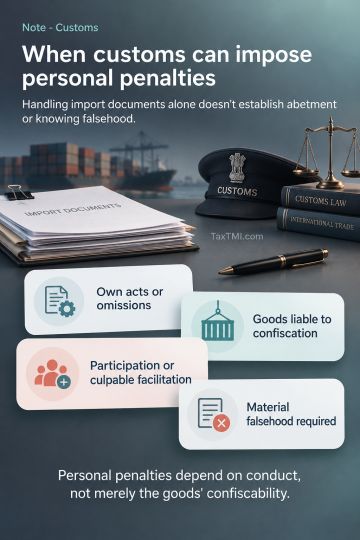
Confiscability of imported goods does not, by itself, establish the personal liability of every intermediary who handled the import documents. Penalty for abetment under Section 112(a) of the Customs Act, 1962 requires examination of the intermediary's own conduct. Section 114AA separately requires proof of knowing or intentional involvement with materially false or incorrect declarations, statements or documents.

In 2026 (10) TMI 1257 - CESTAT KOLKATA, the tribunal upheld deletion of both penalties against an intermediary whose involvement was confined to introducing persons and forwarding documents to a licensed Customs Broker. The decision illustrates the distinction between participation in the documentary chain and proved participation in the underlying customs contravention.

2. Legal & Statutory Context

Confiscability and the personal penalty nexus

Section 111 of the Customs Act, 1962 identifies improperly imported goods liable to confiscation. Relevant statutory categories include dutiable or prohibited goods concealed in a conveyance under clause (e), goods of that description concealed in a package under clause (i), and, under clause (m), goods which do not correspond "in respect of value or in any other particular" with the entry made under the Act. These provisions supply the confiscation framework; they do not independently establish an intermediary's penal liability.

Section 112(a) of the Customs Act, 1962 applies to any person who, in relation to goods, "does or omits to do any act which act or omission would render such goods liable to confiscation under section 111, or abets the doing or omission of such an act". The provision therefore distinguishes a person whose own act or omission creates the confiscation exposure from a person alleged to have abetted that conduct.

The penalty originally imposed on the respondent intermediary was under Section 112(a)(i). For goods in respect of which a prohibition is in force under the Act or another law, clause (i) prescribes a penalty "not exceeding the value of the goods or five thousand rupees, whichever is the greater". The tribunal did not determine the quantum because the foundation of personal liability failed.

Section 112(b), by contrast, concerns specified dealings with goods which the person "knows or has reason to believe are liable to confiscation under section 111". Although the notice also proposed action under that provision, no penalty under Section 112(b) was imposed. Its relevance here is the express distinction in statutory language, not an additional ground of liability.

The express mental element in false-document liability

Section 114AA of the Customs Act, 1962 provides: "If a person knowingly or intentionally makes, signs or uses, or causes to be made, signed or used, any declaration, statement or document which is false or incorrect in any material particular, in the transaction of any business for the purposes of this Act", that person is liable to a penalty not exceeding five times the value of goods.

The operative requirements are cumulative: identifiable documentary conduct, material falsity or incorrectness, a connection with business for customs purposes, and the prescribed knowledge or intention. The provision reaches a person who causes a document to be used, even without personally preparing or signing it. Conversely, mere physical transmission does not dispense with proof of the mental element.

The importer's statutory responsibilities

Section 17(1) of the Customs Act, 1962 requires an importer entering goods under Section 46 to "self-assess the duty, if any, leviable on such goods", subject to the stated statutory exception. Section 46(4) of the Customs Act, 1962 requires the importer to make and subscribe to a declaration concerning the truth of the bill of entry and produce the supporting invoice and prescribed documents.

Section 46(4A) additionally requires the importer to ensure "the accuracy and completeness" of the information, "the authenticity and validity" of supporting documents, and compliance with applicable restrictions or prohibitions. These duties explain why an importer's declaration cannot automatically be attributed to a document-forwarding intermediary. They do not, however, immunise an intermediary whose own abetment or knowing documentary misconduct is proved.

3. Interpretative Issues

The first issue is whether strict liability for an act rendering goods confiscable also eliminates the culpability inherent in an allegation of abetment. The two inquiries should not be conflated. Where the department relies on a person's own operative act or omission, the direct limb of Section 112(a) requires examination. Where it relies on assistance given to another person's contravention, it must establish the ingredients of abetment.

The second issue concerns the meaning of "uses" and "causes to be ... used" in Section 114AA. These expressions prevent liability from being confined to the document's author. Nevertheless, their breadth remains qualified by "knowingly or intentionally" and "false or incorrect in any material particular". A false import description and an intermediary's handling of that description are distinct evidentiary propositions.

The third issue is evidentiary. Proof of abetment need not invariably take the form of an admission or direct evidence of a fraudulent agreement. Conduct and corroborated circumstances may establish intentional assistance. Equally, suspicion arising from professional involvement, contacts or presence at examination cannot substitute for a reasoned connection with the contravention.

4. Detailed Commentary & Analysis

The respondent intermediary's limited role

The respondent intermediary was neither the importer, the declarant nor the Customs Broker. Documents passed through a chain of intermediaries before reaching the licensed broker. Examination disclosed areca nuts concealed behind bags of ammonium chloride, although the invoice described the goods as ammonium chloride. The investigation identified other persons as having planned and financed the concealment, and the actual beneficiary stated that he did not know the respondent intermediary.

The respondent intermediary argued that he had neither stuffed, shipped, invoiced, declared nor financed the goods. He also submitted that the concealment and misdeclaration were already complete before his involvement. The important distinction is that these were submissions concerning the causal and temporal limits of his role; the tribunal's operative reasoning rested on the department's failure to prove involvement or knowledge.

The tribunal's decisive inquiry

The tribunal expressly separated confiscability from personal liability. Its questions were whether the respondent intermediary had committed or abetted an act attracting Section 112(a), and whether he had knowingly or intentionally engaged in the documentary conduct covered by Section 114AA. It upheld the first appellate authority's negative findings on both questions and dismissed the department's appeal.

The department produced no evidence establishing the respondent intermediary's knowledge of the offending import or beneficial involvement. Introducing one person to another did not establish participation in the import arrangement. The outcome was therefore evidence-specific, rather than a categorical exemption for intermediaries.

Knowledge must relate to the offending conduct

The respondent intermediary was present during examination and communicated the discovery to another person, advising that person to approach customs authorities. Awareness acquired when concealment is discovered does not, without further evidence, establish earlier knowledge or intentional facilitation. Documentary handling must likewise be evaluated against what the intermediary knew when undertaking the relevant act.

Absence of beneficial ownership or financial gain supported the factual conclusion, but neither Section 112(a)'s abetment limb nor Section 114AA makes personal enrichment an indispensable statutory condition. An unpaid facilitator may still incur liability if the required conduct and culpability are established.

5. Judicial / Administrative Perspective

Strict liability for the direct act of importation

In 2024 (2) TMI 98 - DELHI HIGH COURT, imports were made using forged WPC licences. The court held that confiscation under Section 111(d) did not require mens rea and that Section 112(a) operated on a strict-liability basis where the importers' acts rendered the goods confiscable. It contrasted Section 112(b)'s knowledge requirement with Section 114AA's knowing or intentional documentary misconduct. The relevance is that absence of knowledge is not a universal defence to every application of Section 112(a). The inquiry must first identify the conduct and statutory limb relied upon.

Abetment by a Customs House Agent

In 2019 (11) TMI 72 - DELHI HIGH COURT, the issue was whether a Customs House Agent's processing of forged exemption certificates justified penalties. The investigation did not establish active involvement or conscious participation in the forgery. The court upheld deletion of penalties under Sections 112(b) and 114AA because the requisite knowledge was absent. For Section 112(a), it distinguished the broader operation of the provision from liability specifically founded on abetment, which required material establishing participation or culpable facilitation. This distinction directly supports scrutiny of the respondent intermediary's individual role.

A coherent reading of these authorities distinguishes direct causative conduct from alleged abetment. The strict-liability analysis does not justify treating every person in a documentary chain as an abettor. Nor does the abetment analysis establish a universal mens rea requirement for the entire provision.

Specific evidence against professional participants

In 2018 (3) TMI 121 - CESTAT BANGALORE, penalties against a Chartered Engineer, Customs House Agent and local representative were examined. The tribunal required clear, cogent evidence of specific conduct establishing abetment; filing a bill of entry or performing a limited professional role was insufficient by itself. Customs officers had participated in examination, and the adjudication lacked reliable evidence of knowing assistance. Section 114AA liability against the Chartered Engineer also failed for want of material showing the making or use of a false document. The decision illustrates that professional participation cannot replace proof of statutory ingredients.

Intentional assistance proved through circumstances

In 2010 (5) TMI 36 - DELHI HIGH COURT, the person penalised monitored postal parcels, informed an intermediary, failed to report missing mandatory declarations and received payments. Statements and surrounding circumstances supported intentional assistance. The court explained abetment through instigation, conspiracy or intentional aiding and upheld liability on a preponderance of probabilities. Unlike neutral forwarding, the coordinated conduct supplied an evidentiary basis for inferring participation. The decision also confirms that customs penalty proceedings do not require proof beyond reasonable doubt.

Corroboration and the evidentiary matrix

In 2015 (3) TMI 820 - DELHI HIGH COURT, abetment findings rested on statements supported by call-detail records, transport evidence, airline records and other documentary material. The court upheld the inference of knowledge, intention and common interest on a preponderance of probabilities. The significance lies in corroboration: communications were not considered in isolation but as part of an interconnected factual record. Its rejection of a cross-examination challenge was also contextual, involving disclosed material, belated requests and corroborative evidence; it does not establish that procedural objections are invariably immaterial.

Dereliction of duty distinguished from abetment

In 2015 (1) TMI 260 - CESTAT MUMBAI, export-related penalties under Section 114(iii) failed because the evidence established, at most, inadequate examination or dereliction of duty, not knowing assistance in fraudulent exports. Telephone records and supervisory statements did not establish the alleged abetment. The tribunal also considered the absence of material rebutting good faith in the context of Sections 155 and 106. Its relevance is analogical: negligent performance and culpable assistance are different concepts, although the statutory setting concerned exports and customs officers.

Affirmative false certification distinguished

In 2005 (10) TMI 159 - CESTAT, NEW DELHI, a customs inspector admitted certifying conformity without examining the export goods. Re-examination disclosed a materially different consignment, and the record included an intermediary connection and findings concerning consideration for favourable reports. The tribunal upheld the Section 114 penalty and rejected the asserted Section 155 protection. Unlike mere deficient diligence, an affirmative certification unsupported by the examination it purported to record supplied concrete misconduct. The decision does not make personal financial benefit a universal ingredient of abetment.

Regulatory duties and agency attribution

In 2010 (4) TMI 661 - CESTAT, CHENNAI, an export-overvaluation penalty was founded on alleged facilitation by a Customs House Agent. Regulations 13 and 19 of the Customs House Agents Licensing Regulations, 2004 imposed advisory, due-diligence and supervisory duties. The adjudicating authority also invoked Section 147 on an agency-deeming basis, treating the exporter's acts as attributable to the agent unless disproved. Nevertheless, the tribunal found no evidence of knowing facilitation or reason to believe that valuation requirements were being violated and set aside the Section 117 penalty. Regulatory obligations did not cure the evidentiary deficiency in the abetment allegation.

Connivance cannot be presumed from clearance activity

In 2013 (6) TMI 589 - GUJARAT HIGH COURT, prohibited non-basmati rice was exported in place of declared basmati rice. The court found no evidence that the Customs House Agent knew of the substitution or connived in it. Customs examination and the resulting Let Export Order were relevant circumstances, while a stuffing-related trade-notice requirement did not justify presumed complicity. The Section 114(i) penalty was set aside. The principle assists documentary intermediaries, but customs clearance itself is not conclusive immunity where contrary evidence proves knowing participation.

False-document culpability must be individualised

In 1975 (1) TMI 23 - MADRAS High Court, fabricated or inflated invoices supported false income-tax returns. Section 277 of the Income-tax Act, 1961 required proof that the maker knew or believed the verification to be false, or did not believe it to be true. Liability was sustained against the knowledgeable signatory partner and attributed to the firm through that authorised partner; another partner was relieved for want of proof connecting him to knowing verification or document use. The analogy supports individualised culpability, but the criminal standard applied there must not displace the customs adjudicatory standard.

Separate justification for an additional documentary penalty

In 2015 (2) TMI 175 - CESTAT BANGALORE, misdeclaration attracted a sustained Section 114A penalty, but the additional Section 114AA penalty was deleted because no separate activity justified it beyond the conduct already penalised. Its relevance is the need for an independently articulated foundation for documentary liability. It does not establish a blanket prohibition on concurrent penalties under Sections 112(a) and 114AA; the respondent intermediary's case failed on proof of the respective ingredients, not a general rule against cumulation.

Administrative formulation

The administrative treatment is consistent with the statutory distinctions. Paragraph 5.1 of Offences and Penal Provisions - CBEC's Customs Manual 2025 reproduces Section 112's direct-conduct, abetment and knowing-dealing categories. Paragraph 8.1 of Offences and Penal Provisions - CBEC's Customs Manual 2025 retains Section 114AA's expressions "knowingly or intentionally" and "false or incorrect in any material particular", together with the ceiling of five times the value of goods. Neither formulation substitutes documentary proximity for the statutory requirements.

6. Implications & Observations

The decisions support a provision-specific and person-specific approach to adjudication:

  • Identify the act rendering the goods confiscable and distinguish it from the intermediary's alleged assistance.
  • Specify whether Section 112(a) liability rests on direct conduct or abetment, rather than using "facilitation" as a self-proving conclusion.
  • For Section 114AA, identify the declaration, statement or document, the materially false particular, the act of making, signing, using or causing use, and the evidence of knowledge or intention.
  • Assess statements, communications, payments and timing collectively. Neither isolated contact nor absence of personal gain is determinative.
  • Distinguish regulatory shortcomings from proved penal misconduct, without assuming that one necessarily excludes the other.

Document provenance, transmission records and contemporaneous instructions may help distinguish neutral handling from knowing facilitation. Presence during examination should be assessed according to what it proves about knowledge at the relevant time, not treated as retrospective proof of complicity.

At the appellate stage, a challenge to reasoned exoneration requires engagement with the evidentiary findings. In the respondent intermediary's case, the department did not identify material establishing the missing involvement or knowledge. Repetition of the allegation that an intermediary facilitated clearance did not answer that deficiency.

7. Concluding Remarks

Section 112(a) and Section 114AA address connected but distinct misconduct. The direct limb of Section 112(a) cannot be equated with its abetment limb, while Section 114AA expressly requires knowing or intentional documentary conduct. The tribunal's decision establishes no general immunity for intermediaries. Its central lesson is narrower: confiscable goods, false import documents and participation in a commercial chain do not, without the necessary evidentiary connection, establish personal penal liability.


Full Text:

2026 (10) TMI 1257 - CESTAT KOLKATA

Topics

Acts Income Tax