Loading...

⚠ ✕
❮ Top
☎ Help
☰
×

By creating an account you can:

Logo TaxTMI
Call Us / Help / Feedback✕

Contact Us At :

✉ E-mail: [email protected]

✆ To Call / Whatsapp, Check Contact Us

FAQs :

To know Frequently Asked Questions, Check FAQs

Most Asked Video Tutorials :

For more tutorials, Check Video Tutorials

Submit Feedback/Suggestion :

Email :
Please provide your email address so we can follow up on your feedback.
Category :
Description :
Min 15 characters 0/2000
Make Most of Text Search ✕
  1. Checkout this video tutorial: How to search effectively on TaxTMI.
  2. Put words in double quotes for exact word search, eg: "income tax"
  3. Avoid noise words such as : 'and, of, the, a'
  4. Sort by Relevance to get the most relevant document.
  5. Press Enter to add multiple terms/multiple phrases, and then click on Search to Search.
  6. Text Search
  7. The system will try to fetch results that contains ALL your words.
  8. Once you add keywords, you'll see a new 'Search In' filter that makes your results even more precise.
  9. Text Search
╳
Add to...
You have not created any category. Kindly create one to bookmark this item!
✕
Create New Category
Hide
Title :
Description :
❮❮ Hide
❮ Default View
Expand ❯❯
Close ✕
🔎 Filters / Advanced Search ❯
TEXT

Press 'Enter' to add multiple search terms. Rules for Better Search

Search In
Main Text + AI Text ❯
  • Main Text
  • Main Text + AI Text
  • AI Text
Law:
---- All Laws---- ❯
  • ---- All Laws----
  • Benami Property
  • Bill
  • Central Excise
  • Companies Law
  • Customs
  • DGFT
  • FEMA
  • GST
  • GST - States
  • IBC
  • Income Tax
  • Indian Laws
  • Money Laundering
  • SEBI
  • SEZ
  • Service Tax
  • VAT / Sales Tax
Types:
---- All Types ---- ❯
  • ---- All Types ----
  • Act Rules
  • Case Laws
  • Circulars
  • Manuals
  • News
  • Notifications
Sort By: ?
In Sort By 'Default', exact matches for text search are shown at the top, followed by the remaining results in their regular order.
Relevance Default Date
☰   Show Results ❯
    Case Laws Income Tax
    Limits of Revisional Jurisdiction: Adequate Enquiry, Limited Scrutiny, and the Proper Use of Section...
    Case Laws Income Tax
    Maximum Marginal Rate and Surcharge for Discretionary Trusts: ITAT Special Bench Clarifies Slab-Base...
    Case Laws Customs
    Classification of Quicklime under the Customs Tariff: CESTAT Bangalore's Reaffirmation of HSN-Based ...
    Case Laws Income Tax
    Validity of Reassessment Notices Post-Ashish Agarwal and TOLA: Limitation and Sanction u/ss 149 and ...
    Case Laws Customs
    Seizure, Provisional Release and Limitation: Supreme Court on the Interplay of Sections 110(2), 110A...
    Case Laws Income Tax
    Prima Facie Adjustments v. Substantive Adjudication: Procedural Boundaries in Return Processing (CPC...
    Survey, Unaccounted Stock (Eye-Estimates) and the Limits of Section 130: Statutory Primacy of Sectio...
    Input Tax Credit Abuse (ITC Fraud) and Judicial Review: Delhi High Court on Natural Justice, RUDs an...
    Writ Jurisdiction and Statutory Appeal in GST Fraud Investigations: A Judicial Re-affirmation
    Case Laws Income Tax
    Section 11(3) Post-Amendment, Accumulated Income and the Sixth Year: Legal Interpretation, Procedura...
    Case Laws Income Tax
    Form No.10B & Section 119(2)(b): Condonation of Delay in Tax Exemption Claims: Principles, Precedent...
    Case Laws Customs
    Regulatory Ambit of Import of Second-Hand Electronic Capital Goods: Classification, Exemption and Pr...
    Case Laws Income Tax
    Section 195, DTAAs and Software Licences: A Practical Framework for Withholding Tax
    Provisional Attachment under GST: Draconian Powers, Statutory Time-Bars and the Rule of Law: Interpr...
    Case Laws Income Tax
    Section 263 Revisited: Jurisdictional Boundaries Where AO Takes a Plausible View on 80G Claims
    Case Laws Customs
    Provisional Release in Customs Law: Balancing Revenue Protection and Commercial Fairness - A Compara...
    Case Laws Customs
    Conditional Re-export and Revenue Safeguards: Judicially Crafted Remedies in Customs Adjudication
    GST Limitation Regime vs Executive Notifications: Judicial Review of Time-Limit Notifications under ...
    Case Laws Income Tax
    Section 11(3) After Finance Act, 2022: Utilization of Accumulated Income - Deemed Income, Vesting an...
    Case Laws Income Tax
    When Can an ITAT Reopen a Decision? Distinguishing Prior Binding Precedent from Subsequent Case-Law
❮
❯
❯❯
Maximize Maximize Maximize
0 / 200
Expand Note
Add to Folder

No Folders have been created

+

Are you sure you want to delete "My most important" ?

NOTE:

Notes
Showing Results for :
Reset Filters
Results Found:
Show All Summaries Hide All Summaries
Case Laws Income Tax
Show AI Summary
Income tax revisional jurisdiction: if AO investigated, PCIT must decide merits or record specific investigative failure, not remand.
Where the Assessing Officer has conducted enquiries and accepted the assessee's explanation, the revisional authority cannot remand the assessment on a generic claim of inadequate enquiry; it must either record an abject failure to investigate with specific findings or decide the issue on merits in the revisional order and demonstrate error and prejudice.
Case Laws Income Tax
Show AI Summary
Discretionary trusts taxed at maximum marginal rate must have surcharge computed under slab and threshold rules, not automatically at top rate.
For private discretionary trusts taxed at the maximum marginal rate under sections 164/167B, the term denotes the highest basic slab rate under the Finance Act, but surcharge on that tax must be computed according to the Finance Act's slab- and threshold-based surcharge provisions; if the trust's total income does not cross the statutory surcharge threshold, no surcharge is leviable despite basic tax being at the top slab rate.
Case Laws Customs
Show AI Summary
Quicklime classification: impure lime falls under specific tariff heading, not high purity calcium oxide, per HSN purity standard.
The imported material, chemically tested as impure calcium oxide (about 92.2% CaO with mineral impurities), is classifiable under Heading 2522 10 00 as Quicklime. Chapter Note 1 to Chapter 25 must be read contextually and does not disqualify quicklime from Chapter 25 where the tariff text and HSN Explanatory Notes expressly contemplate calcined quicklime. Heading 2825 is confined to chemically pure calcium oxide (approximately 98% CaO) and its residuary sub-heading cannot displace the specific Heading 2522 unless that purity threshold and absence of impurities are met.
Case Laws Income Tax
Show AI Summary
Reassessment notices: surviving-time computation under COVID-era relief and new limitation rules renders late notices time-barred.
The court held that in transitional reassessment cases the appropriate sanctioning authority is determined by when the original three-year expiry fell within the COVID-era relief window, so approval by the ordinarily specified authority for within-three-year cases suffices; limitation is governed by a two-step surviving-time computation measured from the original notice as of the relief-window terminal date, excluding stayed periods and the time allowed to reply, and any later notice issued beyond that surviving time is time-barred under the substituted limitation regime read with the time-relief statute and the legal-fiction continuity.
Case Laws Customs
Show AI Summary
Seizure of goods: six month statutory limit for issuing show cause notice is mandatory despite provisional release.
The six month limit in Section 110(2) for issuing a show cause notice after seizure under Section 110(1) is mandatory; only a single six month extension under the first proviso is permissible. Provisional release under Section 110A does not suspend, extend or neutralise that time bar. The 2018 second proviso making the six month rule inapplicable where provisional release is ordered is a substantive change and does not validate pre amendment seizures prolonged without notice.
Case Laws Income Tax
Show AI Summary
Prima facie adjustments cannot decide debatable legal claims in return processing; contested deductions require scrutiny procedures.
When a claimed deduction depends on timely deposit of employee welfare contributions and the legal question is debatable or pending higher adjudication, summary processing adjustments cannot be used to resolve the dispute; such matters require scrutiny or reassessment procedures and the validity of any processing-stage action must be judged by the law and facts existing at the time of processing.
Case Laws GST
Show AI Summary
Survey discovered unaccounted stock must be assessed under sections 35(6) and 73/74, not via section 130.
Tax liability for unaccounted goods found in a survey must be determined under section 35(6) read with sections 73/74 of the GST Act; section 130 cannot be used to quantify tax or levy penalty in such cases. The statutory cross reference to sections 73/74 requires adherence to their procedural safeguards, and quantification based solely on eye estimates during survey is insufficient without proper weighment or verification.
Case Laws GST
Show AI Summary
Input Tax Credit fraud: writ relief limited where appeals exist; hearings and raw RUDs generally suffice absent prejudice.
The High Court held that writ jurisdiction must be exercised with restraint in complex ITC fraud matters appealable under Section 107; at least one personal hearing and provision of RUDs as collected by the Department generally suffice absent demonstrable prejudice; detailed allocation of penal liability under Sections 73/74/75(13)/122 requires adjudicatory or appellate factfinding and cannot be resolved in writ proceedings.
Case Laws GST
Show AI Summary
Writ jurisdiction limited where statutory appeal exists for fact intensive GST fraud investigations; appellate forum preferred for evidentiary disputes.
The High Court reaffirmed that writ jurisdiction under Article 226 is generally inappropriate where a statutory appeal exists for fact intensive GST investigations alleging fraudulent availment of Input Tax Credit through fake invoices. Courts should confine review to jurisdictional defects or breaches of natural justice; detailed evidentiary disputes involving voluminous Relied Upon Documents, recorded statements and transaction chains are better resolved by the specialised appellate forum, which should hear appeals on merits and avoid dismissing on limitation grounds where appropriate.
Case Laws Income Tax
Show AI Summary
Prospectivity of tax amendments: changes to accumulation rules apply from their effective date, not to prior accruals.
Interpretation of section 11(3) concludes that, under the pre-amendment text, accumulated charitable funds could be applied in the year immediately following the five-year accumulation period; the 2022/2023 amendment removing that year was treated as prospective under the presumption against retrospective tax imposition. Separately, corrections by the Centralised Processing Centre under section 143(1) are confined to mechanistic errors and should not resolve debatable substantive questions of statutory interpretation.
Case Laws Income Tax
Show AI Summary
Condonation of delay in tax exemption claims should favor substantive rights over mere technical filing defects when bona fide.
Equitable application of the Condonation Power requires authorities to admit late Form No.10B filings when short delays or credible explanations would otherwise strip claimants of substantive exemption rights; procedural defects such as digital-signature technicalities must be tested against documentary e-filing evidence and substantial compliance, while administrative safeguards permit subsequent verification of the audit report.
Case Laws Customs
Show AI Summary
Imported second hand MFDs meeting HSE technical criteria can be exempt from BIS registration and obtain conditional provisional release.
Where importers produce prima facie evidence that imported second hand MFDs meet the Highly Specialized Equipment (HSE) criteria (limited units per model and physical thresholds such as weight >80 kg), those devices are exempt from compulsory BIS registration under the CRO and fall within the FTP residuary category for second hand capital goods; accordingly, provisional release may be granted on conditions (bond/guarantee and document verification) without prejudice to final adjudication.
Case Laws Income Tax
Show AI Summary
Royalty characterisation for software determines withholding-non exclusive copies/licenses generally not subject to TDS unless income is chargeable.
Payments for off the shelf/shrink wrapped software or hardware embedded software that constitute a resale of a copyrighted article or a grant of a non exclusive, restricted licence for internal use do not ordinarily constitute royalty under section 9(1)(vi) or typical DTAA provisions; withholding under section 195 arises only where the non resident's receipts are chargeable to tax in India (e.g., due to a PE or transfer of substantive copyright rights), and retrospective domestic amendments cannot be used to impose past withholding obligations on payors who lacked notice of the expanded definition.
Case Laws GST
Show AI Summary
Provisional attachment limits: fixed statutory expiry prevents re-issuance of lapsed attachment orders on same property.
A provisional attachment under the CGST scheme automatically ceases on expiry of the statutory time limit; once it has lapsed by operation of law, tax authorities have no power to re issue or renew a fresh provisional attachment over the same property on substantially the same grounds, and any such fresh order is void. Procedural rules or executive instructions cannot be used to circumvent this statutory safeguard and must be aligned with the primary legislation.
Case Laws Income Tax
Show AI Summary
Revisional jurisdiction cannot overturn a plausible assessment on charitable deductions where donation conditions are met.
Tribunals held that Explanation 2 limiting CSR expenditure as a business deduction operates within the business income chapter and does not ipso facto bar claims under the donations regime; specific statutory exceptions indicate Parliament's choice to restrict only certain items. A mandatory CSR outlay does not automatically negate donation character where there is no material return, provided donee approval and documentary evidence are established. On revisional power, section 263 cannot be invoked to overturn an assessing officer's tenable, precedent backed view where enquiries were made; revision is justified only if the AO's conclusion is legally untenable or there was no inquiry.
Case Laws Customs
Show AI Summary
Provisional release of seized imports permitted subject to proportionate security, favouring bonds over bank guarantees before adjudication.
Provisional release under Section 110 is permitted subject to proportionate protections: payment of duties as self-assessed; payment of a substantive portion (commonly fifty percent) of any departmental differential; and execution of enforceable bonds for the balance. Bank guarantees or cash security for speculative fines prior to adjudication are often disproportionate and may be replaced by bonds, though deliberate mis-declaration, concealment or prohibited imports justify stricter protective measures.
Case Laws Customs
Show AI Summary
Conditional re-export of detained imports permitted when revenue is secured by enforceable financial guarantees and timelines.
Courts may permit re-export of detained imports where the anticipated departmental remedy is monetary, provided the importer furnishes enforceable financial safeguards-typically a bond quantifying revenue exposure and a bank guarantee for a calibrated portion of the redetermined value-and complies with prescribed timelines; such orders are without prejudice to the Department's right to complete investigations, adjudicate, assess differential duties, and impose penalties.
Case Laws GST
Show AI Summary
Force majeure causation in GST limitation: proximate cause and mandatory council recommendation govern valid time limit extensions.
Section 168A empowers executive modification of GST limitation periods but operates as delegated legislation subject to strict construction: valid exercise requires (i) a qualifying force majeure event, (ii) inability to complete prescribed actions, and (iii) proximate causation by that event; GST Council recommendation is a mandatory precondition and GIC substitution or post-facto ratification does not cure statutory defect.
Case Laws Income Tax
Show AI Summary
Accumulated trust income: Tribunal rulings treat the 2022 amendment as prospective, preserving the prior six year utilisation window.
Two Tribunal benches held that the Finance Act, 2022 amendment to the accumulation provision is prospective; accumulations made before 1 April 2022 remain governed by the prior law including the additional one year grace, and utilisation within that six year window cannot be taxed for AY 2023 24. The Tribunals relied on the presumption against retrospectivity, the Finance Bill memorandum stating an effective date of 1 April 2023, and fairness doctrines to conclude Parliament did not intend to curtail vested rights retroactively.
Case Laws Income Tax
Show AI Summary
Tribunal recall power limited: later judicial overruling alone cannot reopen finalized tax orders under review rules.
The tribunal's power to amend is limited to rectifying a mistake apparent from the record existing at the time of the original order or to taking into account contemporaneous binding precedent not placed before it; a subsequent overruling or clarification by a superior court cannot alone justify recall, in light of the explanatory bar in Order XLVII Rule 1 CPC and related authorities.

TMI Notes

Back

All TMI Notes

Showing Results for :
Reset Filters
No Records Found

TMI Notes

Abetment and Knowing Use of False Import Documents under Sections 112(a) and 114AA

6 November, 2026

Contents
Acts
Plus +
Summary
Note

Note

-

Bookmark

(New) -

Download

Print

Print

This commentary provides doctrinal analysis and practical insights on the legal issue discussed below. The judgment is analysed in the context of its factual background, issues framed, and conclusions reached by the Court.

2026 (10) TMI 1257 - CESTAT KOLKATA

1. Introduction

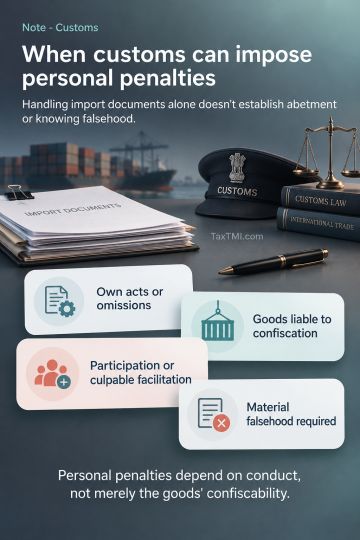
Confiscability of imported goods does not, by itself, establish the personal liability of every intermediary who handled the import documents. Penalty for abetment under Section 112(a) of the Customs Act, 1962 requires examination of the intermediary's own conduct. Section 114AA separately requires proof of knowing or intentional involvement with materially false or incorrect declarations, statements or documents.

In 2026 (10) TMI 1257 - CESTAT KOLKATA, the tribunal upheld deletion of both penalties against an intermediary whose involvement was confined to introducing persons and forwarding documents to a licensed Customs Broker. The decision illustrates the distinction between participation in the documentary chain and proved participation in the underlying customs contravention.

2. Legal & Statutory Context

Confiscability and the personal penalty nexus

Section 111 of the Customs Act, 1962 identifies improperly imported goods liable to confiscation. Relevant statutory categories include dutiable or prohibited goods concealed in a conveyance under clause (e), goods of that description concealed in a package under clause (i), and, under clause (m), goods which do not correspond "in respect of value or in any other particular" with the entry made under the Act. These provisions supply the confiscation framework; they do not independently establish an intermediary's penal liability.

Section 112(a) of the Customs Act, 1962 applies to any person who, in relation to goods, "does or omits to do any act which act or omission would render such goods liable to confiscation under section 111, or abets the doing or omission of such an act". The provision therefore distinguishes a person whose own act or omission creates the confiscation exposure from a person alleged to have abetted that conduct.

The penalty originally imposed on the respondent intermediary was under Section 112(a)(i). For goods in respect of which a prohibition is in force under the Act or another law, clause (i) prescribes a penalty "not exceeding the value of the goods or five thousand rupees, whichever is the greater". The tribunal did not determine the quantum because the foundation of personal liability failed.

Section 112(b), by contrast, concerns specified dealings with goods which the person "knows or has reason to believe are liable to confiscation under section 111". Although the notice also proposed action under that provision, no penalty under Section 112(b) was imposed. Its relevance here is the express distinction in statutory language, not an additional ground of liability.

The express mental element in false-document liability

Section 114AA of the Customs Act, 1962 provides: "If a person knowingly or intentionally makes, signs or uses, or causes to be made, signed or used, any declaration, statement or document which is false or incorrect in any material particular, in the transaction of any business for the purposes of this Act", that person is liable to a penalty not exceeding five times the value of goods.

The operative requirements are cumulative: identifiable documentary conduct, material falsity or incorrectness, a connection with business for customs purposes, and the prescribed knowledge or intention. The provision reaches a person who causes a document to be used, even without personally preparing or signing it. Conversely, mere physical transmission does not dispense with proof of the mental element.

The importer's statutory responsibilities

Section 17(1) of the Customs Act, 1962 requires an importer entering goods under Section 46 to "self-assess the duty, if any, leviable on such goods", subject to the stated statutory exception. Section 46(4) of the Customs Act, 1962 requires the importer to make and subscribe to a declaration concerning the truth of the bill of entry and produce the supporting invoice and prescribed documents.

Section 46(4A) additionally requires the importer to ensure "the accuracy and completeness" of the information, "the authenticity and validity" of supporting documents, and compliance with applicable restrictions or prohibitions. These duties explain why an importer's declaration cannot automatically be attributed to a document-forwarding intermediary. They do not, however, immunise an intermediary whose own abetment or knowing documentary misconduct is proved.

3. Interpretative Issues

The first issue is whether strict liability for an act rendering goods confiscable also eliminates the culpability inherent in an allegation of abetment. The two inquiries should not be conflated. Where the department relies on a person's own operative act or omission, the direct limb of Section 112(a) requires examination. Where it relies on assistance given to another person's contravention, it must establish the ingredients of abetment.

The second issue concerns the meaning of "uses" and "causes to be ... used" in Section 114AA. These expressions prevent liability from being confined to the document's author. Nevertheless, their breadth remains qualified by "knowingly or intentionally" and "false or incorrect in any material particular". A false import description and an intermediary's handling of that description are distinct evidentiary propositions.

The third issue is evidentiary. Proof of abetment need not invariably take the form of an admission or direct evidence of a fraudulent agreement. Conduct and corroborated circumstances may establish intentional assistance. Equally, suspicion arising from professional involvement, contacts or presence at examination cannot substitute for a reasoned connection with the contravention.

4. Detailed Commentary & Analysis

The respondent intermediary's limited role

The respondent intermediary was neither the importer, the declarant nor the Customs Broker. Documents passed through a chain of intermediaries before reaching the licensed broker. Examination disclosed areca nuts concealed behind bags of ammonium chloride, although the invoice described the goods as ammonium chloride. The investigation identified other persons as having planned and financed the concealment, and the actual beneficiary stated that he did not know the respondent intermediary.

The respondent intermediary argued that he had neither stuffed, shipped, invoiced, declared nor financed the goods. He also submitted that the concealment and misdeclaration were already complete before his involvement. The important distinction is that these were submissions concerning the causal and temporal limits of his role; the tribunal's operative reasoning rested on the department's failure to prove involvement or knowledge.

The tribunal's decisive inquiry

The tribunal expressly separated confiscability from personal liability. Its questions were whether the respondent intermediary had committed or abetted an act attracting Section 112(a), and whether he had knowingly or intentionally engaged in the documentary conduct covered by Section 114AA. It upheld the first appellate authority's negative findings on both questions and dismissed the department's appeal.

The department produced no evidence establishing the respondent intermediary's knowledge of the offending import or beneficial involvement. Introducing one person to another did not establish participation in the import arrangement. The outcome was therefore evidence-specific, rather than a categorical exemption for intermediaries.

Knowledge must relate to the offending conduct

The respondent intermediary was present during examination and communicated the discovery to another person, advising that person to approach customs authorities. Awareness acquired when concealment is discovered does not, without further evidence, establish earlier knowledge or intentional facilitation. Documentary handling must likewise be evaluated against what the intermediary knew when undertaking the relevant act.

Absence of beneficial ownership or financial gain supported the factual conclusion, but neither Section 112(a)'s abetment limb nor Section 114AA makes personal enrichment an indispensable statutory condition. An unpaid facilitator may still incur liability if the required conduct and culpability are established.

5. Judicial / Administrative Perspective

Strict liability for the direct act of importation

In 2024 (2) TMI 98 - DELHI HIGH COURT, imports were made using forged WPC licences. The court held that confiscation under Section 111(d) did not require mens rea and that Section 112(a) operated on a strict-liability basis where the importers' acts rendered the goods confiscable. It contrasted Section 112(b)'s knowledge requirement with Section 114AA's knowing or intentional documentary misconduct. The relevance is that absence of knowledge is not a universal defence to every application of Section 112(a). The inquiry must first identify the conduct and statutory limb relied upon.

Abetment by a Customs House Agent

In 2019 (11) TMI 72 - DELHI HIGH COURT, the issue was whether a Customs House Agent's processing of forged exemption certificates justified penalties. The investigation did not establish active involvement or conscious participation in the forgery. The court upheld deletion of penalties under Sections 112(b) and 114AA because the requisite knowledge was absent. For Section 112(a), it distinguished the broader operation of the provision from liability specifically founded on abetment, which required material establishing participation or culpable facilitation. This distinction directly supports scrutiny of the respondent intermediary's individual role.

A coherent reading of these authorities distinguishes direct causative conduct from alleged abetment. The strict-liability analysis does not justify treating every person in a documentary chain as an abettor. Nor does the abetment analysis establish a universal mens rea requirement for the entire provision.

Specific evidence against professional participants

In 2018 (3) TMI 121 - CESTAT BANGALORE, penalties against a Chartered Engineer, Customs House Agent and local representative were examined. The tribunal required clear, cogent evidence of specific conduct establishing abetment; filing a bill of entry or performing a limited professional role was insufficient by itself. Customs officers had participated in examination, and the adjudication lacked reliable evidence of knowing assistance. Section 114AA liability against the Chartered Engineer also failed for want of material showing the making or use of a false document. The decision illustrates that professional participation cannot replace proof of statutory ingredients.

Intentional assistance proved through circumstances

In 2010 (5) TMI 36 - DELHI HIGH COURT, the person penalised monitored postal parcels, informed an intermediary, failed to report missing mandatory declarations and received payments. Statements and surrounding circumstances supported intentional assistance. The court explained abetment through instigation, conspiracy or intentional aiding and upheld liability on a preponderance of probabilities. Unlike neutral forwarding, the coordinated conduct supplied an evidentiary basis for inferring participation. The decision also confirms that customs penalty proceedings do not require proof beyond reasonable doubt.

Corroboration and the evidentiary matrix

In 2015 (3) TMI 820 - DELHI HIGH COURT, abetment findings rested on statements supported by call-detail records, transport evidence, airline records and other documentary material. The court upheld the inference of knowledge, intention and common interest on a preponderance of probabilities. The significance lies in corroboration: communications were not considered in isolation but as part of an interconnected factual record. Its rejection of a cross-examination challenge was also contextual, involving disclosed material, belated requests and corroborative evidence; it does not establish that procedural objections are invariably immaterial.

Dereliction of duty distinguished from abetment

In 2015 (1) TMI 260 - CESTAT MUMBAI, export-related penalties under Section 114(iii) failed because the evidence established, at most, inadequate examination or dereliction of duty, not knowing assistance in fraudulent exports. Telephone records and supervisory statements did not establish the alleged abetment. The tribunal also considered the absence of material rebutting good faith in the context of Sections 155 and 106. Its relevance is analogical: negligent performance and culpable assistance are different concepts, although the statutory setting concerned exports and customs officers.

Affirmative false certification distinguished

In 2005 (10) TMI 159 - CESTAT, NEW DELHI, a customs inspector admitted certifying conformity without examining the export goods. Re-examination disclosed a materially different consignment, and the record included an intermediary connection and findings concerning consideration for favourable reports. The tribunal upheld the Section 114 penalty and rejected the asserted Section 155 protection. Unlike mere deficient diligence, an affirmative certification unsupported by the examination it purported to record supplied concrete misconduct. The decision does not make personal financial benefit a universal ingredient of abetment.

Regulatory duties and agency attribution

In 2010 (4) TMI 661 - CESTAT, CHENNAI, an export-overvaluation penalty was founded on alleged facilitation by a Customs House Agent. Regulations 13 and 19 of the Customs House Agents Licensing Regulations, 2004 imposed advisory, due-diligence and supervisory duties. The adjudicating authority also invoked Section 147 on an agency-deeming basis, treating the exporter's acts as attributable to the agent unless disproved. Nevertheless, the tribunal found no evidence of knowing facilitation or reason to believe that valuation requirements were being violated and set aside the Section 117 penalty. Regulatory obligations did not cure the evidentiary deficiency in the abetment allegation.

Connivance cannot be presumed from clearance activity

In 2013 (6) TMI 589 - GUJARAT HIGH COURT, prohibited non-basmati rice was exported in place of declared basmati rice. The court found no evidence that the Customs House Agent knew of the substitution or connived in it. Customs examination and the resulting Let Export Order were relevant circumstances, while a stuffing-related trade-notice requirement did not justify presumed complicity. The Section 114(i) penalty was set aside. The principle assists documentary intermediaries, but customs clearance itself is not conclusive immunity where contrary evidence proves knowing participation.

False-document culpability must be individualised

In 1975 (1) TMI 23 - MADRAS High Court, fabricated or inflated invoices supported false income-tax returns. Section 277 of the Income-tax Act, 1961 required proof that the maker knew or believed the verification to be false, or did not believe it to be true. Liability was sustained against the knowledgeable signatory partner and attributed to the firm through that authorised partner; another partner was relieved for want of proof connecting him to knowing verification or document use. The analogy supports individualised culpability, but the criminal standard applied there must not displace the customs adjudicatory standard.

Separate justification for an additional documentary penalty

In 2015 (2) TMI 175 - CESTAT BANGALORE, misdeclaration attracted a sustained Section 114A penalty, but the additional Section 114AA penalty was deleted because no separate activity justified it beyond the conduct already penalised. Its relevance is the need for an independently articulated foundation for documentary liability. It does not establish a blanket prohibition on concurrent penalties under Sections 112(a) and 114AA; the respondent intermediary's case failed on proof of the respective ingredients, not a general rule against cumulation.

Administrative formulation

The administrative treatment is consistent with the statutory distinctions. Paragraph 5.1 of Offences and Penal Provisions - CBEC's Customs Manual 2025 reproduces Section 112's direct-conduct, abetment and knowing-dealing categories. Paragraph 8.1 of Offences and Penal Provisions - CBEC's Customs Manual 2025 retains Section 114AA's expressions "knowingly or intentionally" and "false or incorrect in any material particular", together with the ceiling of five times the value of goods. Neither formulation substitutes documentary proximity for the statutory requirements.

6. Implications & Observations

The decisions support a provision-specific and person-specific approach to adjudication:

  • Identify the act rendering the goods confiscable and distinguish it from the intermediary's alleged assistance.
  • Specify whether Section 112(a) liability rests on direct conduct or abetment, rather than using "facilitation" as a self-proving conclusion.
  • For Section 114AA, identify the declaration, statement or document, the materially false particular, the act of making, signing, using or causing use, and the evidence of knowledge or intention.
  • Assess statements, communications, payments and timing collectively. Neither isolated contact nor absence of personal gain is determinative.
  • Distinguish regulatory shortcomings from proved penal misconduct, without assuming that one necessarily excludes the other.

Document provenance, transmission records and contemporaneous instructions may help distinguish neutral handling from knowing facilitation. Presence during examination should be assessed according to what it proves about knowledge at the relevant time, not treated as retrospective proof of complicity.

At the appellate stage, a challenge to reasoned exoneration requires engagement with the evidentiary findings. In the respondent intermediary's case, the department did not identify material establishing the missing involvement or knowledge. Repetition of the allegation that an intermediary facilitated clearance did not answer that deficiency.

7. Concluding Remarks

Section 112(a) and Section 114AA address connected but distinct misconduct. The direct limb of Section 112(a) cannot be equated with its abetment limb, while Section 114AA expressly requires knowing or intentional documentary conduct. The tribunal's decision establishes no general immunity for intermediaries. Its central lesson is narrower: confiscable goods, false import documents and participation in a commercial chain do not, without the necessary evidentiary connection, establish personal penal liability.


Full Text:

2026 (10) TMI 1257 - CESTAT KOLKATA

Topics

Acts Income Tax