Loading...

⚠ ✕
❮ Top
☎ Help
☰
×

By creating an account you can:

Logo TaxTMI
Call Us / Help / Feedback✕

Contact Us At :

✉ E-mail: [email protected]

✆ To Call / Whatsapp, Check Contact Us

FAQs :

To know Frequently Asked Questions, Check FAQs

Most Asked Video Tutorials :

For more tutorials, Check Video Tutorials

Submit Feedback/Suggestion :

Email :
Please provide your email address so we can follow up on your feedback.
Category :
Description :
Min 15 characters 0/2000
Make Most of Text Search ✕
  1. Checkout this video tutorial: How to search effectively on TaxTMI.
  2. Put words in double quotes for exact word search, eg: "income tax"
  3. Avoid noise words such as : 'and, of, the, a'
  4. Sort by Relevance to get the most relevant document.
  5. Press Enter to add multiple terms/multiple phrases, and then click on Search to Search.
  6. Text Search
  7. The system will try to fetch results that contains ALL your words.
  8. Once you add keywords, you'll see a new 'Search In' filter that makes your results even more precise.
  9. Text Search
╳
Add to...
You have not created any category. Kindly create one to bookmark this item!
✕
Create New Category
Hide
Title :
Description :
❮❮ Hide
❮ Default View
Expand ❯❯
Close ✕
🔎 Filters / Advanced Search ❯
TEXT

Press 'Enter' to add multiple search terms. Rules for Better Search

Search In
Main Text + AI Text ❯
  • Main Text
  • Main Text + AI Text
  • AI Text
Law:
---- All Laws---- ❯
  • ---- All Laws----
  • Benami Property
  • Bill
  • Central Excise
  • Companies Law
  • Customs
  • DGFT
  • FEMA
  • GST
  • GST - States
  • IBC
  • Income Tax
  • Indian Laws
  • Money Laundering
  • SEBI
  • SEZ
  • Service Tax
  • VAT / Sales Tax
Types:
---- All Types ---- ❯
  • ---- All Types ----
  • Act Rules
  • Case Laws
  • Circulars
  • Manuals
  • News
  • Notifications
Sort By: ?
In Sort By 'Default', exact matches for text search are shown at the top, followed by the remaining results in their regular order.
Relevance Default Date
☰   Show Results ❯
    Service of GST Show Cause Notices and Orders through the Common Portal: Validity of Service, Hearing...
    News GST
    Bill-To Ship-To E-Way Bill Compliance, Portal Closure and Transit Controls: GST E-Way Bills: Rule 13...
    E-Way Bill Requirements Under Rule 138: GST E-Way Bill Framework for Movement of Goods, Transit Docu...
    Case Laws Customs
    Limits of Website Upload (of Notifications) as Notice for Delegated Legislation Where the Parent Sta...
    Case Laws Indian Laws
    Illegality of Arrest and Remand for Non-Supply of Written Grounds: The Two-Hour Pre-Remand Standard ...
    When Trademark Ownership Controversies Fall Outside Insolvency Adjudication: Application of the 'Nex...
    Locus Standi - Intervention by Homebuyer Societies in Insolvency Proceedings: Statutory Limits under...
    News Bill
    Rates of income-tax in respect of income liable to tax for the assessment year 2026-27 for the purpo...
    News Bill
    Tax rates under section 115BAC of the Income-tax Act, 1961
    News Bill
    Individual, HUF, association of persons, body of individuals, artificial juridical person.
    News Bill
    Co-operative Societies
    News Bill
    Firms
    News Bill
    Local authorities
    News Bill
    Companies
    News Bill
    Rates of income-tax in respect of income liable to tax for the tax year 2026-27 for the purposes of ...
    News Bill
    Tax rates under section 202
    News Bill
    Individual, HUF, association of persons, body of individuals, artificial juridical person.
    News Bill
    Co-operative Societies
    News Bill
    Firms
    News Bill
    Local authorities
❮
❯
❯❯
Maximize Maximize Maximize
0 / 200
Expand Note
Add to Folder

No Folders have been created

+

Are you sure you want to delete "My most important" ?

NOTE:

Notes
Showing Results for :
Reset Filters
Results Found:
Show All Summaries Hide All Summaries
Case Laws GST
Show AI Summary
Common Portal service requires effective access to complete GST notices and orders, preserving hearing rights and appellate limitation.
GST service through the Common Portal is an express statutory mode, but portal availability must be distinguished from effective service of an adjudicatory communication. Rule 142 preserves the distinction between a substantive show cause notice or order and its electronic summary in FORM GST DRC-01 or DRC-07. Electronic summaries do not, without more, demonstrate communication of complete allegations, grounds, facts and reasons. Portal-based service must be assessed by statutory compliance, accessibility of the complete communication, and the taxpayer's real opportunity to respond, particularly where appellate limitation is involved.
News GST
Show AI Summary
E-way bill compliance strengthens traceability through Ship-To GSTIN capture, voluntary closure, and disciplined transit controls.
Rule 138 and Rule 138A require pre-movement e-way bill generation, carriage of the prescribed invoice or challan documents, and distance-based validity, with cancellation confined to cases where goods are not transported as declared. The portal advisory adds mandatory Ship-To GSTIN capture in Bill-To/Ship-To transactions and a voluntary post-delivery closure facility, while circular guidance treats transporter godowns as an additional place of business when declared by the recipient. Enforcement under Section 129 and Section 130 distinguishes detention for transit contravention from confiscation linked to intent to evade tax, and minor e-way bill defects are described as technical lapses rather than automatic proof of evasion.
Act Rules GST
Show AI Summary
E-way bill compliance under GST rules governs prior movement information, transit documents, validity, cancellation, and special goods regimes.
Rule 138 of the Central Goods and Services Tax Rules, 2017 governs the e-way bill system for movement of goods and requires prior electronic information before movement begins in specified cases, generally where consignment value exceeds fifty thousand rupees. The rule allocates responsibility for Part A and Part B of FORM GST EWB-01 among registered persons, authorised transporters, e-commerce operators, courier agencies and fallback transporters, while also covering special cases such as job work, handicraft goods, consolidated movement and transport by road, rail, air or vessel. Rule 138A specifies the documents that must accompany the conveyance, Rule 138 provides validity, cancellation and exemption rules, and Rule 138F creates a special intra-State regime for notified precious goods.
Case Laws Customs
Show AI Summary
Import regulation: Gazette publication is required before a notification binds importers; website uploads do not suffice for enforceability.
Publication in the Official Gazette is a condition precedent to the enforceability of notifications under Section 3 of the Foreign Trade (Development and Regulation) Act, 1992; website uploads cannot substitute for Gazette promulgation. Internal references to the "date of this Notification" must be read as the Gazette publication date, and where a notification incorporates paragraph 1.05(b) of the Foreign Trade Policy, transitional protection applies if its objective conditions (LC established before imposition, timely registration, shipment within validity) are satisfied.
Case Laws Indian Laws
Show AI Summary
Arrest communication: written grounds generally required; oral only temporarily, written copy at least two hours before remand.
The obligation to communicate grounds of arrest applies across statutes and, as a rule, must be met by supplying written grounds in a language the arrestee understands. In exceptional exigencies oral communication at arrest is permissible temporarily, but a written copy must be provided within a reasonable time and no later than two hours before production for remand; remand papers must include the grounds and explain any delay. Non compliance renders the arrest and remand illegal, though authorities may seek fresh custody after supplying written grounds with reasons for earlier non supply.
Case Laws IBC
Show AI Summary
Trademark ownership disputes in insolvency require a clear nexus to CIRP; complex title issues belong to full proceedings.
A disputed trademark cannot be declared an asset of the corporate debtor in summary CIRP proceedings absent a demonstrable nexus with insolvency; where title turns on contested private transactions and rival claims, the approved resolution plan governs stakeholders and summary disposition that effectively alters plan rights is impermissible. Avoidance conclusions require properly pleaded applications, material and notice; absent these safeguards, invoking preferential or undervalued transaction provisions in collateral proceedings violates natural justice.
Case Laws IBC
Show AI Summary
Homebuyer societies' intervention in insolvency is limited; representation must follow authorised representative routes post-admission.
Locus standi under the IBC is stage-sensitive: pre-admission proceedings are in personam and participation is confined to the applicant and corporate debtor, while post-admission proceedings are in rem and allow broader standing subject to statutory channels. Individual allottees recognised as financial creditors must be represented through the Code's authorised-representation mechanisms rather than by separate societies asserting membership rights, and inherent tribunal powers cannot create substantive participatory rights absent statutory basis.
News Bill
Show AI Summary
Income-tax rates for assessment year 2026-27 remain unchanged; schedule placement for advance tax and salary TDS is preserved.
Tax rates for assessment year 2026-27 remain unchanged and continue to be prescribed either in specific sections of the Income-tax Act (including concessional regimes for domestic companies, cooperative societies and the alternate individual regime) or in the First Schedule. Rates formerly listed in Part III of the First Schedule to the Finance Act, 2025 - used for advance tax computation, TDS from salaries and charging tax payable in certain cases - are reclassified as Part I of the First Schedule for AY 2026-27.
News Bill
Show AI Summary
Tax rates under section 115BAC prescribe slab rates up to 30% with surcharge tiers and caps on dividend and capital gains.
Section 115BAC(1A) sets default slab rates for certain resident taxpayers ranging from nil up to 30% above Rs.24,00,000; these apply unless an option under section 115BAC(6) is exercised. Income-tax under clause (1A)(iii) is subject to surcharge tiers (10%, 15%, 25%) based on total-income thresholds, with the surcharge on dividend income and specified capital gains capped at 15% and a 15% cap also for associations of persons consisting only of companies. Marginal relief is available.
News Bill
Show AI Summary
Individual tax rates set in the Finance Bill 2026: progressive slabs with higher nil thresholds for senior residents.
The Finance Bill 2026 prescribes progressive income-tax slabs for individuals, HUFs, associations of persons, bodies of individuals and artificial juridical persons: nil up to Rs. 2,50,000; 5% on Rs. 2,50,001-5,00,000; 20% on Rs. 5,00,001-10,00,000; 30% above Rs. 10,00,000; with higher nil thresholds for resident senior citizens (Rs. 3,00,000 for 60-79 years; Rs. 5,00,000 for 80+), and states these rates mirror the prior year.
News Bill
Show AI Summary
Co-operative societies: the Finance Bill preserves the existing three-band income-tax rate structure (10%, 20%, 30%).
Specified income-tax rates for co-operative societies are set out in Paragraph B of Part I-A of the First Schedule to the Finance Bill. The Bill retains the existing three-band structure: 10% on income up to the first band, 20% on the middle band, and 30% on income above the top band, thereby preserving the prior rate structure for co-operative societies.
News Bill
Show AI Summary
Firms' income-tax rate unchanged at 30% under the Finance Bill, specified in Paragraph C of Part I-A.
The Finance Bill specifies the income-tax rate for firms in Paragraph C of Part I A of the First Schedule, maintaining the rate at 30%.
News Bill
Show AI Summary
Local authorities: income-tax rate remains 30% under Paragraph D of Part I-A of the First Schedule in the Finance Bill.
The Finance Bill specifies the income-tax rate for local authorities in Paragraph D of Part I-A of the First Schedule, fixing the rate at 30% and maintaining continuity for that taxpayer category.
News Bill
Show AI Summary
Union Budget corporate tax: 25% for smaller domestic firms, 30% generally, 35% for non-domestic, plus surcharge and 4% cess.
Domestic companies with turnover or gross receipts up to Rs. 400 crore are taxed at 25%; other domestic companies at 30%; non-domestic companies at 35% on income other than that chargeable at special rates. Surcharge rates are unchanged, with the surcharge not applying to income of a specified fund and with a 25% cap on surcharge for persons under the referenced preferential regime for income above Rs. 5 crore (excluding dividend income and certain capital gains). Marginal relief is provided where surcharge applies. A 4% Health and Education Cess applies on income-tax inclusive of surcharge, with no marginal relief for the cess.
News Bill
Show AI Summary
Income-tax rates for 2026-27 remain unchanged across specified sections and Part I-B of the First Schedule.
Income-tax rates for the tax year 2026-27 remain unchanged: rate provisions in the Act for domestic companies, individuals/HUFs/AOPs/BOIs/AJPs and cooperative societies and the rates set out in Part I-B of the First Schedule to the Bill are not amended and the existing rate structures continue to apply.
News Bill
Show AI Summary
Tax rates under section 202 set default slabs with surcharge bands, surcharge caps for specified cases, and marginal relief.
Tax rates under section 202 set graded default income-tax slabs for specified taxpayers for 2026-27, subject to an option to elect an alternative regime; a surcharge applies to higher total income bands (with inclusion rules for dividend income and capital gains), surcharge caps where alternative provisions apply and for certain associations of persons, and marginal relief to alleviate threshold impacts.
News Bill
Show AI Summary
Income-tax 2026-27: new slab rates, optional Part I-B age-based slabs, and revised surcharge caps and relief.
Section 202 prescribes progressive income-tax slabs for 2026-27 for individuals, HUFs, AOPs, BOIs and specified artificial juridical persons, while preserving an option under section 202(4) to adopt the Part I-B rates. Part I-B provides alternative slabs including age-based thresholds for senior and super senior residents. Computed tax (including specified dividend and capital gains) attracts a graduated surcharge with provisos capping surcharge on dividend/capital gains at 15%, limiting surcharge for company-only AOPs to 15%, and reducing the 37% surcharge to 25% for persons taxed under section 202; marginal relief applies.
News Bill
Show AI Summary
Co-operative societies: unchanged tax rates, tiered surcharge with marginal relief, and optional lower-rate tax regime with reduced surcharge.
Co-operative societies are taxed under Paragraph B of Part I B of the First Schedule with rates unchanged from the prior year. Surcharge applies in tiers according to total income, with marginal relief available to reduce surcharge impact where appropriate. A resident co-operative society that satisfies prescribed conditions may elect an alternative lower-rate tax regime; when elected, a specified lower surcharge percentage applies to that tax.
News Bill
Show AI Summary
Firms: income-tax rate unchanged; 12% surcharge over one crore rupees with a cap limiting additional tax.
Firms continue to pay the same specified rate of income-tax as in the prior year. A 12% surcharge applies where a firm's total income exceeds one crore rupees, but the total tax plus surcharge on income exceeding one crore rupees is limited so it does not exceed the tax on one crore rupees by more than the excess income.
News Bill
Show AI Summary
Local authorities face the same income-tax rate with a 12% surcharge above one crore, subject to a cap.
Local authorities remain subject to the same income-tax rate as specified in Paragraph D of Part I-B of the First Schedule; a 12% surcharge on such income-tax applies where total income exceeds one crore rupees, but the combined income-tax and surcharge on income above one crore is limited so it does not exceed the income-tax on one crore rupees by more than the excess amount.

TMI Notes

Back

All TMI Notes

Showing Results for :
Reset Filters
No Records Found

TMI Notes

Subcontracted Services on Own Account and the Intermediary Exclusion under Section 2(13)

6 November, 2026

Contents
Circulars
Acts
Rules & Regulations
Plus +
Summary
Note

Note

-

Bookmark

(New) -

Download

Print

Print

This is a neutral professional article. The judgment is analysed in the context of its factual background, issues framed, and conclusions reached by the Court.

2026 (10) TMI 1143 - GSTAT NEW DELHI-[PB]

At a Glance

  • A subcontractor actually performing contracted services on its own account is distinguishable from an intermediary merely arranging or facilitating another person's supply.
  • The existence of several participants in a commercial chain does not, by itself, establish intermediary services. The relevant arrangement must disclose a main supply and a separate arranging or facilitating supply.
  • Independent-contractor obligations, responsibility for deliverables, contractual relationships, invoicing and consideration must be examined together. Neither contractual nomenclature nor the remuneration method is conclusive in isolation.
  • Exclusion from intermediary status does not automatically establish an export. All five conditions in Section 2(6) of the Integrated Goods and Services Tax Act, 2017 must be satisfied.

Background & Context

Marketing, recruitment support and customer-facing activities frequently involve interaction with persons other than the contractual recipient. The central classification question is whether the Indian supplier performs an identifiable service for the overseas recipient or merely brings about a supply between other persons.

In 2026 (10) TMI 1143 - GSTAT NEW DELHI-[PB], the taxpayer supplied marketing, promotional, business-support and IT-enabled services to an overseas recipient under a master services agreement. The overseas recipient separately contracted with foreign educational institutions and local recruitment advisers. The advisers interacted with prospective students and received enrolment-linked commission.

The taxpayer's arrangement was different. It received cost-plus remuneration in convertible foreign exchange, operated as an independent contractor and was restricted from undertaking obligations for the overseas recipient without prior written instruction. It was not a party to the advisers' agreements and did not invoice either the educational institutions or the advisers.

The department treated activities such as supporting advisers, liaising with recruitment agents and assisting admission processes as facilitation of education services. Refund claims were consequently rejected. The tribunal instead held that the taxpayer performed subcontracted services on its own account, qualified as an exporter of services and was entitled to refund relief in its appeals.

Key Issues / Provisions

The intermediary definition and its express exclusion

Section 2(13) of the IGST Act defines an intermediary as "a broker, an agent or any other person, by whatever name called, who arranges or facilitates the supply of goods or services or both, or securities, between two or more persons", but expressly excludes "a person who supplies such goods or services or both or securities on his own account". The exclusion is integral to the definition, not a discretionary concession.

The agency distinction also finds statutory support in Section 2(5) of the CGST Act: an agent carries on the business of supply or receipt of goods or services "on behalf of another". Under Section 2(93)(a), where consideration is payable, the recipient is "the person who is liable to pay that consideration". These definitions assist in distinguishing the contractual recipient from persons incidentally benefiting from performance.

Five cumulative conditions for export

Section 2(6) of the IGST Act requires:

  1. The supplier to be located in India.
  2. The recipient to be located outside India.
  3. The place of supply to be outside India.
  4. Payment to have been received in convertible foreign exchange, or in Indian rupees wherever permitted by the Reserve Bank of India.
  5. The supplier and recipient not to be "merely establishments of a distinct person" under Explanation 1 to Section 8.

The fifth condition concerns establishments of the same person. Explanation 1 to Section 8 of the IGST Act includes a person having an establishment in India and another outside India. Explanation 2 recognises business conducted through a branch, agency or representational office as an establishment in that territory.

Circular No. 161/17/2021-GST clarifies that an Indian-incorporated company and a separately incorporated foreign company are separate persons. An Indian subsidiary's supply to its foreign parent is therefore not barred by Section 2(6)(v) merely because of group ownership; the remaining export conditions must still be fulfilled.

Place of supply and the relevant period

Section 13(2) of the IGST Act provides that, except for services specified in sub-sections (3) to (13), the place of supply "shall be the location of the recipient of services". Where that location is unavailable in the ordinary course of business, the proviso substitutes the supplier's location.

For the disputed periods, Section 13(8)(b) prescribed the supplier's location for intermediary services. The tribunal records that the Finance Act, 2026 omitted that clause. The omission must be distinguished from the continuing definition in Section 2(13); it does not retrospectively resolve classification for earlier periods. The dispute concerned supplies preceding the omission.

Section 13(3)(b) separately addresses services "supplied to an individual", whether the recipient or a person acting for the recipient, requiring that individual's physical presence with the supplier. Mere interaction with students in India does not, without establishing these statutory conditions, displace the general recipient-location rule.

Detailed Analysis

Actual performance must be distinguished from commercial facilitation

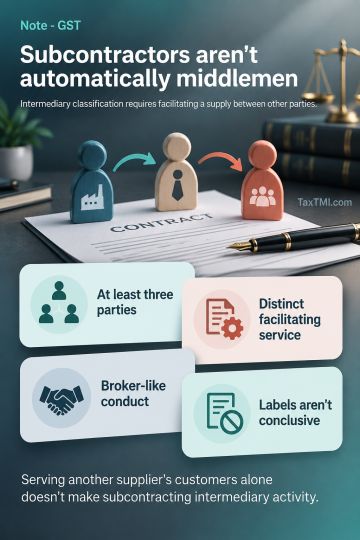
Circular No. 159/15/2021-GST identifies three foundational requirements: at least three parties, two distinct supplies, and the character of an agent, broker or similar person. The ancillary arranging or facilitating service must be "clearly identifiable and distinguished from the main supply". Counting every participant in the wider business chain is therefore insufficient.

Paragraph 3.5 states: "Sub-contracting for a service is not an intermediary service." Its explanation is substantive: the subcontractor supplies the main service, "either fully or a part thereof", rather than merely arranging its provision. The software-development illustration confirms that interaction with the principal contractor's customer does not change the character of an independently performed subcontract.

This distinction answers the department's argument that the taxpayer could not be a subcontractor because it did not itself provide education. The relevant enquiry was whether it performed the marketing and support obligations entrusted to it, not whether it delivered the ultimate educational programme. Otherwise, almost every outsourced business-support activity could be characterised as facilitating the recipient's downstream business.

Conversely, a bilateral agreement and invoicing to an overseas principal are not sufficient by themselves. The circular's machinery-sale illustration describes an intermediary invoicing only one principal. The decisive question remains whether the supplier performs the contracted service or arranges another supply between other persons.

The tribunal's application to the contractual arrangements

The tribunal treated the taxpayer's own-account performance, independent-contractor status and absence of agency powers as significant. The taxpayer used its own resources to perform substantive marketing and IT-enabled work. The separately contracted advisers' enrolment activities were not attributable to it merely because its work supported the same commercial objective.

Applying ejusdem generis, the tribunal read "any other person" in Section 2(13) in the context of the preceding expressions "broker" and "agent". It rejected an unrestricted interpretation encompassing an independent supplier simply because its services advanced another business's operations.

The cost-plus model reinforced this conclusion, particularly when contrasted with the advisers' success-linked commission. Nevertheless, payment terminology is evidentiary rather than determinative. The education-sector authorities discussed below demonstrate that commission-based remuneration does not invariably establish intermediary status.

GST authorities on subcontracted performance

In 2022 (11) TMI 743 - PUNJAB AND HARYANA HIGH COURT, the issue concerned BPO and IT services performed under a master subcontracting agreement. The taxpayer undertook deliverables, performance risks and service-level obligations for an overseas contractor, including direct delivery to that contractor's customers. The court held that actual performance was not arrangement or facilitation. The non-agency clause and absence of direct contracts with ultimate customers supported the conclusion, and the original refund order was restored. The decision establishes that customer-facing delivery under a subcontract is compatible with own-account supply.

That decision also applied consistency where the same agreement had previously been accepted and no material factual or legal change justified a different result. Its relevance is not that earlier acceptance overrides the statute, but that a changed classification requires a sustainable basis rather than a different description of unchanged contractual performance.

In 2025 (5) TMI 150 - KARNATAKA HIGH COURT, pre-sale and post-sale customer-support services supplied to foreign affiliates were examined against the same statutory and circular-based tests. The taxpayer performed the support service itself, was prohibited from acting as agent or entering sales contracts, and lacked contractual privity with end customers. The court rejected intermediary classification and quashed the refund rejection and recovery notice insofar as they rested on that finding. Other issues remained available for separate contest, illustrating that success on classification does not determine every refund objection.

Marketing and customer-support authorities under service tax

The doctrinal connection is express. Rule 2(f) of the Place of Provision of Services Rules, 2012 excluded a person providing "the main service or supplies the goods on his account". Circular No. 159/15/2021-GST recognises broad continuity between that definition and Section 2(13), apart from the addition of securities. Earlier decisions are therefore useful on classification, without transplanting their separate tax machinery into GST.

In 2023 (7) TMI 719 - DELHI HIGH COURT, marketing, administrative and support services were supplied under an independent-contractor agreement. The taxpayer could not represent or bind the overseas recipient, received cost-plus consideration unrelated to downstream sales and did not arrange a separate supply between other parties. The court upheld the conclusion that these were own-account services. This closely supports the distinction between performing marketing work and acting as a sales intermediary.

In 2023 (9) TMI 304 - DELHI HIGH COURT, the taxpayer supplied telecommunications infrastructure, customer care and billing support to an overseas recipient. It independently contracted with Indian operators on its own account. The court held that these arrangements represented substantive service provision rather than brokerage, and upheld export treatment and credit refund. The decision shows that procuring local inputs does not itself transform the supplier into an intermediary.

In 2024 (1) TMI 887 - CESTAT HYDERABAD, collections and contact-centre operations were performed under subcontracting and performance-level agreements. The taxpayer bore performance obligations to the overseas contractor, received cost-plus compensation and had no contractual privity with ultimate business partners. The tribunal held that the challenged activities formed part of the main service, not a separately identifiable facilitating supply. Its relevance lies in examining operational obligations rather than isolating customer-contact functions.

In 2025 (3) TMI 200 - CESTAT CHANDIGARH, promotional and marketing services were supplied as an independent contractor for cost-plus remuneration. The taxpayer invoiced the overseas recipient, had no customer contract and remained responsible for work it further subcontracted. The tribunal held that only the main promotional service was supplied, with no separate auxiliary facilitation service. Further outsourcing did not alter the taxpayer's responsibility or create intermediary status.

In 2024 (11) TMI 922 - CESTAT BANGALORE, research and development, marketing assistance, demonstrations and customer support were examined together. The agreements and invoices established principal-to-principal performance for the overseas recipient. The tribunal rejected the department's attempt to characterise those activities as mere facilitation and upheld export treatment. The decision reinforces that sales-related content does not dispense with proof of an intermediary arrangement.

In 2024 (10) TMI 147 - CESTAT NEW DELHI, brand-development and promotional obligations were performed on the taxpayer's own account. The tribunal found no contractual requirement to arrange another person's main service. Outsourcing some tasks did not change that conclusion, and the general recipient-location rule applied. The authority is relevant where a supplier remains responsible for an integrated service despite using subcontractors.

Education-sector comparisons

In 2024 (3) TMI 1178 - CESTAT NEW DELHI, recruitment, promotion, enrolment assistance and related liaison were performed for foreign universities. Although remuneration was described as commission, the taxpayer supplied the contracted services itself rather than arranging for a third party to perform them. The tribunal held that the services were exports and not intermediary services. The decision is particularly important against treating commission as a conclusive classification test.

In 2024 (8) TMI 399 - CESTAT CHANDIGARH, the taxpayer contracted only with an overseas education-services contractor, not with universities or students. For the period governed by the intermediary definition, the tribunal found subcontracted performance rather than a three-party facilitation arrangement. Export treatment was sustained. The contractual chain closely illustrates why the ultimate educational service and the independently performed subcontract must be identified separately.

The education-consultancy decision separately analysed by the GST tribunal concerned marketing and recruitment support supplied directly to foreign universities. The court held that incidental assistance to students did not establish intermediary status where the taxpayer did not charge students, bind universities or guarantee admission. The tribunal relied on that reasoning when accepting the taxpayer's export classification.

A further education-marketing authority discussed in that reasoning emphasised the contractual recipient, the person liable for consideration and the nature of the actual service. It rejected the proposition that advancing the foreign institution's business objective necessarily amounted to intermediary activity. This directly addresses attempts to substitute the location of an incidental beneficiary for the statutory enquiry.

The separately considered university-recruitment authority similarly held that recommending students did not make them the recipients of services paid for by foreign universities. Export relief remained subject to receipt of foreign-currency consideration. Its significance is the distinction between assisting an applicant operationally and supplying the contracted recruitment service to the university.

Other comparisons and contrary advance rulings

The sourcing-support authority analysed by the tribunal concerned supplier identification, factory visits, production monitoring and shipment support. Independent-contractor obligations, cost-plus remuneration, non-binding recommendations and the overseas recipient's freedom to select suppliers supported the conclusion that the taxpayer supplied business-support services on its own account. The comparison demonstrates that extensive coordination is not necessarily brokerage.

The tribunal also applied its earlier support-service reasoning that "any other person" must be understood in the context of broker-like or agent-like characteristics. Its relevance was to prevent an unrestricted reading of Section 2(13) that would override the express own-account exclusion.

The department relied on an advance ruling concerning vendor identification and quality monitoring, where the applicant was treated as facilitating supplies between its foreign holding company and Indian vendors. That conclusion turned on a facilitation character different from the subcontracted performance accepted here.

A separate advance ruling concerned promotion of foreign university courses for commission and classified the applicant as an intermediary. The contrasting education-sector decisions show why neither the industry description nor commission alone resolves the statutory enquiry.

The third advance ruling concerned support services to a foreign parent and also adopted intermediary classification. The tribunal declined to follow these advance rulings in preference to the High Court authorities. It did not establish a universal export rule for support services; it applied the judicial tests to the taxpayer's particular obligations.

Practical Implications

Classification requires a coherent contractual and evidentiary account. Relevant materials include the master agreement, service schedules, upstream contracts where necessary, adviser agreements, invoices, remittance evidence, transfer-pricing descriptions and records demonstrating actual deliverables. Expressions such as "liaison", "support" or "recruitment" require examination in their operational context.

  • Identify the precise service the taxpayer undertakes to perform and the person entitled to enforce that obligation.
  • Determine whether a separate supply between other principals is merely being arranged, rather than performed fully or partly by the taxpayer.
  • Examine authority to negotiate, represent or bind another person alongside responsibility for personnel, infrastructure and performance.
  • Reconcile invoicing, consideration and corporate identity. The tribunal rejected the identity objection where the relevant corporate change was not seriously disputed.
  • Test recipient location, payment realisation and separate legal personality independently of intermediary classification.

For refund consequences, Section 16(1)(a) of the IGST Act includes exports within "zero rated supply". For the disputed periods, Section 16(3)(a) permitted supply under bond or Letter of Undertaking without integrated tax and refund of unutilised credit, subject to prescribed requirements.

Section 54(3) of the CGST Act expressly recognises refund for "zero rated supplies made without payment of tax". Rule 89(2)(c) of the CGST Rules requires the export-service invoice statement and relevant Bank Realisation Certificates or Foreign Inward Remittance Certificates. Establishing export character therefore addresses the substantive classification objection, while applicable documentary and computation requirements remain relevant.

Key Takeaways

The governing distinction is between performing a service and arranging its performance by others. A subcontractor does not become an intermediary merely because it interacts with customers, supports recruitment or contributes to an overseas recipient's downstream business.

The tribunal's conclusion rests on the combined contractual and operational evidence: substantive own-account performance, independent responsibility, separate adviser arrangements and consideration received from the overseas recipient. Those features must be evaluated together, followed by a separate assessment of every export condition under Section 2(6). Export classification then provides the foundation-not a substitute-for compliance with the zero-rated refund framework.


Full Text:

2026 (10) TMI 1143 - GSTAT NEW DELHI-[PB]

Topics

Acts Income Tax