Loading...

⚠ ✕
❮ Top
☎ Help
☰
×

By creating an account you can:

Logo TaxTMI
Call Us / Help / Feedback✕

Contact Us At :

✉ E-mail: [email protected]

✆ To Call / Whatsapp, Check Contact Us

FAQs :

To know Frequently Asked Questions, Check FAQs

Most Asked Video Tutorials :

For more tutorials, Check Video Tutorials

Submit Feedback/Suggestion :

Email :
Please provide your email address so we can follow up on your feedback.
Category :
Description :
Min 15 characters 0/2000
Make Most of Text Search ✕
  1. Checkout this video tutorial: How to search effectively on TaxTMI.
  2. Put words in double quotes for exact word search, eg: "income tax"
  3. Avoid noise words such as : 'and, of, the, a'
  4. Sort by Relevance to get the most relevant document.
  5. Press Enter to add multiple terms/multiple phrases, and then click on Search to Search.
  6. Text Search
  7. The system will try to fetch results that contains ALL your words.
  8. Once you add keywords, you'll see a new 'Search In' filter that makes your results even more precise.
  9. Text Search
╳
Add to...
You have not created any category. Kindly create one to bookmark this item!
✕
Create New Category
Hide
Title :
Description :
❮❮ Hide
❮ Default View
Expand ❯❯
Close ✕
🔎 Filters / Advanced Search ❯
TEXT

Press 'Enter' to add multiple search terms. Rules for Better Search

Search In
Main Text + AI Text ❯
  • Main Text
  • Main Text + AI Text
  • AI Text
Law:
---- All Laws---- ❯
  • ---- All Laws----
  • Benami Property
  • Bill
  • Central Excise
  • Companies Law
  • Customs
  • DGFT
  • FEMA
  • GST
  • GST - States
  • IBC
  • Income Tax
  • Indian Laws
  • Money Laundering
  • SEBI
  • SEZ
  • Service Tax
  • VAT / Sales Tax
Types:
---- All Types ---- ❯
  • ---- All Types ----
  • Act Rules
  • Case Laws
  • Circulars
  • Manuals
  • News
  • Notifications
Sort By: ?
In Sort By 'Default', exact matches for text search are shown at the top, followed by the remaining results in their regular order.
Relevance Default Date
☰   Show Results ❯
    News Bill
    AGRICULTURE INFRASTRUCTURE AND DEVELOPMENT CESS (AIDC)
    News Bill
    AMENDMENT TO SEVENTH SCHEDULE TO THE FINANCE ACT, 2001
    News Bill
    EXEMPTION FROM CENTRAL EXCISE DUTY ON VALUE OF BIOGAS/COMPRESSED BIOGAS (CBG) CONTAINED IN BLENDED C...
    News Bill
    DEFERMENT OF DATE OF IMPLEMENTATION OF HIGHER EXCISE DUTY ON SALE OF UNBLENDED DIESEL
    News Bill
    AMENDMENTS IN THE CGST ACT, 2017
    News Bill
    AMENDMENTS IN THE IGST ACT, 2017
    Intermediary Services Under Section 2(13) of the IGST Act and Export of Services Under Section 2(6):...
    Distinction Between Setting Aside an Illegal Bail Order and Cancellation of Bail: Revisional Scrutin...
    Case Laws Income Tax
    Section 153C (Finance Act, 2015) and Third-Party Search Assessments: Interplay of Belongs To and Per...
    Case Laws Income Tax
    Effect of Section 92CA(1) Reference on Assessment Limitation: Application of Section 153(4) in Trans...
    Case Laws Income Tax
    Digital Material Recovered in Search under Section 132 and Its Nexus with the Non-Searched Person: C...
    Refund Disputes Linked to Rule 96(10) and Rule 89(4B): Consequences of Omission of Rules Without Exp...
    Service Mechanisms (for Notices and SCN) in GST: Deemed Service, Portal Availability, and Statutory ...
    Case Laws Customs
    Due Compliance with Section 138C(4) of the Customs Act, 1962 for Admissibility of Electronic Records...
    Case Laws Customs
    Sequential Application of the General Rules for Interpretation in Customs Tariff Classification unde...
    Section 74 CGST Proceedings and the Impermissibility of Clubbing Multiple Financial Years in a Singl...
    Composite Show Cause Notices Under Section 74 of the CGST Act, 2017 and the Requirement of Tax-Perio...
    Case Laws Customs
    Reverse Burden, Ownership Attribution, and Proof in Gold Seizure Cases: Reaffirming Procedural Safeg...
    Case Laws Income Tax
    Section 68, Loan Credits, and the Limits of Suspicion: Evidentiary Discipline in Search-Linked Asses...
    Case Laws Income Tax
    JAO vs. FAO: Reassessment in the Faceless Era: The Continuing Validity of JAO Jurisdiction Pending S...
❮
❯
❯❯
Maximize Maximize Maximize
0 / 200
Expand Note
Add to Folder

No Folders have been created

+

Are you sure you want to delete "My most important" ?

NOTE:

Notes
Showing Results for :
Reset Filters
Results Found:
Show All Summaries Hide All Summaries
News Bill
Show AI Summary
New aircraft rubber pneumatic tyres continue to attract 0.5% agriculture infrastructure and development cess from 02.02.2026.
New pneumatic tyres of rubber used on aircraft under tariff item 4011 30 00 will continue to attract a 0.5% Agriculture Infrastructure and Development Cess. The notification entry is amended to omit reference to a removed exemption entry with effect from 02.02.2026, without changing the 0.5% AIDC rate for these goods (other than those with nil basic customs duty).
News Bill
Show AI Summary
Chewing and related tobacco NCCD schedule rates raised to 60% from May 1, 2026, while effective rate stays 25%.
Seventh Schedule to the Finance Act, 2001 is amended to raise NCCD rates from 25% to 60% for HS 2403 99 10 (chewing tobacco), HS 2403 99 30 (jarda scented tobacco) and HS 2403 99 90 (other tobacco products including gutkha) effective 01.05.2026, while a notification will maintain the applied effective rate at 25%.
News Bill
Show AI Summary
Biogas/CBG in blended CNG: value and related taxes excluded from transaction value for central excise from 02.02.2026.
The value of Biogas/Compressed Biogas (CBG) contained in blended CNG, and the central, state, union territory or integrated taxes paid on that Biogas/CBG, are excluded from the transaction value for computing central excise duty on blended CNG; the exclusion is effected by amending the existing notification framework and takes effect from 02.02.2026, with the prior GST-only relief rescinded.
News Bill
Show AI Summary
Unblended diesel additional excise duty implementation deferred until 31.03.2028 by amendment to existing notification effective immediately.
The additional excise duty of Rs.2 per litre on unblended diesel is deferred until 31.03.2028 by amendment of Notification No. 11/2017 Central Excise through Notification No. 02/2026 Central Excise (01.02.2026), thereby postponing the levy of the higher duty on unblended diesel.
News Bill
Show AI Summary
Goods and Services Tax: amendments remove discount-agreement link, expand refund scope, and allow interim appellate authorities.
Amendments remove the requirement that a post-sale discount be linked to an agreement and prescribe issuance of a credit note under section 34 when input tax credit is reversed; section 34 is amended to reference section 15. Section 54 is amended to extend provisional refunds to inverted duty structure claims and to remove the sanction threshold for refunds on exported goods with tax paid. Section 101A gains sub-section (1A) allowing the Central Government to notify an existing authority or tribunal to hear appeals under section 101B pending the National Appellate Authority, with sub-sections (2)-(13) not applying where such empowerment occurs, effective 01.04.2026.
News Bill
Show AI Summary
Place of supply for intermediary services will follow the IGST Act default provision after omission of the specific clause.
The amendment omits clause (b) of sub section (8) of section 13 of the Integrated Goods and Services Tax Act, 2017 so that the place of supply for intermediary services will be determined by the default provision in section 13(2) of the IGST Act, aligning intermediary services with the Act's general place of supply framework.
Case Laws GST
Show AI Summary
Education consultancy commissions treated as exportable services, not intermediary services, where foreign institution is the contracting recipient.
The Court held that the intermediary test focuses on whether a person merely "arranges or facilitates" a supply, excluding those who supply on their own account; where agreements and consideration establish a principal-to-principal supply to foreign educational institutions, the services qualify as export of services and not intermediary services, making place of supply the recipient's location and supporting refund entitlement.
Case Laws GST
Show AI Summary
GST arrests: Court set aside bail premised on format defects where substantive compliance and no demonstrable prejudice existed.
The High Court held that a challenge to the legal sustainability of a bail order is distinct from cancellation for supervening conduct and, on the facts, found substantive compliance with CGST arrest safeguards (including authorisation recording reasons to believe and supply of arrest memo and grounds) and BNSS Sections 47-48 when assessed through a prejudice oriented test; absence of statutory headings or non enclosure of detailed grounds with the relative did not, without demonstrable prejudice, justify the magistrate's bail order, which was set aside and the bail bonds cancelled with liberty to apply afresh.
Case Laws Income Tax
Show AI Summary
Section 153C: amended trigger applies if seized material is received post amendment, widening third party assessment scope.
The substituted text widens the jurisdictional trigger for third party assessments from strict ownership to where books or documents "pertain to" or contain information that "relates to" the other person; the first proviso's deeming fiction makes the date of receipt of seized material by the other person's Assessing Officer the operative reference point, so if receipt, satisfaction and issuance of notice occur after the amendment, the amended provision governs, subject to the requirement of recorded satisfaction that the material bears on determination of total income.
Case Laws Income Tax
Show AI Summary
Transfer pricing assessments: outer statutory limitation governs final orders; DRP deadlines do not enlarge the overall limitation.
The tribunal permitted admission of additional legal grounds based on facts on record and held that the outer statutory limitation governs final assessments in eligible-assessee transfer pricing cases. The dispute-resolution procedural deadline requires prompt action after directions but does not enlarge the overall limitation; statutory extension available for transfer pricing references is to be applied to the outer limit, and external judicial limitation extensions do not extend the time for completing original assessments.
Case Laws Income Tax
Show AI Summary
Digital material recovered in a third party search cannot alone justify invoking Section 153C without a direct nexus to the non searched person.
Section 153C jurisdiction requires seized or requisitioned books of account or documents from a search that relate to or pertain to a non searched person; digital images recovered in a third party search that did not name or connect the petitioners could not sustain Section 153C. The Assessing Officer's reliance on post search forms, voluntary supply of documents, public domain inquiries, and an inferential consideration mismatch rendered the recorded satisfaction de hors the statutory trigger, allowing writ relief for jurisdictional defect.
Case Laws GST
Show AI Summary
GST refund and recovery proceedings founded solely on omitted rules lapse absent express saving clause.
Omission of Rule 89(4B) and Rule 96(10) without an express saving clause causes pending proceedings and non-final orders founded solely on those rules to lapse, except for transactions past and closed. The General Clauses Act's preservation principle does not apply to omissions effected by subordinate rules/notification, and transitional or laying provisions of the parent statute do not operate as omnibus saving clauses. Consequently, undisposed show cause notices and orders dependent only on the omitted rules were quashed and affected refund applications were remitted for reconsideration after hearing within a stipulated period.
Case Laws GST
Show AI Summary
GST electronic service by portal or email may not trigger appeal limitation absent verifiable communication or retrieval evidence.
Whether portal upload or e-mail intimation automatically triggers the limitation period under Section 107 depends on whether such electronic modes fall within the statutory deeming fictions of Section 169(2) or Section 169(3). Although Section 169(1)(c)-(d) and Rule 142 permit electronic service, the express deeming consequences are confined to specified modes; absent acknowledgement or verifiable retrieval logs, IT Act presumptions of dispatch/receipt do not alone establish communication for appeal limitation.
Case Laws Customs
Show AI Summary
Electronic evidence admissibility in customs proceedings: contemporaneous extraction records and Section 108 statements can satisfy the certificate requirement.
The Court held that contemporaneous extraction/printing records, device particulars, and un-retracted Section 108 statements acknowledging computer printouts can constitute substantive due compliance with Section 138C(4) of the Customs Act, 1962; a certificate not in prescribed format will not automatically invalidate admissibility where authenticity is not disputed, while other statutory evidentiary issues (including Section 138B) remain open for adjudication.
Case Laws Customs
Show AI Summary
Aluminium shelving classed by import condition: use allowed only if statutorily permitted; supports aren't parts at import.
Classification requires sequentially applying GRI 1 with relevant Section and Chapter Notes; aligned HSN Explanatory Notes guide interpretation. Use is relevant only where permitted and must reflect intended use objectively evident at importation per the as imported principle. A "part" must have an essential functional nexus to machine operation; mere supporting platforms or shelves that do not contribute mechanically to operation are not parts and may instead fall under material-based structure headings.
Case Laws GST
Show AI Summary
Composite GST show cause notices spanning multiple financial years misalign tax-period limitation and may be quashed.
Issuance of a single consolidated show cause notice covering distinct financial years was held impermissible because GST liability is tethered to tax-period returns and limitation timelines; consolidation misaligns period-specific adjudication clocks, constitutes a jurisdictional defect, and warrants quashing with liberty to re-issue notices in strict conformity with the period-wise statutory scheme.
Case Laws GST
Show AI Summary
Composite GST show cause notices aggregating multiple financial years lack scope; demands must be period-specific and limitation-linked.
The GST demand-and-recovery framework is period-based: tax liability and limitation are tied to returns for each tax period or financial year, and limitation is computed from the annual return due date or an erroneous return for that year. Consolidating multiple financial years into one consolidated show cause notice is outside the statutory design and constitutes a jurisdictional defect; administrative advisories cannot override the period-specific statutory scheme. Authorities may, if no other impediment exists, initiate proceedings framed strictly period-wise under the applicable demand provisions.
Case Laws Customs
Show AI Summary
Gold/jewellery cases require mandatory section 138B admissibility for investigation statements before proving ownership or smuggling links.
Section 138B creates a mandatory admissibility regime for section 108 investigation statements: unless clause (a) applies, the maker must be examined before the adjudicating authority and an admissibility opinion recorded before using those statements to prove truth. Ownership cannot be fixed on an appellant where such statements are excluded, and confiscation/penalty theories for jewellery must follow the correct statutory route-section 111 for imported goods and section 120 when alleging goods are made from smuggled inputs. Documentary explanations require verification before rejection.
Case Laws Income Tax
Show AI Summary
Unsecured loans through banking channels cannot be treated as unexplained credits absent transaction specific incriminating material.
Unsecured bank routed loans cannot be treated as unexplained credits where the assessee produced confirmations, lender bank statements, audited accounts and tax filings, and the Assessing Officer relied chiefly on uncorroborated third party search statements or administrative press releases without transaction specific incriminating material. For years prior to the Finance Act, 2022 amendment, a generalized source of source obligation for loan credits is not mandated; repayments in the lender's account are distinct from fresh upstream borrowings. Appellate authorities may independently verify facts under their powers if the AO is given opportunity to respond.
Case Laws Income Tax
Show AI Summary
Reassessment jurisdiction: both JAO and FAO held to have concurrent authority, pending apex resolution of the faceless regime.
The Delhi High Court holds that both JAO and FAO possess concurrent jurisdiction to initiate reassessment under Section 148, construing Section 151A as administrative/enabling rather than jurisdiction-extinguishing. It reasons that routine SLP dismissals do not automatically create binding Article 141 precedent to overturn a coordinate-bench High Court view, and declines to treat the Delhi precedent as per incuriam absent a contrary Supreme Court ratio; interim apex stays are case-specific and do not displace the Delhi position.

TMI Notes

Back

All TMI Notes

Showing Results for :
Reset Filters
No Records Found

TMI Notes

Subcontracted Services on Own Account and the Intermediary Exclusion under Section 2(13)

6 November, 2026

Contents
Circulars
Acts
Rules & Regulations
Plus +
Summary
Note

Note

-

Bookmark

(New) -

Download

Print

Print

This is a neutral professional article. The judgment is analysed in the context of its factual background, issues framed, and conclusions reached by the Court.

2026 (10) TMI 1143 - GSTAT NEW DELHI-[PB]

At a Glance

  • A subcontractor actually performing contracted services on its own account is distinguishable from an intermediary merely arranging or facilitating another person's supply.
  • The existence of several participants in a commercial chain does not, by itself, establish intermediary services. The relevant arrangement must disclose a main supply and a separate arranging or facilitating supply.
  • Independent-contractor obligations, responsibility for deliverables, contractual relationships, invoicing and consideration must be examined together. Neither contractual nomenclature nor the remuneration method is conclusive in isolation.
  • Exclusion from intermediary status does not automatically establish an export. All five conditions in Section 2(6) of the Integrated Goods and Services Tax Act, 2017 must be satisfied.

Background & Context

Marketing, recruitment support and customer-facing activities frequently involve interaction with persons other than the contractual recipient. The central classification question is whether the Indian supplier performs an identifiable service for the overseas recipient or merely brings about a supply between other persons.

In 2026 (10) TMI 1143 - GSTAT NEW DELHI-[PB], the taxpayer supplied marketing, promotional, business-support and IT-enabled services to an overseas recipient under a master services agreement. The overseas recipient separately contracted with foreign educational institutions and local recruitment advisers. The advisers interacted with prospective students and received enrolment-linked commission.

The taxpayer's arrangement was different. It received cost-plus remuneration in convertible foreign exchange, operated as an independent contractor and was restricted from undertaking obligations for the overseas recipient without prior written instruction. It was not a party to the advisers' agreements and did not invoice either the educational institutions or the advisers.

The department treated activities such as supporting advisers, liaising with recruitment agents and assisting admission processes as facilitation of education services. Refund claims were consequently rejected. The tribunal instead held that the taxpayer performed subcontracted services on its own account, qualified as an exporter of services and was entitled to refund relief in its appeals.

Key Issues / Provisions

The intermediary definition and its express exclusion

Section 2(13) of the IGST Act defines an intermediary as "a broker, an agent or any other person, by whatever name called, who arranges or facilitates the supply of goods or services or both, or securities, between two or more persons", but expressly excludes "a person who supplies such goods or services or both or securities on his own account". The exclusion is integral to the definition, not a discretionary concession.

The agency distinction also finds statutory support in Section 2(5) of the CGST Act: an agent carries on the business of supply or receipt of goods or services "on behalf of another". Under Section 2(93)(a), where consideration is payable, the recipient is "the person who is liable to pay that consideration". These definitions assist in distinguishing the contractual recipient from persons incidentally benefiting from performance.

Five cumulative conditions for export

Section 2(6) of the IGST Act requires:

  1. The supplier to be located in India.
  2. The recipient to be located outside India.
  3. The place of supply to be outside India.
  4. Payment to have been received in convertible foreign exchange, or in Indian rupees wherever permitted by the Reserve Bank of India.
  5. The supplier and recipient not to be "merely establishments of a distinct person" under Explanation 1 to Section 8.

The fifth condition concerns establishments of the same person. Explanation 1 to Section 8 of the IGST Act includes a person having an establishment in India and another outside India. Explanation 2 recognises business conducted through a branch, agency or representational office as an establishment in that territory.

Circular No. 161/17/2021-GST clarifies that an Indian-incorporated company and a separately incorporated foreign company are separate persons. An Indian subsidiary's supply to its foreign parent is therefore not barred by Section 2(6)(v) merely because of group ownership; the remaining export conditions must still be fulfilled.

Place of supply and the relevant period

Section 13(2) of the IGST Act provides that, except for services specified in sub-sections (3) to (13), the place of supply "shall be the location of the recipient of services". Where that location is unavailable in the ordinary course of business, the proviso substitutes the supplier's location.

For the disputed periods, Section 13(8)(b) prescribed the supplier's location for intermediary services. The tribunal records that the Finance Act, 2026 omitted that clause. The omission must be distinguished from the continuing definition in Section 2(13); it does not retrospectively resolve classification for earlier periods. The dispute concerned supplies preceding the omission.

Section 13(3)(b) separately addresses services "supplied to an individual", whether the recipient or a person acting for the recipient, requiring that individual's physical presence with the supplier. Mere interaction with students in India does not, without establishing these statutory conditions, displace the general recipient-location rule.

Detailed Analysis

Actual performance must be distinguished from commercial facilitation

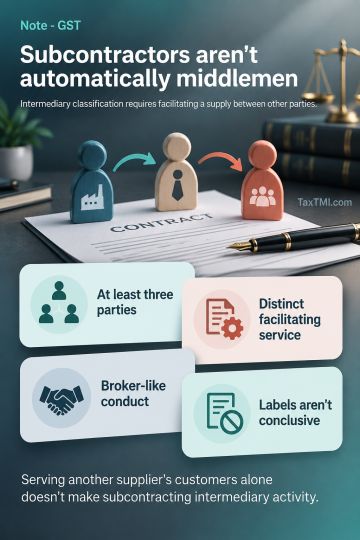
Circular No. 159/15/2021-GST identifies three foundational requirements: at least three parties, two distinct supplies, and the character of an agent, broker or similar person. The ancillary arranging or facilitating service must be "clearly identifiable and distinguished from the main supply". Counting every participant in the wider business chain is therefore insufficient.

Paragraph 3.5 states: "Sub-contracting for a service is not an intermediary service." Its explanation is substantive: the subcontractor supplies the main service, "either fully or a part thereof", rather than merely arranging its provision. The software-development illustration confirms that interaction with the principal contractor's customer does not change the character of an independently performed subcontract.

This distinction answers the department's argument that the taxpayer could not be a subcontractor because it did not itself provide education. The relevant enquiry was whether it performed the marketing and support obligations entrusted to it, not whether it delivered the ultimate educational programme. Otherwise, almost every outsourced business-support activity could be characterised as facilitating the recipient's downstream business.

Conversely, a bilateral agreement and invoicing to an overseas principal are not sufficient by themselves. The circular's machinery-sale illustration describes an intermediary invoicing only one principal. The decisive question remains whether the supplier performs the contracted service or arranges another supply between other persons.

The tribunal's application to the contractual arrangements

The tribunal treated the taxpayer's own-account performance, independent-contractor status and absence of agency powers as significant. The taxpayer used its own resources to perform substantive marketing and IT-enabled work. The separately contracted advisers' enrolment activities were not attributable to it merely because its work supported the same commercial objective.

Applying ejusdem generis, the tribunal read "any other person" in Section 2(13) in the context of the preceding expressions "broker" and "agent". It rejected an unrestricted interpretation encompassing an independent supplier simply because its services advanced another business's operations.

The cost-plus model reinforced this conclusion, particularly when contrasted with the advisers' success-linked commission. Nevertheless, payment terminology is evidentiary rather than determinative. The education-sector authorities discussed below demonstrate that commission-based remuneration does not invariably establish intermediary status.

GST authorities on subcontracted performance

In 2022 (11) TMI 743 - PUNJAB AND HARYANA HIGH COURT, the issue concerned BPO and IT services performed under a master subcontracting agreement. The taxpayer undertook deliverables, performance risks and service-level obligations for an overseas contractor, including direct delivery to that contractor's customers. The court held that actual performance was not arrangement or facilitation. The non-agency clause and absence of direct contracts with ultimate customers supported the conclusion, and the original refund order was restored. The decision establishes that customer-facing delivery under a subcontract is compatible with own-account supply.

That decision also applied consistency where the same agreement had previously been accepted and no material factual or legal change justified a different result. Its relevance is not that earlier acceptance overrides the statute, but that a changed classification requires a sustainable basis rather than a different description of unchanged contractual performance.

In 2025 (5) TMI 150 - KARNATAKA HIGH COURT, pre-sale and post-sale customer-support services supplied to foreign affiliates were examined against the same statutory and circular-based tests. The taxpayer performed the support service itself, was prohibited from acting as agent or entering sales contracts, and lacked contractual privity with end customers. The court rejected intermediary classification and quashed the refund rejection and recovery notice insofar as they rested on that finding. Other issues remained available for separate contest, illustrating that success on classification does not determine every refund objection.

Marketing and customer-support authorities under service tax

The doctrinal connection is express. Rule 2(f) of the Place of Provision of Services Rules, 2012 excluded a person providing "the main service or supplies the goods on his account". Circular No. 159/15/2021-GST recognises broad continuity between that definition and Section 2(13), apart from the addition of securities. Earlier decisions are therefore useful on classification, without transplanting their separate tax machinery into GST.

In 2023 (7) TMI 719 - DELHI HIGH COURT, marketing, administrative and support services were supplied under an independent-contractor agreement. The taxpayer could not represent or bind the overseas recipient, received cost-plus consideration unrelated to downstream sales and did not arrange a separate supply between other parties. The court upheld the conclusion that these were own-account services. This closely supports the distinction between performing marketing work and acting as a sales intermediary.

In 2023 (9) TMI 304 - DELHI HIGH COURT, the taxpayer supplied telecommunications infrastructure, customer care and billing support to an overseas recipient. It independently contracted with Indian operators on its own account. The court held that these arrangements represented substantive service provision rather than brokerage, and upheld export treatment and credit refund. The decision shows that procuring local inputs does not itself transform the supplier into an intermediary.

In 2024 (1) TMI 887 - CESTAT HYDERABAD, collections and contact-centre operations were performed under subcontracting and performance-level agreements. The taxpayer bore performance obligations to the overseas contractor, received cost-plus compensation and had no contractual privity with ultimate business partners. The tribunal held that the challenged activities formed part of the main service, not a separately identifiable facilitating supply. Its relevance lies in examining operational obligations rather than isolating customer-contact functions.

In 2025 (3) TMI 200 - CESTAT CHANDIGARH, promotional and marketing services were supplied as an independent contractor for cost-plus remuneration. The taxpayer invoiced the overseas recipient, had no customer contract and remained responsible for work it further subcontracted. The tribunal held that only the main promotional service was supplied, with no separate auxiliary facilitation service. Further outsourcing did not alter the taxpayer's responsibility or create intermediary status.

In 2024 (11) TMI 922 - CESTAT BANGALORE, research and development, marketing assistance, demonstrations and customer support were examined together. The agreements and invoices established principal-to-principal performance for the overseas recipient. The tribunal rejected the department's attempt to characterise those activities as mere facilitation and upheld export treatment. The decision reinforces that sales-related content does not dispense with proof of an intermediary arrangement.

In 2024 (10) TMI 147 - CESTAT NEW DELHI, brand-development and promotional obligations were performed on the taxpayer's own account. The tribunal found no contractual requirement to arrange another person's main service. Outsourcing some tasks did not change that conclusion, and the general recipient-location rule applied. The authority is relevant where a supplier remains responsible for an integrated service despite using subcontractors.

Education-sector comparisons

In 2024 (3) TMI 1178 - CESTAT NEW DELHI, recruitment, promotion, enrolment assistance and related liaison were performed for foreign universities. Although remuneration was described as commission, the taxpayer supplied the contracted services itself rather than arranging for a third party to perform them. The tribunal held that the services were exports and not intermediary services. The decision is particularly important against treating commission as a conclusive classification test.

In 2024 (8) TMI 399 - CESTAT CHANDIGARH, the taxpayer contracted only with an overseas education-services contractor, not with universities or students. For the period governed by the intermediary definition, the tribunal found subcontracted performance rather than a three-party facilitation arrangement. Export treatment was sustained. The contractual chain closely illustrates why the ultimate educational service and the independently performed subcontract must be identified separately.

The education-consultancy decision separately analysed by the GST tribunal concerned marketing and recruitment support supplied directly to foreign universities. The court held that incidental assistance to students did not establish intermediary status where the taxpayer did not charge students, bind universities or guarantee admission. The tribunal relied on that reasoning when accepting the taxpayer's export classification.

A further education-marketing authority discussed in that reasoning emphasised the contractual recipient, the person liable for consideration and the nature of the actual service. It rejected the proposition that advancing the foreign institution's business objective necessarily amounted to intermediary activity. This directly addresses attempts to substitute the location of an incidental beneficiary for the statutory enquiry.

The separately considered university-recruitment authority similarly held that recommending students did not make them the recipients of services paid for by foreign universities. Export relief remained subject to receipt of foreign-currency consideration. Its significance is the distinction between assisting an applicant operationally and supplying the contracted recruitment service to the university.

Other comparisons and contrary advance rulings

The sourcing-support authority analysed by the tribunal concerned supplier identification, factory visits, production monitoring and shipment support. Independent-contractor obligations, cost-plus remuneration, non-binding recommendations and the overseas recipient's freedom to select suppliers supported the conclusion that the taxpayer supplied business-support services on its own account. The comparison demonstrates that extensive coordination is not necessarily brokerage.

The tribunal also applied its earlier support-service reasoning that "any other person" must be understood in the context of broker-like or agent-like characteristics. Its relevance was to prevent an unrestricted reading of Section 2(13) that would override the express own-account exclusion.

The department relied on an advance ruling concerning vendor identification and quality monitoring, where the applicant was treated as facilitating supplies between its foreign holding company and Indian vendors. That conclusion turned on a facilitation character different from the subcontracted performance accepted here.

A separate advance ruling concerned promotion of foreign university courses for commission and classified the applicant as an intermediary. The contrasting education-sector decisions show why neither the industry description nor commission alone resolves the statutory enquiry.

The third advance ruling concerned support services to a foreign parent and also adopted intermediary classification. The tribunal declined to follow these advance rulings in preference to the High Court authorities. It did not establish a universal export rule for support services; it applied the judicial tests to the taxpayer's particular obligations.

Practical Implications

Classification requires a coherent contractual and evidentiary account. Relevant materials include the master agreement, service schedules, upstream contracts where necessary, adviser agreements, invoices, remittance evidence, transfer-pricing descriptions and records demonstrating actual deliverables. Expressions such as "liaison", "support" or "recruitment" require examination in their operational context.

  • Identify the precise service the taxpayer undertakes to perform and the person entitled to enforce that obligation.
  • Determine whether a separate supply between other principals is merely being arranged, rather than performed fully or partly by the taxpayer.
  • Examine authority to negotiate, represent or bind another person alongside responsibility for personnel, infrastructure and performance.
  • Reconcile invoicing, consideration and corporate identity. The tribunal rejected the identity objection where the relevant corporate change was not seriously disputed.
  • Test recipient location, payment realisation and separate legal personality independently of intermediary classification.

For refund consequences, Section 16(1)(a) of the IGST Act includes exports within "zero rated supply". For the disputed periods, Section 16(3)(a) permitted supply under bond or Letter of Undertaking without integrated tax and refund of unutilised credit, subject to prescribed requirements.

Section 54(3) of the CGST Act expressly recognises refund for "zero rated supplies made without payment of tax". Rule 89(2)(c) of the CGST Rules requires the export-service invoice statement and relevant Bank Realisation Certificates or Foreign Inward Remittance Certificates. Establishing export character therefore addresses the substantive classification objection, while applicable documentary and computation requirements remain relevant.

Key Takeaways

The governing distinction is between performing a service and arranging its performance by others. A subcontractor does not become an intermediary merely because it interacts with customers, supports recruitment or contributes to an overseas recipient's downstream business.

The tribunal's conclusion rests on the combined contractual and operational evidence: substantive own-account performance, independent responsibility, separate adviser arrangements and consideration received from the overseas recipient. Those features must be evaluated together, followed by a separate assessment of every export condition under Section 2(6). Export classification then provides the foundation-not a substitute-for compliance with the zero-rated refund framework.


Full Text:

2026 (10) TMI 1143 - GSTAT NEW DELHI-[PB]

Topics

Acts Income Tax