Loading...

⚠ ✕
❮ Top
☎ Help
☰
×

By creating an account you can:

Logo TaxTMI
Call Us / Help / Feedback✕

Contact Us At :

✉ E-mail: [email protected]

✆ To Call / Whatsapp, Check Contact Us

FAQs :

To know Frequently Asked Questions, Check FAQs

Most Asked Video Tutorials :

For more tutorials, Check Video Tutorials

Submit Feedback/Suggestion :

Email :
Please provide your email address so we can follow up on your feedback.
Category :
Description :
Min 15 characters 0/2000
Make Most of Text Search ✕
  1. Checkout this video tutorial: How to search effectively on TaxTMI.
  2. Put words in double quotes for exact word search, eg: "income tax"
  3. Avoid noise words such as : 'and, of, the, a'
  4. Sort by Relevance to get the most relevant document.
  5. Press Enter to add multiple terms/multiple phrases, and then click on Search to Search.
  6. Text Search
  7. The system will try to fetch results that contains ALL your words.
  8. Once you add keywords, you'll see a new 'Search In' filter that makes your results even more precise.
  9. Text Search
╳
Add to...
You have not created any category. Kindly create one to bookmark this item!
✕
Create New Category
Hide
Title :
Description :
❮❮ Hide
❮ Default View
Expand ❯❯
Close ✕
🔎 Filters / Advanced Search ❯
TEXT

Press 'Enter' to add multiple search terms. Rules for Better Search

Search In
Main Text + AI Text ❯
  • Main Text
  • Main Text + AI Text
  • AI Text
Law:
---- All Laws---- ❯
  • ---- All Laws----
  • Benami Property
  • Bill
  • Central Excise
  • Companies Law
  • Customs
  • DGFT
  • FEMA
  • GST
  • GST - States
  • IBC
  • Income Tax
  • Indian Laws
  • Money Laundering
  • SEBI
  • SEZ
  • Service Tax
  • VAT / Sales Tax
Types:
---- All Types ---- ❯
  • ---- All Types ----
  • Act Rules
  • Case Laws
  • Circulars
  • Manuals
  • News
  • Notifications
Sort By: ?
In Sort By 'Default', exact matches for text search are shown at the top, followed by the remaining results in their regular order.
Relevance Default Date
☰   Show Results ❯
    News Bill
    Clarifying repeal and savings clause where amount allowed as deduction earlier is to be treated as i...
    News Bill
    Amendment in the definition of the specified fund
    News Bill
    Amendment in the provision relating to merger of non-profit organisations (NPOs)
    News Bill
    Amendment in the provisions relating to the violations by a registered NPO
    News Bill
    Amendment of section 332(1)(f) of the Income-tax Act, 2025 to remove certain funds from the requirem...
    News Bill
    Amendment in section 349 of the Income-tax Act, 2025 to provide for filing of belated return by NPO
    News Bill
    Non-allowability of Interest as a deduction against Dividend Income
    News Bill
    Rationalisation of Schedule XI relating to Provident Funds
    News Bill
    Exemption for Sovereign Gold Bond
    News Bill
    Increase in tax rates of Securities Transaction Tax
    News Bill
    Taxation of buyback of shares
    News Bill
    No tax to de deducted at source in respect of interest income credited or paid to any co-operative s...
    News Bill
    AMENDMENT TO THE CUSTOMS ACT, 1962
    News Bill
    AMENDMENTS TO THE CUSTOMS TARIFF ACT, 1975
    News Bill
    AMENDMENT TO RULES UNDER CUSTOMS ACT, 1962
    News Bill
    OTHER PROPOSALS INVOLVING CHANGES IN BASIC CUSTOMS DUTY RATES IN NOTIFICATIONS
    News Bill
    OTHER CHANGES PROPOSED IN THE CUSTOM NOTIFICATIONS
    News Bill
    REVIEW OF CUSTOMS DUTY EXEMPTIONS
    News Bill
    Review of exemptions prescribed by other notifications.
    News Bill
    SOCIAL WELFARE SURCHARGE (SWS)
❮
❯
❯❯
Maximize Maximize Maximize
0 / 200
Expand Note
Add to Folder

No Folders have been created

+

Are you sure you want to delete "My most important" ?

NOTE:

Notes
Showing Results for :
Reset Filters
Results Found:
Show All Summaries Hide All Summaries
News Bill
Show AI Summary
Tax treatment: previously allowed deductions or excluded amounts will be treated as income under the new Act from 2026 27 onward.
Amendment to section 536(2)(h) provides that sums allowed as deductions or not included under the repealed Income-tax Act, 1961 will be deemed income under the Income-tax Act, 2025 if they would have been includible under the 1961 Act, even without any violation of prior conditions, effective 1 April 2026 for tax year 2026-27 onward.
News Bill
Show AI Summary
Specified fund definition aligned with income tax provision, effective April 1, 2026 for tax year 2026 27 onward.
Amendment aligns the definition of specified fund in Note 1(g) to Schedule VI with the income tax provision definition, so that existing Sl. Nos. 1-4 of Schedule VI apply to any entity that meets the aligned specified fund definition; the amendment takes effect from 1 April 2026 and applies to the tax year 2026-27 and thereafter.
News Bill
Show AI Summary
Merger of non-profit organisations exempt from accreted-income tax if same or similar objects and prescribed conditions are met.
A new provision exempts registered non-profit organisations from accreted-income tax on merger when the transferee and transferor are registered non-profit organisations with the same or similar objects and the merger meets prescribed conditions; the merger-liability rule is amended to make tax payable where the merging entity is non-registered, where a registered non-profit's merger fails to satisfy prescribed conditions despite similar objects, or where objects are not the same or similar.
News Bill
Show AI Summary
Registered non-profit organisations: commercial activity for public utility no longer treated as a specified violation risking registration cancellation.
The amendment removes commercial activities by registered non-profit organisations carried out for advancement of General Public Utility from the category of specified violation in section 351, preventing such activity from triggering registration cancellation, and aligns the treatment with other violation provisions; effective 1 April 2026 for tax year 2026-27 and thereafter.
News Bill
Show AI Summary
Registration requirement removed for certain Schedule VII funds to align exemption rules under the Income-tax regime.
Amendment excludes persons listed in Schedule VII (Table Sl. No. 10-16) from section 332(1)(f) of the Income-tax Act, 2025, removing their obligation to register under section 332 to claim income-tax exemption and aligning registration requirements with the Income-tax Act, 1961; effective 1 April 2026 for tax year 2026-27 onwards.
News Bill
Show AI Summary
Belated filing by registered non-profit organisations is permitted under amended section 349 referencing belated-filing provision.
The amendment enables registered non-profit organisations to file belated income-tax returns by adding a cross-reference to the belated-filing provision within the statutory rule governing return filing by such organisations, restoring the belated-filing ability previously available and applying from 1 April 2026 to the 2026-27 tax year and thereafter.
News Bill
Show AI Summary
Dividend income: interest deductions disallowed for earning dividend or mutual fund unit income from April 1, 2026.
The Finance Bill amends the law to disallow any deduction for interest expenditure incurred in earning dividend income or income from units of mutual funds, removing the earlier deduction that had been permitted up to a twenty per cent ceiling of gross dividend or mutual fund income; the change applies prospectively from the Bill's implementation date and affects income taxed under Income from other sources.
News Bill
Show AI Summary
Provident fund tax rules are realigned to the EPF framework, removing legacy contribution limits and investment cap.
Align recognised provident fund tax provisions with the EPF framework by omitting parity and percentage-based restrictions that duplicate the Rs.7.5 lakh unified employer contribution cap, restrict recognition to funds exempt under section 17 of the EPF Act, remove the fifty per cent statutory limit on Government securities investment, and retain regulatory oversight via subordinate EPF instruments; effective 1 April 2026 for tax year 2026-27 onward.
News Bill
Show AI Summary
Sovereign Gold Bond exemption limited to original subscribers who hold until maturity, effective for tax year 2026-27 onward.
The capital gains exemption for Sovereign Gold Bonds is confined to bonds subscribed at original issue and held continuously until redemption on maturity, to ensure uniform application across all Reserve Bank of India issuances.
News Bill
Show AI Summary
Securities Transaction Tax rates for options and futures increased; revised rates apply to transactions on or after April 1, 2026.
A calibrated revision raises STT on derivatives: sale of an option in securities from 0.1% to 0.15% of the premium; sale of an exercised option from 0.125% to 0.15% of the intrinsic price; and sale of a future in securities from 0.02% to 0.05% of the traded price. The changes aim to curb disproportionate speculation in futures and options trading, take effect from 1 April 2026, and apply to transactions in options and futures entered into on or after that date.
News Bill
Show AI Summary
Taxation of share buybacks reclassified as capital gains; higher tax rates apply to promoters and promoter companies.
Consideration received on buy-back of shares is recharacterised from dividend income to taxable capital gains, with cost of acquisition of extinguished shares remaining separately recognised. Promoters will face an effective tax liability of thirty per cent on buy-back gains (tax at applicable rates plus an additional tax) and promoter companies will face an effective tax liability of twenty-two per cent. These amendments apply from the first day of the relevant financial year and to the tax year 2026-27 and subsequent years.
News Bill
Show AI Summary
Interest paid to co operative societies carrying on banking exempt from TDS under Finance Bill amendment effective April 1, 2026.
The Act is amended to align with the Income tax Act, 1961 by providing that deduction of tax at source shall not be made on interest income (other than interest on securities) credited or paid to any co operative society engaged in carrying on the business of banking, including a co operative land mortgage bank; the amendment takes effect from 1 April 2026.
News Bill
Show AI Summary
Indian-flagged fishing vessels beyond territorial waters get specific customs rules, including duty-free landing and entry procedures.
Amendments extend Customs Act jurisdiction for fishing activities beyond territorial waters, define Indian-flagged fishing vessel, and insert section 56A to permit duty free importation of fish harvested beyond territorial waters and to treat fish landed at foreign ports as exports while authorising rules on entry, declaration, custody, examination, assessment, clearance, transit and transhipment. Other amendments deem certain penalties a charge for non payment of duty, fix advance rulings' validity at five years with transitional extensions, allow removal of warehoused goods between warehouses without prior officer permission, and enable regulations for custody of imported or export bound goods.
News Bill
Show AI Summary
Customs tariff amendments adjust basic customs duty rates, create new tariff lines, and reclassify import items effective Feb-May 2026.
The First Schedule to the Customs Tariff Act, 1975 is amended to change Basic Customs Duty rates and to create new tariff items: immediate BCD increases effective 02.02.2026 (via provisional declaration), targeted BCD decreases effective 01.04.2026, and a comprehensive reclassification and rate migration from exemption notifications into the Tariff Act effective 01.05.2026, preserving applied duty levels while enabling better product identification and monitoring.
News Bill
Show AI Summary
Baggage rules updated; deferred import duty payments shifted to monthly for eligible importers, creating a new eligibility class.
The baggage regime is replaced by Baggage Rules, 2026 to clarify temporary carriage of goods, avoid unnecessary detention, and restructure Transfer of Residence benefits by duration of stay, effective 02.02.2026; deferred import duty payment frequency is changed from 15 days to monthly and a new class of eligible importers is created by amending the Deferred Payment of Import Duty Rules, 2016.
News Bill
Show AI Summary
Basic Customs Duty changes: several commodities moved to nil duty while potassium hydroxide sees a 7.5% levy increase.
Amendments to Basic Customs Duty effective 2 February 2026 alter duty incidence for specified imports: monazite, sodium antimonate for solar glass, nuclear power generation goods and control/burnable absorber rods, and specified microwave-oven manufacture components are moved to nil duty, while potassium hydroxide is newly subject to a 7.5% basic customs duty; consult the notification for full descriptions.
News Bill
Show AI Summary
Customs BCD exemptions extended to BESS, aircraft parts, nuclear projects, specified drugs and select critical minerals.
BCD exemptions are expanded to cover capital goods for Battery Energy Storage Systems and to extend relief for aircraft raw materials and components (including engines) for manufacture or maintenance when imported by defence Public Sector Units, subject to the IGCRS Rules, 2022 and an end use certificate from a Joint Secretary level officer. Exemptions for goods for specified Nuclear Power Projects are broadened irrespective of capacity and extended through 30.09.2035. Lists in the customs notification are updated to add medicines and rare diseases for personal import exemptions, and select critical mineral entries are being consolidated into the tariff with the prior notification to be rescinded.
News Bill
Show AI Summary
Customs duty exemptions: 102 conditional entries extended, 22 allowed to lapse, and select unconditional exemptions omitted.
A review of notification No. 45/2025 Customs extends validity of 102 conditional exemption/concessional BCD entries to 31.03.2028, allows 22 conditional entries to lapse on 31.03.2026, and omits specified unconditional exemptions effective 02.02.2026 so applicable BCD rates will apply from the First Schedule. The review also removes or prescribes sunset clauses, modifies certain entries (including mergers, description changes, and extended time limits), and incorporates some rates into the Tariff.
News Bill
Show AI Summary
Budget changes extend BCD exemptions for listed goods to March 31, 2028 and omit redundant notification entries.
Extension of certain BCD exemptions to 31.03.2028 is prescribed for specified notifications covering precious stones on approval/return basis, goods imported for execution of export orders for jobbing, copper products from reverts, and gold/silver from copper anode slime exported for toll smelting. One standalone exemption for castor oil cake manufactured in SEZs and brought to DTA lapses on 31.03.2026, and a notification exempting works of art and antiques for public exhibition is given a sunset date of 31.03.2028. Selected exemption entries in notification No. 36/2024-Customs are omitted effective 02.02.2026 as redundant, with BCD rates to operate via the First Schedule of the Customs Tariff Act, 1975.
News Bill
Show AI Summary
Social Welfare Surcharge changes extend specific customs exemptions, add SWS on personal-use imports, and exempt electronic toys.
Amendments to notification No. 11/2018-Customs consolidate and preserve SWS exemptions for specified graphite, quartz, silicon dioxide and related items; reassign concessional BCD for sub heading 2106 90 to the First Schedule while retaining SWS incidence; modify the spent catalyst/ash exemption description to remove a lapsed cross reference without altering exemption; impose SWS on all dutiable personal use imports under heading 9804; and exempt parts and goods under heading 9503 (electronic toys) from SWS.

TMI Notes

Back

All TMI Notes

Showing Results for :
Reset Filters
No Records Found

TMI Notes

Subcontracted Services on Own Account and the Intermediary Exclusion under Section 2(13)

6 November, 2026

Contents
Circulars
Acts
Rules & Regulations
Plus +
Summary
Note

Note

-

Bookmark

(New) -

Download

Print

Print

This is a neutral professional article. The judgment is analysed in the context of its factual background, issues framed, and conclusions reached by the Court.

2026 (10) TMI 1143 - GSTAT NEW DELHI-[PB]

At a Glance

  • A subcontractor actually performing contracted services on its own account is distinguishable from an intermediary merely arranging or facilitating another person's supply.
  • The existence of several participants in a commercial chain does not, by itself, establish intermediary services. The relevant arrangement must disclose a main supply and a separate arranging or facilitating supply.
  • Independent-contractor obligations, responsibility for deliverables, contractual relationships, invoicing and consideration must be examined together. Neither contractual nomenclature nor the remuneration method is conclusive in isolation.
  • Exclusion from intermediary status does not automatically establish an export. All five conditions in Section 2(6) of the Integrated Goods and Services Tax Act, 2017 must be satisfied.

Background & Context

Marketing, recruitment support and customer-facing activities frequently involve interaction with persons other than the contractual recipient. The central classification question is whether the Indian supplier performs an identifiable service for the overseas recipient or merely brings about a supply between other persons.

In 2026 (10) TMI 1143 - GSTAT NEW DELHI-[PB], the taxpayer supplied marketing, promotional, business-support and IT-enabled services to an overseas recipient under a master services agreement. The overseas recipient separately contracted with foreign educational institutions and local recruitment advisers. The advisers interacted with prospective students and received enrolment-linked commission.

The taxpayer's arrangement was different. It received cost-plus remuneration in convertible foreign exchange, operated as an independent contractor and was restricted from undertaking obligations for the overseas recipient without prior written instruction. It was not a party to the advisers' agreements and did not invoice either the educational institutions or the advisers.

The department treated activities such as supporting advisers, liaising with recruitment agents and assisting admission processes as facilitation of education services. Refund claims were consequently rejected. The tribunal instead held that the taxpayer performed subcontracted services on its own account, qualified as an exporter of services and was entitled to refund relief in its appeals.

Key Issues / Provisions

The intermediary definition and its express exclusion

Section 2(13) of the IGST Act defines an intermediary as "a broker, an agent or any other person, by whatever name called, who arranges or facilitates the supply of goods or services or both, or securities, between two or more persons", but expressly excludes "a person who supplies such goods or services or both or securities on his own account". The exclusion is integral to the definition, not a discretionary concession.

The agency distinction also finds statutory support in Section 2(5) of the CGST Act: an agent carries on the business of supply or receipt of goods or services "on behalf of another". Under Section 2(93)(a), where consideration is payable, the recipient is "the person who is liable to pay that consideration". These definitions assist in distinguishing the contractual recipient from persons incidentally benefiting from performance.

Five cumulative conditions for export

Section 2(6) of the IGST Act requires:

  1. The supplier to be located in India.
  2. The recipient to be located outside India.
  3. The place of supply to be outside India.
  4. Payment to have been received in convertible foreign exchange, or in Indian rupees wherever permitted by the Reserve Bank of India.
  5. The supplier and recipient not to be "merely establishments of a distinct person" under Explanation 1 to Section 8.

The fifth condition concerns establishments of the same person. Explanation 1 to Section 8 of the IGST Act includes a person having an establishment in India and another outside India. Explanation 2 recognises business conducted through a branch, agency or representational office as an establishment in that territory.

Circular No. 161/17/2021-GST clarifies that an Indian-incorporated company and a separately incorporated foreign company are separate persons. An Indian subsidiary's supply to its foreign parent is therefore not barred by Section 2(6)(v) merely because of group ownership; the remaining export conditions must still be fulfilled.

Place of supply and the relevant period

Section 13(2) of the IGST Act provides that, except for services specified in sub-sections (3) to (13), the place of supply "shall be the location of the recipient of services". Where that location is unavailable in the ordinary course of business, the proviso substitutes the supplier's location.

For the disputed periods, Section 13(8)(b) prescribed the supplier's location for intermediary services. The tribunal records that the Finance Act, 2026 omitted that clause. The omission must be distinguished from the continuing definition in Section 2(13); it does not retrospectively resolve classification for earlier periods. The dispute concerned supplies preceding the omission.

Section 13(3)(b) separately addresses services "supplied to an individual", whether the recipient or a person acting for the recipient, requiring that individual's physical presence with the supplier. Mere interaction with students in India does not, without establishing these statutory conditions, displace the general recipient-location rule.

Detailed Analysis

Actual performance must be distinguished from commercial facilitation

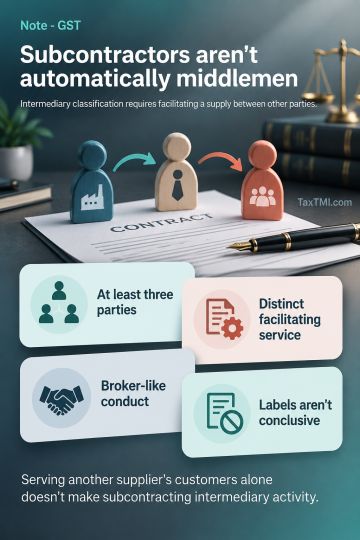
Circular No. 159/15/2021-GST identifies three foundational requirements: at least three parties, two distinct supplies, and the character of an agent, broker or similar person. The ancillary arranging or facilitating service must be "clearly identifiable and distinguished from the main supply". Counting every participant in the wider business chain is therefore insufficient.

Paragraph 3.5 states: "Sub-contracting for a service is not an intermediary service." Its explanation is substantive: the subcontractor supplies the main service, "either fully or a part thereof", rather than merely arranging its provision. The software-development illustration confirms that interaction with the principal contractor's customer does not change the character of an independently performed subcontract.

This distinction answers the department's argument that the taxpayer could not be a subcontractor because it did not itself provide education. The relevant enquiry was whether it performed the marketing and support obligations entrusted to it, not whether it delivered the ultimate educational programme. Otherwise, almost every outsourced business-support activity could be characterised as facilitating the recipient's downstream business.

Conversely, a bilateral agreement and invoicing to an overseas principal are not sufficient by themselves. The circular's machinery-sale illustration describes an intermediary invoicing only one principal. The decisive question remains whether the supplier performs the contracted service or arranges another supply between other persons.

The tribunal's application to the contractual arrangements

The tribunal treated the taxpayer's own-account performance, independent-contractor status and absence of agency powers as significant. The taxpayer used its own resources to perform substantive marketing and IT-enabled work. The separately contracted advisers' enrolment activities were not attributable to it merely because its work supported the same commercial objective.

Applying ejusdem generis, the tribunal read "any other person" in Section 2(13) in the context of the preceding expressions "broker" and "agent". It rejected an unrestricted interpretation encompassing an independent supplier simply because its services advanced another business's operations.

The cost-plus model reinforced this conclusion, particularly when contrasted with the advisers' success-linked commission. Nevertheless, payment terminology is evidentiary rather than determinative. The education-sector authorities discussed below demonstrate that commission-based remuneration does not invariably establish intermediary status.

GST authorities on subcontracted performance

In 2022 (11) TMI 743 - PUNJAB AND HARYANA HIGH COURT, the issue concerned BPO and IT services performed under a master subcontracting agreement. The taxpayer undertook deliverables, performance risks and service-level obligations for an overseas contractor, including direct delivery to that contractor's customers. The court held that actual performance was not arrangement or facilitation. The non-agency clause and absence of direct contracts with ultimate customers supported the conclusion, and the original refund order was restored. The decision establishes that customer-facing delivery under a subcontract is compatible with own-account supply.

That decision also applied consistency where the same agreement had previously been accepted and no material factual or legal change justified a different result. Its relevance is not that earlier acceptance overrides the statute, but that a changed classification requires a sustainable basis rather than a different description of unchanged contractual performance.

In 2025 (5) TMI 150 - KARNATAKA HIGH COURT, pre-sale and post-sale customer-support services supplied to foreign affiliates were examined against the same statutory and circular-based tests. The taxpayer performed the support service itself, was prohibited from acting as agent or entering sales contracts, and lacked contractual privity with end customers. The court rejected intermediary classification and quashed the refund rejection and recovery notice insofar as they rested on that finding. Other issues remained available for separate contest, illustrating that success on classification does not determine every refund objection.

Marketing and customer-support authorities under service tax

The doctrinal connection is express. Rule 2(f) of the Place of Provision of Services Rules, 2012 excluded a person providing "the main service or supplies the goods on his account". Circular No. 159/15/2021-GST recognises broad continuity between that definition and Section 2(13), apart from the addition of securities. Earlier decisions are therefore useful on classification, without transplanting their separate tax machinery into GST.

In 2023 (7) TMI 719 - DELHI HIGH COURT, marketing, administrative and support services were supplied under an independent-contractor agreement. The taxpayer could not represent or bind the overseas recipient, received cost-plus consideration unrelated to downstream sales and did not arrange a separate supply between other parties. The court upheld the conclusion that these were own-account services. This closely supports the distinction between performing marketing work and acting as a sales intermediary.

In 2023 (9) TMI 304 - DELHI HIGH COURT, the taxpayer supplied telecommunications infrastructure, customer care and billing support to an overseas recipient. It independently contracted with Indian operators on its own account. The court held that these arrangements represented substantive service provision rather than brokerage, and upheld export treatment and credit refund. The decision shows that procuring local inputs does not itself transform the supplier into an intermediary.

In 2024 (1) TMI 887 - CESTAT HYDERABAD, collections and contact-centre operations were performed under subcontracting and performance-level agreements. The taxpayer bore performance obligations to the overseas contractor, received cost-plus compensation and had no contractual privity with ultimate business partners. The tribunal held that the challenged activities formed part of the main service, not a separately identifiable facilitating supply. Its relevance lies in examining operational obligations rather than isolating customer-contact functions.

In 2025 (3) TMI 200 - CESTAT CHANDIGARH, promotional and marketing services were supplied as an independent contractor for cost-plus remuneration. The taxpayer invoiced the overseas recipient, had no customer contract and remained responsible for work it further subcontracted. The tribunal held that only the main promotional service was supplied, with no separate auxiliary facilitation service. Further outsourcing did not alter the taxpayer's responsibility or create intermediary status.

In 2024 (11) TMI 922 - CESTAT BANGALORE, research and development, marketing assistance, demonstrations and customer support were examined together. The agreements and invoices established principal-to-principal performance for the overseas recipient. The tribunal rejected the department's attempt to characterise those activities as mere facilitation and upheld export treatment. The decision reinforces that sales-related content does not dispense with proof of an intermediary arrangement.

In 2024 (10) TMI 147 - CESTAT NEW DELHI, brand-development and promotional obligations were performed on the taxpayer's own account. The tribunal found no contractual requirement to arrange another person's main service. Outsourcing some tasks did not change that conclusion, and the general recipient-location rule applied. The authority is relevant where a supplier remains responsible for an integrated service despite using subcontractors.

Education-sector comparisons

In 2024 (3) TMI 1178 - CESTAT NEW DELHI, recruitment, promotion, enrolment assistance and related liaison were performed for foreign universities. Although remuneration was described as commission, the taxpayer supplied the contracted services itself rather than arranging for a third party to perform them. The tribunal held that the services were exports and not intermediary services. The decision is particularly important against treating commission as a conclusive classification test.

In 2024 (8) TMI 399 - CESTAT CHANDIGARH, the taxpayer contracted only with an overseas education-services contractor, not with universities or students. For the period governed by the intermediary definition, the tribunal found subcontracted performance rather than a three-party facilitation arrangement. Export treatment was sustained. The contractual chain closely illustrates why the ultimate educational service and the independently performed subcontract must be identified separately.

The education-consultancy decision separately analysed by the GST tribunal concerned marketing and recruitment support supplied directly to foreign universities. The court held that incidental assistance to students did not establish intermediary status where the taxpayer did not charge students, bind universities or guarantee admission. The tribunal relied on that reasoning when accepting the taxpayer's export classification.

A further education-marketing authority discussed in that reasoning emphasised the contractual recipient, the person liable for consideration and the nature of the actual service. It rejected the proposition that advancing the foreign institution's business objective necessarily amounted to intermediary activity. This directly addresses attempts to substitute the location of an incidental beneficiary for the statutory enquiry.

The separately considered university-recruitment authority similarly held that recommending students did not make them the recipients of services paid for by foreign universities. Export relief remained subject to receipt of foreign-currency consideration. Its significance is the distinction between assisting an applicant operationally and supplying the contracted recruitment service to the university.

Other comparisons and contrary advance rulings

The sourcing-support authority analysed by the tribunal concerned supplier identification, factory visits, production monitoring and shipment support. Independent-contractor obligations, cost-plus remuneration, non-binding recommendations and the overseas recipient's freedom to select suppliers supported the conclusion that the taxpayer supplied business-support services on its own account. The comparison demonstrates that extensive coordination is not necessarily brokerage.

The tribunal also applied its earlier support-service reasoning that "any other person" must be understood in the context of broker-like or agent-like characteristics. Its relevance was to prevent an unrestricted reading of Section 2(13) that would override the express own-account exclusion.

The department relied on an advance ruling concerning vendor identification and quality monitoring, where the applicant was treated as facilitating supplies between its foreign holding company and Indian vendors. That conclusion turned on a facilitation character different from the subcontracted performance accepted here.

A separate advance ruling concerned promotion of foreign university courses for commission and classified the applicant as an intermediary. The contrasting education-sector decisions show why neither the industry description nor commission alone resolves the statutory enquiry.

The third advance ruling concerned support services to a foreign parent and also adopted intermediary classification. The tribunal declined to follow these advance rulings in preference to the High Court authorities. It did not establish a universal export rule for support services; it applied the judicial tests to the taxpayer's particular obligations.

Practical Implications

Classification requires a coherent contractual and evidentiary account. Relevant materials include the master agreement, service schedules, upstream contracts where necessary, adviser agreements, invoices, remittance evidence, transfer-pricing descriptions and records demonstrating actual deliverables. Expressions such as "liaison", "support" or "recruitment" require examination in their operational context.

  • Identify the precise service the taxpayer undertakes to perform and the person entitled to enforce that obligation.
  • Determine whether a separate supply between other principals is merely being arranged, rather than performed fully or partly by the taxpayer.
  • Examine authority to negotiate, represent or bind another person alongside responsibility for personnel, infrastructure and performance.
  • Reconcile invoicing, consideration and corporate identity. The tribunal rejected the identity objection where the relevant corporate change was not seriously disputed.
  • Test recipient location, payment realisation and separate legal personality independently of intermediary classification.

For refund consequences, Section 16(1)(a) of the IGST Act includes exports within "zero rated supply". For the disputed periods, Section 16(3)(a) permitted supply under bond or Letter of Undertaking without integrated tax and refund of unutilised credit, subject to prescribed requirements.

Section 54(3) of the CGST Act expressly recognises refund for "zero rated supplies made without payment of tax". Rule 89(2)(c) of the CGST Rules requires the export-service invoice statement and relevant Bank Realisation Certificates or Foreign Inward Remittance Certificates. Establishing export character therefore addresses the substantive classification objection, while applicable documentary and computation requirements remain relevant.

Key Takeaways

The governing distinction is between performing a service and arranging its performance by others. A subcontractor does not become an intermediary merely because it interacts with customers, supports recruitment or contributes to an overseas recipient's downstream business.

The tribunal's conclusion rests on the combined contractual and operational evidence: substantive own-account performance, independent responsibility, separate adviser arrangements and consideration received from the overseas recipient. Those features must be evaluated together, followed by a separate assessment of every export condition under Section 2(6). Export classification then provides the foundation-not a substitute-for compliance with the zero-rated refund framework.


Full Text:

2026 (10) TMI 1143 - GSTAT NEW DELHI-[PB]

Topics

Acts Income Tax