 TaxTMI
Login
 TaxTMI

Login
Loading...
Press 'Enter' to add multiple search terms. Rules for Better Search

Press 'Enter' after typing page number.
Press 'Enter' after typing page number.


No Folders have been created
Are you sure you want to delete "My most important" ?
NOTE:
Press 'Enter' after typing page number.


Press 'Enter' after typing page number.

All TMI Notes
Press 'Enter' after typing page number.
All TMI Notes

Note

Bookmark

Share


This commentary provides doctrinal analysis and practical insights on the legal issue discussed below. The judgment is analysed in the context of its factual background, issues framed, and conclusions reached by the Court.
2026 (10) TMI 97 - DELHI HIGH COURT
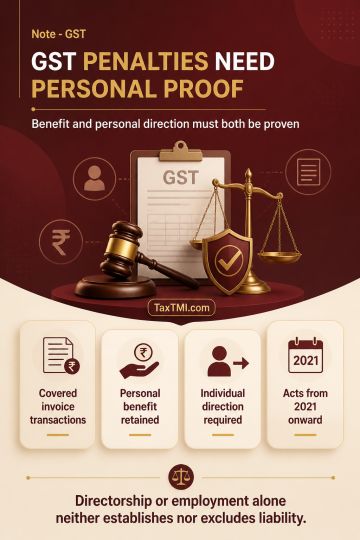
The expression "any person" in Section 122(1A) of the Central Goods and Services Tax Act, 2017 is the statutory basis for extending penalty exposure beyond the taxable person through whom an offending GST transaction may have been executed. Its breadth, however, does not create a general regime of derivative, office-based or designation-based liability. The provision applies only where the person proceeded against satisfies two cumulative statutory conditions: that person must have retained the benefit of a specified transaction, and the transaction must have been conducted at that person's instance.
In 2026 (10) TMI 97 - DELHI HIGH COURT, the Court held that "any person" is not confined to a "taxable person". It extends to a registered or unregistered person, provided the two statutory requirements are established. The ruling therefore adopts a function-and-benefit-based inquiry rather than an inquiry controlled solely by GST registration, directorship, employment, or formal association with the taxable entity.
The decisive qualification is equally important. Section 122(1A) is not attracted merely because an individual was connected with the affairs of a company, firm, limited liability partnership or other juridical entity. The adjudicating authority must establish the underlying contravention and separately establish, through material relevant to the individual, both retention of benefit and conduct of the transaction at that individual's instance.
Section 122 of the Central Goods and Services Tax Act, 2017 employs materially different expressions across its sub-sections. Section 122(1) begins with "Where a taxable person who" and imposes penalty for the listed contraventions. In contrast, Section 122(1A) provides:
"Any person who retains the benefit of a transaction covered under clauses (i), (ii), (vii) or clause (ix) of sub-section (1) and at whose instance such transaction is conducted, shall be liable to a penalty of an amount equivalent to the tax evaded or input tax credit availed of or passed on."
The four cross-referred contraventions are confined to: supply without invoice or through an incorrect or false invoice under clause (i); issuance of an invoice or bill without supply under clause (ii); taking or utilising input tax credit without actual receipt of goods or services under clause (vii); and taking or distributing input tax credit contrary to Section 20 under clause (ix). Section 122(1A) does not extend to every offence enumerated in Section 122(1).
The penal consequence is substantial: an amount equivalent to the tax evaded or input tax credit availed of or passed on. The statutory seriousness of this consequence reinforces the need to identify the precise transaction, the benefit allegedly retained, and the person at whose instance it was conducted.
Section 2 of the Central Goods and Services Tax Act, 2017 distinguishes the relevant concepts. Section 2(107) defines a "taxable person" as "a person who is registered or liable to be registered under section 22 or section 24". Section 2(94) defines a "registered person" as a person registered under Section 25, excluding a person having a Unique Identity Number.
Section 2(84), by comparison, defines "person" inclusively and widely. It includes an individual, Hindu Undivided Family, company, firm, limited liability partnership, association of persons or body of individuals, corporation, body corporate, co-operative society, local authority, Government, society, trust, and "every artificial juridical person" not falling within the preceding categories.
Section 122(3) again uses the broader expression "any person", but covers distinct conduct, including aiding or abetting offences under Section 122(1), dealing with goods liable to confiscation, dealing with services known or believed to contravene the Act, non-appearance pursuant to summons, and invoice-related defaults. Its penalty may extend to twenty-five thousand rupees. The contrast demonstrates that Section 122(1A) is not a substitute for every form of participation or assistance; it has its own defined ingredients and its own measure of penalty.
The central interpretative question is whether "any person" in Section 122(1A) should be read down as a taxable or registered person. The wider construction recognises that Parliament used "taxable person" in Section 122(1), "any person" in Sections 122(1A) and 122(3), and "any registered person" in Section 122(2). Ordinarily, where different expressions are deliberately used within the same statutory provision, they must be assigned distinct fields of operation. Reading "any person" as synonymous with "taxable person" would erase this legislative distinction.
The statutory sequence is significant. Section 122(1) identifies the specified misconduct of a taxable person. Section 122(1A) then identifies a further person who, though potentially outside the taxable person's registration status, retained the benefit and caused the transaction to be conducted. Thus, the underlying contravention and the personal penalty are connected, but they are not identical inquiries.
The word "and" between the two limbs of Section 122(1A) is determinative. The authority must establish both that the noticee "retains the benefit" and that the transaction was conducted "at whose instance". Retention without proof that the transaction was conducted at the noticee's instance is insufficient. Equally, an allegation that a person directed or influenced a transaction, without proof that the person retained its benefit, does not meet the text of the provision.
This construction rejects an automatic inference from corporate position. A director, employee, consultant, authorised signatory, nominee, shareholder, or other associate does not become liable simply by reason of status. The inquiry is evidentiary and individualised: what benefit was retained by that person, and what material shows that the impugned transaction was conducted at that person's instance?
The breadth of "any person" serves to reach a natural person or entity operating behind a taxable entity. A company or other artificial juridical person can act only through natural persons. Confining Section 122(1A) to the registered entity could leave outside its scope a person who allegedly orchestrated the transaction and retained its benefit but did not hold the GST registration.
That purposive reach does not amount to unstated vicarious liability. Vicarious liability is a creation of statute and cannot ordinarily be inferred merely from an individual's designation or proximity to the principal contravention. Section 122(1A) supplies its own connecting factors-retention of benefit and conduct at the person's instance-and those factors, rather than office or title, control the liability inquiry.
2026 (10) TMI 97 - DELHI HIGH COURT holds that "any person" in Section 122(1A) includes a person who is not registered and is not liable to registration. The Court reasoned that the distinction between "taxable person", "registered person" and "any person" is deliberate. The definition of "person" in Section 2(84), extending even to every artificial juridical person, was treated as reinforcing the breadth of the expression.
The judgment also identifies the commercial mischief addressed by the provision. An allegedly fraudulent invoice or input tax credit arrangement may be routed through an entity in the name of another person, while its alleged orchestration and economic benefit lie elsewhere. A construction confined to the person in whose name the GST registration stands could therefore fail to reach the alleged beneficiary operating behind that entity. On this reasoning, "any person" enlarges the class of possible noticees beyond the taxable person.
Nevertheless, the ruling makes clear that the expanded class is not self-executing. The authority must first establish a transaction covered by one of the four specified clauses of Section 122(1). Only then does the further inquiry arise into who retained the benefit and at whose instance the transaction was conducted. The Court left factual satisfaction of these requirements to the statutory appellate process.
The expression "retains the benefit" requires a finding directed to the noticee's own benefit. It cannot be replaced by a generic allegation that the taxable entity derived a benefit or that revenue suffered loss. The statutory inquiry concerns whether the particular person against whom Section 122(1A) is invoked retained the benefit of the covered transaction.
The nature and evidentiary source of the alleged benefit will necessarily vary. The statutory language does not prescribe a fixed form of benefit. What it does require is a reasoned finding connecting the benefit to the noticee. A conclusion that simply transfers the entity's alleged benefit to every person associated with it would collapse the distinct requirements of Section 122(1A).
The second requirement asks whether the transaction was conducted "at whose instance". This calls for material demonstrating that the noticee caused, directed, orchestrated, procured, or otherwise made the covered transaction occur. Mere employment, signature authority, attendance in management, or formal directorship may be relevant evidentiary circumstances, but none independently substitutes for the statutory requirement.
The phrase must also be read with "retains the benefit". Section 122(1A) targets the person who both stands to retain the benefit and causes the transaction. This combined formulation distinguishes the provision from a broad aiding-and-abetting clause. Where the allegation is only that a person assisted, participated in a limited capacity, or handled documentation, the authority must examine whether the alleged facts satisfy Section 122(1A), Section 122(3), or neither provision. The higher penalty under Section 122(1A) cannot be imposed merely by characterising every operational connection as conduct "at whose instance".
A notice under Section 122(1A) should identify the particular covered clause under Section 122(1), describe the relevant transaction, state the facts said to establish benefit retained by the individual noticee, and articulate the basis for asserting that the transaction was conducted at that noticee's instance. A notice that relies solely on position or designation risks failing to communicate the case that must be answered.
Correspondingly, an adjudication order must record findings on each statutory ingredient. A reasoned order cannot proceed from a finding against a company or firm directly to personal penalty against every officer or employee. It must separately address the evidence and submissions relating to the individual noticee. This is both a consequence of the text of Section 122(1A) and an application of settled principles of natural justice and reasoned adjudication.
2024 (3) TMI 1277 - BOMBAY HIGH COURT adopted a narrower construction. It treated Section 122(1A) as ordinarily concerning a taxable or registered person and held, on the material before it, that employees and power-of-attorney holders could not be penalised without material demonstrating personal retention of benefit and personal involvement in conducting the transaction. The notice was quashed insofar as it sought to fasten such liability on the individual noticees.
The significance of this decision lies in its insistence that directorship, employment or authority to act cannot alone establish personal penalty. However, the narrower conclusion that Section 122(1A) is confined to a taxable or registered person was not accepted in 2026 (10) TMI 97 - DELHI HIGH COURT. The governing construction is that non-taxable status does not itself preclude Section 122(1A), although absence of proof of the twin conditions remains fatal to the proposed penalty.
2026 (2) TMI 1409 - BOMBAY HIGH COURT followed the narrower approach regarding the category of persons and emphasised that employees and office-bearers cannot be penalised in the absence of material or findings showing personal retention of benefit and conduct of the transaction at their instance. It further held that Section 122(1A) cannot apply to conduct preceding its commencement.
The later Delhi ruling agrees with the insistence on the two factual prerequisites and also accepts prospective application of Section 122(1A). It differs only on the status-based limitation. Thus, the continuing analytical value of the Bombay decision is that personal culpability under the precise statutory test must be established; its view that a non-taxable person lies categorically outside Section 122(1A) is not followed.
2007 (4) TMI 367 - Supreme Court, while construing a distinct statutory regime, reiterates that vicarious liability depends on the statutory framework and requires foundational averments placing the individual within that framework. A label such as manager or director was held insufficient without the necessary statutory allegations. The decision does not construe Section 122(1A), but it supports the general proposition that personal liability cannot arise from vague designation-based pleading.
2006 (4) TMI 256 - HIGH COURT OF DELHI similarly held that personal liability of a director cannot rest merely on directorship. The adjudicating authority must identify the specific duty, default and factual basis of individual culpability in a self-contained and reasoned order. Although rendered under another enactment, this reasoning is consistent with the requirement under Section 122(1A) to make individual findings on benefit and causative involvement.
1979 (10) TMI 220 - Supreme Court demonstrates the converse principle: where a statute expressly identifies persons in charge, persons responsible for business, or officers acting with consent, connivance or neglect, liability can extend beyond the company on proof of those stipulated conditions. The decision underscores that corporate-officer liability is statute-specific. Section 122(1A) must therefore be applied through its own statutory language, not through an assumed universal rule that all persons in management are liable for a company's tax contravention.
The principal practical consequence is that GST registration is not a threshold defence to a Section 122(1A) proceeding. An unregistered individual, a person not liable for registration, or an entity other than the taxable person may fall within "any person". Conversely, registration, directorship or managerial position is not a threshold ground for imposing penalty. The decisive question remains whether the two cumulative statutory conditions are proved.
For revenue authorities, a sustainable proceeding requires transaction-specific and person-specific analysis. The show cause notice should avoid collective allegations and should separately set out: the covered Section 122(1) contravention; the benefit allegedly retained by each noticee; the basis on which each noticee is said to have caused the transaction; and the proposed penalty computation under Section 122(1A).
For noticees, the response should separately address each limb. It should distinguish organisational role from actual control, identify whether the alleged benefit was ever received or retained personally, contest any absence of evidence connecting the person to the initiation or direction of the transaction, and require the authority to identify the precise statutory clause invoked. A defence based only on non-registration is inadequate under the wider construction; a defence based on absence of the two statutory ingredients directly engages the text.
The prospective character of Section 122(1A) remains a separate limitation. As held in 2026 (10) TMI 97 - DELHI HIGH COURT, its application turns on the date of the underlying transaction or act, not the date of the show cause notice. Accordingly, even where a person falls within the broad expression "any person", penalty under Section 122(1A) can arise only for acts or transactions occurring on or after 01.01.2021.
Section 122(1A) creates a carefully delimited route to personal penalty in connection with specified invoice and input tax credit contraventions. "Any person" is broad enough to include a person who is neither registered nor liable for registration under GST. The provision may therefore reach beyond the taxable entity and its GST registration.
Its breadth is controlled by two safeguards embedded in the text: the person must have retained the benefit of the specified transaction, and the transaction must have been conducted at that person's instance. These conjunctive elements exclude liability based solely on designation, employment, directorship or general association with the taxable person. The legally sustainable approach is consequently neither status-based immunity nor automatic corporate attribution, but a precise, evidence-led application of the statutory twin test.
Full Text:

