Loading...

⚠ ✕
❮ Top
☎ Help
☰
×

By creating an account you can:

Logo TaxTMI
Call Us / Help / Feedback✕

Contact Us At :

✉ E-mail: [email protected]

✆ To Call / Whatsapp, Check Contact Us

FAQs :

To know Frequently Asked Questions, Check FAQs

Most Asked Video Tutorials :

For more tutorials, Check Video Tutorials

Submit Feedback/Suggestion :

Email :
Please provide your email address so we can follow up on your feedback.
Category :
Description :
Min 15 characters 0/2000
Make Most of Text Search ✕
  1. Checkout this video tutorial: How to search effectively on TaxTMI.
  2. Put words in double quotes for exact word search, eg: "income tax"
  3. Avoid noise words such as : 'and, of, the, a'
  4. Sort by Relevance to get the most relevant document.
  5. Press Enter to add multiple terms/multiple phrases, and then click on Search to Search.
  6. Text Search
  7. The system will try to fetch results that contains ALL your words.
  8. Once you add keywords, you'll see a new 'Search In' filter that makes your results even more precise.
  9. Text Search
╳
Add to...
You have not created any category. Kindly create one to bookmark this item!
✕
Create New Category
Hide
Title :
Description :
❮❮ Hide
❮ Default View
Expand ❯❯
Close ✕
🔎 Filters / Advanced Search ❯
TEXT

Press 'Enter' to add multiple search terms. Rules for Better Search

Search In
Main Text + AI Text ❯
  • Main Text
  • Main Text + AI Text
  • AI Text
Law:
---- All Laws---- ❯
  • ---- All Laws----
  • Benami Property
  • Bill
  • Central Excise
  • Companies Law
  • Customs
  • DGFT
  • FEMA
  • GST
  • GST - States
  • IBC
  • Income Tax
  • Indian Laws
  • Money Laundering
  • SEBI
  • SEZ
  • Service Tax
  • VAT / Sales Tax
Types:
---- All Types ---- ❯
  • ---- All Types ----
  • Act Rules
  • Case Laws
  • Circulars
  • Manuals
  • News
  • Notifications
Sort By: ?
In Sort By 'Default', exact matches for text search are shown at the top, followed by the remaining results in their regular order.
Relevance Default Date
☰   Show Results ❯
    Case Laws Income Tax
    Leave Encashment Exemption for Non-Government Employees under Section 10(10AA)(ii) and the Enhanced ...
    Case Laws Income Tax
    Dependent Agent Permanent Establishment under Article 5(5) of the India-Switzerland DTAA: Authority,...
    Case Laws Customs
    Proper Officer Jurisdiction for Customs Show Cause Notices under Sections 2(34), 17, 28 and 124
    Case Laws Money Laundering
    Provisional Attachment of Pre-Offence Property as Proceeds of Crime or Equivalent Value under the PM...
    Disciplinary Suspension of Resolution Professionals Across Ongoing CIRPs: Proportionality, Hearing a...
    Electronic Authentication of GST Demand Proceedings: Rule 26(3), Sections 75, 160 and 169
    Large-Scale GST Evasion Prosecutions: Cognizable and Non-Bailable Classification under Section 132 a...
    Case Laws Customs
    Country of Origin Certificates and Preferential Customs Duty under Notification No. 46/2011-Customs ...
    Refund of Accumulated Input Tax Credit on Packing Materials under Section 54(3)(ii) of the CGST Act
    Detention of Goods in Transit: Consequences of Delay in Notice under Section 129(3)
    Case Laws Income Tax
    Section 192 TDS on Leave Travel Concession and the Effect of Subsisting Judicial Restraint
    Cross-Segment Price Manipulation in Stock Derivatives under the SEBI Act and PFUTP Regulations
    Case Laws Income Tax
    Enhanced Rate of Tax u/s 115BBE: Survey Surrenders of Excess Stock and Cash: Business Income, Deemed...
    Retention of Seized Mobile Phones and Bank Debit Cards Beyond the Section 67(7) Period
    Case Laws Customs
    Classification of Disposable Analytical Cartridges under Chapter 90 and Heading 3926
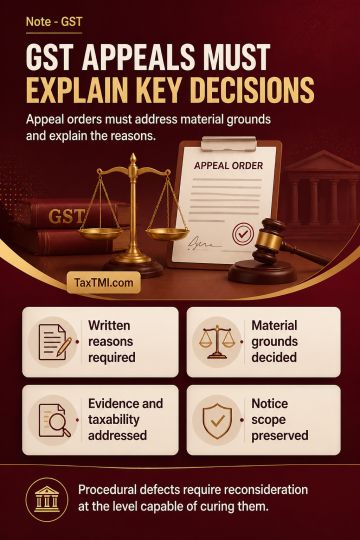
    Reasoned and Speaking Appellate Orders u/s 107 of the CGST Act: Duty to Decide Material Grounds of A...
    Pre-Movement E-Way Bill Compliance and Section 129 Detention for Undocumented Goods in Transit
    Case Laws Income Tax
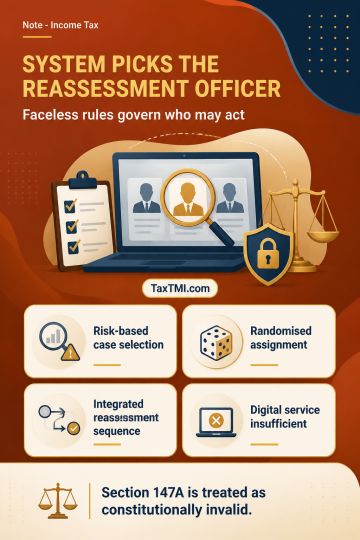
    Faceless Reassessment Jurisdiction: Retrospective Validation under Section 147A and Automated Alloca...
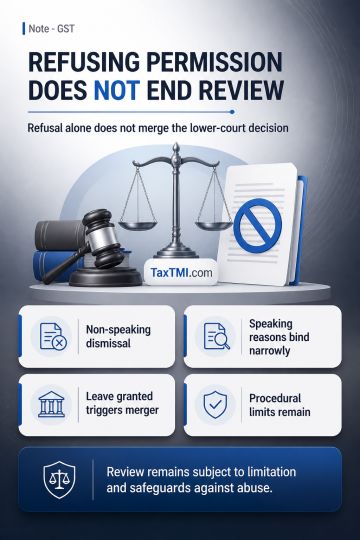
    Doctrine of Merger: Effect of Non-Speaking and Speaking Dismissal of Special Leave Petitions on Merg...
    Case Laws Indian Laws
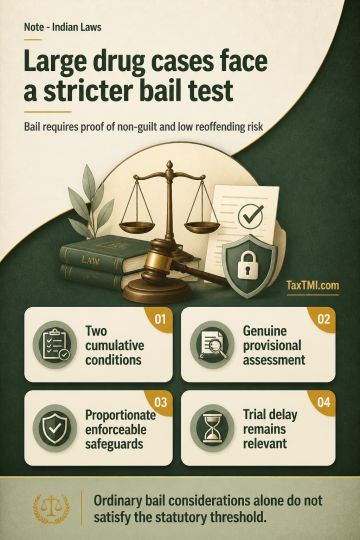
    Section 37 of the NDPS Act: Twin Conditions for Grant of Bail in Commercial Quantity Cases
❮
❯
❯❯
Maximize Maximize Maximize
0 / 200
Expand Note
Add to Folder

No Folders have been created

+

Are you sure you want to delete "My most important" ?

NOTE:

Notes
Showing Results for :
Reset Filters
Results Found:
Show All Summaries Hide All Summaries
Case Laws Income Tax
Show AI Summary
Leave encashment exemption: Non-government employees may claim the enhanced notified ceiling subject to statutory computation conditions.
Retirement leave encashment received by employees other than Central or State Government employees falls under Section 10(10AA)(ii). Exemption depends on retirement, the ten-month earned-leave limit, average salary for the preceding ten months, earned-leave entitlement restrictions, aggregate limits, and prior exempt receipts. The enhanced notified ceiling of Rs. 25,00,000, deemed to operate from 1 April 2023, is treated in the Tribunal approach discussed as a beneficial rationalisation available to eligible pending claims for earlier assessment years, without displacing the statutory computation conditions.
Case Laws Income Tax
Show AI Summary
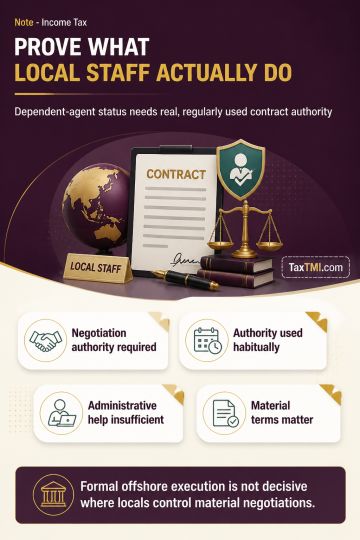
Dependent agent permanent establishment requires proven habitual contractual authority; liaison, administrative support, and customer contact alone remain insufficient.
Dependent agent permanent establishment under Article 5(5) requires proof that an Indian person has authority to negotiate and enter contracts for the foreign enterprise and habitually exercises that authority. Customer liaison, account management, administrative support, communication of pre-approved terms, document routing, and assistance with online standard-form contracting fall short unless Indian personnel substantively determine essential terms or routinely bring negotiations to a binding commercial conclusion. Formal offshore execution is not decisive where local personnel effectively control material negotiations. Corporate association, economic dependence, and independent-agent considerations cannot replace proof of the positive authority and habitual-exercise requirements.
Case Laws Customs
Show AI Summary
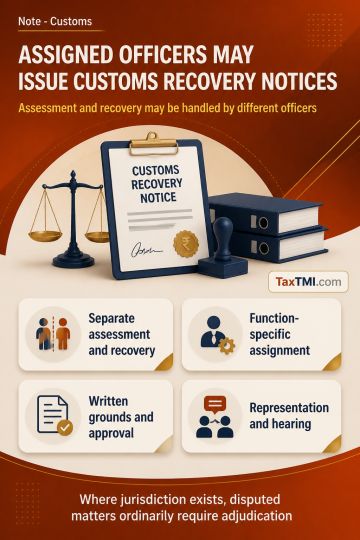
Proper-officer jurisdiction permits assigned customs officers to issue recovery notices without having performed the original assessment.
Customs show-cause jurisdiction requires both appointment as an officer of customs and function-specific assignment as the proper officer. Assessment under Section 17 and recovery under Section 28 are distinct functions; the original assessing officer need not alone issue a recovery notice. Retrospective validation of qualifying officers' proper-officer status applies independently of the preserved historical recovery regime. Confiscation and penalty proceedings require written grounds, prescribed prior approval, representation, and hearing. Where jurisdiction exists, disputed facts, evidence, limitation, and procedural compliance ordinarily require determination through adjudication.
Case Laws Money Laundering
Show AI Summary
Equivalent-value attachment permits securing untainted pre-offence assets only when unavailable criminal proceeds, valuation, and statutory risk are established.
Pre-offence property is ordinarily not directly derived from later scheduled-offence activity, but may be provisionally attached as equivalent value where actual proceeds are unavailable. Such attachment requires identification and reasoned valuation of the alleged proceeds, material showing their unavailability, and recorded reasons to believe that non-attachment risks concealment, transfer, or other frustration of confiscation. A later use of illicit funds to repay loans, construction borrowing, or secured obligations may separately establish a direct or indirect nexus. Section 24 presumptions do not replace the foundational requirements for attachment.
Case Laws IBC
Show AI Summary
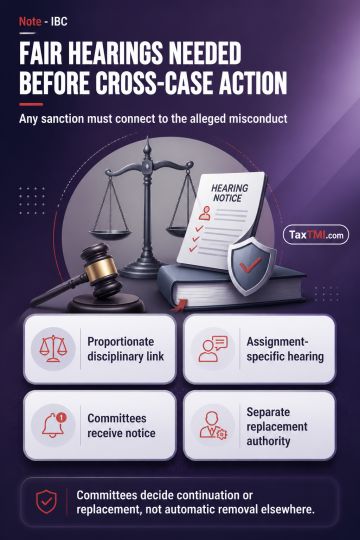
Cross-assignment disciplinary suspension requires proportionate, assignment-specific hearing while creditor committees retain statutory control over replacement decisions.
Where disciplinary misconduct concerns one CIRP, cross-assignment suspension requires a proportionate link to the pleaded charge, supporting material and hearing afforded. Section 220(2) permits disciplinary sanctions after hearing, while Regulation 13(7) requires intimation to Committees of Creditors and the Adjudicating Authority. On the prima facie construction applied, intimation informs each Committee's decision on continuation or replacement rather than automatically removing the professional from unrelated ongoing assignments. The Board's regulatory role and the Committee's replacement power remain distinct but connected.
Case Laws GST
Show AI Summary
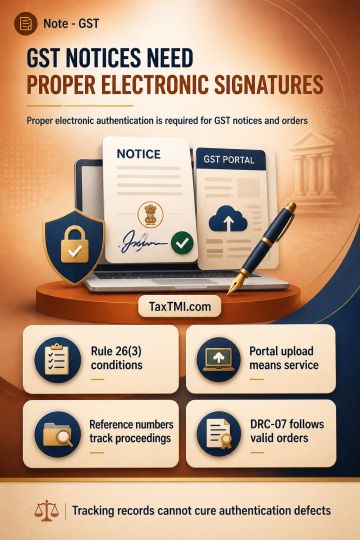
Electronic authentication of GST notices requires prescribed signatures; portal uploads, reference numbers, and DRC summaries cannot independently validate proceedings.
Rule 26(3) makes electronic issuance and authentication by digital signature, e-signature, or a notified verification mode cumulative conditions for GST notices and orders. A portal upload concerns service, while a system-generated reference number, DRC summary, or DIN performs tracking or procedural functions; none independently establishes the authorised officer's authentication. Section 169 governs service rather than validity, and Section 160 does not ordinarily cure a defect preventing attribution of the instrument to the competent officer. DRC-01 cannot replace the statutory notice, and DRC-07 supports recovery only upon a valid order.
Case Laws GST
Show AI Summary
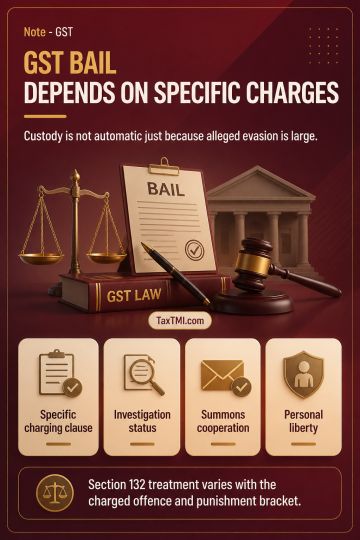
GST bail classification requires precise Section 132 charging clauses, with investigation status, cooperation and proportionality governing custodial necessity.
GST-evasion bail adjudication requires a case-specific assessment of custodial necessity rather than an automatic consequence of the alleged tax magnitude, Magistrate-triability, or a maximum five-year sentence. Section 132 classification depends on the precise offence clause and punishment bracket, not merely on the alleged quantum of evasion. Relevant considerations include the stage of investigation, cooperation with summons, security of evidence, individual role, risks of absconding or interference, proportionality, and personal liberty under Article 21.
Case Laws Customs
Show AI Summary
Certificate-specific origin verification prevents preferential-duty denial based solely on unrelated suspect certificates or supplier doubts.
Preferential customs-duty treatment requires compliance with applicable rules of origin and reliable proof that imported goods qualify as originating. A country-of-origin certificate is important evidence but does not remove the importer's duty to possess supporting origin information and exercise reasonable care. Challenges to preferential treatment must be certificate-specific and consignment-specific: an adverse finding concerning identified certificates cannot, without direct evidence, invalidate separate certificates. Customs verification should identify the particular proof of origin, alleged defect and material linking it to the import, while fraud, suppression or misrepresentation independently established may support substantive action.
Case Laws GST
Show AI Summary
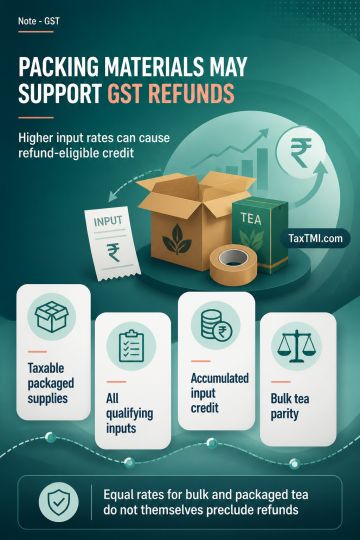
Packing-material input tax credit may support inverted-duty refunds when higher-rated inputs cause accumulation for taxable packaged supplies.
Refund of accumulated input tax credit under Section 54(3)(ii) may arise where packing materials used to make taxable packaged outward supplies bear a higher tax rate than the outward supply and generate the accumulation. The inquiry extends to all qualifying inputs and is not limited to a principal raw material. Parity between the rate on bulk tea and packaged tea does not itself preclude refund if higher-taxed packing materials used for the packaged supply are the cause of unutilised credit.
Case Laws GST
Show AI Summary
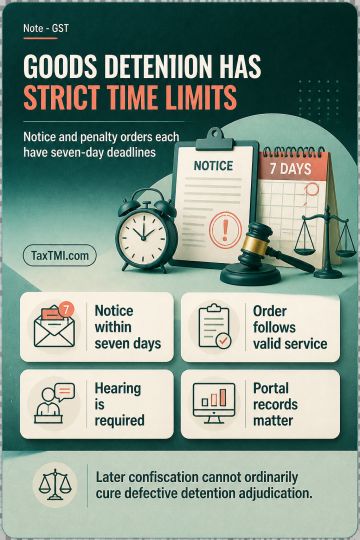
Mandatory detention timelines require timely notice, hearing and penalty order, preventing prolonged restraint of goods in transit.
Section 129(3) establishes a mandatory two-stage timeline: issuance of the penalty notice within seven days of formal detention or seizure, followed by a penalty order within seven days of legally effective service. The periods are independent, and compliance at one stage cannot cure delay at the other. Service, portal timestamps and the electronic records required under Rule 142 are material to chronology. Penalty requires a hearing, while payment under protest may still require a reasoned order to preserve appellate access. Later confiscation action cannot ordinarily cure a defective detention adjudication.
Case Laws Income Tax
Show AI Summary
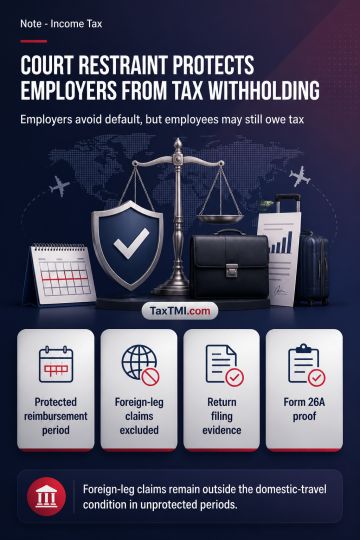
Subsisting judicial restraint on leave travel concession withholding prevents employer default while preserving employees' underlying tax liability.
A subsisting judicial restraint expressly prohibiting deduction from leave travel concession reimbursements governs the employer's withholding conduct for the covered period. Non-deduction in compliance with that restraint cannot constitute failure to discharge an enforceable duty under Sections 192 and 201, even if the underlying exemption claim is later found substantively unavailable. The restraint does not eliminate employee-level tax liability. For unprotected periods, foreign-leg or circuitous travel claims remain outside the domestic-travel condition, and payer protection may depend on proving employee return filing, income inclusion and tax payment through Form 26A.
Case Laws SEBI
Show AI Summary
Cross-segment price manipulation examines whether futures orders artificially influence option executions, engaging anti-fraud rules, director responsibility, and interim safeguards.
Cross-segment price manipulation may arise where aggressive futures orders alter the last traded price or visible order-book conditions so that larger, sentimentally opposite options orders obtain favourable execution. The relevant inquiry considers the integrated sequence of resting orders, aggressive executions, cancellations, timing, concentration, price impact and delta-adjusted exposure. Anti-fraud prohibitions cover manipulative devices, false appearances of trading and price manipulation, while opposite futures and options positions alone do not establish misconduct. Director liability requires responsibility for business conduct, or consent, connivance or neglect.
Case Laws Income Tax
Show AI Summary
Survey surrender characterisation determines whether excess stock and cash are taxed as business income or under special deemed-income provisions.
The special regime in Section 115BBE is consequential: it applies only after the amount is properly brought within a specified deeming provision, and a survey surrender, book entry or return description cannot itself create that character. Mixed stock forming part of ordinary business inventory and credibly explained through business records may be assessed as business income at normal rates. Similarly, excess cash may be treated as business income where a commercial source is satisfactorily established and no separate or non-business source is shown.
Case Laws GST
Show AI Summary
Statutory limits on GST seizure require return of retained mobile phones and debit cards without a valid extension.
Section 67(7) establishes a six-month return rule where no notice in respect of seized goods is issued. Any further period requires sufficient cause, action by the proper officer, and a maximum further period of six months; ongoing investigation cannot replace an actual extension order. Although Section 67(7) uses "goods" while Section 67(2) also covers documents, books and things, its application to seized mobile phones and bank debit cards indicates that classification cannot be used to avoid the temporal restriction where articles are held under statutory seizure.
Case Laws Customs
Show AI Summary
Analytical cartridge classification follows functional integration and sole-use suitability, not plastic composition, disposability, or general consumable character.
STA micro-cuvettes containing an enclosed steel ball are assessed as complete functional components of a blood-coagulation analyser, rather than merely as plastic laboratory articles. Classification turns on their objective design, analytical role, exclusive or principal suitability and absence of practical general use. Chapter 90 Note 2 requires consideration of an independent specific heading first and then classification of other dedicated parts or accessories with the relevant instrument. Disposable or single-use status and plastic composition do not by themselves establish classification as residual plastic articles.
Case Laws GST
Show AI Summary
Speaking appellate orders require findings on material GST appeal grounds, ensuring fair hearings and meaningful higher review.
Section 107(12) requires a written appellate order identifying material points for determination, deciding them, and giving reasons. Formulaic confirmation of original assessment does not establish independent appellate consideration, particularly where jurisdiction, notice, evidence, quantification, taxability, section 74 conditions, interest, or penalty are contested. Sections 74 and 75 require a defined notice, disclosure of relied-upon material, effective hearing, and reasoned determination within the notice's scope. Where procedural defects arise at the original stage as well as on appeal, reconsideration must occur at the level capable of curing the foundational defect without expanding the show-cause case.
Case Laws GST
Show AI Summary
Pre-movement e-way bill compliance requires invoices and transport records before dispatch, while later documents cannot cure undocumented transit.
Pre-movement e-way bill compliance requires issuance of an invoice at or before removal, generation of the e-way bill before road movement, and carriage of both records during transit. Where goods are intercepted without either record, the contravention arises upon commencement of undocumented movement; documents generated only after interception cannot retrospectively establish compliance. Such documents may still be considered with other contemporaneous evidence when assessing bona fides or alleged intent to evade tax. Section 129 detention proceedings remain subject to notice, hearing, electronic-summary and statutory-timeline requirements.
Case Laws Income Tax
Show AI Summary
Automated allocation in reassessment determines officer jurisdiction, while retrospective validation cannot bypass continuing faceless-scheme requirements.
Section 151A and the e-Assessment of Income Escaping Assessment Scheme, 2022 require covered reassessment functions and section 148 notice issuance through automated allocation. Risk-based selection of cases is distinct from randomised allocation of the officer authorised to act. Sections 148A and 148 form an integrated reassessment sequence, so general concurrent jurisdiction, administrative instructions or digital service cannot substitute for the prescribed faceless allocation. Section 147A did not amend the continuing statutory and scheme-based allocation requirements and is treated as constitutionally invalid.
Case Laws GST
Show AI Summary
Doctrine of merger distinguishes refusal of special leave from appellate disposal, preserving review subject to independent procedural limits.
Under Article 136, a refusal of special leave remains a discretionary leave-stage determination. A non-speaking dismissal does not merge the challenged lower-court decision into a Supreme Court order, affirm its reasoning, or automatically create res judicata. A speaking refusal may bind only as to legal propositions expressly declared under Article 141, without producing merger. Merger arises when leave is granted and appellate jurisdiction is exercised. Review, writ, and remanded proceedings remain subject to independent procedural requirements, including limitation and safeguards against abuse.
Case Laws Indian Laws
Show AI Summary
NDPS commercial-quantity bail requires independent proof of non-guilt and low reoffending risk alongside proportionate safeguards.
Section 37 of the NDPS Act imposes cumulative bail conditions in commercial-quantity cases: the court must find reasonable grounds to believe the accused is not guilty and unlikely to reoffend while on bail. These requirements supplement ordinary bail factors and demand a genuine, provisional assessment of credible material. Personal liberty and trial delay remain relevant, but must be reconciled with the statutory threshold. Bail conditions, including verification safeguards for foreign nationals, must be proportionate, genuine and capable of enforcement.

TMI Notes

Back

All TMI Notes

Showing Results for :
Reset Filters
No Records Found

TMI Notes

Back

All TMI Notes

Classification of Disposable Analytical Cartridges under Chapter 90 and Heading 3926

9 October, 2026

Contents
Circulars
Acts
Plus +
Summary
Note

Note

-

Bookmark

(New) -

Download

Print

Print

This is a neutral professional article. The judgment is analysed in the context of its factual background, issues framed, and conclusions reached by the Court.

2026 (9) TMI 1612 - CESTAT CHENNAI

At a Glance

  • STA micro-cuvettes designed exclusively for a coagulation analyser, comprising a plastic cartridge body and an enclosed steel ball, have been held classifiable under CTI 9027 9090 rather than CTI 3926 9099.
  • The controlling inquiry is not whether the article is disposable, single-use, or predominantly made of plastic. It is whether, objectively, it is specifically designed for and functionally integrated with the analytical instrument.
  • Chapter 90 Note 2(b) directs that parts and accessories suitable for use solely or principally with a particular instrument are to be classified with that instrument, subject to the prior operation of Note 2(a) where the article is itself covered by a separate heading.
  • Heading 3926, as a residual heading for other articles of plastics, cannot displace a specific Chapter 90 classification that follows from the relevant Chapter Note.

Background & Context

The classification dispute concerned STA micro-cuvettes used in a blood coagulation analyser. The goods were sealed cartridge assemblies with a plastic body containing a small steel ball. They were designed for use with the specified analytical system and were imported in cartridge or cassette form.

The analytical process was decisive. A plasma sample is placed in the micro-cuvette, while the enclosed steel ball is magnetically controlled by the analyser. As coagulation occurs, fibrin formation stops the ball's movement; the analyser's sensing system detects that event to determine coagulation time. The micro-cuvette therefore does more than hold a sample. Its geometry, enclosed steel ball and interaction with the analyser's magnetic and sensing mechanisms enable the intended viscosity-based diagnostic process.

The competing classifications were CTI 9027 9090, asserted as the classification applicable to identifiable parts or accessories of an analytical instrument, and CTI 3926 9099, asserted as the classification for plastic laboratory consumables. The Tribunal resolved the issue in favour of CTI 9027 9090 in 2026 (9) TMI 1612 - CESTAT CHENNAI.

Key Issues / Provisions

General Rules for Interpretation

The legal starting point is Rule 1 of the General Rules for the Interpretation of the First Schedule. It states that, for legal purposes, classification must be determined "according to the terms of the headings and any relative Section or Chapter Notes". Section and Chapter titles are only aids to reference.

Rule 3(a) applies where goods are prima facie classifiable under two or more headings. It requires that "the heading which provides the most specific description shall be preferred to headings providing a more general description". Rule 3(b), applicable only where Rule 3(a) does not resolve the issue, classifies composite goods according to the material or component that gives them their essential character.

Chapter 90 Note 2

Chapter 90 Note 2 establishes a sequence for parts and accessories. Note 2(a) requires parts and accessories which are themselves goods included in a heading of Chapter 90 or of Chapters 84, 85 or 91, subject to specified exclusions, to be classified in their respective headings. Note 2(b) then applies to "other parts and accessories" which are suitable for use solely or principally with a particular kind of machine, instrument or apparatus; such goods are classified with the machine, instrument or apparatus of that kind.

The distinction is material. Note 2(b) is not a general end-use rule that overrides a specific heading available to the article itself. But where the article is not separately and specifically covered and is shown to be suitable solely or principally for a particular Chapter 90 instrument, Note 2(b) provides the governing classification rule.

Competing characterisations

Heading 9027 covers instruments and apparatus for physical or chemical analysis, including viscosity-measuring instruments. The question was whether the imported micro-cuvette had the character of a dedicated functional component or accessory of such apparatus. Heading 3926, by contrast, covers other articles of plastics. The latter classification would depend on the article being no more than a plastic laboratory article without the requisite specific functional identity under Chapter 90.

Detailed Analysis

Functional integration, exclusive suitability and the character of the article as imported

The Tribunal held that the micro-cuvette must be assessed as a complete article, not by isolating its plastic outer body. Its configuration and enclosed steel ball were specifically designed for the coagulation analyser. The steel ball was not incidental: its magnetically controlled movement formed part of the mechanism through which coagulation time was determined.

On the evidence recorded, the micro-cuvettes had no established practical use with other instruments. They were essential to conducting the intended test, even though the analyser remained physically intact when a cuvette was not inserted. The relevant question was therefore whether the article was essential to the intended analytical operation, rather than whether it was permanently installed in the instrument or whether the instrument could be switched on without it.

This approach accords with 2010 (7) TMI 20 - Supreme Court. That decision treated controllers, input-output modules and chassis as Chapter 90 parts or accessories because their technical characteristics showed that they contributed to a defined measuring or controlling function. It applied the functional-unit approach and Chapter 90 Note 2(b), recognising that separately presented components may take their classification from their principal suitability for the specialised apparatus.

The distinction between a part and an accessory was also considered in 2008 (3) TMI 22 - Supreme Court. A part is an essential component without which the whole cannot function, whereas an accessory is supplementary and adds convenience, effectiveness or utility. The micro-cuvette satisfied, at the least, the broader statutory formulation of "parts and accessories" in Note 2(b), because it was necessary for conducting the specified analytical test and actively participated in that test.

Disposable does not necessarily mean consumable

A central aspect of the ruling is that "disposable" and "consumable" are not synonymous. Disposable identifies an intended use-cycle or limited life. Consumable ordinarily refers to material that is used up, exhausted, physically or chemically consumed, or loses its identity in operation. Thus, single use, short durability, disposal after use, or biosafety-driven destruction cannot alone determine tariff classification.

The classification must instead follow the article's objective characteristics, function and sole or principal suitability. A disposable item may be a part or accessory if it is specially designed for, functionally integrated with and necessary to the machine's operation. Conversely, an article that is merely used up in a process without operating as a functional component may remain a consumable supply.

Circular No. 19/2013-Customs illustrates the importance of following the Note 2 sequence. It addressed disposable filters used in blood purification and clarified that they were classifiable under tariff item 84212900 because they were themselves covered by Heading 8421. The circular specifically applies Rule 1 and Chapter 90 Note 2(a), under which an article with its own applicable heading is classified there rather than with the larger medical system. The circular does not create a rule that all disposable medical or analytical components must be treated as consumables or as plastic articles.

The limits of sole-use and material-based arguments

2015 (5) TMI 241 - Supreme Court confirms that Note 2(a) has priority where a part or accessory is itself specifically described in a Chapter 90 heading. In that matter, the specific heading for liquid crystal devices prevailed over a heading for meter parts. Similarly, 2023 (3) TMI 1338 - Supreme Court reaffirmed that a specific tariff entry and relevant exclusionary notes cannot be overridden solely through a principal-use argument. These decisions reinforce the necessary preliminary inquiry: whether the article has a more specific independent heading. On the facts concerning the micro-cuvette, the Tribunal found that Note 2(b), rather than Note 2(a), supplied the operative rule.

2003 (1) TMI 700 - Supreme Court emphasises commercial identity and recognises that specialised goods, made to specification and not of general use, may be classified as parts of the principal article. The micro-cuvettes were not ordinary laboratory vessels marketed for general application; their objective design and exclusive compatibility supported their identity as dedicated analytical components.

Conversely, 1992 (10) TMI 175 - CEGAT, NEW DELHI demonstrates why a specialised-use assertion is not, by itself, conclusive. Plastic tubes, fittings, bolts and nuts, being articles of general use covered by specific plastic headings and subject to exclusionary notes, could not be moved to a machinery-parts heading merely because of their end use. The micro-cuvette decision is distinguishable because the goods were not found to be general-use plastic articles; their specific design and analytical role attracted Chapter 90 Note 2(b).

2007 (4) TMI 263 - Supreme Court further establishes that plastic composition does not preclude classification as a part or accessory. Plastic name plates were held to be vehicle accessories because they added identity, effectiveness and market value, and no applicable exclusion required their relegation to Chapter 39. The principle supports the proposition that the material of construction is relevant only when it is made relevant by the tariff terms and notes; it is not a substitute for examining the article's actual tariff identity.

Specific Chapter 90 treatment over the residual plastics heading

The Tribunal characterised Heading 3926 as a residual entry for other articles of plastics. Once the micro-cuvette was found to be an identifiable part or accessory solely or principally suitable for the coagulation analyser, classification followed under Heading 9027 by the express operation of Note 2(b). The decision did not rest merely on a general preference for specific entries; it applied the specific statutory classification mechanism in Chapter 90.

1994 (9) TMI 68 - Supreme Court supports this interpretative order. It applied Rule 3(a) to prefer the heading providing the more specific description and held that components solely used with the specifically classified principal article followed that principal classification. The micro-cuvette ruling applies the same discipline, while locating the immediate legal basis in Chapter 90 Note 2(b).

Practical Implications

  • Import documentation should identify the full functional construction of a dedicated analytical cartridge or component, including embedded elements that interact with the instrument.
  • Technical literature should establish sole or principal suitability, absence of practical general use, the precise analytical role performed, and the consequences of using a generic substitute.
  • The terms "disposable", "single-use" and "consumable" should not be treated as determinative classification labels. Their meaning must be tested against the tariff scheme and the product's objective characteristics.
  • A Chapter 90 Note 2 analysis should be sequenced correctly: first determine whether Note 2(a) assigns the article to its own heading; only thereafter consider Note 2(b) for other dedicated parts or accessories.
  • Arguments based only on plastic content are vulnerable where the article has acquired a distinct identity as a specially designed functional component. Equally, a claim based solely on machine-specific use will fail where a specific plastic heading, an exclusionary note, or general-use character governs the article.
  • Foreign or private rulings require caution. Their relevance depends on a demonstrated parity between the governing tariff provisions and the facts of the goods.

Key Takeaways

STA micro-cuvettes used exclusively with a coagulation analyser were held to be classifiable under CTI 9027 9090 because their specially designed construction and steel-ball mechanism made them functionally integrated with the analytical process. Their plastic body and single-use character did not convert them into residuary articles of plastics under CTI 3926 9099.

The decision confirms a structured classification discipline: apply Rule 1 and the relevant Section and Chapter Notes first; determine whether the article has an independent specific heading under Chapter 90 Note 2(a); and, where it does not, apply Note 2(b) to dedicated parts or accessories suitable solely or principally for the particular instrument. A residual plastics classification is not available where that exercise yields a specific Chapter 90 result.


Full Text:

2026 (9) TMI 1612 - CESTAT CHENNAI

Topics

Acts Income Tax