 TaxTMI
Login

Login
Loading...
Press 'Enter' to add multiple search terms. Rules for Better Search

Press 'Enter' after typing page number.
Press 'Enter' after typing page number.


No Folders have been created
Are you sure you want to delete "My most important" ?
NOTE:
Press 'Enter' after typing page number.













Press 'Enter' after typing page number.

All TMI Notes
Press 'Enter' after typing page number.
Press 'Enter' after typing page number.
All TMI Notes
 Get Daily Updates

Note

Bookmark

Share


Download

This is a neutral professional article. The judgment is analysed in the context of its factual background, issues framed, and conclusions reached by the Court.
2026 (9) TMI 1612 - CESTAT CHENNAI
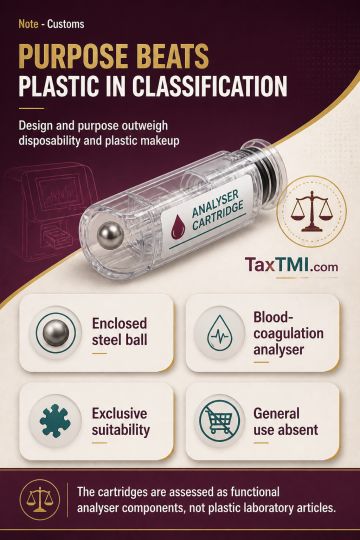
The classification dispute concerned STA micro-cuvettes used in a blood coagulation analyser. The goods were sealed cartridge assemblies with a plastic body containing a small steel ball. They were designed for use with the specified analytical system and were imported in cartridge or cassette form.
The analytical process was decisive. A plasma sample is placed in the micro-cuvette, while the enclosed steel ball is magnetically controlled by the analyser. As coagulation occurs, fibrin formation stops the ball's movement; the analyser's sensing system detects that event to determine coagulation time. The micro-cuvette therefore does more than hold a sample. Its geometry, enclosed steel ball and interaction with the analyser's magnetic and sensing mechanisms enable the intended viscosity-based diagnostic process.
The competing classifications were CTI 9027 9090, asserted as the classification applicable to identifiable parts or accessories of an analytical instrument, and CTI 3926 9099, asserted as the classification for plastic laboratory consumables. The Tribunal resolved the issue in favour of CTI 9027 9090 in 2026 (9) TMI 1612 - CESTAT CHENNAI.
The legal starting point is Rule 1 of the General Rules for the Interpretation of the First Schedule. It states that, for legal purposes, classification must be determined "according to the terms of the headings and any relative Section or Chapter Notes". Section and Chapter titles are only aids to reference.
Rule 3(a) applies where goods are prima facie classifiable under two or more headings. It requires that "the heading which provides the most specific description shall be preferred to headings providing a more general description". Rule 3(b), applicable only where Rule 3(a) does not resolve the issue, classifies composite goods according to the material or component that gives them their essential character.
Chapter 90 Note 2 establishes a sequence for parts and accessories. Note 2(a) requires parts and accessories which are themselves goods included in a heading of Chapter 90 or of Chapters 84, 85 or 91, subject to specified exclusions, to be classified in their respective headings. Note 2(b) then applies to "other parts and accessories" which are suitable for use solely or principally with a particular kind of machine, instrument or apparatus; such goods are classified with the machine, instrument or apparatus of that kind.
The distinction is material. Note 2(b) is not a general end-use rule that overrides a specific heading available to the article itself. But where the article is not separately and specifically covered and is shown to be suitable solely or principally for a particular Chapter 90 instrument, Note 2(b) provides the governing classification rule.
Heading 9027 covers instruments and apparatus for physical or chemical analysis, including viscosity-measuring instruments. The question was whether the imported micro-cuvette had the character of a dedicated functional component or accessory of such apparatus. Heading 3926, by contrast, covers other articles of plastics. The latter classification would depend on the article being no more than a plastic laboratory article without the requisite specific functional identity under Chapter 90.
The Tribunal held that the micro-cuvette must be assessed as a complete article, not by isolating its plastic outer body. Its configuration and enclosed steel ball were specifically designed for the coagulation analyser. The steel ball was not incidental: its magnetically controlled movement formed part of the mechanism through which coagulation time was determined.
On the evidence recorded, the micro-cuvettes had no established practical use with other instruments. They were essential to conducting the intended test, even though the analyser remained physically intact when a cuvette was not inserted. The relevant question was therefore whether the article was essential to the intended analytical operation, rather than whether it was permanently installed in the instrument or whether the instrument could be switched on without it.
This approach accords with 2010 (7) TMI 20 - Supreme Court. That decision treated controllers, input-output modules and chassis as Chapter 90 parts or accessories because their technical characteristics showed that they contributed to a defined measuring or controlling function. It applied the functional-unit approach and Chapter 90 Note 2(b), recognising that separately presented components may take their classification from their principal suitability for the specialised apparatus.
The distinction between a part and an accessory was also considered in 2008 (3) TMI 22 - Supreme Court. A part is an essential component without which the whole cannot function, whereas an accessory is supplementary and adds convenience, effectiveness or utility. The micro-cuvette satisfied, at the least, the broader statutory formulation of "parts and accessories" in Note 2(b), because it was necessary for conducting the specified analytical test and actively participated in that test.
A central aspect of the ruling is that "disposable" and "consumable" are not synonymous. Disposable identifies an intended use-cycle or limited life. Consumable ordinarily refers to material that is used up, exhausted, physically or chemically consumed, or loses its identity in operation. Thus, single use, short durability, disposal after use, or biosafety-driven destruction cannot alone determine tariff classification.
The classification must instead follow the article's objective characteristics, function and sole or principal suitability. A disposable item may be a part or accessory if it is specially designed for, functionally integrated with and necessary to the machine's operation. Conversely, an article that is merely used up in a process without operating as a functional component may remain a consumable supply.
Circular No. 19/2013-Customs illustrates the importance of following the Note 2 sequence. It addressed disposable filters used in blood purification and clarified that they were classifiable under tariff item 84212900 because they were themselves covered by Heading 8421. The circular specifically applies Rule 1 and Chapter 90 Note 2(a), under which an article with its own applicable heading is classified there rather than with the larger medical system. The circular does not create a rule that all disposable medical or analytical components must be treated as consumables or as plastic articles.
2015 (5) TMI 241 - Supreme Court confirms that Note 2(a) has priority where a part or accessory is itself specifically described in a Chapter 90 heading. In that matter, the specific heading for liquid crystal devices prevailed over a heading for meter parts. Similarly, 2023 (3) TMI 1338 - Supreme Court reaffirmed that a specific tariff entry and relevant exclusionary notes cannot be overridden solely through a principal-use argument. These decisions reinforce the necessary preliminary inquiry: whether the article has a more specific independent heading. On the facts concerning the micro-cuvette, the Tribunal found that Note 2(b), rather than Note 2(a), supplied the operative rule.
2003 (1) TMI 700 - Supreme Court emphasises commercial identity and recognises that specialised goods, made to specification and not of general use, may be classified as parts of the principal article. The micro-cuvettes were not ordinary laboratory vessels marketed for general application; their objective design and exclusive compatibility supported their identity as dedicated analytical components.
Conversely, 1992 (10) TMI 175 - CEGAT, NEW DELHI demonstrates why a specialised-use assertion is not, by itself, conclusive. Plastic tubes, fittings, bolts and nuts, being articles of general use covered by specific plastic headings and subject to exclusionary notes, could not be moved to a machinery-parts heading merely because of their end use. The micro-cuvette decision is distinguishable because the goods were not found to be general-use plastic articles; their specific design and analytical role attracted Chapter 90 Note 2(b).
2007 (4) TMI 263 - Supreme Court further establishes that plastic composition does not preclude classification as a part or accessory. Plastic name plates were held to be vehicle accessories because they added identity, effectiveness and market value, and no applicable exclusion required their relegation to Chapter 39. The principle supports the proposition that the material of construction is relevant only when it is made relevant by the tariff terms and notes; it is not a substitute for examining the article's actual tariff identity.
The Tribunal characterised Heading 3926 as a residual entry for other articles of plastics. Once the micro-cuvette was found to be an identifiable part or accessory solely or principally suitable for the coagulation analyser, classification followed under Heading 9027 by the express operation of Note 2(b). The decision did not rest merely on a general preference for specific entries; it applied the specific statutory classification mechanism in Chapter 90.
1994 (9) TMI 68 - Supreme Court supports this interpretative order. It applied Rule 3(a) to prefer the heading providing the more specific description and held that components solely used with the specifically classified principal article followed that principal classification. The micro-cuvette ruling applies the same discipline, while locating the immediate legal basis in Chapter 90 Note 2(b).
STA micro-cuvettes used exclusively with a coagulation analyser were held to be classifiable under CTI 9027 9090 because their specially designed construction and steel-ball mechanism made them functionally integrated with the analytical process. Their plastic body and single-use character did not convert them into residuary articles of plastics under CTI 3926 9099.
The decision confirms a structured classification discipline: apply Rule 1 and the relevant Section and Chapter Notes first; determine whether the article has an independent specific heading under Chapter 90 Note 2(a); and, where it does not, apply Note 2(b) to dedicated parts or accessories suitable solely or principally for the particular instrument. A residual plastics classification is not available where that exercise yields a specific Chapter 90 result.
Full Text:

