 TaxTMI
Login
 TaxTMI

Login
Loading...
Press 'Enter' to add multiple search terms. Rules for Better Search

Press 'Enter' after typing page number.
Press 'Enter' after typing page number.


No Folders have been created
Are you sure you want to delete "My most important" ?
NOTE:
Press 'Enter' after typing page number.
Press 'Enter' after typing page number.

All TMI Notes
Press 'Enter' after typing page number.
All TMI Notes

Note

Bookmark

Share


This commentary provides doctrinal analysis and practical insights on the legal issue discussed below. The judgment is analysed in the context of its factual background, issues framed, and conclusions reached by the Court.
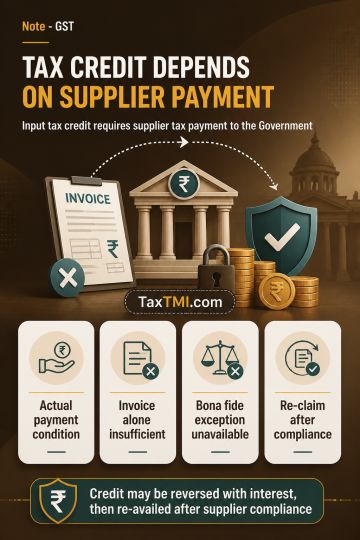
The constitutional validity of the supplier-tax-payment condition for input tax credit has now been affirmed by the Supreme Court in 2026 (7) TMI 1839 - SC Order. The Court upheld the conclusion that there is no basis to declare Section 16(2)(c) of the Central Goods and Services Tax Act, 2017 unconstitutional, or to read it down merely because the recipient asserts that it is a bona fide purchaser and the supplier has failed to remit tax.
The central issue is narrow but commercially consequential. A recipient may possess a tax invoice, receive the supply, make payment to the supplier and file its return. Yet, Section 16(2)(c) makes credit conditional upon the tax charged on that supply having been actually paid to the Government. The resulting question was whether placing the consequence of supplier default upon the recipient is arbitrary, discriminatory, disproportionate, or destructive of the recipient's asserted right to credit.
The Supreme Court answered the constitutional question by approving the view that the GST framework cannot be equated with the earlier Delhi VAT framework invoked in support of a bona fide-purchaser exception. The supplier-payment condition must therefore be understood as an operative statutory eligibility condition within the integrated GST credit, reversal and re-availment scheme.
Section 16(1) is the enabling provision. It entitles every registered person, subject to prescribed conditions and restrictions and in the manner specified in Section 49, to take credit of input tax charged on supplies used or intended to be used in the course or furtherance of business. The provision does not create an unconditional right to credit. Its express terms make entitlement contingent upon the statutory framework.
The critical limitation appears in Section 16(2), which begins with a non-obstante formulation: "no registered person shall be entitled to the credit of any input tax" unless the specified requirements are met. The relevant cumulative conditions include possession of a tax invoice or prescribed tax-paying document under clause (a), receipt of goods or services under clause (b), actual payment of the tax to Government under clause (c), and furnishing of the return under clause (d). Clauses (aa) and (ba) additionally connect entitlement to the supplier-furnished invoice details and the absence of restriction on credit details communicated under Section 38.
The precise language of Section 16(2)(c) is material: "subject to the provisions of section 41, the tax charged in respect of such supply has been actually paid to the Government, either in cash or through utilisation of input tax credit admissible in respect of the said supply." Thus, invoice possession, actual receipt and payment by the recipient are not textual substitutes for actual payment of the tax charged into the Government account.
Section 41(1) permits a registered person to avail self-assessed eligible input tax credit in the return, with credit being made to the electronic credit ledger. But self-assessment does not render the credit irrevocable. Under Section 41(2), credit availed in respect of supplies for which "the tax payable whereon has not been paid by the supplier" must be reversed by the recipient along with applicable interest in the prescribed manner. Its proviso permits the recipient to re-avail the reversed amount when the supplier subsequently pays the tax.
Rule 37A supplies a specific operational mechanism in the situation it addresses. Where the supplier has furnished outward-supply details in Form GSTR-1, or through the invoice furnishing facility, but has not furnished the corresponding Form GSTR-3B by the 30th day of September following the end of the financial year in which the recipient availed the credit, the recipient must reverse that credit in Form GSTR-3B by the 30th day of November following that financial year. If the reversal is not made by that date, the amount becomes payable with interest under Section 50. Once the supplier subsequently furnishes the relevant Form GSTR-3B, the recipient may re-avail the credit in a later Form GSTR-3B.
The constitutional objections have principally drawn upon Article 14, which commands that the State shall not deny equality before law or equal protection of laws. The challenge has also been framed by reference to the freedom to carry on trade or business under Article 19(1)(g) and the protection against deprivation of property except by authority of law under Article 300A.
The statutory structure does not permit clause (c) to be severed from the other conditions in Section 16(2). The expression "unless" makes each specified condition necessary to entitlement. Satisfaction of invoice, receipt, return-filing, and data-communication conditions does not displace the separate requirement that the tax charged has actually been paid to Government. This is the principal textual obstacle to a construction which treats recipient bona fides as a complete answer to supplier default.
The doctrine of reading down is an interpretative tool used to preserve a provision against constitutional invalidity where its language reasonably permits a narrower construction. It cannot be employed to substitute a judicially designed exception for a clear statutory condition merely because literal operation causes commercial hardship. The Supreme Court accepted the analysis that the CGST Act and the Delhi VAT enactment operate within materially different statutory schemes and held that parity between a CGST recipient and a purported bona fide purchaser under the Delhi VAT enactment cannot be drawn.
Section 41(2) is central to the proportionality analysis. It requires reversal if the supplier has not paid tax, but expressly allows re-availment when the supplier later discharges the liability. Rule 37A similarly enables re-availment upon subsequent furnishing of the supplier's corresponding return. The statutory design therefore treats the recipient's credit as conditional and reversible during supplier default, rather than treating every reversal as permanently extinguishing the credit.
It does not. Validity of the condition and correctness of a particular demand are distinct inquiries. A statutory condition may be intra vires, while a demand based on an undisclosed, unverified or mechanically applied allegation of supplier default may remain vulnerable on statutory and procedural grounds. The recipient's evidence on the genuineness of supply, receipt of goods or services, payment trail, invoices, transport or delivery material, and the precise basis of alleged ineligibility must be evaluated in the adjudicatory process.
The Supreme Court's determination rests on an integrated reading of the GST credit architecture. The Court specifically noted the distinction and differences between the Delhi VAT Act and the CGST Act, as well as the scheme for availment of credit under GST. It found "no possibility of drawing parity" so as to place a CGST purchasing dealer on the same footing as a purported bona fide purchasing dealer under the Delhi VAT enactment where the supplier fails to pay tax.
This conclusion is decisive against the proposition that a recipient's bona fides, by themselves, constitutionally neutralise the actual-payment condition. The Court also took note of Section 41 and of Sections 73 and 74 in the context that reversed credit may be re-availed after the supplier is made to discharge the tax liability. The constitutional conclusion was express: there were no grounds either to declare Section 16(2)(c) unconstitutional or to read down the provision.
The conclusion is doctrinally consistent with the settled proposition that input tax credit is a statutory entitlement or concession governed by the conditions of the enactment that creates it. This description does not trivialise the economic significance of credit. Rather, it identifies the source and limits of the entitlement. Where the legislature has imposed a condition that tax must have been actually paid to Government, the recipient cannot claim a freestanding constitutional entitlement to ignore that condition solely because it has separately paid tax-inclusive consideration to the supplier.
The Article 14 challenge was founded on the practical asymmetry between an honest recipient and a defaulting supplier. The difficulty is real: the recipient may not control the supplier's ultimate compliance. However, the Supreme Court-approved analysis treats the relevant comparison as one governed by the GST statutory framework, not by an assumed equivalence with earlier VAT arrangements. The scheme contains self-assessment, verification, reversal, recovery and re-availment components. In that setting, the condition operates to protect the integrity of credit flow and the public revenue rather than as an impermissible classification merely because its commercial burden falls upon the recipient during supplier default.
The same reasoning bears on Article 19(1)(g). A fiscal condition governing availment of a statutory tax credit is not, without more, an unconstitutional restriction on the carrying on of business. The claimant must establish that the condition crosses the high threshold of manifest arbitrariness or otherwise infringes the constitutional guarantee. The affirmed judicial view is that the supplier-payment requirement, read with the remedial capacity to re-avail credit after supplier payment, does not meet that threshold.
Article 300A is likewise not attracted merely because credit is reversed or denied under an enacted condition. The constitutional text protects against deprivation of property save by authority of law. Section 16(2)(c), read with Section 41 and the prescribed mechanism, supplies that authority of law. This does not excuse authorities from complying with the statutory process; it means that the existence of the legislated condition does not itself amount to an unconstitutional deprivation.
For administration and litigation, a crucial distinction must be preserved. The recipient bears the consequences of non-fulfilment of the statutory condition, but the department cannot proceed by presumption divorced from the governing statutory period, applicable mechanism and supporting material. The issue is not whether bona fides erase clause (c); it is whether the statutory facts necessary to invoke clause (c), reversal, interest or a fraud-based demand have been properly pleaded, established and adjudicated.
In 2026 (5) TMI 127 - GUJARAT HIGH COURT, the High Court held that the conditions in Section 16(2) are cumulative and that the claimant bears the burden of proving eligibility, including actual payment of tax. It treated credit as a statutory concession and declined both invalidation and reading down. The judgment nevertheless recognised the hardship faced by genuine recipients and urged technological and legislative measures to enable invoice-linked verification and prompt recovery from defaulting suppliers. The Supreme Court expressly affirmed this reasoning.
2026 (1) TMI 385 - TRIPURA HIGH COURT had reached a different interpretative result. It held the provision constitutionally sustainable but read it down so that bona fide, non-collusive transactions would not suffer denial of credit merely because the supplier defaulted. The Supreme Court noted that the analytical exercise adopted in the affirmed Gujarat decision had not been undertaken in that decision, and rejected parity with the Delhi VAT approach. The constitutional read-down approach cannot consequently govern the issue resolved by the Supreme Court.
2024 (8) TMI 836 - GAUHATI HIGH COURT similarly adopted the earlier bona fide-purchaser approach, read down the relevant provisions, and treated departmental recovery from the defaulting seller as the appropriate course. Its significance lies in demonstrating the pre-existing divergence. However, the Supreme Court's affirmance of the Gujarat view displaces the premise that Delhi VAT reasoning can be transposed to Section 16(2)(c) of the CGST Act.
The Delhi VAT authority in 2017 (10) TMI 1020 - DELHI HIGH COURT had read down a provision which did not distinguish a bona fide purchaser from one colluding with a defaulting seller. It considered denial of credit to a diligent purchaser, despite valid registration, invoice and matching material, to be vulnerable under Article 14. The Supreme Court did not accept this authority as a basis for construing the CGST Act, because the statutory schemes were held not comparable for this purpose.
2023 (8) TMI 1038 - PATNA HIGH COURT applied the statutory text directly: actual payment to Government was held necessary, the conditions were read cumulatively, and remedies against the defaulting supplier were held not to create credit for the purchaser before the tax reaches Government. That reasoning accords with the Supreme Court-approved construction of Section 16(2)(c).
2023 (11) TMI 1153 - KERALA HIGH COURT rejected an Article 14 challenge to Section 16(2)(c) and treated credit as a conditional statutory benefit, not an absolute right. The decision is relevant for its application of the manifest-arbitrariness standard: prescription of conditions for a fiscal concession does not by itself constitute prohibited discrimination.
In 2024 (6) TMI 288 - KERALA HIGH COURT, the challenge to Section 16(2)(c) was rejected in the context of a destination-based GST system and the inter-State consequences of credit. The Court considered the actual-payment condition a permissible measure to ensure that unreceived revenue is not required to be transferred through the credit chain. It also emphasised that self-assessed credit remains subject to verification, reversal and re-availment.
2023 (8) TMI 174 - CALCUTTA HIGH COURT is important on a different plane. It held that mere non-reflection in GSTR-2A did not automatically establish ineligibility where there was no adjudged failure of the conditions under Section 16(2). It also disapproved direct action against the recipient without enquiry into the supplier in the circumstances before it. The decision does not create a constitutional exception to actual payment under clause (c); it underscores the need to distinguish a mere data mismatch from a proved supplier-payment default.
The Supreme Court's general formulation in 2016 (9) TMI 408 - Supreme Court is that input tax credit is a statutory concession whose form and conditions may be prescribed by the legislature. Although decided in an earlier VAT context on a different condition, the principle supports strict adherence to conditions expressly attached to credit, subject always to constitutional limits.
2026 (10) TMI 296 - PUNJAB AND HARYANA HIGH COURT applies the post-affirmance position with an important procedural qualification. It recognises Section 16(2)(c) as constitutionally valid but rejects mechanical reversal merely because a supplier's registration was later cancelled or returns showed nil or short liability. The adjudicating authority must examine transaction genuineness, the recipient's evidence, the circumstances of supplier default, recovery action against the supplier and the statutory mechanism applicable to the relevant period.
2026 (10) TMI 295 - DELHI HIGH COURT rejected the constitutional challenge by applying the binding Supreme Court ruling. Yet it set aside an adjudication founded on retrospective supplier-registration cancellation because it lacked supplier-wise and invoice-specific particulars and did not record findings on the statutory ingredients required for a fraud-based demand. Constitutional validity therefore does not validate an unparticularised order.
2026 (9) TMI 2068 - DELHI HIGH COURT likewise treated the constitutional challenge as settled, while leaving substantive demand issues to the statutory appellate remedy. The decision reinforces the distinction between the legal validity of clause (c) and disputed factual questions concerning alleged wrongful credit.
In 2026 (9) TMI 1659 - DELHI HIGH COURT, the supplier-payment condition was held neither arbitrary nor disproportionate. The Court stated that the recipient must establish through cogent material that tax charged by the supplier was actually deposited, while factual disputes over receipt, payment trails and overlapping proceedings should ordinarily be examined in appeal.
2026 (9) TMI 1022 - RAJASTHAN HIGH COURT treated the constitutional issue as covered by the Supreme Court ruling and declined to entertain the challenge. It directed the affected taxpayers to the statutory appellate process against the final orders.
Finally, 2026 (9) TMI 939 - RAJASTHAN HIGH COURT held that Section 16(2)(c), Section 41 and the claimant's burden to establish eligibility form a coherent scheme. It rejected a bona fide-purchaser read-down but stressed that a fraud-based notice must disclose supporting factual material rather than reproduce statutory expressions. The merits of alleged bogus or genuine transactions remain matters for statutory adjudication and appeal.
The constitutional controversy is no longer a viable basis, on its own, for seeking a declaration that Section 16(2)(c) is invalid or for claiming a universal bona fide-recipient exemption. The operative legal position is that actual payment by the supplier remains an essential condition for credit, subject to the statutory reversal and re-availment framework.
Recipients should maintain a coherent evidentiary record of invoice issuance, supplier registration status at the time of supply, contractual documents, receipt of goods or services, transport or delivery evidence where applicable, payment of consideration, return disclosures and communications with suppliers. Such material may not dispense with Section 16(2)(c), but it remains critical to establish that the underlying supply was genuine and that the factual premise of a proposed reversal or fraud allegation is incorrect.
Where a supplier-payment default is established, the analysis should identify the applicable statutory mechanism. Section 41(2) contemplates reversal with applicable interest and re-availment after supplier payment. Rule 37A lays down specified return-linked dates and consequences for the situation covered by the Rule. The precise tax period, supplier-return position, date of availment and subsequent compliance must therefore be addressed rather than assumed.
For adjudication, notices and orders require transaction-specific discipline. An allegation based solely on a later cancellation of supplier registration, a generic mismatch, or a conclusory assertion of fraud may not adequately establish the statutory basis for denial. The authorities discussed above require disclosure of the relevant material, consideration of the recipient's evidence, a real opportunity of hearing, and reasoned findings on the conditions said to be unfulfilled.
For litigation strategy, the distinction between constitutional validity and factual eligibility is decisive. A challenge asserting that the clause is unconstitutional stands foreclosed by the Supreme Court ruling. Challenges concerning absence of actual evidence, failure to specify invoices or tax periods, incorrect application of Rule 37A, non-consideration of proof of genuine supply, or absence of foundational material for a fraud-based proceeding remain fact-sensitive statutory objections. Where a final appealable order exists, the statutory appellate remedy ordinarily assumes importance.
Section 16(2)(c) is constitutionally valid. The requirement that tax charged on the supply must have been actually paid to Government is a cumulative condition of input tax credit, not a condition displaced by the recipient's assertion of bona fides. The statutory response to supplier default is reversal coupled with the possibility of re-availment when the supplier pays, rather than judicial deletion of the condition.
The ruling does not authorise indiscriminate or mechanical ITC reversal. The statutory condition must be applied through a fact-based process that identifies the alleged default, engages with the recipient's material, applies the mechanism governing the relevant period, and records legally sustainable reasons. The enduring practical lesson is therefore twofold: constitutional invalidation is unavailable, but rigorous scrutiny of the factual and procedural foundation of each ITC demand remains indispensable.
Full Text:

