Loading...

⚠ ✕
❮ Top
☎ Help
☰
×

By creating an account you can:

Logo TaxTMI
Call Us / Help / Feedback✕

Contact Us At :

✉ E-mail: [email protected]

✆ To Call / Whatsapp, Check Contact Us

FAQs :

To know Frequently Asked Questions, Check FAQs

Most Asked Video Tutorials :

For more tutorials, Check Video Tutorials

Submit Feedback/Suggestion :

Email :
Please provide your email address so we can follow up on your feedback.
Category :
Description :
Min 15 characters 0/2000
Make Most of Text Search ✕
  1. Checkout this video tutorial: How to search effectively on TaxTMI.
  2. Put words in double quotes for exact word search, eg: "income tax"
  3. Avoid noise words such as : 'and, of, the, a'
  4. Sort by Relevance to get the most relevant document.
  5. Press Enter to add multiple terms/multiple phrases, and then click on Search to Search.
  6. Text Search
  7. The system will try to fetch results that contains ALL your words.
  8. Once you add keywords, you'll see a new 'Search In' filter that makes your results even more precise.
  9. Text Search
╳
Add to...
You have not created any category. Kindly create one to bookmark this item!
✕
Create New Category
Hide
Title :
Description :
❮❮ Hide
❮ Default View
Expand ❯❯
Close ✕
🔎 Filters / Advanced Search ❯
TEXT

Press 'Enter' to add multiple search terms. Rules for Better Search

Search In
Main Text + AI Text ❯
  • Main Text
  • Main Text + AI Text
  • AI Text
Law:
---- All Laws---- ❯
  • ---- All Laws----
  • Benami Property
  • Bill
  • Central Excise
  • Companies Law
  • Customs
  • DGFT
  • FEMA
  • GST
  • GST - States
  • IBC
  • Income Tax
  • Indian Laws
  • Money Laundering
  • SEBI
  • SEZ
  • Service Tax
  • VAT / Sales Tax
Types:
---- All Types ---- ❯
  • ---- All Types ----
  • Act Rules
  • Case Laws
  • Circulars
  • Manuals
  • News
  • Notifications
Sort By: ?
In Sort By 'Default', exact matches for text search are shown at the top, followed by the remaining results in their regular order.
Relevance Default Date
☰   Show Results ❯
    Case Laws Indian Laws
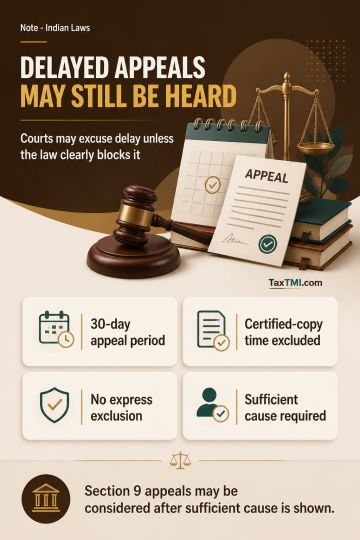
    Condonation of Delay in Statutory Appeals under Section 5 of the Limitation Act, 1963
    Case Laws Income Tax
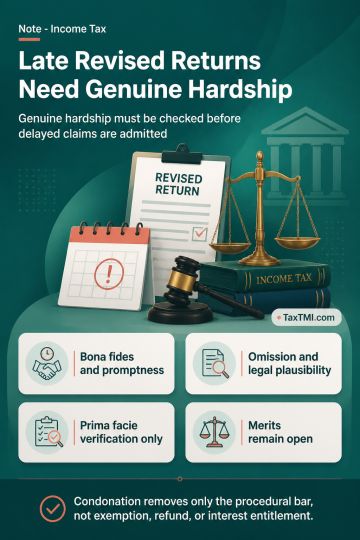
    Condonation of Delay for Filing Revised Returns under Section 119(2)(b): Genuine Hardship and Merits...
    Case Laws Income Tax
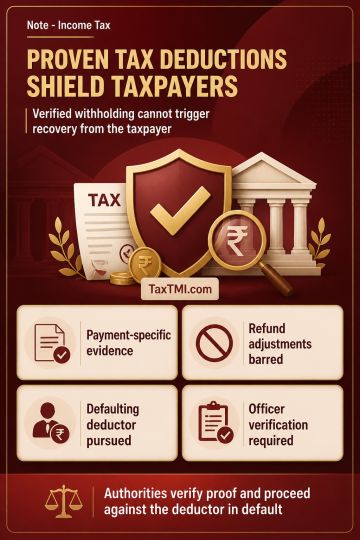
    TDS Credit Where the Deductor Defaults: Proof of Deduction Without Form 16 or Form 16A
    Case Laws Indian Laws
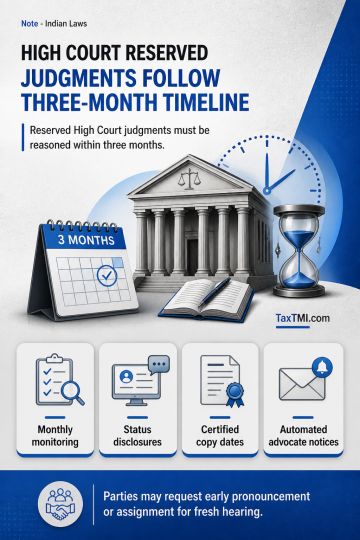
    Reserved High Court Judgments: Constitutional Timelines, Accountability and Litigant Remedies
    Price Depression in Securities Markets: Evidentiary Requirements under the PFUTP Regulations
    Case Laws Income Tax
    Foreign Leave Travel Concession and Tax Deduction at Source under Sections 10(5), 192 and 201
    Refund of Accumulated Input Tax Credit under Inverted Duty Structure: Section 54(3)(ii) and Rule 89(...
    Detention of Goods in Transit: Consequences of Delayed Penalty Orders Under Section 129(3)
    ITC: Constitutional Validity of Section 16(2)(c) of the CGST Act and Supplier-Tax-Payment Condition ...
    Substantive Right of Appeal and Onerous Pre-Deposit Conditions under the CGST Act
    Extended Limitation under GST: Fraud, Wilful Misstatement and Suppression Must Appear from the Notic...
    Omission of Rule 96(10) of the CGST Rules and Its Effect on Pending Integrated Tax Refund Proceeding...
    Interim Protection from Arrest after Dismissal of Anticipatory Bail under the GST Arrest Framework
    Case Laws Income Tax
    Interplay of Sections 87A, 111A and 115BAC(1A) in Computing Rebate on Special-Rate Capital Gains
    Extended Limitation u/s 74 of the CGST Act: Foundational Facts for Fraud, Wilful Misstatement and Su...
    Case Laws Income Tax
    Arm's Length Price Determination u/s 92C: Comparability Analysis: Economic Relevance of Turnover and...
    Case Laws Income Tax
    Make-Available Requirement for Managerial and Consultancy Services under the India-Singapore DTAA: A...
    Case Laws Income Tax
    Rebate under Section 87A on Short-Term Capital Gains Taxable under Section 111A
    Case Laws Income Tax
    Reassessment Notice Procedure: Administrative Approval under Section 143(2), Sanction under Section ...
    Case Laws Income Tax
    Reassessment Limitation under Section 149: Exclusion of Reply Time under Section 148A(b)
❮
❯
❯❯
Maximize Maximize Maximize
0 / 200
Expand Note
Add to Folder

No Folders have been created

+

Are you sure you want to delete "My most important" ?

NOTE:

Notes
Showing Results for :
Reset Filters
Results Found:
Show All Summaries Hide All Summaries
Case Laws Indian Laws
Show AI Summary
Condonation of delay under Section 5 remains available in special statutory appeals unless the governing scheme clearly excludes it.
Section 5 of the Limitation Act, 1963 applies to a special statutory appeal through Section 29(2) unless the governing enactment excludes it expressly or by necessary implication. A special limitation period alone is insufficient to exclude condonation. Restrictive language, a defined maximum condonable period, or a complete statutory limitation code may create a non-extendable outer limit. Section 9 of the Chhattisgarh Rajya Suraksha Adhiniyam contains a 30-day appeal period and excludes certified-copy time, but lacks an express bar or outer condonation ceiling; delay may therefore be considered upon proof of sufficient cause.
Case Laws Income Tax
Show AI Summary
Genuine hardship in delayed revised-return claims requires prima facie verification without converting condonation into final tax adjudication.
Section 119(2)(b) may permit admission of a delayed revised-return claim where expiry of the Section 139(5) period causes genuine hardship. Condonation removes only the procedural bar and does not establish exemption, refund, or interest entitlement. Genuine hardship requires assessment of bona fides, the nature of the omission, promptness after discovery, legal plausibility, and the consequence of refusal. Circular No. 9/2015 permits prima facie verification and inquiry, but substantive taxability and refund entitlement remain for merits examination.
Case Laws Income Tax
Show AI Summary
TDS credit after verified deduction protects taxpayers from demands and refund adjustments caused by deductor default.
TDS credit in domestic deductor-default cases depends on verified actual deduction from the taxpayer's income, not solely on deposit, TDS statements, Form 16 or Form 16A, or Form 26AS reflection. Section 205 bars direct or indirect recovery, including refund adjustment, to the extent tax was deducted. The taxpayer must provide reliable payment-specific evidence, and the Assessing Officer must verify the claim while the Department proceeds against the defaulting deductor.
Case Laws Indian Laws
Show AI Summary
Timely reserved judgments: a three-month framework, transparency, and staged remedies protect liberty and require reasoned decisions.
Reserved High Court judgments are subject to a three-month framework for a reasoned pronouncement, supported by monthly monitoring, status disclosures, date-recorded certified copies, and automated notice to advocates. Urgent matters may receive an operative-part pronouncement, but reasons must be uploaded within seven days or, where practical difficulties exist, within fifteen days. Parties may seek early pronouncement after the specified period and, after further delay, request withdrawal and assignment for a fresh hearing.
Case Laws SEBI
Show AI Summary
Settlement-price depression allegations require cogent proof of manipulation, not merely short exposure, closing sales, or position-limit non-disclosure.
Settlement-price depression under the PFUTP framework requires cogent proof of a manipulative act, device, scheme or artifice, not merely a substantial short derivative position, closing-window sales, or an incentive to benefit from a lower settlement price. Position concentration and position-limit non-disclosure are distinct from PFUTP fraud. Sales below the last traded price require market-wide causal analysis of other trading activity, execution mechanics, benchmark methodology, commercial rationale, and actual price impact. A genuine hedge and agency-attributed exposure do not, without further proof, establish manipulation.
Case Laws Income Tax
Show AI Summary
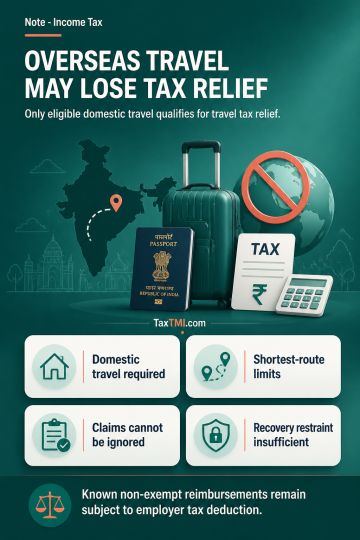
Foreign LTC tax exemption requires domestic travel; employers must deduct tax on known non-exempt travel reimbursements.
Foreign LTC/LFC payments for itineraries containing an overseas leg are outside the Section 10(5) exemption, which is confined to actual eligible domestic travel subject to Rule 2B shortest-route and fare conditions. Under Section 192, employers must include known non-exempt payments in estimated salary and deduct tax; they cannot disregard available claim records showing foreign or circuitous travel. A recovery restraint does not automatically suspend the deduction obligation. Section 201 recipient-compliance conditions, interest, and penalty based on reasonable cause require separate analysis.
Case Laws GST
Show AI Summary
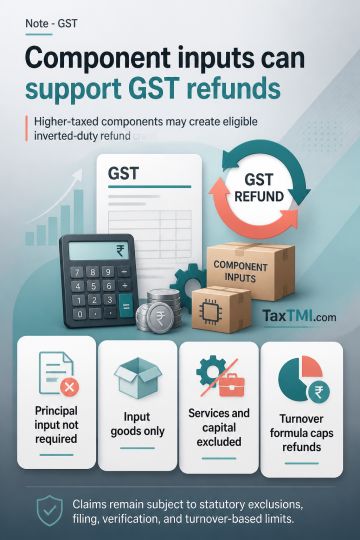
Inverted-duty GST refunds remain available where higher-taxed component inputs, rather than only principal inputs, cause accumulated eligible credit.
Refund of accumulated unutilised ITC under an inverted-duty structure depends on a causal link between higher-taxed input goods and lower-taxed output supplies. The test is not restricted to the principal raw material; higher-rated component inputs may support a claim despite parity between the principal input and output. Refund remains confined to credit on input goods, excluding input services and capital goods. Rule 89(5) separately determines the maximum refundable amount through its turnover-based formula, subject to statutory exclusions and prescribed filing and verification requirements.
Case Laws GST
Show AI Summary
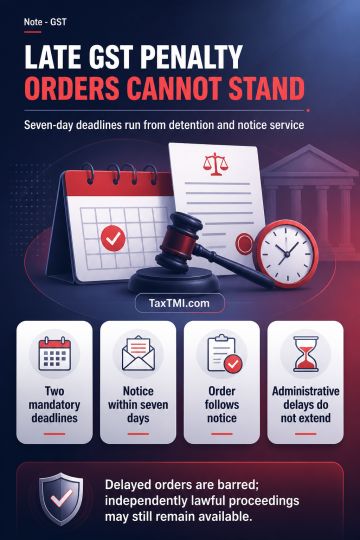
Mandatory goods-detention timelines bar delayed GST penalty orders despite administrative complications, while independently lawful proceedings may remain available.
Section 129(3) imposes two mandatory sequential deadlines: a penalty notice must be issued within seven days of detention or seizure, and the penalty order must follow within seven days of service of that notice. The service date, rather than reply, valuation or intervening events, controls the latter period. Administrative difficulty cannot extend either deadline. The framework also requires a hearing, while inspection reporting timelines and administrative forms remain distinct and cannot dilute the statutory time limits.
Case Laws GST
Show AI Summary
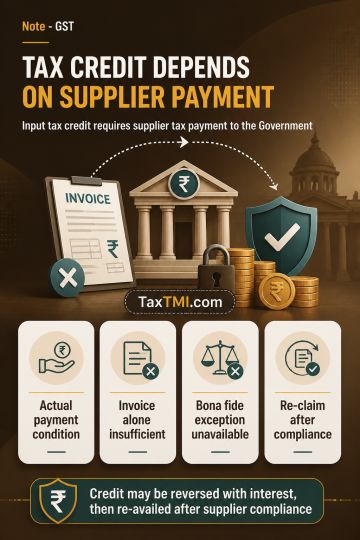
Input tax credit requires actual supplier tax payment, while reversal must rest on transaction-specific evidence and procedures.
Input tax credit under Section 16(2)(c) of the CGST Act is conditional upon actual payment of the tax charged on the supply to the Government. The condition is cumulative and is not replaced by the recipient's invoice, payment to the supplier, receipt of supply, return filing, or bona fides. Self-assessed credit is reversible with applicable interest where the supplier has not paid tax, but may be re-availed after subsequent supplier compliance. A bona fide-purchaser exception cannot be read into the actual-payment requirement, although any reversal or demand must rest on specific statutory facts, supporting material, and reasoned adjudication.
Case Laws GST
Show AI Summary
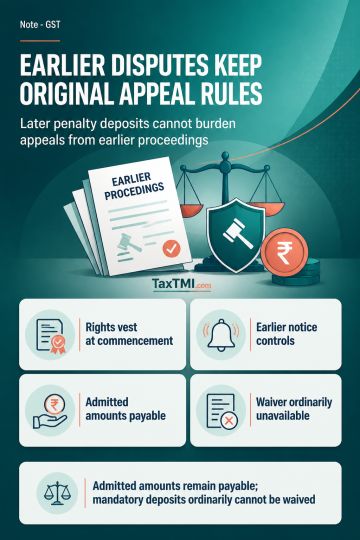
Vested appellate rights prevent later penalty-only pre-deposit conditions from burdening appeals arising from earlier commenced adjudication.
Substituted CGST pre-deposit requirement for penalty-only orders does not govern an appeal arising from a formal show-cause notice issued before 1 October 2025, absent express retrospective language or necessary implication. The right of appeal and its applicable conditions vest when the lis commences; a filing-stage deposit that bars institution is substantive, not merely procedural. Admitted amounts remain payable, while a mandatory applicable deposit cannot ordinarily be waived or reduced by the Appellate Authority.
Case Laws GST
Show AI Summary
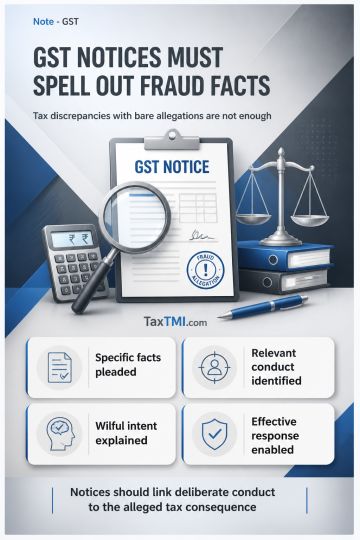
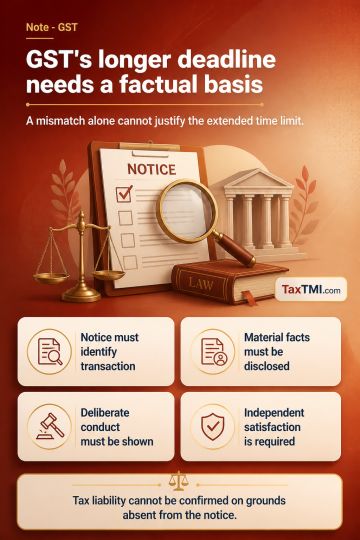
Extended GST limitation requires show cause notices to plead fraud, wilful misstatement, or suppression through specific factual allegations.
Section 74 requires the notice itself to state the material facts supporting the precise statutory limb invoked and the causal nexus between that conduct and the alleged tax consequence. The phrase "by reason of" requires a pleaded connection; a tax discrepancy coupled with a conclusory allegation of fraud or suppression is insufficient. The notice should identify the relevant act, omission, representation, non-disclosure or device, explain why it is deliberate or wilful, and enable an effective response.
Case Laws GST
Show AI Summary
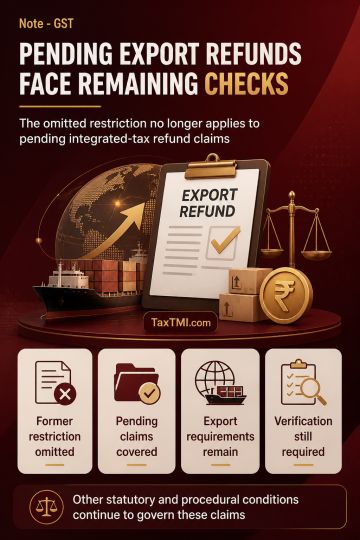
Omission of export-refund restriction requires pending integrated-tax refund claims to be assessed under surviving statutory and procedural conditions.
Omission of Rule 96(10), effective from 08 October 2024 without a saving clause, applies to integrated-tax export-refund proceedings pending on that date. Such claims are assessed without the former restriction concerning specified notification benefits because Section 6 of the General Clauses Act does not preserve an omitted subordinate rule. The omission does not remove independent requirements for zero-rated supplies, refund eligibility, export documentation, returns, limitation, verification, or the applicable Rule 96 and Rule 89 procedures.
Case Laws GST
Show AI Summary
Interim arrest protection cannot survive dismissal of anticipatory bail; GST arrest requires communicated authorisation, not merely a summons.
Interim protection from arrest is ancillary to a live anticipatory-bail proceeding and cannot subsist as a freestanding direction after an application is dismissed as not maintainable. Under the GST arrest framework, a summons does not by itself make the summoned person an accused or create a legally sustainable apprehension of arrest. Arrest depends upon the Commissioner's reasons to believe and an order authorising arrest. The Section 69 authorisation order must be communicated before arrest, enabling the affected person to pursue available remedies before personal liberty is curtailed.
Case Laws Income Tax
Show AI Summary
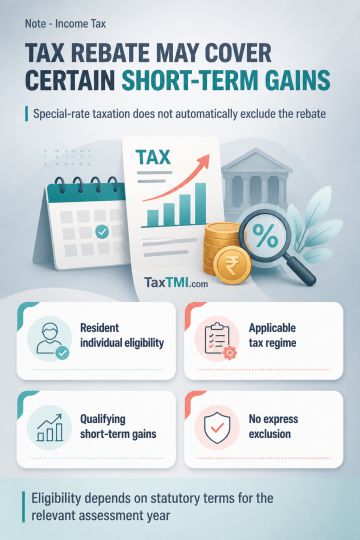
Section 87A rebate may apply after special-rate computation of qualifying short-term capital gains, absent an express statutory exclusion.
Section 111A requires qualifying short-term capital gains to be taxed at the prescribed special rate, while section 87A operates as a rebate from income-tax computed on total income for an eligible resident individual under the applicable section 115BAC(1A) regime. Special-rate taxation governs computation and does not itself imply exclusion from the rebate. Unlike section 112A(6), section 111A contains no express provision reducing the rebate base by tax on qualifying gains. Eligibility depends on the statutory terms applicable for the relevant assessment year.
Case Laws GST
Show AI Summary
Extended GST limitation requires pleaded foundational facts linking alleged fraud, wilful misstatement, or suppression to tax evasion.
Section 74 permits extended GST limitation only where tax short payment, erroneous refund, or wrongful input tax credit arose by reason of fraud, wilful misstatement, or suppression of facts to evade tax. A mismatch or discrepancy alone is insufficient. The show cause notice must disclose foundational facts identifying the transaction, withheld or misstated material, deliberate conduct alleged, and its factual link to tax evasion. Audit objections or approaching limitation cannot replace the proper officer's independent satisfaction. Liability cannot be confirmed on grounds beyond those specified in the notice.
Case Laws Income Tax
Show AI Summary
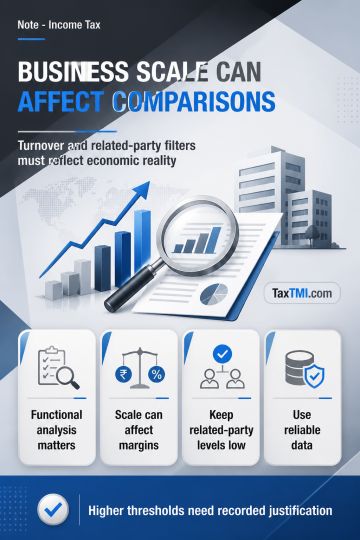
Transfer-pricing comparability requires turnover and related-party transaction filters to reflect functional, economic, and data-based reliability rather than fixed thresholds.
Transfer-pricing comparability under the transactional net margin method requires economically reliable uncontrolled comparables selected through functional, asset, risk, contractual and market analysis. Turnover is not a universal statutory threshold, but material scale differences may justify exclusion where they affect margins through brand value, intangibles, bargaining power or economies of scale. Related-party transaction tolerance should ordinarily be the lowest practicable level; a higher threshold requires a recorded finding that sufficient lower-related-party comparables are unavailable. Any re-determination and comparable selection must comply with statutory conditions, reliable data requirements and Rule 10B.
Case Laws Income Tax
Show AI Summary
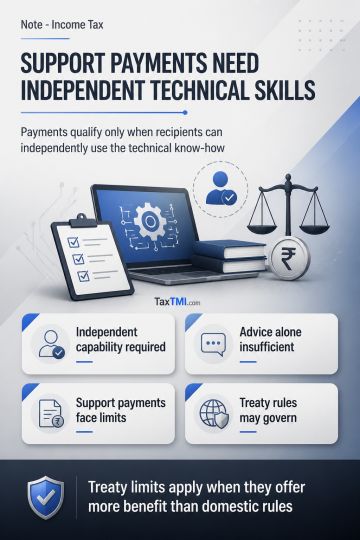
Make-available requirement limits treaty characterization of management and support payments as fees unless recipients gain independent technical capability.
Fees for technical services under Article 12(4) of the India-Singapore DTAA require more than managerial, technical or consultancy characterisation. The services must satisfy an additional treaty gateway, including making available technical knowledge, experience, skill, know-how or processes that enable the recipient to apply the technology independently. Advice, operational assistance, recurring support, training or business benefits do not alone establish transfer of technical capability. Where the DTAA is more beneficial than the broader domestic definition, the treaty limitation governs, subject to treaty-residence and documentation requirements.
Case Laws Income Tax
Show AI Summary
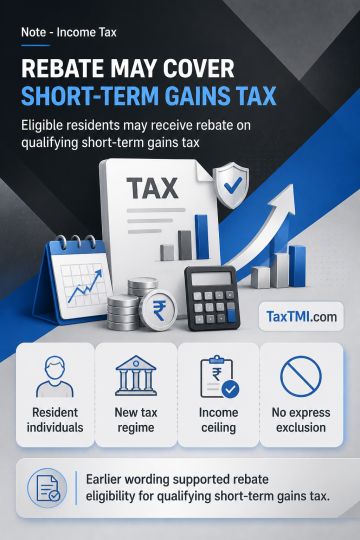
Income-tax rebate may extend to short-term capital gains tax when total-income conditions under the new regime are met.
Under the pre-restriction statutory formulation, a resident individual taxable under section 115BAC(1A) and within the prescribed total-income ceiling is analysed as eligible for section 87A rebate against income-tax on total income, including tax on qualifying short-term capital gains under section 111A. Section 111A fixes the special-rate computation but contains no express rebate exclusion. The explicit exclusion for specified long-term gains in section 112A(6) supports this distinction. Later limiting language in section 87A must be applied according to the statutory period concerned.
Case Laws Income Tax
Show AI Summary
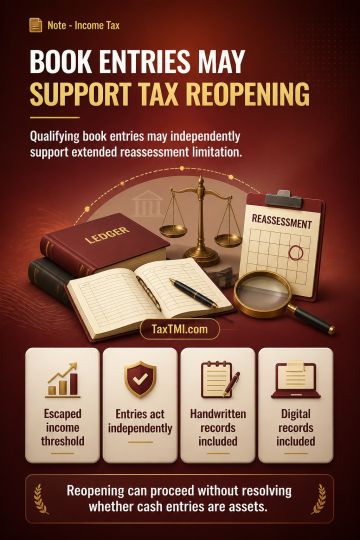
Extended reassessment limitation permits reopening on qualifying book entries, independently of disputes over whether seized cash entries are assets.
Extended limitation under section 149(1)(b) may operate where books, documents or evidence reveal escaped income meeting the prescribed monetary threshold and represented as an asset, qualifying expenditure, or entries in books of account. These categories operate disjunctively; qualifying book entries may therefore provide an independent jurisdictional basis without resolving whether cash entries are assets. Handwritten and digital records may be treated as books where possession, control, corroboration, and attribution establish their nexus with the taxpayer.
Case Laws Income Tax
Show AI Summary
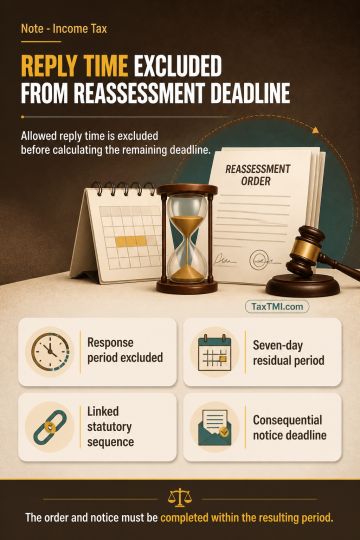
Reassessment limitation requires exclusion of allowed reply time, followed by a finite statutory period for consequential notice issuance.
Under the former reassessment framework, the time or extended time allowed for responding to a Section 148A(b) show-cause notice is excluded when computing limitation for the consequential notice. If the period remaining immediately after that exclusion does not exceed seven days, the sixth proviso supplies a seven-day residual period. The Section 148A(d) order and reassessment notice form a linked statutory sequence and must be completed within the resulting limitation period.

TMI Notes

Back

All TMI Notes

Showing Results for :
Reset Filters
No Records Found

TMI Notes

Back

All TMI Notes

Interplay of Sections 87A, 111A and 115BAC(1A) in Computing Rebate on Special-Rate Capital Gains

5 October, 2026

Contents
Acts
Plus +
Summary
Note

Note

-

Bookmark

(New) -

Download

Print

Print

This commentary provides doctrinal analysis and practical insights on the legal issue discussed below. The judgment is analysed in the context of its factual background, issues framed, and conclusions reached by the Court.

2026 (9) TMI 1033 - ITAT JAIPUR

Rebate under Section 87A on Short-Term Capital Gains Taxable under Section 111A

1. Introduction

The central question is whether a resident individual, whose total income falls within the monetary threshold prescribed for the concessional regime under section 115BAC(1A), can claim rebate under section 87A where the tax liability includes short-term capital gains chargeable at the special rate under section 111A.

In 2026 (9) TMI 1033 - ITAT JAIPUR, the Tribunal affirmed that, for the assessment year considered, the rebate could not be denied merely because a component of total income consisted of short-term capital gains taxable at a special rate. The conclusion rests on the text of section 87A, the absence of an exclusion in section 111A, and the contrast with the express restriction enacted in section 112A(6) for specified long-term capital gains.

The ruling is significant because it separates two distinct stages in tax computation: first, calculation of tax under the applicable charging and special-rate provisions; and secondly, allowance of a rebate from the income-tax so computed, where the statutory conditions for rebate are met. The decision treats special-rate taxation as determining the amount of tax, not as silently creating an exclusion from a rebate that is otherwise framed by reference to total income.

2. Legal & Statutory Context

Section 87A grants a rebate to an assessee who is an individual resident in India. Its central operative formulation is that the eligible assessee is entitled to a deduction "from the amount of income-tax" computed, before deductions under the relevant Chapter, "on his total income with which he is chargeable". Thus, the provision is directed to a rebate from income-tax on total income, rather than to a deduction confined to a particular head of income.

For the period considered in the Tribunal's decision, the first proviso inserted by the Finance Act, 2023 stated that where total income was chargeable to tax under section 115BAC(1A), and did not exceed Rs. 7,00,000, the individual was entitled to a deduction from income-tax on total income equal to 100 per cent of such income-tax or Rs. 25,000, whichever was less. The proviso also contained marginal-relief language where total income exceeded Rs. 7,00,000 and the tax payable exceeded the amount of such excess.

The text presently reproduced in Section 87A records subsequent substitutions of the threshold and maximum rebate, as well as a further proviso. Those later textual changes must be applied only according to their stated effective operation. The decision analysed the statutory formulation applicable to the period before it; it does not determine the scope of rebate for a different period governed by altered language.

Section 111A(1) applies where total income includes short-term capital gains from transfer of specified equity shares, units of an equity-oriented fund, or units of a business trust, subject to the stipulated securities transaction tax condition. It directs that tax payable on total income shall be the aggregate of tax on the qualifying short-term gains at the prescribed special rate and tax on the balance total income as if that balance were total income. The provision therefore establishes a distinct computation mechanism and rate for the qualifying gains.

Section 115BAC(1A) begins with the expression "Notwithstanding anything contained in this Act but subject to the provisions of this Chapter". It prescribes the concessional-regime slab rates for total income of the persons specified thereunder, subject to the option-out mechanism in section 115BAC(6). Its language preserves the operation of the special-rate provisions contained in Chapter XII while computing tax; it does not, by its own terms, state that a rebate under section 87A is unavailable on tax arising from section 111A gains.

The legislative contrast is supplied by Section 112A(6). In express terms, it provides that where total income includes the specified long-term capital gains, "the rebate under section 87A shall be allowed from the income-tax on the total income as reduced by tax payable on such capital gains." This is a direct statutory instruction that excludes the tax on the specified section 112A gains from the base against which rebate is allowed. No corresponding language occurs in section 111A.

3. Interpretative Issues

The first issue is the meaning and reach of the expression "total income" in section 87A. A rebate provision framed as a deduction from income-tax on total income ordinarily applies after the taxable income and tax liability have been determined in accordance with the Act. The text does not distinguish between tax computed at slab rates and tax computed at a special rate.

The second issue concerns the legal consequence of section 111A prescribing a special rate. A special-rate provision must be given full effect at the computation stage. However, the fact that a rate is special does not itself answer whether a later rebate is available. That answer must be found in the rebate provision or in an express restriction connected with the special-rate provision.

The third issue is the effect of the phrase "subject to the provisions of this Chapter" in section 115BAC(1A). The Tribunal treated the phrase as ensuring that Chapter XII special-rate rules govern the calculation of tax where applicable. It did not read the phrase as displacing an independent rebate provision in Chapter VIII. This construction permits both provisions to operate: section 111A determines tax on qualifying gains, and section 87A thereafter applies to the income-tax on total income if its conditions are fulfilled.

The fourth issue is whether a restriction may be implied from the overall scheme of special-rate taxation. The Tribunal rejected that approach. A tax benefit must indeed be claimed within the statute, but when the statutory language clearly grants the benefit and does not state a relevant exclusion, an adjudicator cannot supply one by implication. This is particularly so where Parliament has demonstrated, in section 112A(6), that it can enact a targeted limitation when it intends to do so.

4. Detailed Commentary & Analysis

The Tribunal's reasoning is founded on a sequential computation model. Section 111A first determines the tax payable by requiring an aggregate of: tax on eligible short-term capital gains at the special rate; and tax on the remaining total income. This preserves the special rate in full. Section 87A then speaks of a deduction from the income-tax computed on total income. On this reading, allowing the rebate does not alter the rate applicable under section 111A or render the special-rate provision redundant. It only gives effect to a separate rebate after the liability is computed.

The absence of an express exclusion in section 111A was treated as legally material. It would be impermissible to rewrite section 87A as though it stated that income taxed at a special rate was excluded from "total income", or as though tax on such income was excluded from "the amount of income-tax". Neither proposition appears in the relevant statutory text considered by the Tribunal.

The comparison with section 112A(6) reinforces this conclusion. Section 112A does not merely apply a special rate to specified long-term gains; sub-section (6) goes further and specifically limits the base from which section 87A rebate may be allowed. The contrast indicates that the special rate and the rebate exclusion are separate legislative choices. The presence of the latter in section 112A cannot be transposed into section 111A in the absence of equivalent language.

The Revenue had contended that rebate cannot be applied so as to neutralise or override the scheme of taxation at special rates. Properly understood, the Tribunal's approach does not neutralise the special rate. The tax on short-term capital gains is first computed exactly as section 111A commands. The subsequent statutory rebate may reduce the resulting liability, but that is the intended function of a rebate provision framed as a deduction from income-tax. Harmonious construction requires effect to both provisions, not the implied curtailment of one provision by another.

The Revenue also invoked Circular No. 13/2025 in support of its position. Its operative text is not stated. The Tribunal noted that the Revenue representative did not distinguish the authorities cited by the taxpayer or identify a contrary decision of the jurisdictional High Court or the Supreme Court. In any event, an administrative clarification cannot substitute for an exclusion not found in the governing statutory language for the relevant period.

The Tribunal accordingly upheld the appellate direction to allow section 87A rebate on the tax attributable to short-term capital gains. Its conclusion is carefully anchored to the statutory conditions applicable for the period: resident-individual status, total income within the applicable threshold, taxation under section 115BAC(1A), and the absence of an express statutory restriction concerning section 111A gains.

5. Judicial / Administrative Perspective

In 2025 (8) TMI 842 - ITAT AHMEDABAD, the Tribunal directly considered short-term capital gains under section 111A for an individual under section 115BAC(1A). It held that neither section 87A nor section 111A contained an express bar to the rebate. It also treated section 112A(6) as a meaningful legislative contrast and construed the "subject to" clause in section 115BAC(1A) as governing tax computation rather than extinguishing a Chapter VIII rebate. This authority provides the most detailed foundation for the conclusion affirmed in the principal decision.

In 2025 (12) TMI 170 - ITAT RAJKOT, the Tribunal followed the Ahmedabad reasoning on materially identical statutory conditions. It held that system-driven denial of the claim could not prevail over the absence of an express statutory bar. The decision is important for confirming that a section 143(1) adjustment cannot survive once the substantive rebate entitlement is established.

In 2026 (5) TMI 1715 - ITAT BANGALORE, the Tribunal emphasised that total income includes capital gains and that an omission to enact an exclusion in section 111A cannot be supplied by interpretation. It also treated the later restrictive change referred to in the materials as prospective. The ruling strengthens the proposition that eligibility depends upon the text applicable to the assessment year, rather than an inferred policy against rebates on special-rate income.

In 2026 (3) TMI 1753 - ITAT CHENNAI, the Tribunal held that section 87A applies to tax computed on total income without distinguishing normal-rate income from special-rate capital gains for the applicable year. It treated section 115BAC(1A) as a tax-rate computation provision and held that a subsequent restriction could not govern the earlier period. The principal decision expressly relied upon this reasoning.

In 2025 (9) TMI 224 - ITAT CHENNAI, the Tribunal applied the plain-language principle to a claim involving capital gains taxed at special rates. The decision's relevance to section 111A lies in its broader proposition that a clear statutory rebate cannot be denied by introducing an unstated category-based exclusion. It cannot, however, displace the explicit limitation contained in section 112A(6), which must operate where its conditions are satisfied.

In 2025 (1) TMI 1501 - BOMBAY HIGH COURT, the Court addressed the administrative dimension. It held that an electronic return utility cannot prevent an assessee at the threshold from making a rebate claim that may ultimately be found legally correct. The Court left the substantive eligibility issue to the statutory authorities. The decision therefore does not decide the section 111A merits, but it establishes an important procedural proposition: automated processing architecture cannot foreclose a legally arguable claim.

6. Implications & Observations

  • Eligibility analysis must begin with the statutory text applicable to the relevant assessment year. Thresholds, rebate caps, and limitations appearing in a later version of section 87A cannot automatically be applied to an earlier period.

  • Practitioners should preserve the distinction between computation of tax under section 111A and allowance of rebate under section 87A. The former determines the special-rate tax; the latter concerns the deduction from income-tax after computation.

  • A claim should be supported by a transparent computation showing total income, qualifying section 111A gains, tax computed under section 111A, tax on the balance income, and the section 87A rebate claimed. This makes clear that the special rate has not been disregarded.

  • Where a CPC intimation disallows the rebate, the taxpayer should identify the exact statutory provision relied upon for the adjustment. A denial based solely on system configuration or an assumed exclusion requires substantive examination under the Act.

  • The section 112A(6) comparison has a limited but powerful function. It supports the absence-of-exclusion reasoning for section 111A, but it also means that the express long-term-capital-gains limitation must be respected on its own terms.

  • The judicial materials reveal a consistent tribunal-level approach in favour of rebate on qualifying section 111A gains for the period considered. The principal decision also records that no contrary jurisdictional High Court or Supreme Court decision was brought to the Tribunal's attention. The outcome nevertheless remains assessment-year-specific and provision-specific.

7. Concluding Remarks

The decision in 2026 (9) TMI 1033 - ITAT JAIPUR adopts a textually coherent construction of sections 87A, 111A and 115BAC(1A). Section 111A governs the special-rate computation of tax on qualifying short-term capital gains; section 87A, as applicable for the period in question, grants a rebate from income-tax on total income without excluding such gains. The express restriction in section 112A(6), coupled with the absence of its counterpart in section 111A, was decisive.

The practical rule emerging from the decision is not that all special-rate income necessarily qualifies for section 87A rebate. Rather, a rebate can be curtailed only where the statute applicable to the relevant period expressly does so. For qualifying resident individuals within the prescribed total-income limit and covered by section 115BAC(1A), short-term capital gains under section 111A could not, on the statutory language examined, be isolated and excluded from the rebate base merely because they were taxed at a special rate.


Full Text:

2026 (9) TMI 1033 - ITAT JAIPUR

Topics

Acts Income Tax