Loading...

⚠ ✕
❮ Top
☎ Help
☰
×

By creating an account you can:

Logo TaxTMI
Call Us / Help / Feedback✕

Contact Us At :

✉ E-mail: [email protected]

✆ To Call / Whatsapp, Check Contact Us

FAQs :

To know Frequently Asked Questions, Check FAQs

Most Asked Video Tutorials :

For more tutorials, Check Video Tutorials

Submit Feedback/Suggestion :

Email :
Please provide your email address so we can follow up on your feedback.
Category :
Description :
Min 15 characters 0/2000
Make Most of Text Search ✕
  1. Checkout this video tutorial: How to search effectively on TaxTMI.
  2. Put words in double quotes for exact word search, eg: "income tax"
  3. Avoid noise words such as : 'and, of, the, a'
  4. Sort by Relevance to get the most relevant document.
  5. Press Enter to add multiple terms/multiple phrases, and then click on Search to Search.
  6. Text Search
  7. The system will try to fetch results that contains ALL your words.
  8. Once you add keywords, you'll see a new 'Search In' filter that makes your results even more precise.
  9. Text Search
╳
Add to...
You have not created any category. Kindly create one to bookmark this item!
✕
Create New Category
Hide
Title :
Description :
❮❮ Hide
❮ Default View
Expand ❯❯
Close ✕
🔎 Filters / Advanced Search ❯
TEXT

Press 'Enter' to add multiple search terms. Rules for Better Search

Search In
Main Text + AI Text ❯
  • Main Text
  • Main Text + AI Text
  • AI Text
Law:
---- All Laws---- ❯
  • ---- All Laws----
  • Benami Property
  • Bill
  • Central Excise
  • Companies Law
  • Customs
  • DGFT
  • FEMA
  • GST
  • GST - States
  • IBC
  • Income Tax
  • Indian Laws
  • Money Laundering
  • SEBI
  • SEZ
  • Service Tax
  • VAT / Sales Tax
Types:
---- All Types ---- ❯
  • ---- All Types ----
  • Act Rules
  • Case Laws
  • Circulars
  • Manuals
  • News
  • Notifications
Sort By: ?
In Sort By 'Default', exact matches for text search are shown at the top, followed by the remaining results in their regular order.
Relevance Default Date
☰   Show Results ❯
    GSTR-2A Mismatch, Supplier Certification (of tax payment) and the Burden of Proving Input Tax Credit...
    Concessional GST on Works Contracts for Co-operative Spinning Mills: Government Entity Status and Pr...
    Case Laws Customs
    Abetment and Knowing Use of False Import Documents under Sections 112(a) and 114AA
    Subcontracted Services on Own Account and the Intermediary Exclusion under Section 2(13)
    Case Laws Customs
    Classification of Two-Ton Ductless Split Air Conditioners under Tariff Item 8415 82 10
    Case Laws Income Tax
    Transfer Pricing of Pre-Conversion Interest on Compulsorily Convertible Debentures
    Case Laws Customs
    Clubbing of Contrived Split Consignments under Rule 2(a) and Valuation of a Dismantled Motorcycle
    GST on Corporate Guarantees: Substantive Liability, Deemed Valuation and Judicial Relief
    Case Laws Income Tax
    Employee Secondment under the India-USA DTAA: Employment Rights, Reimbursements and Included Service...
    Pre-deposit Under Section 112 and Independent Compliance with Tribunal Filing Fees
    Case Laws Income Tax
    TDS on Interest Paid by Co-operative Banks to Non-Member Co-operative Societies under Section 194A(3...
    Input Tax Credit and Supplier Non-Payment: Statutory Limits on Mechanical Reversal Under Section 16(...
    Case Laws Customs
    Appellate Jurisdiction over Goods Imported as Baggage under Sections 129A and 129DD of the Customs A...
    Monetary Limits for Departmental GST Appeals under Section 120 and Circular No. 207/1/2024-GST
    Alleged Re-use of E-Way Bills under Section 129: Evidentiary Burden in Detention Proceedings
    Turnover of Zero-Rated Supply Under Rule 89(4): Invoice Period and Subsequent Physical Export
    Case Laws Income Tax
    Reassessment Proceedings: Speaking Disposal of Objections Before Scrutiny Under Sections 143(2) and ...
    Suppression of Facts under Explanation 2 to Section 74 of the CGST Act in Cases of Ineligible Input ...
    Case Laws Customs
    Classification of Low-Ethoxylated Non-Ionic Fatty Alcohol Ethoxylates under Headings 3402 and 3824
    Case Laws Customs
    Seizure and Detention of Imported Cars under Sections 110, 110A and 124 of the Customs Act, 1962
❮
❯
❯❯
Maximize Maximize Maximize
0 / 200
Expand Note
Add to Folder

No Folders have been created

+

Are you sure you want to delete "My most important" ?

NOTE:

Notes
Showing Results for :
Reset Filters
Results Found:
Show All Summaries Hide All Summaries
Case Laws GST
Show AI Summary
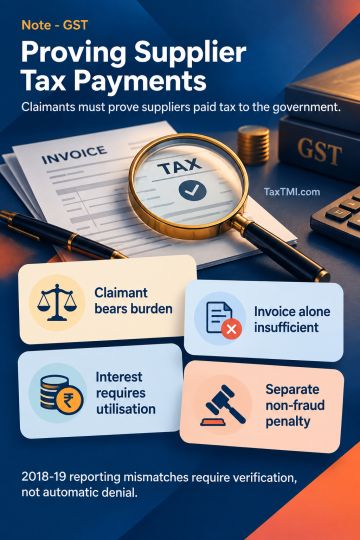
Input tax credit requires proof of supplier tax payment; reporting mismatches call for verification rather than automatic denial.
Supplier payment of tax to the Government is a condition of input tax credit eligibility under section 16(2)(c), and the claimant bears the burden of proving eligibility under section 155. Payment of the invoice and tax to the supplier, receipt of the supply and possession of an invoice do not themselves establish the supplier's remittance. For 2018-19, a GSTR-2A mismatch calls for verification and does not alone prove ineligibility. Interest under section 50(3) requires credit to have been both wrongly availed and utilised; its calculation follows Rule 88B(3). Non-fraud penalty operates under a separate statutory trigger and is not automatically excluded by the absence of fraud or utilisation.
Case Laws GST
Show AI Summary
Non-business construction concessions for spinning mills require eligible recipient status and predominantly non-industrial use of the constructed buildings.
For the disputed period, the works-contract concession required both an eligible governmental recipient and structures predominantly meant for use other than commerce, industry, business or profession. Government Entity status required evidence of the recipient's constitution and qualifying governmental participation, while procurement had to relate to entrusted work. Project funding, tender approval and supervision did not by themselves establish governmental constitution or control. The spinning-mill factory buildings and allied works were intended for yarn production and related commercial activities. The residual construction-services entry carried aggregate GST of 18% for services outside the specified concessional entries.
Case Laws Customs
Show AI Summary
Import document handling alone does not establish customs abetment or knowing use of materially false declarations.
Personal customs penalties depend on the person's own conduct, not merely on the confiscability of imported goods. Under Section 112(a) of the Customs Act, 1962, liability may arise from a person's own act or omission rendering goods liable to confiscation or from abetment of such conduct. The direct limb can operate on a strict-liability basis where a person's own act or omission renders goods confiscable; an allegation of abetment instead requires evidence of participation or culpable facilitation. Section 114AA requires knowing or intentional making, signing or use, or causing the making, signing or use, of a declaration, statement or document that is materially false or incorrect in customs business.
Case Laws GST
Show AI Summary
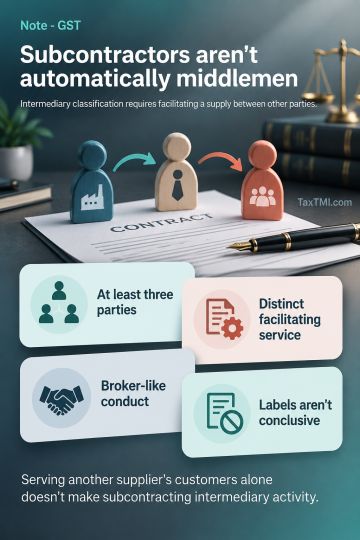
Subcontracted services performed on own account are not intermediary services merely because they support overseas recruitment and customer-facing activities.
Intermediary classification under Section 2(13) of the IGST Act distinguishes arranging or facilitating supplies between other persons from supplying services on one's own account. The intermediary framework requires at least three parties, a main supply and a distinct ancillary facilitating supply, with conduct resembling that of a broker or agent. Subcontracting the whole or part of a service is not intermediary activity merely because performance supports another supplier's business or involves its customers. Neither a bilateral agreement, contractual label nor remuneration method is conclusive.
Case Laws Customs
Show AI Summary
Split air conditioner classification requires capacity and refrigeration features to be assessed against the applicable tariff hierarchy.
Classification of ductless split air conditioners depends on the complete tariff description and the machine's technical characteristics. A complete, cooling-only, two-ton split air conditioner incorporating a refrigerating unit and lacking a heat-reversal valve falls within tariff item 8415 82 10 rather than the general split-system item 8415 10 10. Item 8415 82 10 inherits its parent subheading's refrigerating-unit requirement, while item 8415 83 10 requires the absence of such a unit. Capacity alone does not establish the applicable refrigeration-based entry. Technical evidence should establish whether the goods are a complete machine and identify their capacity and operating features.
Case Laws Income Tax
Show AI Summary
Convertible debenture interest requires evidence-based pricing before conversion; future equity conversion alone cannot establish a nil arm's length price.
Pre-conversion interest on compulsorily convertible debentures (CCDs) issued to a non-resident associated enterprise requires arm's length pricing. Compulsory future conversion and hybrid classification do not, by themselves, establish a nil price or extinguish an existing coupon obligation. Rule 10AB's Other Method requires a price charged, paid or expected in comparable uncontrolled circumstances, with reasonably accurate adjustments for material differences under Rule 10B. Currency, benchmark date, tenure, credit risk, security, non-redemption and conversion benefits affect comparability; a conventional bank lending rate is not automatically comparable to a long-tenor CCD.
Case Laws Customs
Show AI Summary
Split motorcycle consignments require evidence of deliberate fragmentation for composite classification, with valuation assessed independently of classification.
Clubbing of split consignments for customs classification depends on proof that apparently separate imports form one deliberately fragmented transaction, not merely on the possibility of assembly. Rule 2(a) extends a tariff heading to an incomplete article possessing the essential character of the complete article and also covers a complete article presented disassembled. A change of tariff heading alone does not establish that the transaction value is inaccurate; substantive misdescription of the goods requires separate evidentiary consideration. Replacement value must follow the prescribed sequence of methods.
Case Laws GST
Show AI Summary
Corporate guarantee taxation depends on distinguishing taxable supply from valuation, particularly for unpaid support between related businesses.
GST on corporate guarantees requires separate consideration of whether a taxable supply exists and how that supply is valued. Section 7(1)(c) and Schedule I encompass qualifying supplies between related or distinct persons without consideration when made in the course or furtherance of business. Rule 28(2) deems the value of a guarantee furnished to a banking company or financial institution for a related recipient in India to be one per cent of the guaranteed amount per annum or actual consideration, whichever is higher. Where the recipient is eligible for full input tax credit, the proviso treats the value declared in the invoice as the value of the supply.
Case Laws Income Tax
Show AI Summary
Employee secondment taxation depends on employment rights, service consideration and demonstrable transfer of technical capability to host entities.
Local operational control and a stated suspension of foreign employment do not, by themselves, resolve whether underlying foreign employment rights survive. Under Article 12(4)(b) of the India-USA DTAA, technical or consultancy services must make technical knowledge, experience, skill, know-how or processes available, or involve development and transfer of a technical plan or design. Under the knowledge-transfer limb, the recipient must acquire a capability it can use independently; the mere application of expertise or presence of qualified personnel is insufficient. Recovery at actual cost and absence of markup do not, by themselves, establish that a foreign enterprise's receipt is non-taxable.
Case Laws GST
Show AI Summary
GST appellate pre-deposits may be satisfied by verified earlier payments after demand reduction, but filing fees remain independently payable.
When the first appellate authority substantially reduces the disputed tax demand, an earlier deposit may be sufficient to satisfy the Tribunal-stage requirement, subject to verification. Sufficiency depends on the reduced liability, the applicable appellate requirements and the amount actually deposited; a first appellate payment does not automatically eliminate the additional obligation. Tribunal filing fees under Section 112(7) operate independently of pre-deposit. Where a fee shortfall and earlier deposit require verification, proof of fee payment and verification of the deposit precede consideration of admission.
Case Laws Income Tax
Show AI Summary
Inter-co-operative society interest exemption preserves non-deduction by co-operative banks when depositors are co-operative societies under the statutory withholding framework.
Section 194A(3)(v) separately addresses interest paid by a co-operative bank to a member and interest paid by a co-operative society to another co-operative society. The exclusion of co-operative banks is confined to the member-payment limb; a co-operative bank remains a co-operative society for the inter-co-operative society limb. Paragraph 42.7 of Circular No. 19/2015 preserves non-deduction, including time-deposit interest, where the depositor is a co-operative society. Section 80P does not determine this withholding obligation.
Case Laws GST
Show AI Summary
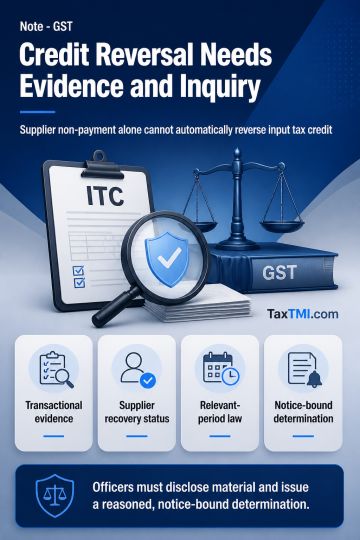
Input tax credit reversal requires evidence linking supplier non-payment to recipient ineligibility and a reasoned statutory inquiry.
Input tax credit under Section 16(2)(c) remains conditional on actual payment of tax to Government, but supplier non-payment or retrospective cancellation cannot by itself justify reversal. The recipient must establish eligibility through transactional evidence, while the proper officer must investigate the particular supply, disclose supplier-default and recovery material, apply the law applicable to the relevant period, and issue a reasoned, notice-bound determination. Supplier recovery status and protection against duplicate collection are material considerations.
Case Laws Customs
Show AI Summary
Baggage-related customs appeals proceed through statutory revision when the jurisdictional exclusion applies to passenger imports.
The first proviso to section 129A(1) excludes Appellate Tribunal jurisdiction over an order under section 128A relating to goods imported or exported as baggage. The decisive issue is the order's connection with baggage, not disputes concerning confiscation, declaration, duty, personal effects, concealment, concession, or penalty. Articles carried by an international passenger in luggage or on the person may constitute baggage. Section 129DD provides revision before the Central Government, ordinarily within three months, subject to a further period on sufficient cause.
Case Laws GST
Show AI Summary
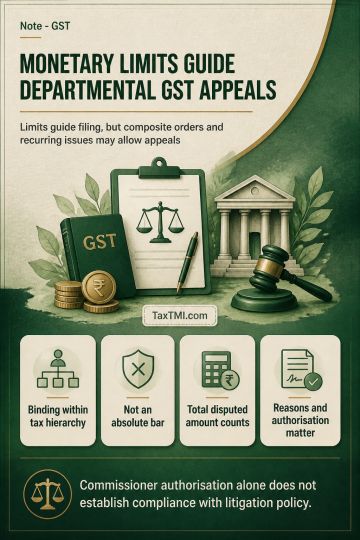
Departmental GST appeal monetary limits regulate officers, while composite orders and proven recurring issues may permit appeals.
Sections 120 and 168 of the Central Goods and Services Tax Act, 2017 make monetary-limit directions binding within the Central tax hierarchy, while they regulate the executive decision to file rather than create an inflexible jurisdictional bar before the Tribunal. In a composite order disposing of multiple appeals or demand notices, the relevant amount is the total disputed tax, interest, penalty or late fee, as applicable. The recurring or interpretative-issue exclusion requires a reasoned, case-specific basis, and Commissioner authorisation does not itself establish compliance with the litigation policy.
Case Laws GST
Show AI Summary
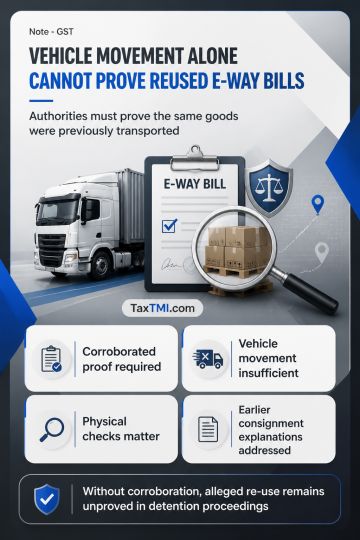
E-way bill re-use allegations require corroborated proof identifying the same goods; vehicle movement alone cannot establish contravention.
Alleged re-use of invoices and e-way bills requires the seizing authority to establish through positive, corroborated evidence that the intercepted goods are the same consignment previously transported under those documents. Toll data, vehicle movements and photographs may justify inquiry but do not alone prove prior delivery, identity of goods or re-use. Where invoices and e-way bills accompany the goods and physical verification shows no discrepancy, the authority must investigate and address any explanation of a different earlier consignment. Cases involving absent or expired transport documents remain factually distinct.
Case Laws GST
Show AI Summary
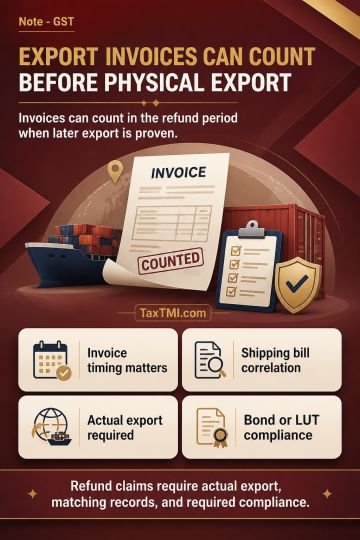
Zero-rated supply turnover includes export invoices from the refund period when actual export is subsequently established under bond or LUT.
Under Rule 89(4), invoice values for goods invoiced before or at removal for export under bond or Letter of Undertaking may be included in zero-rated turnover for the relevant refund period, although physical export occurs later. The invoice and removal determine period-wise attribution for the refund formula, while actual export remains essential to sustain the claim. Shipping bills, bills of export and related export records must correlate with the export invoices to establish that the goods were ultimately exported. Compliance with valuation, input tax credit eligibility and bond or Letter of Undertaking conditions remains necessary.
Case Laws Income Tax
Show AI Summary
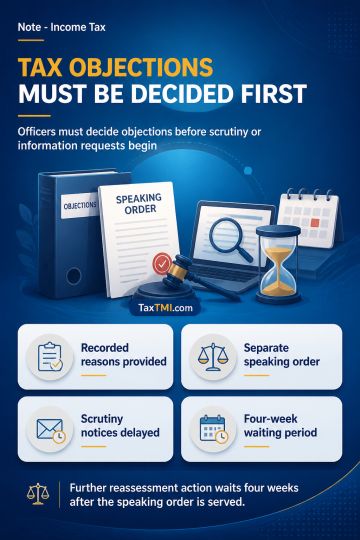
Reassessment objections require speaking disposal and a four-week pause before scrutiny or information requests can begin.
Under the pre-amendment Section 148 framework, reassessment jurisdiction must be resolved before merits-stage scrutiny begins. The Assessing Officer must furnish recorded reasons when requested, permit objections, and decide them through a separate speaking order. A Section 143(2) notice commences scrutiny, while a Section 142(1) notice is a substantive inquiry step; neither may issue before objections are decided. Following rejection, a four-week period from service of the speaking order must be allowed before further reassessment action, preserving an effective opportunity to challenge reopening.
Case Laws GST
Show AI Summary
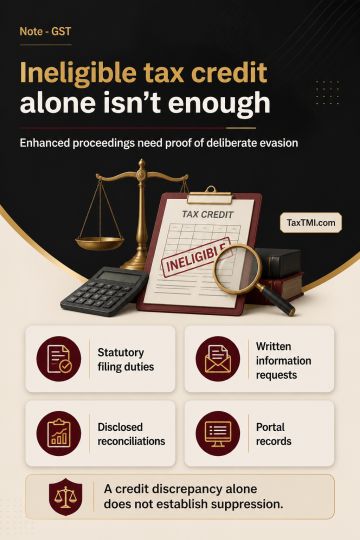
Suppression of facts requires proof of deliberate tax evasion; ineligible input tax credit alone cannot support enhanced proceedings.
Section 74 permits enhanced tax determination for wrongly availed or utilised input tax credit only where fraud, wilful misstatement, or suppression of facts to evade tax is established. Wrong or ineligible credit is distinct from substantive credit eligibility and cannot, without evidence of deliberate conduct and intent, amount to suppression. Under historical Explanation 2, suppression required either omitted information legally required in prescribed filings or failure to provide information sought in writing; both operate subject to the statutory evasion requirement. Disclosed reconciliations and portal records materially weaken a bare allegation of non-declaration.
Case Laws Customs
Show AI Summary
Organic surface-active agent classification requires water solubility and stability; phase-separating low-ethoxylated products fall outside Heading 3402.
Classification of low-ethoxylated non-ionic fatty alcohol ethoxylates under Heading 3402 requires satisfaction of the cumulative water test in Chapter Note 3. At the prescribed concentration, temperature, and standing period, the product must both remain a transparent or translucent liquid, or stable emulsion, without phase separation and reduce water surface tension to the stated threshold. Non-ionic character or surface activity alone is insufficient. Where a low-ethoxylated product separates into layers and fails the solubility and stability requirement, Heading 3824 may be considered after exclusion from Heading 3402.
Case Laws Customs
Show AI Summary
Lawful customs seizure requires recorded confiscation grounds, formal restraint where needed, and timely notice; detention cannot bypass safeguards.
Customs seizure of an imported car requires recorded reason to believe that it is liable to confiscation. A panchnama restraint cannot replace a lawful seizure order, an undertaking where seized goods remain in custody, or a served non-dealing order where seizure is impracticable. Section 110(2) requires prompt notice under Section 124, subject only to the prescribed extension mechanism. Prolonged effective detention cannot postpone those safeguards. Provisional release under Section 110A applies only to goods lawfully seized and cannot validate an earlier detention without statutory authority.

TMI Notes

Back

All TMI Notes

Showing Results for :
Reset Filters
No Records Found

TMI Notes

Reassessment Notice Procedure: Administrative Approval under Section 143(2), Sanction under Section 151 and Limitation under Section 149(1)(b)

30 September, 2026

Contents
Acts
Plus +
Summary
Note

Note

-

Bookmark

(New) -

Download

Print

Print

This commentary provides doctrinal analysis and practical insights on the legal issue discussed below. The judgment is analysed in the context of its factual background, issues framed, and conclusions reached by the Court.

2026 (6) TMI 40 - ITAT PUNE

Introduction

The validity of reassessment proceedings often turns on a sequence of distinct jurisdictional safeguards: the statutory basis for reopening, the limitation applicable to the notice, approval by the competent authority, service of a scrutiny notice after the reassessment return, and the procedural route adopted for the resulting assessment. These requirements cannot be collapsed into a single broad inquiry into escapement of income.

2026 (6) TMI 40 - ITAT PUNE addresses this sequence in a search-based reassessment involving handwritten and digital cash-book material. The tribunal rejected the taxpayer's challenges concerning prior administrative approval for the notice under section 143(2), sanction under section 151, extended limitation under section 149(1)(b), and alleged mechanical approval under section 148B. The decision is particularly significant for its treatment of the extended limitation provision: the tribunal sustained jurisdiction because the seized material disclosed entries in books of account meeting the statutory monetary threshold, independently of the controversy over whether the entries constituted an identifiable asset.

The decision also demonstrates that jurisdictional objections must be pleaded and supported distinctly. An allegation that approval was mechanical, a contention that material was seized from a third-party location, and a challenge to the statutory character of seized entries are legally different objections, each requiring an examination of the governing provision and the evidentiary record.

Legal & Statutory Context

Notice under section 148 and the pre-notice framework

Section 148 provides that, before making an assessment, reassessment or recomputation under section 147, the Assessing Officer shall, subject to section 148A, issue a notice requiring a return. The supplied text further states that no notice may issue unless the Assessing Officer has information suggesting escapement of income. The statutory expression is important: reopening is not founded on a final adjudication of escapement, but on information capable of suggesting escapement.

Section 148A sets out a pre-notice procedure in the supplied statutory text. It requires a show-cause opportunity accompanied by the information suggesting escapement; permits a reply by the assessee; and requires an order, with prior approval of the specified authority, deciding whether it is a fit case to issue notice under section 148. Its applicability to the particular reassessment proceedings considered in the decision is not stated in the document. The taxpayer's separate challenge to the approval under section 148B was not admitted because it had not been raised before the first appellate authority and required factual verification.

Extended limitation under section 149

The tribunal reproduced and applied the version of section 149(1)(b) relevant to the proceedings before it. It permitted a notice where "three years, but not more than ten years, have elapsed" from the end of the relevant assessment year, provided the Assessing Officer possesses books of account, documents or evidence revealing escaped income of fifty lakh rupees or more represented in the form of: "(i) an asset; (ii) expenditure in respect of a transaction or in relation to an event or occasion; or (iii) an entry or entries in the books of account."

The provision is disjunctive. Where the prescribed monetary threshold is met, the jurisdictional condition may be satisfied through any one of the three identified forms. The Explanation then stated that "asset" includes immovable property, shares and securities, loans and advances, and deposits in a bank account. The word "includes" enlarges the enumerated class; nevertheless, the decisive reasoning in the decision did not depend on treating all cash entries as assets.

The supplied text of section 149 also contains a differently framed limitation provision. The statutory version applicable to a particular notice must therefore be identified by reference to the relevant legal period. The operative determination here rests on the formulation specifically reproduced and applied in the decision.

Approvals under sections 151 and 148B

Section 151 identifies the specified authority for the purposes of sections 148 and 148A in the supplied statutory text. The central doctrine remains that statutory approval is a substantive safeguard against arbitrary reopening. The approving authority must consider the proposal and relevant material; however, the statute does not necessarily require the approval itself to contain an elaborate independent narration of reasons where the underlying proposal and material demonstrate application of mind.

Section 148B separately provides that an Assessing Officer below the rank of Joint Commissioner shall not pass an assessment, reassessment or recomputation for years covered by the relevant search-related clauses of Explanation 2 to section 148 without prior approval of the specified superior authority. Section 148B concerns approval for the resulting order; section 151 concerns the specified authority in the notice-stage framework. They are not interchangeable safeguards.

Scrutiny notice under section 143(2)

Section 143(2) authorises the Assessing Officer or prescribed income-tax authority to serve a notice where it is considered necessary or expedient to ensure that income has not been understated, loss has not been excessively computed, or tax has not been underpaid. The supplied text requires service within three months from the end of the financial year in which the return is furnished.

In the proceedings considered here, the administrative approval for issuing the section 143(2) notice arose from a departmental instruction referred to in the record. Its exact terms are not stated in the document. The tribunal therefore decided the issue on the narrower factual question whether approval had, in fact, been received before issuance of the notice.

Interpretative Issues

Whether seized cash-book entries must first qualify as an "asset"

The taxpayer argued that the extended limitation could not be invoked because rough entries, cash-in-hand notings, on-money entries and alleged loans did not establish a real, identifiable and extant asset. The revenue authority answered that cash-in-hand and loans may be assets and, alternatively, that the seized material contained entries in books of account.

The tribunal accepted the alternate statutory route. It held that the Assessing Officer possessed books, documents or evidence revealing income represented in the form of entries in books of account and that the escaped income was likely to meet the fifty-lakh threshold. The practical consequence is clear: a contest about the "asset" limb does not defeat reopening where the entry-in-books limb is independently established on the record.

Whether seized digital and handwritten records are "books of account"

The taxpayer contended that the records were rough jottings or third-party material and did not satisfy the statutory character of books of account. The relevant definition in section 2(12A) is inclusive: "books or books of account" includes ledgers, day-books, cash books, account-books and other books, whether kept in written, electronic or digital form, including print-outs of electronically or digitally stored data.

The tribunal did not treat the issue as one of nomenclature alone. It relied on the group's admitted possession and control of the premises, statements concerning maintenance of records, entries matching accounted bank withdrawals, and the group's role in deciphering and digitising the material into a digital cash book. Those facts supplied the nexus between the seized record and the taxpayer group. They also supported the conclusion that the material could be treated as entries in books for the limited jurisdictional purpose under section 149(1)(b).

What establishes a non-mechanical sanction under section 151

An approval is not invalid merely because it is brief. The real inquiry is whether the specified authority was furnished the relevant proposal and material and whether the record discloses consideration of them. Conversely, a formal endorsement cannot cure a proposal that omits material facts or lacks a rational foundation.

Here, the tribunal found that the Assessing Officer had submitted a detailed annexure and prescribed format referring to seized records, alleged unaccounted receipts and cash-loan entries. The prescribed format also carried supervisory recommendations. In the absence of material demonstrating non-application of mind, the allegation of a mechanical sanction was rejected. The taxpayer's allegation that retractions had not been disclosed did not, by itself, establish that the sanctioning authority had failed to consider the case materials.

Detailed Commentary & Analysis

Prior approval for the section 143(2) notice: approval must precede issuance, not postal delivery

The taxpayer alleged that the administrative approval was post facto because the physical communication bore a later inward stamp. The revenue authority relied on official electronic correspondence and explained that the formal hard copy followed by post for record maintenance. The tribunal accepted the evidence that the approval had reached the Assessing Officer before the section 143(2) notice was issued.

The doctrinal point is narrow but important. Where prior administrative approval is required by an applicable instruction, the relevant event is receipt or communication of approval by the issuing authority before issuance of the notice. A later postal receipt or inward stamp cannot, without more, displace contemporaneous electronic evidence of earlier approval. Equally, the department must preserve an auditable trail showing the approval, its communication, and the date of issuance of the notice.

Section 151 sanction: distinction between insufficiency of reasons and absence of sanctioning scrutiny

The tribunal treated the taxpayer's objection as a challenge to application of mind, not an invitation to conduct a merits assessment at the sanction stage. A section 151 sanction must be based on the reopening proposal, relevant seized material and the statutory conditions. It is not necessary that the sanctioning authority itself quantify every proposed addition or write a full adjudicatory order.

Nevertheless, the decision should not be read as reducing section 151 approval to a formality. Its conclusion rests on the detailed note furnished by the Assessing Officer, the identified seized records, the supervisory recommendations, and the absence of affirmative evidence showing that the approving authority did not consider the material. Where the proposal misstates the jurisdictional basis, omits material exculpatory facts, or contains no discernible link between material and escapement, the issue would require closer scrutiny.

Section 149(1)(b): the threshold must be connected to a statutory category

The tribunal's reasoning preserves two separate requirements under the extended limitation provision. First, the Assessing Officer must possess books, documents or evidence. Secondly, they must reveal escaped income of at least fifty lakh rupees represented through one of the listed statutory categories. The threshold is not merely a quantitative requirement; it must be linked to the material and the statutory form of representation.

For practitioners, the jurisdictional record should therefore identify: the specific seized books, digital files or documents; the entries relied upon; the assessee to whom they relate; the manner in which the entries reveal escaped income; the relevant statutory limb; and the computation demonstrating that the fifty-lakh threshold is met. General descriptions of group-level information may be insufficient where attribution is disputed.

Section 148B challenge: pleading and evidentiary foundation matter

The challenge to approval under section 148B failed at the threshold because it had not been raised before the first appellate authority and entailed factual verification. The tribunal additionally noted that no material had been produced to show that the Assessing Officer or approving authority had ignored the seized material or approval record.

This part of the decision illustrates a procedural distinction. A pure legal issue arising from admitted facts may be raised at a later appellate stage. But an allegation that an approval was mechanical ordinarily turns on the approval record, proposal, timeline and materials placed before the authority. It may therefore require a factual foundation and cannot be sustained by assertion alone.

Judicial / Administrative Perspective

In 2026 (6) TMI 40 - ITAT PUNE, the tribunal held that prior administrative approval for the section 143(2) notice was received before issuance; upheld section 151 sanction because non-application of mind was not established; rejected the extended-limitation challenge on the independent ground of entries in books of account exceeding the monetary threshold; and declined to admit the section 148B challenge. The ruling is controlling on the analysis developed here.

2026 (7) TMI 1959 - ITAT PUNE adopted the same approach in a connected matter. It separately confirmed that prior approval preceded the section 143(2) notice, that the section 151 sanction was not shown to be mechanical, and that the section 148B objection lacked both prior pleading and evidentiary support. Its importance lies in demonstrating consistent treatment of the common approval record; it does not displace the primary decision's reasoning.

2020 (2) TMI 1061 - DELHI HIGH COURT supports the proposition that section 151 approval must involve application of mind, while clarifying that elaborate independent reasons are not indispensable where the competent authority has considered the Assessing Officer's recorded reasons. It is relevant to the distinction between a concise approval and a mechanical approval, which the tribunal applied on the facts before it.

2022 (4) TMI 1191 - BOMBAY HIGH COURT similarly treated fresh and specific information as sufficient at the notice stage and upheld a sanction where the approving authority considered the recorded reasons and transaction details. The authority reinforces that the reopening stage requires prima facie material, not conclusive proof, but it does not dilute the statutory requirement of a genuine approval process.

2024 (10) TMI 1586 - DELHI HIGH COURT addresses the faceless framework. It holds that the faceless procedure does not by itself completely oust the jurisdictional Assessing Officer from the initiation stage and that section 144B is principally procedural. This provides useful context for challenges based solely on faceless reassessment architecture, although the tribunal in the present matter did not decide the taxpayer's section 151A ground because it was not pressed.

1992 (2) TMI 40 - CALCUTTA HIGH COURT concerns an earlier reassessment regime, but retains limited doctrinal relevance: a search-related proceeding does not by itself preclude reassessment where the statutory ingredients for reopening are otherwise satisfied, and the recorded reasons need only disclose a rational prima facie basis. Its statutory setting differs from the section 149(1)(b) framework considered here.

Implications & Observations

  • For the department, approval records should preserve the proposal, seized-material index, quantification note, recommendations, approval communication and notice-issuance trail. This is especially important where approval is transmitted electronically and physical dispatch occurs later.

  • For taxpayers, a section 151 challenge should identify concrete defects: absence of the statutory authority, incorrect limitation category, missing material, omission of a material reply or retraction, or a demonstrable mismatch between the proposal and approval. A general allegation of mechanical approval is unlikely to suffice.

  • For extended limitation, the objection should engage all three statutory limbs under section 149(1)(b). A successful challenge to the "asset" classification may not determine the issue if the revenue authority can establish escaped income represented by expenditure or entries in books of account.

  • Search material found at premises owned by another person is not automatically unusable. Possession, control, corroboration with regular records, statements of responsible persons, and subsequent deciphering or adoption of the records may establish the necessary nexus with the taxpayer.

  • Section 143(2), section 151 and section 148B operate at different stages. A defect alleged at one stage must not be assumed from a controversy at another. Notice-stage sanction, scrutiny-notice approval, and prior approval for the final assessment order each require separate examination.

Concluding Remarks

The decision confirms that reassessment validity must be tested through the statutory sequence rather than by broad assertions of procedural unfairness. The section 143(2) objection failed because prior approval was factually established; the section 151 objection failed because the record showed a detailed proposal and no proven non-application of mind; and the extended-limitation objection failed because section 149(1)(b) was satisfied through entries in books of account exceeding the prescribed threshold.

Its most durable doctrinal contribution is the disjunctive reading of section 149(1)(b). Where seized books or digital records reveal qualifying escaped income through entries in books of account, the extended period need not rest exclusively on the more contestable proposition that every unrecorded cash receipt is an "asset." The jurisdictional record, however, must still establish the source material, taxpayer nexus, statutory category and monetary threshold with precision.


Full Text:

2026 (6) TMI 40 - ITAT PUNE

Topics

Acts Income Tax