Loading...

⚠ ✕
❮ Top
☎ Help
☰
×

By creating an account you can:

Logo TaxTMI
Call Us / Help / Feedback✕

Contact Us At :

✉ E-mail: [email protected]

✆ To Call / Whatsapp, Check Contact Us

FAQs :

To know Frequently Asked Questions, Check FAQs

Most Asked Video Tutorials :

For more tutorials, Check Video Tutorials

Submit Feedback/Suggestion :

Email :
Please provide your email address so we can follow up on your feedback.
Category :
Description :
Min 15 characters 0/2000
Make Most of Text Search ✕
  1. Checkout this video tutorial: How to search effectively on TaxTMI.
  2. Put words in double quotes for exact word search, eg: "income tax"
  3. Avoid noise words such as : 'and, of, the, a'
  4. Sort by Relevance to get the most relevant document.
  5. Press Enter to add multiple terms/multiple phrases, and then click on Search to Search.
  6. Text Search
  7. The system will try to fetch results that contains ALL your words.
  8. Once you add keywords, you'll see a new 'Search In' filter that makes your results even more precise.
  9. Text Search
╳
Add to...
You have not created any category. Kindly create one to bookmark this item!
✕
Create New Category
Hide
Title :
Description :
❮❮ Hide
❮ Default View
Expand ❯❯
Close ✕
🔎 Filters / Advanced Search ❯
TEXT

Press 'Enter' to add multiple search terms. Rules for Better Search

Search In
Main Text + AI Text ❯
  • Main Text
  • Main Text + AI Text
  • AI Text
Law:
---- All Laws---- ❯
  • ---- All Laws----
  • Benami Property
  • Bill
  • Central Excise
  • Companies Law
  • Customs
  • DGFT
  • FEMA
  • GST
  • GST - States
  • IBC
  • Income Tax
  • Indian Laws
  • Money Laundering
  • SEBI
  • SEZ
  • Service Tax
  • VAT / Sales Tax
Types:
---- All Types ---- ❯
  • ---- All Types ----
  • Act Rules
  • Case Laws
  • Circulars
  • Manuals
  • News
  • Notifications
Sort By: ?
In Sort By 'Default', exact matches for text search are shown at the top, followed by the remaining results in their regular order.
Relevance Default Date
☰   Show Results ❯
    Case Laws Companies Law
    Lifting the Corporate Veil Where Promoter Shareholding Is Allegedly Dissipated Despite Judicial Assu...
    Consolidated Show Cause Notices under Sections 73 and 74 and Taxability of School Affiliation Servic...
    Fraudulent Input Tax Credit from Non-Existent Suppliers: Application of Sections 16, 74 and 155 of t...
    Case Laws Money Laundering
    Prolonged Pre-Trial Incarceration and Bail under Section 45 of the Prevention of Money-Laundering Ac...
    Case Laws Income Tax
    Prospective Operation of Section 56(2)(x)(b) in Stamp-Value Difference Cases Involving Immovable Pro...
    Seizure of Cash under Section 67 of the CGST Act and Interest on Illegal Retention
    Case Laws Income Tax
    Disallowance of Salary Expenditure for Allegedly Non-Genuine Services under Section 37
    Case Laws Income Tax
    Fair Market Value of Unquoted Equity Shares Under Section 56(2)(viib) and Rule 11UA
    Refund of Excess IGST Paid on Exports Following Clerical Error in FORM GSTR-3B
    Revocation of Cancellation of GST Registration for Non-Filing of Returns under Section 30 and Rule 2...
    Case Laws Income Tax
    TOLA, Section 149 and the Surviving-Time Test for Reassessment Proceedings
    Case Laws Customs
    Provisional Release of Unseized Imported Food Consignments under the Customs Act, 1962
    Case Laws Customs
    Recovery of Unpaid Anti-Dumping Duty After Self-Assessment Under Section 28 of the Customs Act, 1962
    Project-Wise Anti-Profiteering Methodology in Real Estate under Section 171 of the Central Goods and...
    Case Laws Income Tax
    Retirement Leave Encashment Exemption under Section 10(10AA)(ii) and Retrospective Application of No...
    Transit-State Jurisdiction under GST: Limits on Detention and Penalty in External Inter-State Suppli...
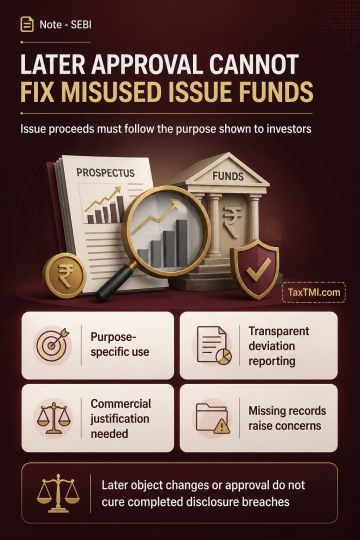
    Post-Facto Shareholder Ratification of Diversion of Preferential Issue Proceeds under the PFUTP Regu...
    Case Laws Income Tax
    Section 195 Withholding on Payments to Non-Residents: Royalty, Fees for Technical Services and Busin...
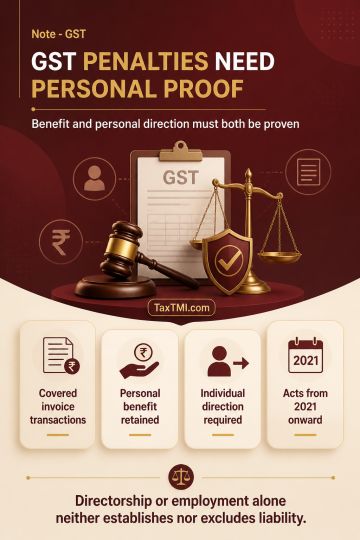
    Penalty: Scope of "Any Person" under Section 122(1A) of the Central Goods and Services Tax Act, 2017
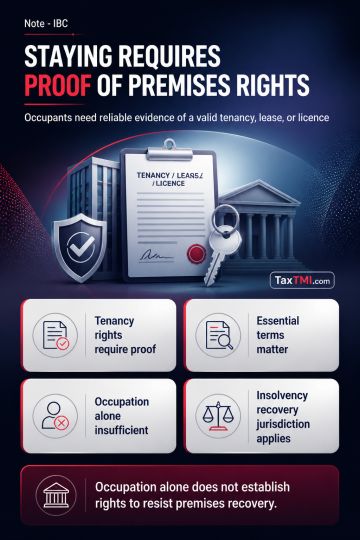
    Recovery of Corporate Debtor Premises and Proof of Tenancy, Lease or Licence Rights under the Insolv...
❮
❯
❯❯
Maximize Maximize Maximize
0 / 200
Expand Note
Add to Folder

No Folders have been created

+

Are you sure you want to delete "My most important" ?

NOTE:

Notes
Showing Results for :
Reset Filters
Results Found:
Show All Summaries Hide All Summaries
Case Laws Companies Law
Show AI Summary
Corporate veil-piercing permits forensic scrutiny in execution where promoter-controlled entities may dissipate shareholding despite judicial assurances.
Corporate veil-piercing in execution is an exceptional response where promoters allegedly use layered entities and securities transactions to deplete shareholding represented as security through judicial assurances. Separate personality remains the rule, and control or ownership alone does not suffice; there must be a nexus between control, misuse of the corporate form, and frustration of enforcement. A forensic audit reconstructs share movements, pledges, sales, financing, approvals, disclosures, and fund flows, distinguishing legitimate enforcement of pre-existing security from coordinated asset dissipation.
Case Laws GST
Show AI Summary
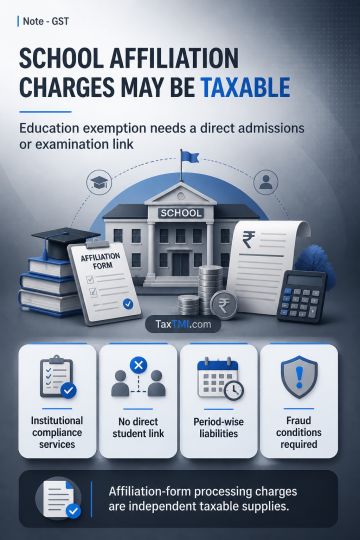
School affiliation services fall outside educational exemption without a direct nexus to admissions or examination conduct.
Consolidated show cause notices may combine financial years governed by Sections 73 and 74 where liabilities are segregated period-wise, each component independently meets limitation and notice requirements, the additional ingredients for fraud-based proceedings are satisfied, and no actual prejudice arises. School affiliation and affiliation-form processing charges are independent taxable supplies where they concern institutional eligibility and compliance, rather than directly and immediately relating to student admission or the conduct of examinations. A broad connection with education does not satisfy the educational-services exemption.
Case Laws GST
Show AI Summary
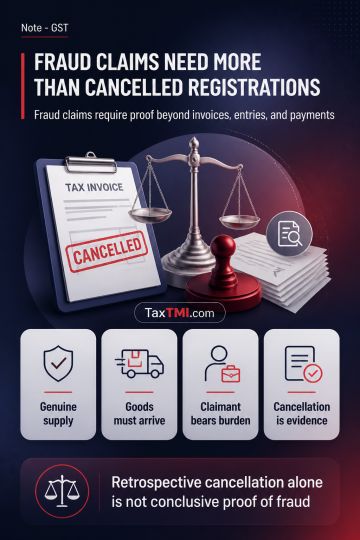
Fraudulent input tax credit requires proof of fictitious supplies, absent goods receipt, and fraud-linked self-assessment, not cancellation alone.
Input tax credit from allegedly non-existent suppliers depends on proof of genuine supply and actual receipt of goods or services, not merely invoices, accounting entries, or banking-channel payments. Section 155 places the burden of establishing ITC eligibility on the claimant. Section 74 requires more than ineligible credit: the wrongful availment must be linked to fraud, wilful misstatement, or suppression to evade tax. Retrospective supplier-registration cancellation is relevant evidence but is not conclusive. A fraud-based notice must disclose facts showing fictitious suppliers, absence of supply, and a basis for inferring the recipient's knowledge or participation.
Case Laws Money Laundering
Show AI Summary
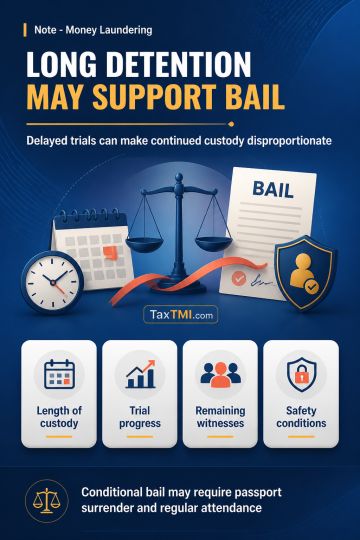
Prolonged pre-trial incarceration may justify conditional PMLA bail when delayed trials make continued detention constitutionally disproportionate.
Section 45 of the Prevention of Money-Laundering Act remains the stringent ordinary bail threshold, requiring prosecutorial opportunity and, on opposition, reasonable grounds to believe that the accused is not guilty and unlikely to offend while on bail. Article 21 nevertheless requires a separate, fact-sensitive inquiry where prolonged pre-trial detention and an unrealistic trial timetable make custody disproportionate. Relevant factors include custody length, trial progress, remaining witnesses, secured documentary evidence, source of delay, predicate-case status, and risks of absconding or witness interference. Conditions such as passport surrender, attendance, non-contact directions, and residence disclosure may safeguard the trial.
Case Laws Income Tax
Show AI Summary
Prospective operation of stamp-value taxation prevents retrospective application where property agreements and substantial payments predate the charging provision.
Section 56(2)(x)(b) applies to immovable property received for inadequate consideration only where its temporal and valuation conditions are satisfied. A stamp-value difference alone does not establish taxability. Where consideration was fixed and substantial payments or contractual performance occurred before the charging provision commenced, later conveyance or registration does not by itself attract the later charge. Agreement-date valuation is available only for covered transactions where consideration was fixed and paid, wholly or partly, through prescribed banking or electronic modes on or before the agreement date. The tax authority must identify the correct statutory basis and provide a meaningful opportunity to respond.
Case Laws GST
Show AI Summary
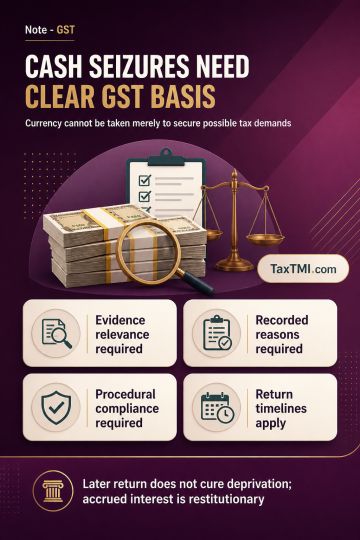
GST cash seizure limits require statutory relevance and restitutionary interest for unlawfully retained currency following searches.
GST seizure powers cannot be used to take cash as a general investigative measure or security for a possible tax demand. Currency is excluded from goods, and "things" is confined contextually to articles useful or relevant as evidence in GST proceedings. Valid seizure and retention require recorded statutory reasons, procedural compliance and observance of return timelines. Unauthorised retention engages property protections; later return does not cure the deprivation, and accrued interest is restitutionary rather than delayed-refund interest.
Case Laws Income Tax
Show AI Summary
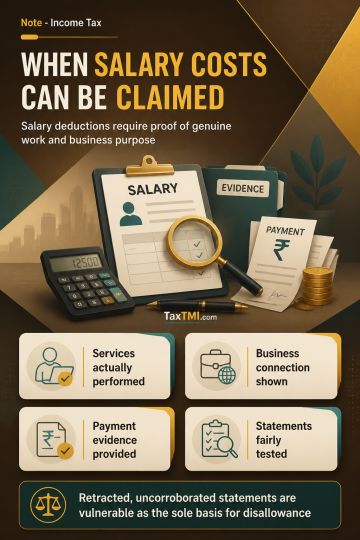
Salary expense genuineness requires proof of actual services, business purpose, and fair testing of adverse third-party statements.
Under Section 37(1), salary expenditure is deductible only where it is actually incurred wholly and exclusively for business purposes and is supported by proof of genuine employment, services rendered, business nexus, and payment. Bank transfers and accounting entries alone are not conclusive. Where a third-party statement is central to an allegation of non-genuine salary, the taxpayer should receive disclosure and a meaningful opportunity to rebut it, including cross-examination where appropriate. A retracted and uncorroborated statement is vulnerable as the sole basis for disallowance.
Case Laws Income Tax
Show AI Summary
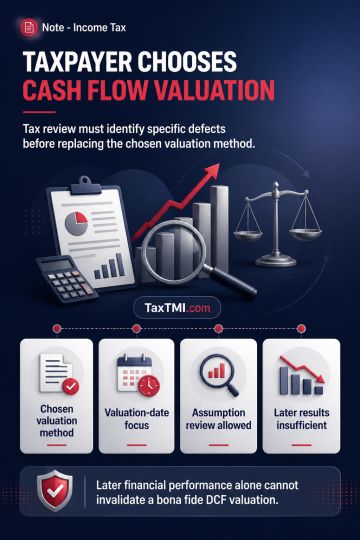
Discounted cash flow valuation remains taxpayer-selected under prescribed rules, while tax scrutiny must identify specific valuation-date defects.
The taxpayer may elect a prescribed DCF valuation for unquoted equity shares, and scrutiny of that method does not permit substitution with Net Asset Value merely because it produces a lower fair market value. The Assessing Officer may examine projections, discount rates, terminal assumptions, computations and source data, but rejection requires demonstrably wrong facts, material errors, a wholly erroneous basis or objectively unsupported assumptions. Subsequent financial performance cannot alone invalidate a bona fide DCF valuation; the relevant inquiry remains the reasonableness of valuation-date information.
Case Laws GST
Show AI Summary
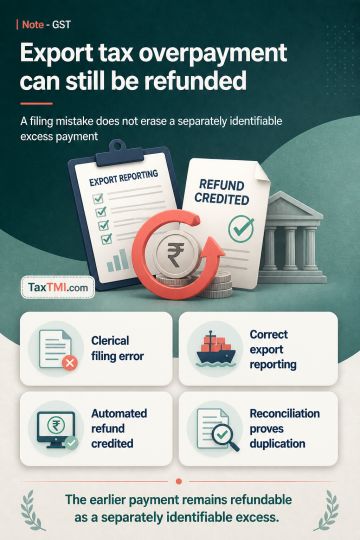
Excess IGST on exports remains refundable when later correction triggers automated refund and reconciliation proves duplicate payment.
Refund of excess IGST paid on zero-rated exports may arise where turnover and tax are mistakenly entered under non-zero-rated supplies in FORM GSTR-3B while export invoices and shipping bills are correctly reported in FORM GSTR-1. If the exporter then pays the same IGST in the correct zero-rated field and the automated refund is credited against that later payment, the earlier payment remains a separately identifiable potential excess; its claim is not a repeat request for the same export-tax refund.
Case Laws GST
Show AI Summary
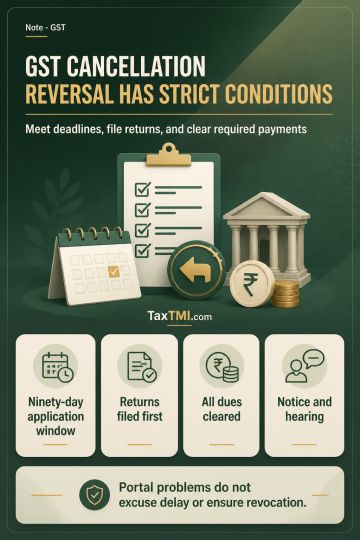
GST registration revocation requires timely application, return compliance, payment of dues, and a reasoned statutory decision.
GST registration revocation after cancellation for return default is a conditional, time-bound process. An application under Section 30 and Rule 23 must ordinarily be filed within ninety days, subject to prescribed extension, and cannot be made until pending returns are filed and tax, interest, penalty and late fee are paid. Portal non-acceptance may permit online or physical submission where technically unavailable, but does not condone delay or ensure revocation. The competent authority must assess statutory eligibility, sufficient grounds and compliance while following notice and hearing requirements before rejection.
Case Laws Income Tax
Show AI Summary
Reassessment limitation under TOLA requires final notices to issue within surviving time and satisfy statutory safeguards.
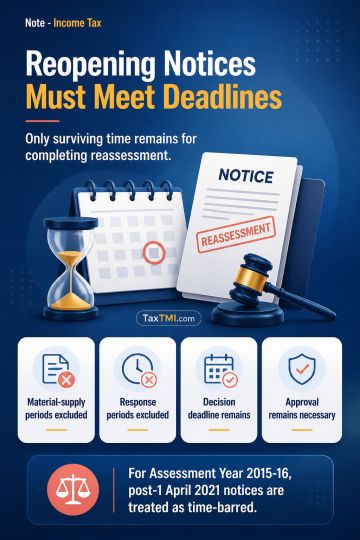
Reassessment limitation under TOLA is a jurisdictional restraint. Transitional notices issued between 1 April 2021 and 30 June 2021 are treated as Section 148A(b) show-cause notices, but only the surviving time remaining until 30 June 2021 is available for completing the reassessment process. Periods for supply of material and the assessee's response are excluded, but the Section 148A(d) decision, statutory approval and final Section 148 notice must issue within the remaining period. For Assessment Year 2015-16, post-1 April 2021 notices are treated as time-barred.
Case Laws Customs
Show AI Summary
Unseized food consignments cannot face indefinite detention without lawful seizure, valid sampling, and prompt assessment.
Provisional release of an unseized imported food consignment is not mechanically governed by Section 110A, which applies to goods seized under Section 110. Customs may examine, test, verify and reassess imports, but indefinite retention without a seizure memorandum or disclosed reasons connecting the goods with confiscation is not justified. Food sampling should follow the specialised food-safety process through an authorised officer. A valid food-safety report may support conditional clearance, while classification, duty liability, confiscation and adjudication remain open. Revenue may be protected through proportionate security.
Case Laws Customs
Show AI Summary
Anti-dumping duty recovery permits post-clearance demands and consequential import IGST where self-assessment omitted an applicable levy.
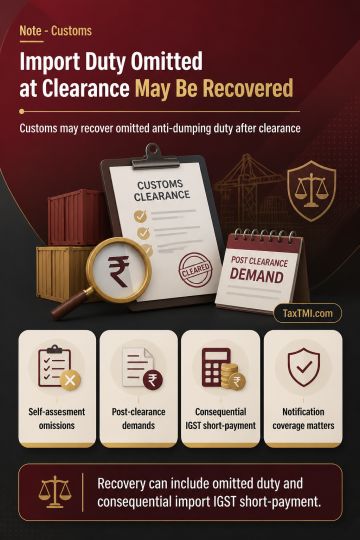
Unpaid anti-dumping duty omitted during self-assessment may be pursued through the customs recovery procedure without prior appellate modification of the self-assessment. The recovery framework applies to anti-dumping duty through statutory incorporation of provisions concerning assessment, non-levy, short-levy, interest and recovery. Where anti-dumping duty is chargeable, it forms part of the aggregate value used to compute IGST on imports, potentially creating a consequential IGST short-payment. Recovery requires accurate assessment of notification coverage, product, origin, rate, valuation, limitation and procedural safeguards.
Case Laws GST
Show AI Summary
Project-wise anti-profiteering requires actual input tax credit measurement and area-based allocation of benefits to real-estate purchasers.
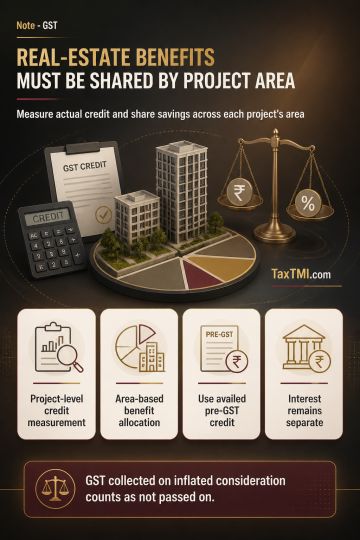
Real-estate anti-profiteering under Section 171 requires project-level identification of additional input tax credit and allocation of the saving across total project area on a per-square-foot basis. Purchase value may quantify credit attributable to project expenditure, but turnover or collections cannot serve as the allocation basis. The comparison must use pre-GST credit actually availed rather than merely available credit. GST collected on consideration inflated by an undistributed benefit forms part of the amount not passed on and remains distinct from statutory interest.
Case Laws Income Tax
Show AI Summary
Retirement leave encashment exemption applies under the enhanced notified ceiling while preserving non-government employee classification and statutory conditions.
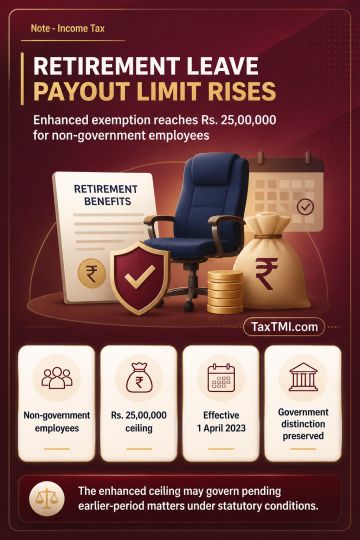
Section 10(10AA)(ii) governs retirement leave-encashment exemption for non-Government employees, subject to the ten-month earned-leave measure, average-salary computation, and the notified monetary ceiling. Notification No. 31/2023 specifies an enhanced ceiling of Rs. 25,00,000, is deemed effective from 1 April 2023, and certifies that retrospective effect causes no adverse effect. The enhanced ceiling is treated as a remedial rationalisation of an existing exemption and may govern pending earlier-period matters, while preserving the distinction between Government and non-Government employees.
Case Laws GST
Show AI Summary
Transit GST jurisdiction limits detention penalties for documented inter-State supplies lacking a local taxable nexus.
Transit-State jurisdiction under GST permits interception, document production, e-way bill verification and authorised physical inspection of goods moving through an intermediate State. It does not, in a pure transit movement, support detention-related penalty for an external inter-State supply where origin and destination lie outside the intercepting State, no tax is payable there, and there is no evidence of diversion, local supply, fictitious or mismatched documents, or mismatch of goods. Cross-empowerment is administrative and does not create an independent territorial taxable nexus.
Case Laws SEBI
Show AI Summary
Shareholder ratification cannot cure preferential-issue fund diversion when disclosed objectives are abandoned, triggering securities-market fraud and disclosure concerns.
Post-facto shareholder approval cannot retrospectively validate diversion of preferential-issue proceeds contrary to issue-specific objects disclosed to shareholders and the market. A special resolution authorises the issue but does not permit unrestricted use of proceeds. Periodic deviation reporting, audit-committee review and utilisation disclosures promote transparency; they do not enable diversion followed by later regularisation. Immediate diversion, inadequate commercial justification and missing documentation may indicate that disclosed objects were not genuinely intended to be performed. Later amendment of corporate objects or shareholder ratification cannot cure a completed securities-market disclosure breach.
Case Laws Income Tax
Show AI Summary
Cross-border software payments require copyright-right, technical-service, and permanent-establishment analysis before withholding obligations are determined under applicable treaties.
Section 195 requires withholding only from a remittance to a non-resident that includes income chargeable in India. For software, royalty depends on transfer of copyright rights, not merely the right to install, access, use, or distribute a copyrighted article under restrictive terms. Where a DTAA is more beneficial, its royalty and FTS definitions control; treaty FTS may require technology to be made available. Amounts that are neither royalty nor FTS require consideration as business profits, ordinarily taxable only where profits are attributable to a permanent establishment. Composite payments require component-wise allocation and analysis.
Case Laws GST
Show AI Summary
Personal GST penalty requires proof that the beneficiary retained benefit and directed a covered invoice or credit transaction.
Section 122(1A) may impose personal GST penalty on a registered or unregistered person only for a covered invoice or input tax credit transaction. Liability requires cumulative proof that the individual retained an identifiable personal benefit and that the transaction was conducted at that person's instance. Directorship, employment, registration, signature authority, or association with the taxable entity neither independently establishes nor excludes liability. Proceedings require transaction-specific and person-specific allegations and findings. The provision operates prospectively for underlying acts or transactions occurring on or after 01.01.2021.
Case Laws IBC
Show AI Summary
Proof of tenancy rights governs insolvency recovery of corporate-debtor premises from occupants lacking enforceable possessory interests.
Where premises form part of the corporate debtor's assets, Sections 18 and 25 of the Insolvency and Bankruptcy Code, 2016 require the resolution professional to take custody, control, preservation and protection measures. An occupant resisting recovery must prove a subsisting tenancy, leasehold interest or enforceable licence through reliable evidence of the parties' intended relationship and its essential terms. Permission to stock goods or conduct limited business activity, prolonged occupation, and business or utility records do not independently create rights in the premises. Section 60(5)(c) supports insolvency jurisdiction over asset-recovery measures connected with the insolvency estate.

TMI Notes

Back

All TMI Notes

Showing Results for :
Reset Filters
No Records Found

TMI Notes

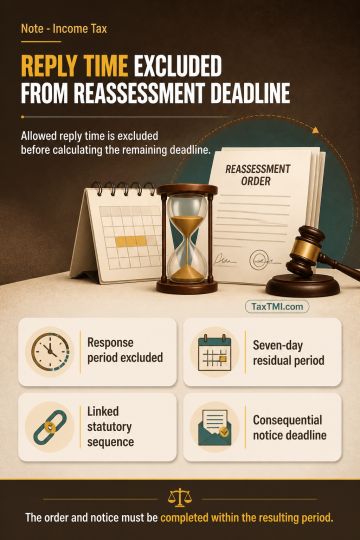
Reassessment Limitation under Section 149: Exclusion of Reply Time under Section 148A(b)

30 September, 2026

Contents
Acts
Plus +
Summary
Note

Note

-

Bookmark

(New) -

Download

Print

Print

This commentary provides doctrinal analysis and practical insights on the legal issue discussed below. The judgment is analysed in the context of its factual background, issues framed, and conclusions reached by the Court.

2026 (5) TMI 1820 - DELHI HIGH COURT

1. Introduction

The limitation architecture for reassessment proceedings requires simultaneous attention to the notice-stage hearing under Section 148A and the outer restriction on issuance of a notice under Section 148. The central issue is whether a show-cause notice under Section 148A(b), issued shortly before expiry of the ordinary limitation period and allowing the assessee time to respond beyond that date, is itself invalid. The connected issue is the manner in which the fifth and sixth provisos to Section 149 operate after the assessee has been afforded time, including extended time, to furnish a reply.

In 2026 (5) TMI 1820 - DELHI HIGH COURT, the court held that the mere fact that seven days were unavailable before the original limitation date did not invalidate the Section 148A(b) notice. The time allowed for the reply was excludable under the fifth proviso to Section 149. However, once that exclusion was applied, the Assessing Officer remained bound by the seven-day statutory extension under the sixth proviso. Since the order under Section 148A(d) and consequential Section 148 notice were issued beyond that seven-day period, both were quashed as barred by limitation.

The ruling is significant because it rejects both extremes: a taxpayer cannot contend that every show-cause notice issued near the end of the limitation period is void, while the department cannot treat the exclusion of reply time as creating an indeterminate or open-ended period for completing the pre-notice process.

2. Legal & Statutory Context

The integrated reassessment sequence

For the proceedings considered by the court, the then-applicable Section 148A required the Assessing Officer, before issuing a Section 148 notice, to follow a structured pre-notice procedure. Section 148A(b) required an opportunity of hearing by a show-cause notice specifying a period "not being less than seven days and but not exceeding thirty days from the date on which such notice is issued", subject to extension on an application by the assessee. Under Section 148A(c), the reply, if furnished, had to be considered. Section 148A(d) then required a decision, based on the material on record including the reply, whether it was a fit case to issue a notice under Section 148.

The order under Section 148A(d) was therefore not a collateral procedural event. It formed part of the statutory pathway leading to reassessment. As held in 2023 (9) TMI 985 - DELHI HIGH COURT, the order under Section 148A(d) must accompany the Section 148 notice. The time for passing that order must consequently operate within the overarching limitation regime governing issuance of the Section 148 notice.

Section 148 makes the reassessment notice subject to Section 148A. The statutory linkage means that a valid Section 148 notice cannot be divorced from the validity and timeliness of the Section 148A process that precedes it.

The former fifth and sixth provisos to Section 149

The decisive provisions were the fifth and sixth provisos to the then-applicable Section 149. The fifth proviso stated:

"for the purposes of computing the period of limitation as per this section, the time or extended time allowed to the assessee, as per show-cause notice issued under clause (b) of section 148A or the period during which the proceeding under section 148A is stayed by an order or injunction of any court, shall be excluded."

The sixth proviso further stipulated:

"where immediately after the exclusion of the period referred to in the immediately preceding proviso, the period of limitation available to the Assessing Officer for passing an order under clause (d) of section 148A does not exceed seven days, such remaining period shall be extended to seven days and the period of limitation under this sub-section shall be deemed to be extended accordingly."

The statutory compilation records subsequent substituted formulations of Sections 148A and 149. The decision examined the earlier Section 148A(b) to (d) framework and the former fifth and sixth provisos to Section 149 reproduced above. The commentary on the decision must accordingly remain confined to proceedings governed by that framework.

3. Interpretative Issues

The first interpretative issue was whether a Section 148A(b) notice becomes invalid merely because the minimum reply period extends beyond the original expiry of limitation for issuing a Section 148 notice. The taxpayer contended that, when the show-cause notice was issued, the Assessing Officer had fewer than seven days before the original limitation date and hence could not lawfully initiate the process.

The second issue concerned the meaning of "time or extended time allowed" in the fifth proviso. The relevant period was not confined to the initial period stated in the show-cause notice. It encompassed the extended period allowed after adjournment requests, subject to the statutory setting of the proceeding.

The third issue concerned the precise operation of the sixth proviso. The proviso does not merely preserve the unexpired balance of the original limitation. It creates a minimum residual period of seven days where, immediately after the fifth-proviso exclusion, the available period does not exceed seven days. That extension is for passing the Section 148A(d) order and issuing the Section 148 notice within the statutorily preserved time.

4. Detailed Commentary & Analysis

Reply opportunity and limitation operate together

The court treated the hearing requirement in Section 148A(b) as a substantive procedural safeguard rather than an empty formality. The statutory minimum of seven days and maximum of thirty days showed that Parliament contemplated a meaningful opportunity to respond. If a Section 148A(b) notice issued near the end of a financial year were invalid merely because the reply period crossed the original limitation date, the prescribed opportunity could become illusory in precisely those cases where the limitation clock was close to expiry.

The court therefore rejected an interpretation under which every Section 148A(b) notice issued after 1 March would be vulnerable. Such a construction would make validity depend on the variable and uncertain time taken by an assessee to furnish a reply. More fundamentally, it would frustrate the purpose of the fifth proviso, which expressly directs exclusion of the time or extended time allowed for the reply.

The exclusion is statutory, not discretionary

The language of the fifth proviso is mandatory: the specified time "shall be excluded." The exclusion does not depend upon whether the initial time available before the original limitation date was seven clear days. Nor does it depend upon a separate administrative extension of the limitation period. The legislative command is that the reply period, including extended time allowed, is left out of the computation.

On the facts, the Section 148A(b) notice was issued on 29 March 2024 and the assessee was initially granted time to respond. Adjournments were sought, further time was allowed, and the reply was ultimately filed on 21 April 2024. The court held that the period from 29 March 2024 to 21 April 2024 was required to be excluded under the fifth proviso.

The sixth proviso imposes a finite terminal period

Exclusion under the fifth proviso does not confer an unrestricted period for departmental action. The sixth proviso identifies the immediate consequence once the exclusion has been made. Where the period available to pass the Section 148A(d) order does not exceed seven days, that residual period is extended to seven days, and the limitation under Section 149 is deemed to be extended accordingly.

The court adopted a combined reading of the two provisos. Once the reply was filed on 21 April 2024, the Assessing Officer had seven days to pass the Section 148A(d) order and issue the Section 148 notice. The permissible terminal date was thus 28 April 2024. The order and notice were issued on 30 April 2024. The delay of two days was fatal because the statutory extension had already been exhausted.

This reasoning gives effect to both components of the scheme. The taxpayer receives the full statutory opportunity to respond, including approved extensions; the revenue authority, in turn, receives the statutory exclusion and, where applicable, the minimum seven-day residual period. Neither component can be enlarged by implication.

5. Judicial / Administrative Perspective

The principal ruling

2026 (5) TMI 1820 - DELHI HIGH COURT establishes that the original limitation date does not invalidate a Section 148A(b) notice simply because the reply period runs beyond it. The jurisdictional question is resolved by applying the fifth proviso and then the sixth proviso to Section 149. Nevertheless, the court also confirms that limitation remains a strict statutory condition: the final Section 148A(d) order and Section 148 notice must be issued within the period produced by that computation.

Order under Section 148A(d) and notice under Section 148

In 2023 (9) TMI 985 - DELHI HIGH COURT, the court held that the period afforded for responding to the Section 148A(b) show-cause notice is excluded under the fifth proviso. It further held that, where the available balance after exclusion is less than seven days, the sixth proviso extends it to seven days. The authority is particularly important for its further conclusion that the Section 148A(d) order must accompany the Section 148 notice. Accordingly, the Assessing Officer cannot invoke the period prescribed for the Section 148A(d) order independently of the overall Section 149 limitation.

Absence of an actual reply after adjournments

2026 (6) TMI 47 - DELHI HIGH COURT applies the same principle where the assessee sought adjournments but did not ultimately file a reply. The court treated the date on which the second adjournment request was declined as the deemed date of filing reply. From that point, the Assessing Officer had the period available under the sixth proviso. Since the Section 148A(d) order and Section 148 notice were issued on the following day, the reassessment action was held to be within limitation.

This application is practically material. The relevant endpoint for limitation is not necessarily an actual written reply. Where no reply is filed, the closure of the allowed or extended response period, including a refusal of further adjournment, may become the operative event for applying the statutory computation.

6. Implications & Observations

  • Limitation objections should be supported by a complete chronology: date of the Section 148A(b) notice, original response deadline, each adjournment request, every extension granted or refused, actual reply date if any, Section 148A(d) order date, and Section 148 notice date.

  • The fifth proviso requires close examination of the time actually allowed, including extended time. A challenge cannot rest solely on the proposition that the first show-cause notice was issued close to the original limitation deadline.

  • After identifying the excludable interval, the practitioner must separately test the sixth proviso. The critical question is whether the remaining period immediately after exclusion did not exceed seven days. If so, the statutory seven-day extension governs the final date for the Section 148A(d) order and Section 148 notice.

  • The Section 148A(d) order and Section 148 notice should be examined together. Because the order is required to accompany the notice, an otherwise timely internal decision cannot cure a delayed Section 148 notice, nor can a notice lacking the required order satisfy the statutory sequence.

  • For the department, administrative records should clearly identify the period initially allowed, the basis and duration of each extension, and the event that marks the closure of the reply stage. For taxpayers, adjournment applications and replies should preserve the relevant dates and expressly reserve the limitation objection where warranted.

7. Concluding Remarks

The decision gives a balanced construction to the former Section 148A and Section 149 regime. The reply period under Section 148A(b) is not defeated merely because it crosses the original limitation date; that period is expressly excluded under the fifth proviso to Section 149. At the same time, the exclusion is followed by a disciplined statutory endpoint under the sixth proviso. Where that proviso applies, the Assessing Officer has seven days, not an indefinite further period, to pass the Section 148A(d) order and issue the consequential Section 148 notice.

The governing lesson is that reassessment limitation must be computed as a connected statutory sequence. The validity of the proceedings depends neither on the original limitation date alone nor on the reply period alone, but on the precise interaction between the Section 148A(b) opportunity, any extended time, the fifth-proviso exclusion, the sixth-proviso extension, and the issuance of the final Section 148 notice.


Full Text:

2026 (5) TMI 1820 - DELHI HIGH COURT

Topics

Acts Income Tax