Loading...

⚠ ✕
❮ Top
☎ Help
☰
×

By creating an account you can:

Logo TaxTMI
Call Us / Help / Feedback✕

Contact Us At :

✉ E-mail: [email protected]

✆ To Call / Whatsapp, Check Contact Us

FAQs :

To know Frequently Asked Questions, Check FAQs

Most Asked Video Tutorials :

For more tutorials, Check Video Tutorials

Submit Feedback/Suggestion :

Email :
Please provide your email address so we can follow up on your feedback.
Category :
Description :
Min 15 characters 0/2000
Make Most of Text Search ✕
  1. Checkout this video tutorial: How to search effectively on TaxTMI.
  2. Put words in double quotes for exact word search, eg: "income tax"
  3. Avoid noise words such as : 'and, of, the, a'
  4. Sort by Relevance to get the most relevant document.
  5. Press Enter to add multiple terms/multiple phrases, and then click on Search to Search.
  6. Text Search
  7. The system will try to fetch results that contains ALL your words.
  8. Once you add keywords, you'll see a new 'Search In' filter that makes your results even more precise.
  9. Text Search
╳
Add to...
You have not created any category. Kindly create one to bookmark this item!
✕
Create New Category
Hide
Title :
Description :
❮❮ Hide
❮ Default View
Expand ❯❯
Close ✕
🔎 Filters / Advanced Search ❯
TEXT

Press 'Enter' to add multiple search terms. Rules for Better Search

Search In
Main Text + AI Text ❯
  • Main Text
  • Main Text + AI Text
  • AI Text
Law:
---- All Laws---- ❯
  • ---- All Laws----
  • Benami Property
  • Bill
  • Central Excise
  • Companies Law
  • Customs
  • DGFT
  • FEMA
  • GST
  • GST - States
  • IBC
  • Income Tax
  • Indian Laws
  • Money Laundering
  • SEBI
  • SEZ
  • Service Tax
  • VAT / Sales Tax
Types:
---- All Types ---- ❯
  • ---- All Types ----
  • Act Rules
  • Case Laws
  • Circulars
  • Manuals
  • News
  • Notifications
Sort By: ?
In Sort By 'Default', exact matches for text search are shown at the top, followed by the remaining results in their regular order.
Relevance Default Date
☰   Show Results ❯
    Case Laws Income Tax
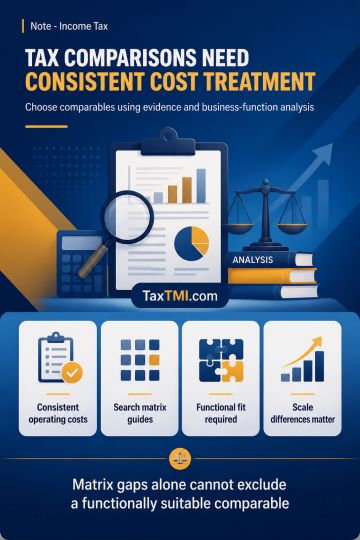
    TNMM Comparability: Operating Items, Search Matrix and Functional Analysis under Rule 10B
    Case Laws Customs
    Validity of Gold Seizure under Section 110 and the Conditional Reverse Burden under Section 123 of t...
    Case Laws Income Tax
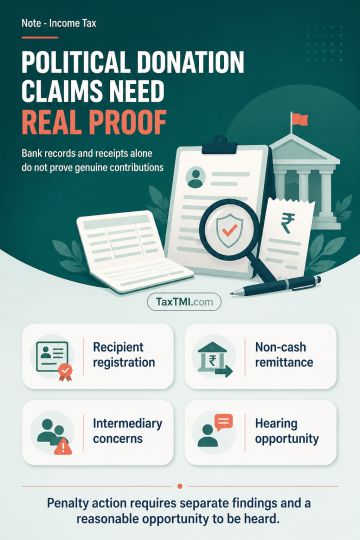
    Deduction under Section 80GGC: Genuineness of Political Contributions and Evidentiary Burden
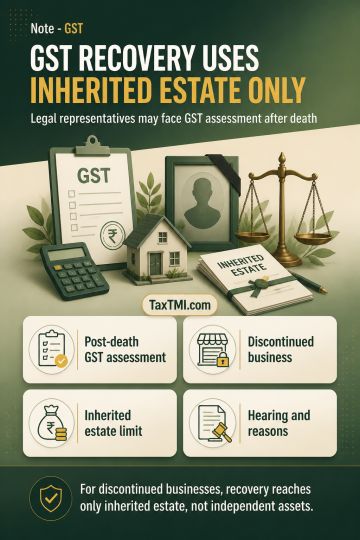
    Post-Death Determination of GST Liability and Estate-Limited Recovery from Legal Heirs
    Non-Confirmation of Seizure under Section 37A of FEMA and the Requirement of Recorded Reasons to Bel...
    Case Laws Companies Law
    Oppression and Mismanagement Proceedings under Sections 241 and 242: Corporate Authority During Pend...
    Case Laws Benami Property
    Benami Claims in Self-Acquired Property: Rejection of Plaint and the Limits of the Fiduciary-Capacit...
    Case Laws Income Tax
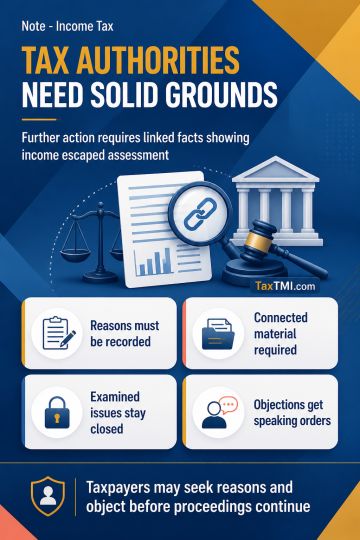
    Reopening of Assessment under Sections 147 and 148: Reason to Believe, Tangible Material and Change ...
    Case Laws Income Tax
    Penalty under Section 270A on Disallowance of Political Donation Deduction under Section 80GGC
    Case Laws Income Tax
    Conditional Registration under Section 12AB and the Limits of Commissioner's Statutory Powers
    Case Laws Customs
    Transaction Value, Rule 12 and Enhancement Based on Consent Letters in Customs Valuation: Limits of ...
    GST on Assignment of Leasehold Rights: Distinguishing Transfer of Immovable Property from Supply of ...
    Case Laws Income Tax
    Leave Encashment Exemption for Non-Government Employees under Section 10(10AA)(ii) and the Enhanced ...
    Case Laws Income Tax
    Dependent Agent Permanent Establishment under Article 5(5) of the India-Switzerland DTAA: Authority,...
    Case Laws Customs
    Proper Officer Jurisdiction for Customs Show Cause Notices under Sections 2(34), 17, 28 and 124
    Case Laws Money Laundering
    Provisional Attachment of Pre-Offence Property as Proceeds of Crime or Equivalent Value under the PM...
    Disciplinary Suspension of Resolution Professionals Across Ongoing CIRPs: Proportionality, Hearing a...
    Electronic Authentication of GST Demand Proceedings: Rule 26(3), Sections 75, 160 and 169
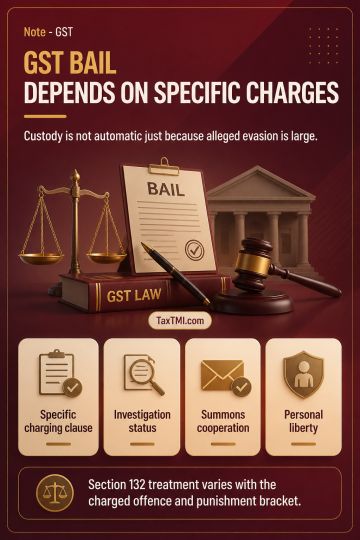
    Large-Scale GST Evasion Prosecutions: Cognizable and Non-Bailable Classification under Section 132 a...
    Case Laws Customs
    Country of Origin Certificates and Preferential Customs Duty under Notification No. 46/2011-Customs ...
❮
❯
❯❯
Maximize Maximize Maximize
0 / 200
Expand Note
Add to Folder

No Folders have been created

+

Are you sure you want to delete "My most important" ?

NOTE:

Notes
Showing Results for :
Reset Filters
Results Found:
Show All Summaries Hide All Summaries
Case Laws Income Tax
Show AI Summary
TNMM comparability requires consistent operating-cost treatment and FAR-based selection, while search matrices cannot replace evidence-led functional analysis.
TNMM requires consistent computation of operating profit and operating cost for the tested party and comparables. A provision for doubtful debts connected with sales and trade receivables may be an operating expense, as may routine business levies; income-tax on profits remains excluded. A search matrix is a disciplined evidentiary tool, not a statutory bar to an out-of-matrix comparable. Inclusion requires proof of functional fit, filter satisfaction and reasons for its absence, while rejection cannot rest solely on matrix absence. FAR analysis, segmental reliability and material scale differences govern comparability.
Case Laws Customs
Show AI Summary
Reasonable belief in gold seizure requires recorded objective grounds before the reverse burden for smuggling can arise.
Gold seizure under Section 110 requires the proper officer to hold, before seizure, objectively supportable reasons to believe that goods are liable to confiscation. For gold, Section 123 shifts the burden of disproving smuggling only after a lawful seizure made in reasonable belief that the gold is smuggled. A general panchnama recital, foreign markings, high purity, or an uncorroborated retracted statement cannot alone establish that foundation. Reasons must exist contemporaneously and cannot be supplied retrospectively through later investigation.
Case Laws Income Tax
Show AI Summary
Political contribution deductions require proof that payments are genuine, not merely bank transfers, receipts, and recipient registration.
Registration of the recipient political party, non-cash remittance, banking records and donation receipts are necessary evidentiary facts for a political-contribution deduction, but do not conclusively prove a genuine contribution. Where credible material indicates an accommodation-entry arrangement involving return of funds through intermediaries, the claimant must substantiate the transaction and address taxpayer-specific circumstances. General allegations about a recipient cannot alone displace a claim without a sufficient nexus to the taxpayer's own payment. Penalty initiation requires separate determination of under-reporting or misreporting and a reasonable opportunity of hearing.
Case Laws GST
Show AI Summary
Estate-limited GST recovery permits post-death assessment of legal representatives while protecting heirs' independent assets after business discontinuance.
Section 93 permits post-death GST determination against a legal representative where a liable person dies. If the business is discontinued, tax, interest and penalty may be recovered only from the deceased's inherited estate and only within its capacity; the heir's independent assets remain outside that limit. Proceedings may be initiated without a pre-death notice, but must be addressed to the legal representative in that capacity, follow the applicable adjudication process, and provide hearing and a reasoned order.
Case Laws FEMA
Show AI Summary
Recorded reasons to believe govern foreign-asset seizure; non-confirmation requires appellate resolution before contradictory adjudication proceeds.
Section 37A permits seizure of equivalent domestic assets only where the authorised officer records written reasons to believe that foreign assets are held in contravention of FEMA. The competent authority must examine the material after hearing both sides and either confirm or set aside seizure. A reasoned non-confirmation based on an absent statutory threshold is substantive on seizure, though it does not finally decide the underlying contravention. Pending appeal, the adjudicating authority cannot displace that finding or adopt a contrary premise; Section 37A(4) applies only to confirmed seizure.
Case Laws Companies Law
Show AI Summary
Unstayed tribunal dismissal leaves former directors without corporate authority while banks follow valid company instructions amid management disputes.
Where an oppression and mismanagement petition has been dismissed, a pending appeal without an appellate stay does not itself restore a former director's authority or suspend the dismissal's operative effect. Sections 241 and 242 require statutory prejudice and prescribed Tribunal findings; procedural irregularities in director removal may be relevant but do not alone establish oppression. Banks should ordinarily follow formally authorised company instructions rather than decide unresolved management disputes, unless a binding judicial or statutory restraint applies.
Case Laws Benami Property
Show AI Summary
Benami property claims cannot be recast through wills or employment-based trust when pleadings assert beneficial ownership.
Benami-property claims based on a claimant's payment for property titled in another person's name may fall within the statutory definition when the property is alleged to be held for that claimant's benefit. A Will, succession claim, or other later instrument does not provide an independent basis of title where the pleaded foundation is restoration of beneficial ownership. The statutory scheme prohibits benami arrangements, bars enforcement of claimed beneficial ownership, and treats prohibited re-transfers as invalid; self-acquired title in the named holder's name does not displace the pleaded funding arrangement.
Case Laws Income Tax
Show AI Summary
Reason to believe in reassessment requires tangible material, a live nexus, and recorded reasons; review of examined issues is barred.
Income-tax reassessment under Sections 147 and 148 is permissible only where recorded reasons, assessed at the time of notice, disclose a bona fide reason to believe that chargeable income escaped assessment. Final proof is unnecessary at that stage, but relevant tangible material must have a rational, live link to escapement. Reopening cannot be used to review an issue consciously examined and decided in the original scrutiny; nor can later or extraneous material supplement the recorded reasons. The taxpayer may seek the reasons, file focused objections, and receive a speaking order before reassessment continues.
Case Laws Income Tax
Show AI Summary
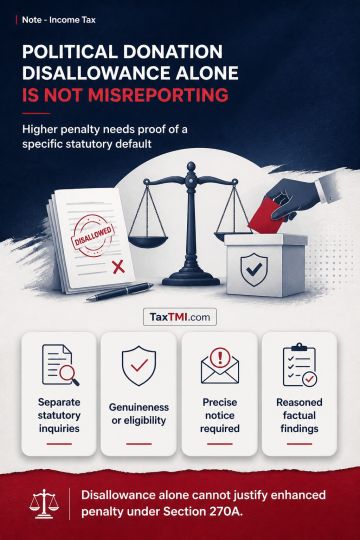
Political-donation deduction disallowance does not itself establish misreporting; enhanced penalty requires proof of a specific statutory default.
Disallowance of a political-contribution deduction under Section 80GGC and imposition of penalty under Section 270A are separate statutory inquiries. An adverse finding on genuineness or eligibility may raise assessed or reassessed income, but cannot alone establish misreporting. Enhanced penalty requires proof that the taxpayer's conduct falls within a specific Section 270A(9) category, supported by a precise notice and reasoned factual findings.
Case Laws Income Tax
Show AI Summary
Conditional charitable registration cannot suspend tax benefits pending litigation outside the statutory grant and cancellation framework.
Section 12AB permits the authority, after inquiry into objects, genuine activities and material legal compliance, to grant registration for the statutory period or reject the application. It does not create a contingent form of registration whose tax consequences await future litigation. Post-registration violations must be addressed through the separate cancellation process, requiring inquiry and hearing. Conditions in prescribed forms or administrative guidance may operationalise statutory duties but cannot create extra-statutory eligibility thresholds, future-conduct obligations or anticipatory cancellation consequences. Binding jurisdictional rulings remain applicable unless stayed, modified or reversed.
Case Laws Customs
Show AI Summary
Transaction value reassessment requires disclosed comparable evidence, while protest-qualified consent preserves appellate rights against enhanced customs valuation.
Transaction value under Section 14 and Rule 3 is the primary basis for valuing imported goods. Rule 12 permits rejection only where an objectively sustainable reasonable doubt persists after considering further information; on request, the grounds must be disclosed in writing and a hearing afforded. Redetermination must follow Rules 4 to 9 sequentially and rely on demonstrably comparable import data. Written acceptance of reassessment may dispense with a speaking order under Section 17(5), but protest-qualified or provisional-clearance correspondence may preserve the statutory right to appeal.
Case Laws GST
Show AI Summary
Leasehold rights assignment may fall outside GST when the lessee permanently transfers the entire proprietary estate.
GST treatment of assignment of leasehold rights turns on whether the lessee has made a complete transfer of its existing estate or continues to provide occupation or enjoyment. Where the assignor transfers the whole residual term, possession, building and associated rights, retains no reversionary or controlling interest, and the assignee succeeds directly to obligations towards the original lessor, the transaction may be characterised as transfer of benefits arising out of land rather than a supply of services. Labels such as premium, salami or transfer fee are not conclusive.
Case Laws Income Tax
Show AI Summary
Leave encashment exemption: Non-government employees may claim the enhanced notified ceiling subject to statutory computation conditions.
Retirement leave encashment received by employees other than Central or State Government employees falls under Section 10(10AA)(ii). Exemption depends on retirement, the ten-month earned-leave limit, average salary for the preceding ten months, earned-leave entitlement restrictions, aggregate limits, and prior exempt receipts. The enhanced notified ceiling of Rs. 25,00,000, deemed to operate from 1 April 2023, is treated in the Tribunal approach discussed as a beneficial rationalisation available to eligible pending claims for earlier assessment years, without displacing the statutory computation conditions.
Case Laws Income Tax
Show AI Summary
Dependent agent permanent establishment requires proven habitual contractual authority; liaison, administrative support, and customer contact alone remain insufficient.
Dependent agent permanent establishment under Article 5(5) requires proof that an Indian person has authority to negotiate and enter contracts for the foreign enterprise and habitually exercises that authority. Customer liaison, account management, administrative support, communication of pre-approved terms, document routing, and assistance with online standard-form contracting fall short unless Indian personnel substantively determine essential terms or routinely bring negotiations to a binding commercial conclusion. Formal offshore execution is not decisive where local personnel effectively control material negotiations. Corporate association, economic dependence, and independent-agent considerations cannot replace proof of the positive authority and habitual-exercise requirements.
Case Laws Customs
Show AI Summary
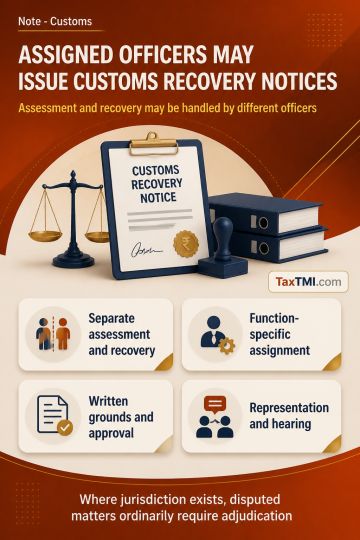
Proper-officer jurisdiction permits assigned customs officers to issue recovery notices without having performed the original assessment.
Customs show-cause jurisdiction requires both appointment as an officer of customs and function-specific assignment as the proper officer. Assessment under Section 17 and recovery under Section 28 are distinct functions; the original assessing officer need not alone issue a recovery notice. Retrospective validation of qualifying officers' proper-officer status applies independently of the preserved historical recovery regime. Confiscation and penalty proceedings require written grounds, prescribed prior approval, representation, and hearing. Where jurisdiction exists, disputed facts, evidence, limitation, and procedural compliance ordinarily require determination through adjudication.
Case Laws Money Laundering
Show AI Summary
Equivalent-value attachment permits securing untainted pre-offence assets only when unavailable criminal proceeds, valuation, and statutory risk are established.
Pre-offence property is ordinarily not directly derived from later scheduled-offence activity, but may be provisionally attached as equivalent value where actual proceeds are unavailable. Such attachment requires identification and reasoned valuation of the alleged proceeds, material showing their unavailability, and recorded reasons to believe that non-attachment risks concealment, transfer, or other frustration of confiscation. A later use of illicit funds to repay loans, construction borrowing, or secured obligations may separately establish a direct or indirect nexus. Section 24 presumptions do not replace the foundational requirements for attachment.
Case Laws IBC
Show AI Summary
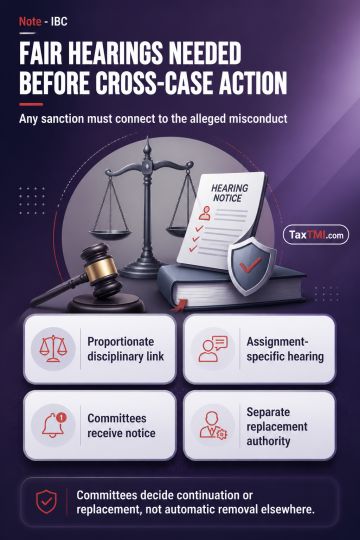
Cross-assignment disciplinary suspension requires proportionate, assignment-specific hearing while creditor committees retain statutory control over replacement decisions.
Where disciplinary misconduct concerns one CIRP, cross-assignment suspension requires a proportionate link to the pleaded charge, supporting material and hearing afforded. Section 220(2) permits disciplinary sanctions after hearing, while Regulation 13(7) requires intimation to Committees of Creditors and the Adjudicating Authority. On the prima facie construction applied, intimation informs each Committee's decision on continuation or replacement rather than automatically removing the professional from unrelated ongoing assignments. The Board's regulatory role and the Committee's replacement power remain distinct but connected.
Case Laws GST
Show AI Summary
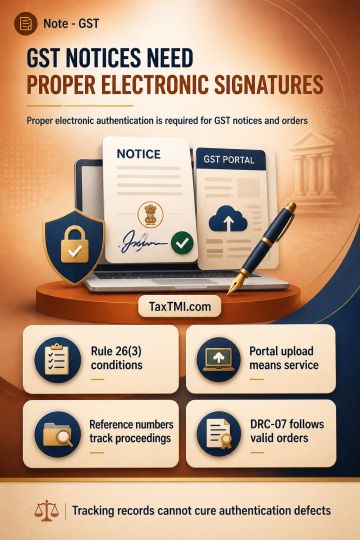
Electronic authentication of GST notices requires prescribed signatures; portal uploads, reference numbers, and DRC summaries cannot independently validate proceedings.
Rule 26(3) makes electronic issuance and authentication by digital signature, e-signature, or a notified verification mode cumulative conditions for GST notices and orders. A portal upload concerns service, while a system-generated reference number, DRC summary, or DIN performs tracking or procedural functions; none independently establishes the authorised officer's authentication. Section 169 governs service rather than validity, and Section 160 does not ordinarily cure a defect preventing attribution of the instrument to the competent officer. DRC-01 cannot replace the statutory notice, and DRC-07 supports recovery only upon a valid order.
Case Laws GST
Show AI Summary
GST bail classification requires precise Section 132 charging clauses, with investigation status, cooperation and proportionality governing custodial necessity.
GST-evasion bail adjudication requires a case-specific assessment of custodial necessity rather than an automatic consequence of the alleged tax magnitude, Magistrate-triability, or a maximum five-year sentence. Section 132 classification depends on the precise offence clause and punishment bracket, not merely on the alleged quantum of evasion. Relevant considerations include the stage of investigation, cooperation with summons, security of evidence, individual role, risks of absconding or interference, proportionality, and personal liberty under Article 21.
Case Laws Customs
Show AI Summary
Certificate-specific origin verification prevents preferential-duty denial based solely on unrelated suspect certificates or supplier doubts.
Preferential customs-duty treatment requires compliance with applicable rules of origin and reliable proof that imported goods qualify as originating. A country-of-origin certificate is important evidence but does not remove the importer's duty to possess supporting origin information and exercise reasonable care. Challenges to preferential treatment must be certificate-specific and consignment-specific: an adverse finding concerning identified certificates cannot, without direct evidence, invalidate separate certificates. Customs verification should identify the particular proof of origin, alleged defect and material linking it to the import, while fraud, suppression or misrepresentation independently established may support substantive action.

TMI Notes

Back

All TMI Notes

Showing Results for :
Reset Filters
No Records Found

TMI Notes

Renting of Immovable Property and Blocked Input Tax Credit under Sections 16 and 17(5) of the CGST Act

24 September, 2026

Contents
Acts
Plus +
Summary
Note

Note

-

Bookmark

(New) -

Download

Print

Print

This is a neutral professional article. The judgment is analysed in the context of its factual background, issues framed, and conclusions reached by the Court.

2026 (7) TMI 220 - MADRAS HIGH COURT

At a Glance

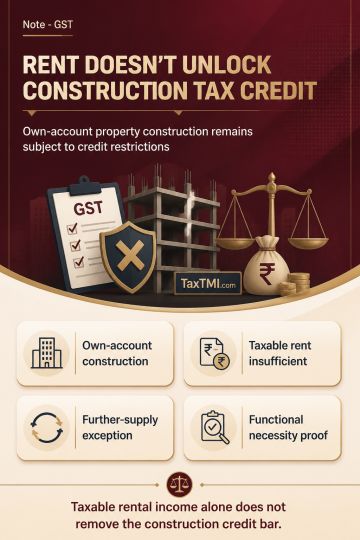
  • Renting of immovable property is treated as a supply of services under Schedule II. That characterisation does not, by itself, make construction-related input tax credit available.
  • The general entitlement in Section 16 is expressly subject to statutory restrictions. The central restriction for property developers and lessors is contained in Section 17(5)(c) and (d).
  • Section 17(5)(c) blocks credit on works contract services used for construction of immovable property, except where the service is an input service for further supply of works contract service. Section 17(5)(d) separately blocks credit on goods or services received for construction of immovable property on the taxpayer's own account, even where used in the course or furtherance of business.
  • The decision reported as 2026 (7) TMI 220 - MADRAS HIGH COURT holds, on its facts, that a taxpayer engaged in renting and leasing could not claim construction-related credit merely because rental receipts were taxable. The Court also sustained invocation of the fraud-and-suppression demand provision.
  • The distinction between a building constituting ordinary immovable property and a building that may satisfy the functionality test as a "plant" was recognised in 2024 (10) TMI 286 - Supreme Court. The inquiry is fact-specific and cannot be presumed from the fact that a building is commercially let out.

Background & Context

The dispute arose from availment of input tax credit on construction-related inputs, capital goods and services by a taxpayer whose outward activity was renting and leasing of immovable property. The credit covered, among other things, construction materials, sanitary and plumbing materials, electrical goods, architecture, landscaping, construction and labour services, works contract services, and related expenditure.

The taxpayer had initially refrained from taking credit because of the restrictions in Section 17(5)(c) and (d). It subsequently claimed credit after a High Court decision had read down Section 17(5)(d) in the context of property constructed for letting out. That earlier approach treated a continuing stream of taxable rent as preserving the tax chain and therefore as warranting credit.

The Court rejected the taxpayer's challenge to the demand. It held that the subsequent availment was contrary to the statutory restrictions and was also beyond the applicable time limit under Section 16. The Court further held that a unilateral communication seeking departmental approval, which was never approved or answered, could not create a bona fide basis for availment of blocked credit or defeat proceedings under Section 74.

The decision is significant because it separates two propositions that are often conflated: first, renting is a taxable supply of services; secondly, the construction-stage inward supplies satisfy the independent conditions for credit. Under the CGST framework, the former does not neutralise a specific blocked-credit provision.

Key Issues / Provisions

Renting and works contract as supplies of services

Schedule II, paragraph 5(a), provides that "renting of immovable property" shall be treated as a supply of services. Paragraph 6(a) likewise treats a "works contract as defined in clause (119) of section 2" as a composite supply of services.

The relevant definition in Section 2(119) describes a works contract as a contract for building, construction, fabrication, completion, erection, installation, fitting out, improvement, modification, repair, maintenance, renovation, alteration or commissioning of immovable property where transfer of property in goods is involved in execution of the contract. This definition is material because Section 17(5)(c) specifically addresses works contract services.

General entitlement and time limit

Section 16(1) confers entitlement to credit of input tax charged on supplies used or intended to be used "in the course or furtherance of" business, subject to prescribed conditions and restrictions. This opening entitlement is not absolute. Section 16(2) additionally requires, among other conditions, possession of the prescribed tax document, receipt of goods or services, payment of tax to the Government in the prescribed manner, and furnishing of the return.

Section 16(4) states that credit on an invoice or debit note cannot be taken after the thirtieth day of November following the end of the relevant financial year or furnishing of the relevant annual return, whichever is earlier. The statutory text also contains specific provisions for identified earlier financial years. For the dispute decided in 2026 (7) TMI 220 - MADRAS HIGH COURT, the Court held that the credit had not been availed within the applicable Section 16 time limit. That conclusion governs the case decided.

Blocked credits for construction of immovable property

Section 17(5) begins with a non-obstante clause: "Notwithstanding anything contained in sub-section (1) of section 16 and sub-section (1) of section 18, input tax credit shall not be available" in respect of the specified categories. Thus, even a business nexus under Section 16(1) cannot prevail over a credit block within Section 17(5).

Section 17(5)(c) blocks credit on "works contract services when supplied for construction of an immovable property" other than plant and machinery. The express exception is where the works contract service is an input service for further supply of works contract service. A person supplying renting services is not, merely because of that outward supply, within this further-supply exception.

Section 17(5)(d) blocks credit on "goods or services or both received by a taxable person for construction of an immovable property" other than plant and machinery "on his own account including when such goods or services or both are used in the course or furtherance of business." The words "including when" are consequential: commercial use, including use for an outward rental business, does not on its own remove the bar.

Explanation 1 to Section 17(5)(c) and (d) provides that "construction" includes reconstruction, renovation, additions, alterations or repairs, to the extent capitalised to the immovable property. The Explanation to Section 17 defines "plant and machinery" as apparatus, equipment and machinery fixed to earth by foundation or structural support and used for making outward supplies; it includes the relevant foundations and structural supports, but excludes land, building or other civil structures, telecommunication towers and pipelines laid outside factory premises.

The supplied statutory text also contains Explanation 2 to Section 17(5)(d), which clarifies that, notwithstanding anything contrary in any judgment, decree or order, a reference to "plant or machinery" in clause (d) shall be construed, and shall always be deemed to have been construed, as a reference to "plant and machinery." The precise consequence of this text for a particular credit period must be assessed against the statutory provisions applicable to that period and the facts of the claim.

Detailed Analysis

Taxable rent does not displace the construction credit block

The Court in 2026 (7) TMI 220 - MADRAS HIGH COURT treated the statutory embargo as decisive. The taxpayer's business of renting and leasing did not alter the character of inward construction-related goods and services as supplies used for construction of immovable property on its own account. The Court therefore held that the credit was impermissible under Section 17(5)(c) and (d).

This approach follows the statutory sequence. Section 16 determines whether there is a general business-related entitlement. Section 17 then limits that entitlement. Where inward supplies fall within either clause (c) or clause (d), the fact that the completed property is deployed in earning taxable rent is insufficient, without more, to establish credit eligibility.

The functionality inquiry under the Supreme Court decision

2024 (10) TMI 286 - Supreme Court is central to the meaning of the earlier expression "plant or machinery" in Section 17(5)(d). The Court held that this expression could not automatically be equated with the defined phrase "plant and machinery" appearing in the Explanation to Section 17. The disjunctive wording had to be given effect and could not be judicially rewritten.

The Court upheld the constitutional validity of Section 17(5)(c), Section 17(5)(d) and Section 16(4), emphasising that input tax credit is a statutory entitlement and that the legislature may prescribe exceptions to it. At the same time, it held that a mall, warehouse or other building may, in an appropriate factual case, qualify as a "plant" for the earlier wording of Section 17(5)(d). The test is functional: whether, considering the registered person's business and the role performed by the building, construction of that building was essential to carrying out the taxable activity. The Court remitted the factual determination rather than treating commercial use or rental use as conclusive.

The primary decision does not treat every rented building as a plant. On the facts before it, the Court found the construction credit to be blocked and held that the earlier High Court basis on which the credit was claimed had been removed by the Supreme Court ruling. Accordingly, a functionality-based contention requires clear, contemporaneous material demonstrating the building's operative and essential role in the particular business; it cannot rest solely on the existence of taxable rental income.

Earlier letting-out view and its reversal

2019 (5) TMI 1278 - ORISSA HIGH COURT had read down Section 17(5)(d) to permit credit for construction of property intended for letting out where the tax chain was said to remain unbroken. Its reasoning focused on avoidance of cascading and the taxable nature of rental receipts. That view explains why taxpayers engaged in leasing may have considered construction credit to be available.

However, 2024 (10) TMI 286 - Supreme Court set aside the reading down of Section 17(5)(d). The constitutional challenge to the blocked-credit provisions failed. The relevant inquiry, under the statutory wording examined by the Supreme Court, was not whether rent was taxable but whether the property could factually be characterised as a plant by applying the functionality test. The primary decision applies this later position and does not preserve the earlier letting-out rationale as an independent ground for credit.

Foundation and structural-support exception

2025 (8) TMI 551 - APPELLATE AUTHORITY FOR ADVANCE RULING, GUJARAT concerned a concrete structure supporting manufacturing equipment. The authority held that the structure was an essential foundation and structural support for plant and machinery and therefore fell within the statutory Explanation. Credit on inputs and input services used for its construction was held available.

That ruling is factually distinct from construction of premises for renting. Its relevance lies in the analytical distinction it draws between an ordinary civil structure and a foundation or structural support that is integral to identified plant and machinery used for outward supplies. A lessor seeking to rely on this exception must establish that the claimed expenditure relates to the qualifying foundation or support, rather than to the building as such.

Pre-GST CENVAT authorities: contextual but not determinative

2018 (9) TMI 1135 - MADRAS HIGH COURT accepted CENVAT credit on construction services used to provide renting of immovable property services. It proceeded on the earlier CENVAT input-service definition and the nexus between construction and the output renting service. The ruling demonstrates the different statutory design of the pre-GST regime; it does not override the non-obstante block in Section 17(5).

Similarly, 2022 (12) TMI 472 - KARNATAKA HIGH COURT upheld CENVAT credit on construction-related inputs and input services used for a renting business. Its rationale was that the constructed building was used in the business of providing the output service. Under GST, that broad nexus reasoning must yield where the express conditions of Section 17(5)(c) or (d) are attracted.

2022 (12) TMI 139 - PUNJAB AND HARYANA HIGH COURT likewise addressed the former CENVAT definition of "input service", including its setting-up limb, and held that a later exclusion was not retrospective for the period in issue. It is useful for understanding the earlier credit position, but it cannot determine eligibility under the CGST Act's separately worded blocked-credit provisions.

Demand, interest and penalty exposure

Section 74(1) authorises a notice where input tax credit has been wrongly availed or utilised "by reason of fraud, or any wilful-misstatement or suppression of facts to evade tax." The notice must require the taxpayer to show cause against tax, interest under Section 50 and penalty equivalent to the tax stated in the notice. Section 74(10) prescribes a five-year period for issuance of the adjudication order, calculated from the due date of the annual return for the relevant financial year or from the date of erroneous refund, as applicable.

In the primary decision, the taxpayer relied on a previous communication to the department. The Court held that an unresponded request for approval, made outside the GST return mechanism, was not departmental concurrence. It also considered the wider actual availment, compared with the proposed credit stated in that communication, while holding that a case for the extended period had been made out. The decision underlines that disclosure arguments depend on the nature, completeness and statutory mode of disclosure, not merely on the existence of correspondence.

Section 50(3) provides that where credit has been wrongly availed and utilised, interest is payable on the wrongly availed and utilised credit at a rate not exceeding twenty-four per cent, in the prescribed manner. Further, Section 122(2)(b) prescribes, where the wrong availment or utilisation is by reason of fraud, wilful misstatement or suppression of facts to evade tax, a penalty equal to ten thousand rupees or the tax due, whichever is higher. Section 74 also contains statutory closure mechanisms on payment within the periods specified in sub-sections (5), (8) and (11).

Practical Implications

  • Credit reviews for rented commercial property should separately identify works contract services, materials, capitalised repair expenditure, movable equipment, and foundations or structural supports. A single project-level conclusion is unlikely to be reliable.
  • The claim should first be tested under Section 16, including the relevant time limit and documentary conditions. It should then be tested independently against both Section 17(5)(c) and Section 17(5)(d).
  • The fact that rental income is taxable, and that construction was commercially necessary to generate that income, does not itself satisfy either the works-contract exception or the plant-and-machinery exception.
  • Where a plant or structural-support argument is available, records should address functional necessity, technical design, identified machinery, the connection between the structure and that machinery, capitalisation treatment, and the nature of outward supplies.
  • Representations or letters to the department should not be treated as approval unless an express statutory approval or determination has actually been issued. Return disclosures and reconciliations should accurately identify ineligible credit and reversals.
  • In a Section 74 dispute, the defence must separately address substantive eligibility, timing under Section 16, the statutory basis for alleging fraud, wilful misstatement or suppression, utilisation of credit for interest purposes, and the consequences of any reversal or payment.

Key Takeaways

  • Renting of immovable property is a supply of services, but taxable outward rent does not automatically permit credit on construction of the rented property.
  • Section 17(5)(c) and (d) are specific overrides of the general business-use entitlement in Section 16(1).
  • The historical read-down that allowed credit merely because property was let out has been set aside. The Supreme Court's functionality analysis does not create a blanket rental-property exception.
  • A claim based on plant, plant and machinery, or qualifying foundation and structural support is necessarily evidence-driven and fact-specific.
  • Belated availment and incomplete statutory disclosure can compound substantive credit disputes by exposing the taxpayer to proceedings under Section 74, interest under Section 50(3), and penalty consequences.


Full Text:

2026 (7) TMI 220 - MADRAS HIGH COURT

Topics

Acts Income Tax