Loading...

⚠ ✕
❮ Top
☎ Help
☰
×

By creating an account you can:

Logo TaxTMI
Call Us / Help / Feedback✕

Contact Us At :

✉ E-mail: [email protected]

✆ To Call / Whatsapp, Check Contact Us

FAQs :

To know Frequently Asked Questions, Check FAQs

Most Asked Video Tutorials :

For more tutorials, Check Video Tutorials

Submit Feedback/Suggestion :

Email :
Please provide your email address so we can follow up on your feedback.
Category :
Description :
Min 15 characters 0/2000
Make Most of Text Search ✕
  1. Checkout this video tutorial: How to search effectively on TaxTMI.
  2. Put words in double quotes for exact word search, eg: "income tax"
  3. Avoid noise words such as : 'and, of, the, a'
  4. Sort by Relevance to get the most relevant document.
  5. Press Enter to add multiple terms/multiple phrases, and then click on Search to Search.
  6. Text Search
  7. The system will try to fetch results that contains ALL your words.
  8. Once you add keywords, you'll see a new 'Search In' filter that makes your results even more precise.
  9. Text Search
╳
Add to...
You have not created any category. Kindly create one to bookmark this item!
✕
Create New Category
Hide
Title :
Description :
❮❮ Hide
❮ Default View
Expand ❯❯
Close ✕
🔎 Filters / Advanced Search ❯
TEXT

Press 'Enter' to add multiple search terms. Rules for Better Search

Search In
Main Text + AI Text ❯
  • Main Text
  • Main Text + AI Text
  • AI Text
Law:
---- All Laws---- ❯
  • ---- All Laws----
  • Benami Property
  • Bill
  • Central Excise
  • Companies Law
  • Customs
  • DGFT
  • FEMA
  • GST
  • GST - States
  • IBC
  • Income Tax
  • Indian Laws
  • Money Laundering
  • SEBI
  • SEZ
  • Service Tax
  • VAT / Sales Tax
Types:
---- All Types ---- ❯
  • ---- All Types ----
  • Act Rules
  • Case Laws
  • Circulars
  • Manuals
  • News
  • Notifications
Sort By: ?
In Sort By 'Default', exact matches for text search are shown at the top, followed by the remaining results in their regular order.
Relevance Default Date
☰   Show Results ❯
    Case Laws Customs
    Country of Origin Certificates and Preferential Customs Duty under Notification No. 46/2011-Customs ...
    Refund of Accumulated Input Tax Credit on Packing Materials under Section 54(3)(ii) of the CGST Act
    Detention of Goods in Transit: Consequences of Delay in Notice under Section 129(3)
    Case Laws Income Tax
    Section 192 TDS on Leave Travel Concession and the Effect of Subsisting Judicial Restraint
    Cross-Segment Price Manipulation in Stock Derivatives under the SEBI Act and PFUTP Regulations
    Case Laws Income Tax
    Enhanced Rate of Tax u/s 115BBE: Survey Surrenders of Excess Stock and Cash: Business Income, Deemed...
    Retention of Seized Mobile Phones and Bank Debit Cards Beyond the Section 67(7) Period
    Case Laws Customs
    Classification of Disposable Analytical Cartridges under Chapter 90 and Heading 3926
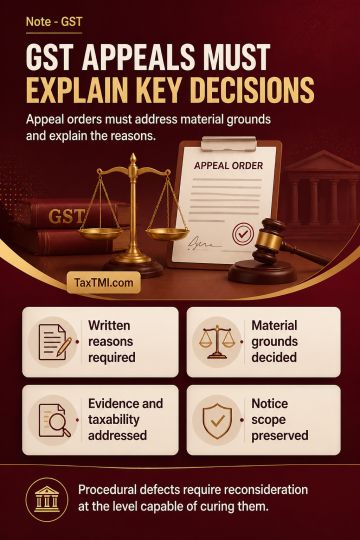
    Reasoned and Speaking Appellate Orders u/s 107 of the CGST Act: Duty to Decide Material Grounds of A...
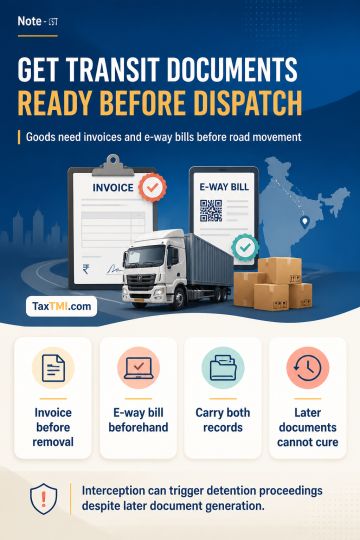
    Pre-Movement E-Way Bill Compliance and Section 129 Detention for Undocumented Goods in Transit
    Case Laws Income Tax
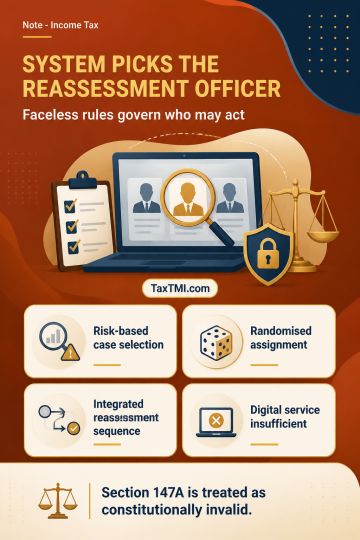
    Faceless Reassessment Jurisdiction: Retrospective Validation under Section 147A and Automated Alloca...
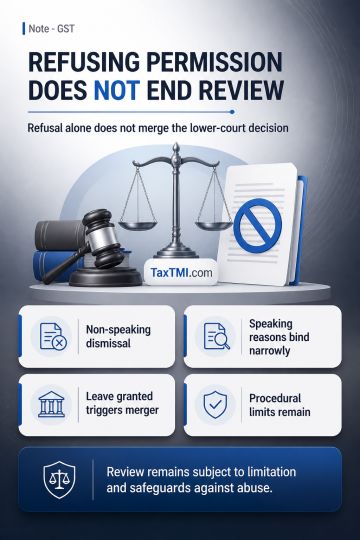
    Doctrine of Merger: Effect of Non-Speaking and Speaking Dismissal of Special Leave Petitions on Merg...
    Case Laws Indian Laws
    Section 37 of the NDPS Act: Twin Conditions for Grant of Bail in Commercial Quantity Cases
    Case Laws Customs
    Pilferage of Imported Goods: Approval, Custody and Duty Liability under the Customs Act, 1962
    Case Laws Indian Laws
    Condonation of Delay in Statutory Appeals under Section 5 of the Limitation Act, 1963
    Case Laws Income Tax
    Condonation of Delay for Filing Revised Returns under Section 119(2)(b): Genuine Hardship and Merits...
    Case Laws Income Tax
    TDS Credit Where the Deductor Defaults: Proof of Deduction Without Form 16 or Form 16A
    Case Laws Indian Laws
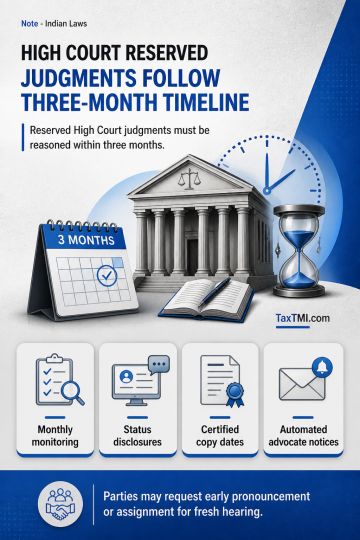
    Reserved High Court Judgments: Constitutional Timelines, Accountability and Litigant Remedies
    Price Depression in Securities Markets: Evidentiary Requirements under the PFUTP Regulations
    Case Laws Income Tax
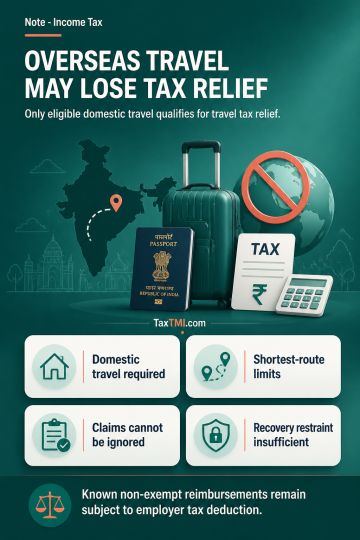
    Foreign Leave Travel Concession and Tax Deduction at Source under Sections 10(5), 192 and 201
❮
❯
❯❯
Maximize Maximize Maximize
0 / 200
Expand Note
Add to Folder

No Folders have been created

+

Are you sure you want to delete "My most important" ?

NOTE:

Notes
Showing Results for :
Reset Filters
Results Found:
Show All Summaries Hide All Summaries
Case Laws Customs
Show AI Summary
Certificate-specific origin verification prevents preferential-duty denial based solely on unrelated suspect certificates or supplier doubts.
Preferential customs-duty treatment requires compliance with applicable rules of origin and reliable proof that imported goods qualify as originating. A country-of-origin certificate is important evidence but does not remove the importer's duty to possess supporting origin information and exercise reasonable care. Challenges to preferential treatment must be certificate-specific and consignment-specific: an adverse finding concerning identified certificates cannot, without direct evidence, invalidate separate certificates. Customs verification should identify the particular proof of origin, alleged defect and material linking it to the import, while fraud, suppression or misrepresentation independently established may support substantive action.
Case Laws GST
Show AI Summary
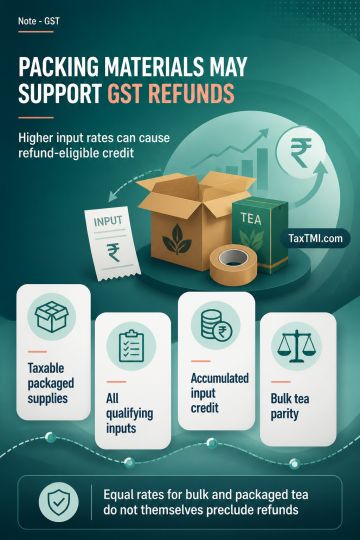
Packing-material input tax credit may support inverted-duty refunds when higher-rated inputs cause accumulation for taxable packaged supplies.
Refund of accumulated input tax credit under Section 54(3)(ii) may arise where packing materials used to make taxable packaged outward supplies bear a higher tax rate than the outward supply and generate the accumulation. The inquiry extends to all qualifying inputs and is not limited to a principal raw material. Parity between the rate on bulk tea and packaged tea does not itself preclude refund if higher-taxed packing materials used for the packaged supply are the cause of unutilised credit.
Case Laws GST
Show AI Summary
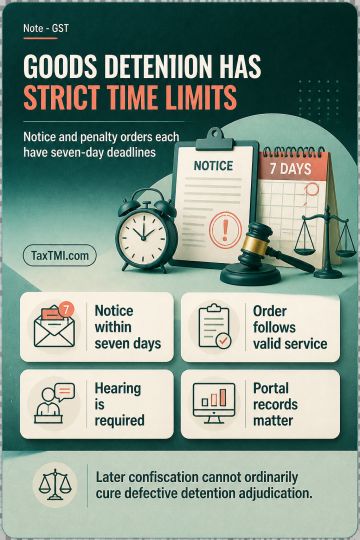
Mandatory detention timelines require timely notice, hearing and penalty order, preventing prolonged restraint of goods in transit.
Section 129(3) establishes a mandatory two-stage timeline: issuance of the penalty notice within seven days of formal detention or seizure, followed by a penalty order within seven days of legally effective service. The periods are independent, and compliance at one stage cannot cure delay at the other. Service, portal timestamps and the electronic records required under Rule 142 are material to chronology. Penalty requires a hearing, while payment under protest may still require a reasoned order to preserve appellate access. Later confiscation action cannot ordinarily cure a defective detention adjudication.
Case Laws Income Tax
Show AI Summary
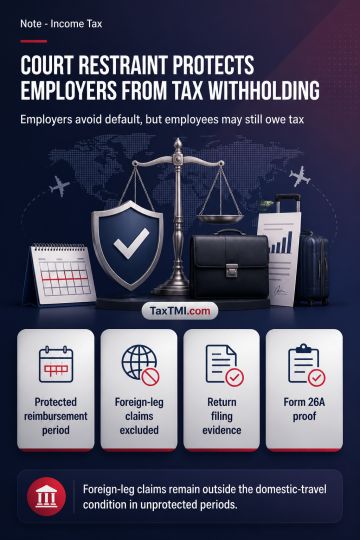
Subsisting judicial restraint on leave travel concession withholding prevents employer default while preserving employees' underlying tax liability.
A subsisting judicial restraint expressly prohibiting deduction from leave travel concession reimbursements governs the employer's withholding conduct for the covered period. Non-deduction in compliance with that restraint cannot constitute failure to discharge an enforceable duty under Sections 192 and 201, even if the underlying exemption claim is later found substantively unavailable. The restraint does not eliminate employee-level tax liability. For unprotected periods, foreign-leg or circuitous travel claims remain outside the domestic-travel condition, and payer protection may depend on proving employee return filing, income inclusion and tax payment through Form 26A.
Case Laws SEBI
Show AI Summary
Cross-segment price manipulation examines whether futures orders artificially influence option executions, engaging anti-fraud rules, director responsibility, and interim safeguards.
Cross-segment price manipulation may arise where aggressive futures orders alter the last traded price or visible order-book conditions so that larger, sentimentally opposite options orders obtain favourable execution. The relevant inquiry considers the integrated sequence of resting orders, aggressive executions, cancellations, timing, concentration, price impact and delta-adjusted exposure. Anti-fraud prohibitions cover manipulative devices, false appearances of trading and price manipulation, while opposite futures and options positions alone do not establish misconduct. Director liability requires responsibility for business conduct, or consent, connivance or neglect.
Case Laws Income Tax
Show AI Summary
Survey surrender characterisation determines whether excess stock and cash are taxed as business income or under special deemed-income provisions.
The special regime in Section 115BBE is consequential: it applies only after the amount is properly brought within a specified deeming provision, and a survey surrender, book entry or return description cannot itself create that character. Mixed stock forming part of ordinary business inventory and credibly explained through business records may be assessed as business income at normal rates. Similarly, excess cash may be treated as business income where a commercial source is satisfactorily established and no separate or non-business source is shown.
Case Laws GST
Show AI Summary
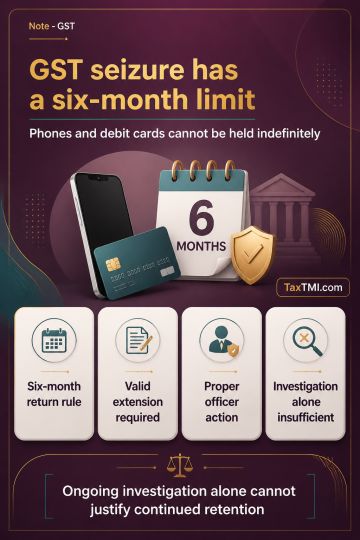
Statutory limits on GST seizure require return of retained mobile phones and debit cards without a valid extension.
Section 67(7) establishes a six-month return rule where no notice in respect of seized goods is issued. Any further period requires sufficient cause, action by the proper officer, and a maximum further period of six months; ongoing investigation cannot replace an actual extension order. Although Section 67(7) uses "goods" while Section 67(2) also covers documents, books and things, its application to seized mobile phones and bank debit cards indicates that classification cannot be used to avoid the temporal restriction where articles are held under statutory seizure.
Case Laws Customs
Show AI Summary
Analytical cartridge classification follows functional integration and sole-use suitability, not plastic composition, disposability, or general consumable character.
STA micro-cuvettes containing an enclosed steel ball are assessed as complete functional components of a blood-coagulation analyser, rather than merely as plastic laboratory articles. Classification turns on their objective design, analytical role, exclusive or principal suitability and absence of practical general use. Chapter 90 Note 2 requires consideration of an independent specific heading first and then classification of other dedicated parts or accessories with the relevant instrument. Disposable or single-use status and plastic composition do not by themselves establish classification as residual plastic articles.
Case Laws GST
Show AI Summary
Speaking appellate orders require findings on material GST appeal grounds, ensuring fair hearings and meaningful higher review.
Section 107(12) requires a written appellate order identifying material points for determination, deciding them, and giving reasons. Formulaic confirmation of original assessment does not establish independent appellate consideration, particularly where jurisdiction, notice, evidence, quantification, taxability, section 74 conditions, interest, or penalty are contested. Sections 74 and 75 require a defined notice, disclosure of relied-upon material, effective hearing, and reasoned determination within the notice's scope. Where procedural defects arise at the original stage as well as on appeal, reconsideration must occur at the level capable of curing the foundational defect without expanding the show-cause case.
Case Laws GST
Show AI Summary
Pre-movement e-way bill compliance requires invoices and transport records before dispatch, while later documents cannot cure undocumented transit.
Pre-movement e-way bill compliance requires issuance of an invoice at or before removal, generation of the e-way bill before road movement, and carriage of both records during transit. Where goods are intercepted without either record, the contravention arises upon commencement of undocumented movement; documents generated only after interception cannot retrospectively establish compliance. Such documents may still be considered with other contemporaneous evidence when assessing bona fides or alleged intent to evade tax. Section 129 detention proceedings remain subject to notice, hearing, electronic-summary and statutory-timeline requirements.
Case Laws Income Tax
Show AI Summary
Automated allocation in reassessment determines officer jurisdiction, while retrospective validation cannot bypass continuing faceless-scheme requirements.
Section 151A and the e-Assessment of Income Escaping Assessment Scheme, 2022 require covered reassessment functions and section 148 notice issuance through automated allocation. Risk-based selection of cases is distinct from randomised allocation of the officer authorised to act. Sections 148A and 148 form an integrated reassessment sequence, so general concurrent jurisdiction, administrative instructions or digital service cannot substitute for the prescribed faceless allocation. Section 147A did not amend the continuing statutory and scheme-based allocation requirements and is treated as constitutionally invalid.
Case Laws GST
Show AI Summary
Doctrine of merger distinguishes refusal of special leave from appellate disposal, preserving review subject to independent procedural limits.
Under Article 136, a refusal of special leave remains a discretionary leave-stage determination. A non-speaking dismissal does not merge the challenged lower-court decision into a Supreme Court order, affirm its reasoning, or automatically create res judicata. A speaking refusal may bind only as to legal propositions expressly declared under Article 141, without producing merger. Merger arises when leave is granted and appellate jurisdiction is exercised. Review, writ, and remanded proceedings remain subject to independent procedural requirements, including limitation and safeguards against abuse.
Case Laws Indian Laws
Show AI Summary
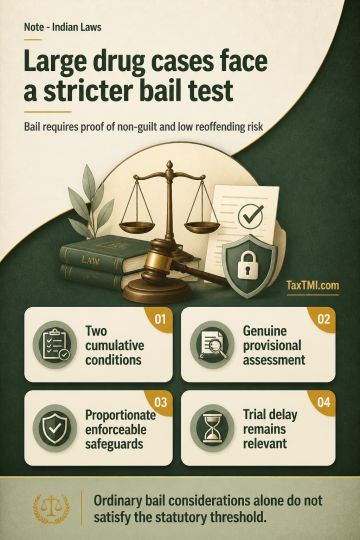
NDPS commercial-quantity bail requires independent proof of non-guilt and low reoffending risk alongside proportionate safeguards.
Section 37 of the NDPS Act imposes cumulative bail conditions in commercial-quantity cases: the court must find reasonable grounds to believe the accused is not guilty and unlikely to reoffend while on bail. These requirements supplement ordinary bail factors and demand a genuine, provisional assessment of credible material. Personal liberty and trial delay remain relevant, but must be reconciled with the statutory threshold. Bail conditions, including verification safeguards for foreign nationals, must be proportionate, genuine and capable of enforcement.
Case Laws Customs
Show AI Summary
Approved customs custodians bear duty for proven pilferage during custody, but not for losses before their approval takes effect.
Customs-duty liability for pilfered imported goods arises only where pilferage occurs after unloading in a customs area while goods are held by an approved custodian. Approval is indispensable; factual control or statutory custody alone does not impose this liability for a period before approval. Importer duty exemption for pre-clearance pilferage operates alongside the custodian's revenue liability. Pilferage must be proved through contemporaneous records and cannot be presumed from every cargo discrepancy, shortage, or loss.
Case Laws Indian Laws
Show AI Summary
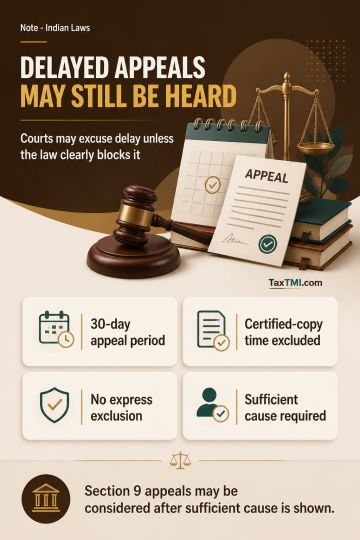
Condonation of delay under Section 5 remains available in special statutory appeals unless the governing scheme clearly excludes it.
Section 5 of the Limitation Act, 1963 applies to a special statutory appeal through Section 29(2) unless the governing enactment excludes it expressly or by necessary implication. A special limitation period alone is insufficient to exclude condonation. Restrictive language, a defined maximum condonable period, or a complete statutory limitation code may create a non-extendable outer limit. Section 9 of the Chhattisgarh Rajya Suraksha Adhiniyam contains a 30-day appeal period and excludes certified-copy time, but lacks an express bar or outer condonation ceiling; delay may therefore be considered upon proof of sufficient cause.
Case Laws Income Tax
Show AI Summary
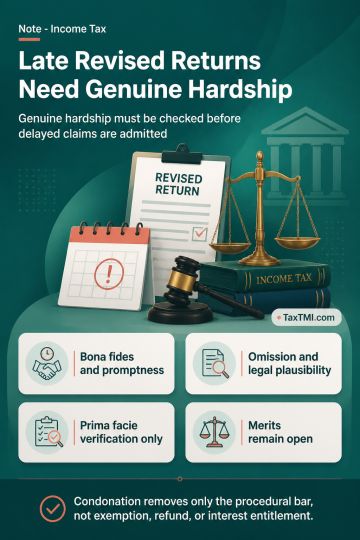
Genuine hardship in delayed revised-return claims requires prima facie verification without converting condonation into final tax adjudication.
Section 119(2)(b) may permit admission of a delayed revised-return claim where expiry of the Section 139(5) period causes genuine hardship. Condonation removes only the procedural bar and does not establish exemption, refund, or interest entitlement. Genuine hardship requires assessment of bona fides, the nature of the omission, promptness after discovery, legal plausibility, and the consequence of refusal. Circular No. 9/2015 permits prima facie verification and inquiry, but substantive taxability and refund entitlement remain for merits examination.
Case Laws Income Tax
Show AI Summary
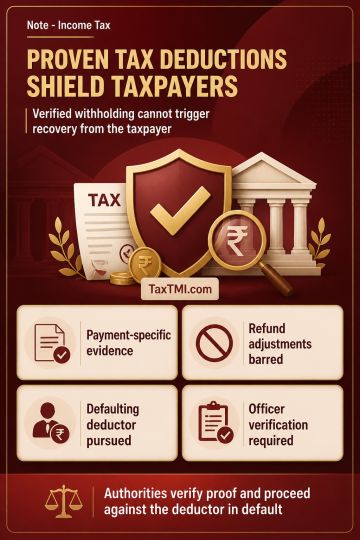
TDS credit after verified deduction protects taxpayers from demands and refund adjustments caused by deductor default.
TDS credit in domestic deductor-default cases depends on verified actual deduction from the taxpayer's income, not solely on deposit, TDS statements, Form 16 or Form 16A, or Form 26AS reflection. Section 205 bars direct or indirect recovery, including refund adjustment, to the extent tax was deducted. The taxpayer must provide reliable payment-specific evidence, and the Assessing Officer must verify the claim while the Department proceeds against the defaulting deductor.
Case Laws Indian Laws
Show AI Summary
Timely reserved judgments: a three-month framework, transparency, and staged remedies protect liberty and require reasoned decisions.
Reserved High Court judgments are subject to a three-month framework for a reasoned pronouncement, supported by monthly monitoring, status disclosures, date-recorded certified copies, and automated notice to advocates. Urgent matters may receive an operative-part pronouncement, but reasons must be uploaded within seven days or, where practical difficulties exist, within fifteen days. Parties may seek early pronouncement after the specified period and, after further delay, request withdrawal and assignment for a fresh hearing.
Case Laws SEBI
Show AI Summary
Settlement-price depression allegations require cogent proof of manipulation, not merely short exposure, closing sales, or position-limit non-disclosure.
Settlement-price depression under the PFUTP framework requires cogent proof of a manipulative act, device, scheme or artifice, not merely a substantial short derivative position, closing-window sales, or an incentive to benefit from a lower settlement price. Position concentration and position-limit non-disclosure are distinct from PFUTP fraud. Sales below the last traded price require market-wide causal analysis of other trading activity, execution mechanics, benchmark methodology, commercial rationale, and actual price impact. A genuine hedge and agency-attributed exposure do not, without further proof, establish manipulation.
Case Laws Income Tax
Show AI Summary
Foreign LTC tax exemption requires domestic travel; employers must deduct tax on known non-exempt travel reimbursements.
Foreign LTC/LFC payments for itineraries containing an overseas leg are outside the Section 10(5) exemption, which is confined to actual eligible domestic travel subject to Rule 2B shortest-route and fare conditions. Under Section 192, employers must include known non-exempt payments in estimated salary and deduct tax; they cannot disregard available claim records showing foreign or circuitous travel. A recovery restraint does not automatically suspend the deduction obligation. Section 201 recipient-compliance conditions, interest, and penalty based on reasonable cause require separate analysis.

TMI Notes

Back

All TMI Notes

Showing Results for :
Reset Filters
No Records Found

TMI Notes

Money Laundering

Judicially Crafted SOP: Kerala High Court on Bank Powers to Freeze Suspicious Accounts under PMLA

26 November, 2025

Contents
Circulars
Acts
Plus +
Summary
Note

Note

-

Bookmark

(New) -

Download

Print

Print

Deciphering Legal Judgments: A Comprehensive Analysis of Judgment

Reported as:

2025 (11) TMI 1636 - KERALA HIGH COURT

Introduction

This decision addresses a pressing and systemic question in contemporary banking and financial regulation: whether a bank may, on its own initiative and without any requisition from a law enforcement agency or court, freeze a customer's bank account based solely on suspicion about the nature of transactions. The matter arises in the backdrop of an exponential increase in financial cyber fraud and the proliferation of "money mule" accounts, particularly after the widespread adoption of UPI and instant digital payment systems.

Two writ petitions, involving separate accounts in the same private bank, were heard together. In both cases, the bank imposed a "debit freeze" citing unusual, high-value transactions inconsistent with the customers' declared profiles. Crucially, no law enforcement or judicial freezing order existed even after more than a year. The petitioners challenged the bank's action as unauthorized, violative of RBI directions, and an infringement of their constitutional right to property under Article 300A.

The judgment is significant for three reasons within the broader legal framework:

  • It examines the interaction between RBI's KYC/AML framework, the Prevention of Money-laundering Act, 2002 (PMLA), and banks' contractual relationships with customers.
  • It fills a regulatory vacuum by judicially articulating a structured protocol for banks to temporarily freeze suspicious accounts, pending RBI's formulation of a formal SOP.
  • It balances competing interests: preventing misuse of banking channels for crime versus protecting customers' property and due process rights.

Key Legal Issues

1. Authority of Banks to Freeze Accounts on Their Own Initiative

The central issue is whether, in the absence of a law enforcement or court order, a bank may unilaterally freeze a customer's account based on internal suspicion arising from transaction patterns. This involves:

  • Interpretation of RBI's KYC/AML Directions and Master Circulars u/s 35A of the Banking Regulation Act, 1949.
  • Scope of duties and powers of a "reporting entity" u/ss 12 and 12AA of PMLA.
  • The meaning of "appropriate action" and "enhanced monitoring" in RBI/AML frameworks.

2. Compatibility of Such Freezing with Constitutional and Property Rights

Linked to the first issue is whether an indefinite or prolonged bank-initiated freeze, without statutory backing or a law enforcement request, violates Article 300A (deprivation of property save by authority of law), and if so, how that affects the legality of bank action.

3. Role and Responsibility of RBI

The judgment also considers whether RBI has discharged its statutory responsibilities u/s 35A of the Banking Regulation Act in the context of escalating cyber financial fraud, and what remedial directions the court can issue to RBI.

4. Temporal Limits and Procedural Safeguards for Bank-initiated Freezes

Assuming some power in banks to act preventively, the court had to define:

  • Whether the power includes immediate freezing without prior notice.
  • How long such a freeze may validly continue absent action by investigative authorities.
  • What notice, communication, and review mechanisms must accompany such action.

Detailed Issue-wise Analysis

1. Statutory and Regulatory Framework

Section 35A of the Banking Regulation Act

The court begins by reproducing Section 35A, emphasizing RBI's broad power to issue binding directions to banks "in the public interest," "in the interest of banking policy," or "to prevent the affairs of any banking company being conducted in a manner detrimental to the interests of the depositors or... the banking company." The court explicitly holds that prevention of financial cyber fraud squarely falls within these purposes.

This sets the background for a critical observation: despite these wide powers, RBI has not fashioned a clear SOP delineating banks' powers and duties concerning freezing of suspicious accounts used for cyber fraud or money laundering. The court is sharply critical of RBI's counter affidavit, which "virtually says that Banks do not have any power to freeze the accounts... in the absence of any requisition from any law-enforcing agency or court," and characterizes RBI's response as casual and inadequate in the face of serious systemic concerns.

RBI KYC & AML Directions and Circulars

The bank relied on various RBI instruments, including:

The court carefully parses these:

  • Monitoring Provisions (e.g., Clause 2.10 of 2012 Circular) - These mandate ongoing monitoring, identification of unusual or large transactions, and filing Suspicious Transaction Reports (STRs) with FIU-IND. They do not confer any express power to freeze accounts.
  • Clause 59 of 2016/2025 Master Direction - Directs banks to diligently monitor and identify "money mule" accounts and to take "appropriate action, including reporting of suspicious transactions to FIU-IND." The judgment highlights that while "appropriate action" is mentioned, freezing is not expressly specified, and RBI has failed to define the expression.
  • Clauses dealing with non-KYC compliant accounts (e.g., Clause 3.2.2.III of 2015 Master Circular, Clauses 17, 38, 39 of the Master Direction) - These provisions allow phased partial and then full freezing, followed by possible closure, but only for KYC non-compliance and only after prior notice and reasonable opportunity. The court holds these are inapplicable to suspicion-based freezing in otherwise KYC-compliant accounts.

Thus, the regulatory framework mandates monitoring, reporting, and in some circumstances account closure/freezing for KYC failure with notice, but is silent on immediate, suspicion-based debit freezes to preserve suspected proceeds of crime.

PMLA and the Concept of "Reporting Entity"

The bank invoked Section 12AA(3) of PMLA to argue for authority to freeze accounts, pointing to its status as a "reporting entity" u/s 2(1)(wa). The court, however, parses Sections 12, 12AA and related Rules as follows:

  • Section 12 imposes record-keeping and reporting obligations for transactions.
  • Section 12AA(1)-(2) mandates enhanced due diligence for "specified transactions" (defined in the Explanation), including verification of identity, source of funds, and purpose of the transaction, and authorizes refusal to allow the specified transaction to be carried out if conditions are not met.
  • Section 12AA(3) requires enhanced future monitoring where specified transactions are considered suspicious.

The court emphasizes that these provisions concern "specified transactions" rather than the entire operation of an account. They do not expressly authorize freezing of accounts or balances, nor do related Rules (e.g., Rule 10(3), which deals with closure for want of identity records after notice).

Nevertheless, the court reasons purposively: if the object of PMLA and RBI's KYC/AML framework is to prevent money laundering and illegal use of the banking system, "appropriate action" and "enhanced monitoring" must logically encompass temporary freezing powers in narrowly defined circumstances. The court thus bridges the gap by reading such a power into the operationalization of Clause 59 and the obligations of reporting entities, while candidly acknowledging the absence of explicit textual authority.

2. Competing Arguments of the Parties

Petitioners' Submissions

The petitioners argued:

  • Banks have no inherent or statutory right to freeze accounts absent specific directions from law enforcement or courts.
  • RBI Circulars only contemplate reporting to FIU-IND and, in certain KYC-failure situations, partial/total freezing with advance notice; no provision authorizes unilateral suspicion-based freezing.
  • Over a year had passed with no requisition, no claimant to the funds, and no criminal case against the petitioners; the continued freeze violated Article 300A.
  • The Gujarat High Court decision in State Bank of India v. Ashvin Chaturbhai Parmar was cited to show that freezing is more prejudicial than closure, as closure involves returning funds, while freezing deprives the account holder of effective control.

They also attempted to justify the high-value transactions through explanations and, in one case, by filing an income tax return acknowledgment (post-freeze) to demonstrate purported legitimate sources of income.

Bank's Submissions

The bank argued:

  • It has a duty to prevent the use of its accounts for illegal activities and to comply with RBI's KYC/AML framework and PMLA obligations.
  • The transaction profiles were starkly inconsistent with declared income and customer profiles (e.g., an account holder declaring monthly income below Rs. 5,000 engaging in deposits of ~Rs. 1.9 crore and withdrawals of ~Rs. 1.56 crore within a few months; similarly large flows in another account opened very shortly before high-volume transactions).
  • Customers had not satisfactorily explained these transactions; even before the High Court, no clear business activity or legitimate justification was disclosed.
  • Under PMLA Section 12AA(3) and the RBI Directions (especially Clause 59 concerning money mules), the bank was not only entitled but obliged to take preventive steps, which should include freezing suspicious accounts.

RBI's Position

RBI's counter affidavit maintained that:

  • It has not issued specific instructions authorizing freezing of accounts except as contemplated in the Master Direction for certain limited situations (e.g., non-PAN, non-KYC, or on receipt of statutory orders).
  • Freezing is primarily to be done against requisitions or orders from competent authorities or courts (including under BNSS and the BUDS Act).
  • RBI's role is to forward statutory orders to banks; it does not direct freezing on its own beyond that framework.

The court found this stance unsatisfactory in light of Section 35A and the cybercrime context, expecting RBI to take a more proactive regulatory position.

3. Court's Balancing Exercise and Construction of "Appropriate Action"

The judgment undertakes a "hard case" balancing. On the one hand:

  • The facts strongly support suspicion: enormous short-term flows, mismatch with profiles, post hoc tax filings, and lack of clarity on the nature of business.
  • The court notes that it could "easily dismiss" the writ petitions on this ground alone and decline discretionary relief under Article 226.

On the other hand:

  • More than a year of freezing without any investigative action, statutory requisition, or clear path for the funds is untenable.
  • There is no clarity in RBI Directions on how long banks may hold such funds or what ultimate disposition should be.
  • Prolonged indefinite freezing without statutory or regulatory scaffolding risks violating Article 300A and basic fairness.

To reconcile the preventive objectives of PMLA/RBI Guidelines with property and due process concerns, the court:

  • Recognizes an implied power in banks to impose temporary debit freezes, without prior notice, in cases of well-grounded suspicion, as part of "appropriate action" under Clause 59 and consistent with PMLA's objectives.
  • Strictly limits such power through procedural safeguards and a temporal cap, effectively creating a structured, quasi-regulatory protocol applicable until RBI formalizes its own SOP.

Key Holdings and Reasoning

1. Ratio Decidendi

At the core, the ratio can be stated as follows:

  • Banks, as reporting entities under PMLA and as regulated entities under RBI's KYC/AML Directions, do have a limited power to impose a temporary debit freeze on customer accounts without prior notice, when they have reasonable grounds to suspect that the account is involved in financial cyber fraud, money laundering, or other illegal activity.
  • Such freezing is justified as "appropriate action" within the meaning of Clause 59 of the RBI Master Direction on KYC and as a necessary adjunct to the objectives of PMLA Section 12AA(3) (enhanced monitoring of suspicious transactions), despite the absence of explicit textual authorization.
  • This power is subject to strict limits: procedural steps must be followed, and the freeze cannot extend beyond a reasonable period of three months unless superseded by directions from competent law enforcement or judicial authorities.

The court operationalizes this ratio by prescribing an eight-point guideline (para 27), which constitutes the operative rule:

  1. Immediate freeze permitted on reasonable suspicion, without prior notice.
  2. Same-day communication to the account holder (via SMS and registered post) stating reasons for suspicion.
  3. Mandatory intimation to jurisdictional Cyber Crime Police and other authorities required under RBI guidelines, with proof of delivery.
  4. Account holder may submit an explanation; the bank must decide within one week and de-freeze if satisfied.
  5. If explanation is absent or unsatisfactory, the bank may continue the freeze only for three months from the last date of delivery to enforcement authorities.
  6. If any order/instruction is received from the authorities, the bank must comply and inform the customer.
  7. If no communication is received within three months, the bank must lift the freeze, allow the customer to deal with the credit balance, and may then either permit continued operation or demand closure of the account.
  8. The customer may challenge the bank's rejection of their explanation through appropriate legal proceedings.

These guidelines are binding directions under Article 226 to the respondent bank and are meant as an interim framework "till the time the RBI comes forward with a Standard Operating Procedure."

2. Obiter Dicta and Systemic Observations

Several broader observations are properly characterized as obiter, though they are influential:

  • The criticism of RBI's "casual" approach and the expectation that RBI, with its expertise and Section 35A powers, must proactively frame a concrete SOP to deal with suspicious accounts in the age of cyber fraud.
  • Observations that if banks fail to take timely preventive action, they risk being viewed as "accomplices" facilitating crime through their accounts.
  • The view that advance notice before freezing in cases of suspected fraud would defeat the very objective of recovery and victim restitution by allowing wrongdoers to empty accounts.

The direction to RBI to frame guidelines prescribing an SOP for freezing suspicious accounts is also in the nature of a forward-looking mandamus grounded in these systemic concerns.

3. Application to the Present Petitions

Although the petitioners' factual explanations were weak and invited serious suspicion, the court refrains from an outright dismissal. Instead, it:

  • Notes that the bank had only communicated with RBI and had not intimated local cyber police or other requisite authorities.
  • Directs the bank to now send the necessary communications and then act strictly in accordance with the guidelines in para 27.
  • Clarifies that upon de-freezing, the bank remains free to demand closure of the account or to apply further freezing if future transactions generate fresh suspicion, subject to the same protocol.

The judgment thus resolves the petitions by molding relief that both recognizes the bank's suspicions as legitimate and protects the petitioners from indefinite, unregulated deprivation of access to their funds.

Conclusion

This decision is a significant judicial intervention at the intersection of constitutional rights, financial regulation, and cybercrime control. It recognizes that in a digital, real-time payments ecosystem, banks cannot be passive conduits; they must actively monitor and prevent misuse of their platforms. At the same time, it insists that such preventive action must be temporally and procedurally bounded to avoid arbitrary, indefinite deprivation of property.

The judgment is particularly notable for:

  • Reading a limited freezing power into the existing RBI/PMLA framework through purposive interpretation of "appropriate action" and enhanced monitoring obligations.
  • Judicially crafting a structured, time-bound process for suspicion-based freezes, addressing notice, engagement with law enforcement, customer explanation, and eventual de-freezing or closure.
  • Placing responsibility squarely on RBI to fill the regulatory vacuum by issuing a formal SOP that balances effective crime control with due process and property rights.

Going forward, this decision is likely to influence:

  • Banking practice: Compliance departments will need to adapt internal protocols to mirror or exceed the safeguards and timelines laid down.
  • Regulatory policy: RBI will be pressed to issue comprehensive directions clarifying when and how banks may freeze accounts, how long they may retain funds absent proceedings, and how to coordinate with investigative agencies.
  • Litigation strategy: Both victims of cyber fraud and account holders whose funds are frozen will rely on this framework in challenging or defending bank actions under Article 226 and in civil or criminal proceedings.

Future developments may include explicit statutory amendments to PMLA or the Banking Regulation Act to codify account-freezing powers and procedures, clarification of the interface with BNSS and special statutes like the BUDS Act, and potentially, judicial refinement of the permissible duration and scope of such freezes in light of Article 300A and proportionality principles.


Full Text:

2025 (11) TMI 1636 - KERALA HIGH COURT

Topics

Acts Income Tax