Loading...

⚠ ✕
❮ Top
☎ Help
☰
×

By creating an account you can:

Logo TaxTMI
Call Us / Help / Feedback✕

Contact Us At :

✉ E-mail: [email protected]

✆ To Call / Whatsapp, Check Contact Us

FAQs :

To know Frequently Asked Questions, Check FAQs

Most Asked Video Tutorials :

For more tutorials, Check Video Tutorials

Submit Feedback/Suggestion :

Email :
Please provide your email address so we can follow up on your feedback.
Category :
Description :
Min 15 characters 0/2000
Make Most of Text Search ✕
  1. Checkout this video tutorial: How to search effectively on TaxTMI.
  2. Put words in double quotes for exact word search, eg: "income tax"
  3. Avoid noise words such as : 'and, of, the, a'
  4. Sort by Relevance to get the most relevant document.
  5. Press Enter to add multiple terms/multiple phrases, and then click on Search to Search.
  6. Text Search
  7. The system will try to fetch results that contains ALL your words.
  8. Once you add keywords, you'll see a new 'Search In' filter that makes your results even more precise.
  9. Text Search
╳
Add to...
You have not created any category. Kindly create one to bookmark this item!
✕
Create New Category
Hide
Title :
Description :
❮❮ Hide
❮ Default View
Expand ❯❯
Close ✕
🔎 Filters / Advanced Search ❯
TEXT

Press 'Enter' to add multiple search terms. Rules for Better Search

Search In
Main Text + AI Text ❯
  • Main Text
  • Main Text + AI Text
  • AI Text
Law:
---- All Laws---- ❯
  • ---- All Laws----
  • Benami Property
  • Bill
  • Central Excise
  • Companies Law
  • Customs
  • DGFT
  • FEMA
  • GST
  • GST - States
  • IBC
  • Income Tax
  • Indian Laws
  • Money Laundering
  • SEBI
  • SEZ
  • Service Tax
  • VAT / Sales Tax
Types:
---- All Types ---- ❯
  • ---- All Types ----
  • Act Rules
  • Case Laws
  • Circulars
  • Manuals
  • News
  • Notifications
Sort By: ?
In Sort By 'Default', exact matches for text search are shown at the top, followed by the remaining results in their regular order.
Relevance Default Date
☰   Show Results ❯
    Detention of Goods in Transit: Consequences of Delayed Penalty Orders Under Section 129(3)
    ITC: Constitutional Validity of Section 16(2)(c) of the CGST Act and Supplier-Tax-Payment Condition ...
    Substantive Right of Appeal and Onerous Pre-Deposit Conditions under the CGST Act
    Extended Limitation under GST: Fraud, Wilful Misstatement and Suppression Must Appear from the Notic...
    Omission of Rule 96(10) of the CGST Rules and Its Effect on Pending Integrated Tax Refund Proceeding...
    Interim Protection from Arrest after Dismissal of Anticipatory Bail under the GST Arrest Framework
    Case Laws Income Tax
    Interplay of Sections 87A, 111A and 115BAC(1A) in Computing Rebate on Special-Rate Capital Gains
    Extended Limitation u/s 74 of the CGST Act: Foundational Facts for Fraud, Wilful Misstatement and Su...
    Case Laws Income Tax
    Arm's Length Price Determination u/s 92C: Comparability Analysis: Economic Relevance of Turnover and...
    Case Laws Income Tax
    Make-Available Requirement for Managerial and Consultancy Services under the India-Singapore DTAA: A...
    Case Laws Income Tax
    Rebate under Section 87A on Short-Term Capital Gains Taxable under Section 111A
    Case Laws Income Tax
    Reassessment Notice Procedure: Administrative Approval under Section 143(2), Sanction under Section ...
    Case Laws Income Tax
    Reassessment Limitation under Section 149: Exclusion of Reply Time under Section 148A(b)
    Case Laws Money Laundering
    Pre-Cognizance Hearing under Section 223 BNSS in PMLA Complaints
    Case Laws Income Tax
    Treaty Entitlement of Non-UK Resident Partners in a Fiscally Transparent UK Partnership
    Indirect Corporate Control and Related-Party Classification in the Corporate Insolvency Resolution P...
    Section 74 Extended Period of Limitation: Departmental Knowledge, Audit Observations and Distinct Sc...
    Renting of Immovable Property and Blocked Input Tax Credit under Sections 16 and 17(5) of the CGST A...
    Case Laws Indian Laws
    Betting on Skill-Based Games: Constitutional Scope of Entry 34 and the Distinction between Skill and...
    Case Laws Benami Property
    Benami Transactions: Proof of Consideration, Fund Routing and Beneficial Ownership under Section 2(9...
❮
❯
❯❯
Maximize Maximize Maximize
0 / 200
Expand Note
Add to Folder

No Folders have been created

+

Are you sure you want to delete "My most important" ?

NOTE:

Notes
Showing Results for :
Reset Filters
Results Found:
Show All Summaries Hide All Summaries
Case Laws GST
Show AI Summary
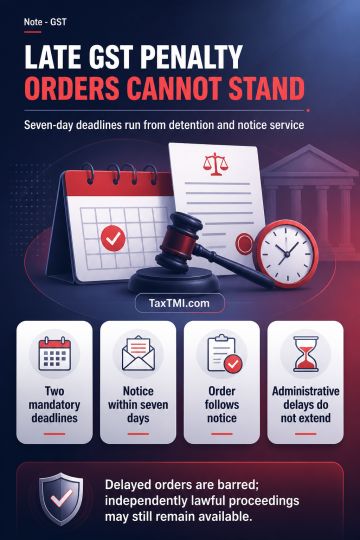
Mandatory goods-detention timelines bar delayed GST penalty orders despite administrative complications, while independently lawful proceedings may remain available.
Section 129(3) imposes two mandatory sequential deadlines: a penalty notice must be issued within seven days of detention or seizure, and the penalty order must follow within seven days of service of that notice. The service date, rather than reply, valuation or intervening events, controls the latter period. Administrative difficulty cannot extend either deadline. The framework also requires a hearing, while inspection reporting timelines and administrative forms remain distinct and cannot dilute the statutory time limits.
Case Laws GST
Show AI Summary
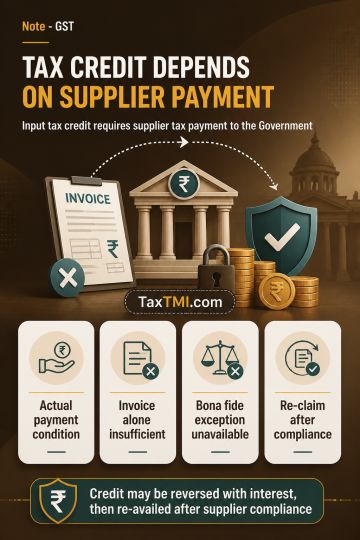
Input tax credit requires actual supplier tax payment, while reversal must rest on transaction-specific evidence and procedures.
Input tax credit under Section 16(2)(c) of the CGST Act is conditional upon actual payment of the tax charged on the supply to the Government. The condition is cumulative and is not replaced by the recipient's invoice, payment to the supplier, receipt of supply, return filing, or bona fides. Self-assessed credit is reversible with applicable interest where the supplier has not paid tax, but may be re-availed after subsequent supplier compliance. A bona fide-purchaser exception cannot be read into the actual-payment requirement, although any reversal or demand must rest on specific statutory facts, supporting material, and reasoned adjudication.
Case Laws GST
Show AI Summary
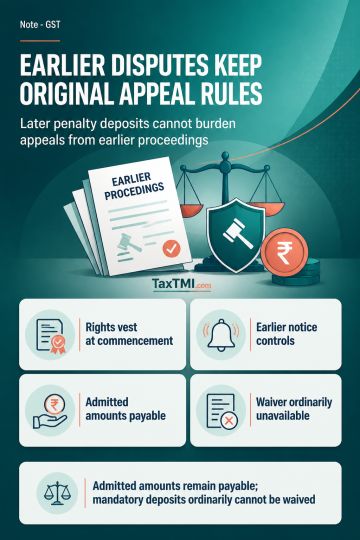
Vested appellate rights prevent later penalty-only pre-deposit conditions from burdening appeals arising from earlier commenced adjudication.
Substituted CGST pre-deposit requirement for penalty-only orders does not govern an appeal arising from a formal show-cause notice issued before 1 October 2025, absent express retrospective language or necessary implication. The right of appeal and its applicable conditions vest when the lis commences; a filing-stage deposit that bars institution is substantive, not merely procedural. Admitted amounts remain payable, while a mandatory applicable deposit cannot ordinarily be waived or reduced by the Appellate Authority.
Case Laws GST
Show AI Summary
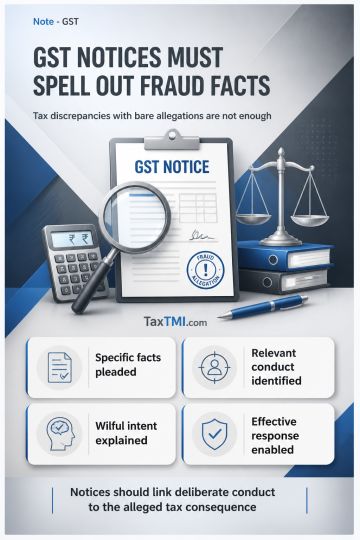
Extended GST limitation requires show cause notices to plead fraud, wilful misstatement, or suppression through specific factual allegations.
Section 74 requires the notice itself to state the material facts supporting the precise statutory limb invoked and the causal nexus between that conduct and the alleged tax consequence. The phrase "by reason of" requires a pleaded connection; a tax discrepancy coupled with a conclusory allegation of fraud or suppression is insufficient. The notice should identify the relevant act, omission, representation, non-disclosure or device, explain why it is deliberate or wilful, and enable an effective response.
Case Laws GST
Show AI Summary
Omission of export-refund restriction requires pending integrated-tax refund claims to be assessed under surviving statutory and procedural conditions.
Omission of Rule 96(10), effective from 08 October 2024 without a saving clause, applies to integrated-tax export-refund proceedings pending on that date. Such claims are assessed without the former restriction concerning specified notification benefits because Section 6 of the General Clauses Act does not preserve an omitted subordinate rule. The omission does not remove independent requirements for zero-rated supplies, refund eligibility, export documentation, returns, limitation, verification, or the applicable Rule 96 and Rule 89 procedures.
Case Laws GST
Show AI Summary
Interim arrest protection cannot survive dismissal of anticipatory bail; GST arrest requires communicated authorisation, not merely a summons.
Interim protection from arrest is ancillary to a live anticipatory-bail proceeding and cannot subsist as a freestanding direction after an application is dismissed as not maintainable. Under the GST arrest framework, a summons does not by itself make the summoned person an accused or create a legally sustainable apprehension of arrest. Arrest depends upon the Commissioner's reasons to believe and an order authorising arrest. The Section 69 authorisation order must be communicated before arrest, enabling the affected person to pursue available remedies before personal liberty is curtailed.
Case Laws Income Tax
Show AI Summary
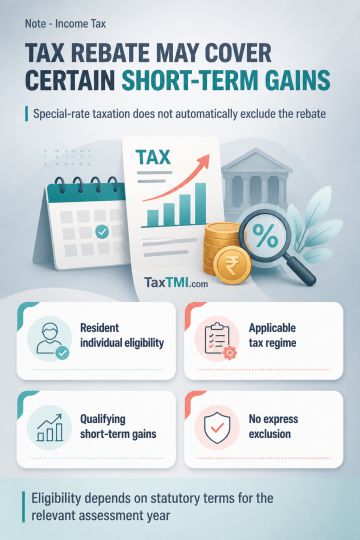
Section 87A rebate may apply after special-rate computation of qualifying short-term capital gains, absent an express statutory exclusion.
Section 111A requires qualifying short-term capital gains to be taxed at the prescribed special rate, while section 87A operates as a rebate from income-tax computed on total income for an eligible resident individual under the applicable section 115BAC(1A) regime. Special-rate taxation governs computation and does not itself imply exclusion from the rebate. Unlike section 112A(6), section 111A contains no express provision reducing the rebate base by tax on qualifying gains. Eligibility depends on the statutory terms applicable for the relevant assessment year.
Case Laws GST
Show AI Summary
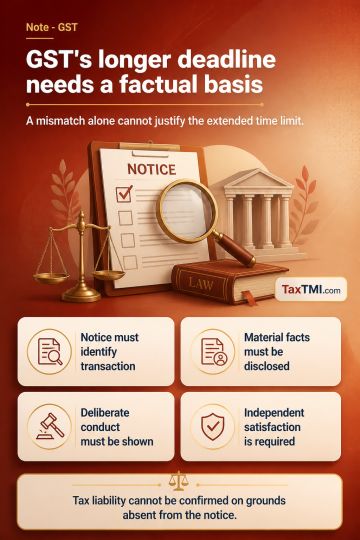
Extended GST limitation requires pleaded foundational facts linking alleged fraud, wilful misstatement, or suppression to tax evasion.
Section 74 permits extended GST limitation only where tax short payment, erroneous refund, or wrongful input tax credit arose by reason of fraud, wilful misstatement, or suppression of facts to evade tax. A mismatch or discrepancy alone is insufficient. The show cause notice must disclose foundational facts identifying the transaction, withheld or misstated material, deliberate conduct alleged, and its factual link to tax evasion. Audit objections or approaching limitation cannot replace the proper officer's independent satisfaction. Liability cannot be confirmed on grounds beyond those specified in the notice.
Case Laws Income Tax
Show AI Summary
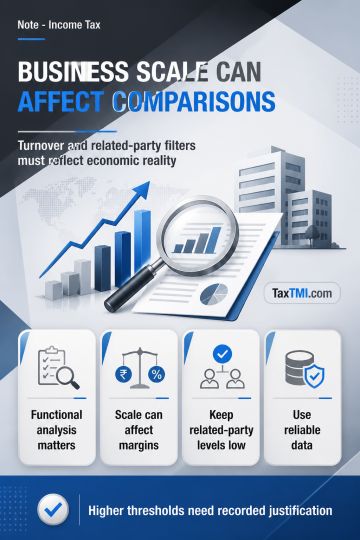
Transfer-pricing comparability requires turnover and related-party transaction filters to reflect functional, economic, and data-based reliability rather than fixed thresholds.
Transfer-pricing comparability under the transactional net margin method requires economically reliable uncontrolled comparables selected through functional, asset, risk, contractual and market analysis. Turnover is not a universal statutory threshold, but material scale differences may justify exclusion where they affect margins through brand value, intangibles, bargaining power or economies of scale. Related-party transaction tolerance should ordinarily be the lowest practicable level; a higher threshold requires a recorded finding that sufficient lower-related-party comparables are unavailable. Any re-determination and comparable selection must comply with statutory conditions, reliable data requirements and Rule 10B.
Case Laws Income Tax
Show AI Summary
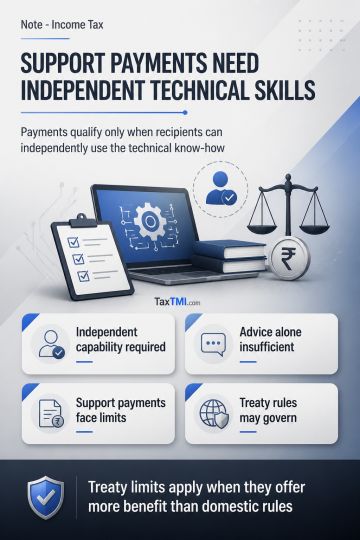
Make-available requirement limits treaty characterization of management and support payments as fees unless recipients gain independent technical capability.
Fees for technical services under Article 12(4) of the India-Singapore DTAA require more than managerial, technical or consultancy characterisation. The services must satisfy an additional treaty gateway, including making available technical knowledge, experience, skill, know-how or processes that enable the recipient to apply the technology independently. Advice, operational assistance, recurring support, training or business benefits do not alone establish transfer of technical capability. Where the DTAA is more beneficial than the broader domestic definition, the treaty limitation governs, subject to treaty-residence and documentation requirements.
Case Laws Income Tax
Show AI Summary
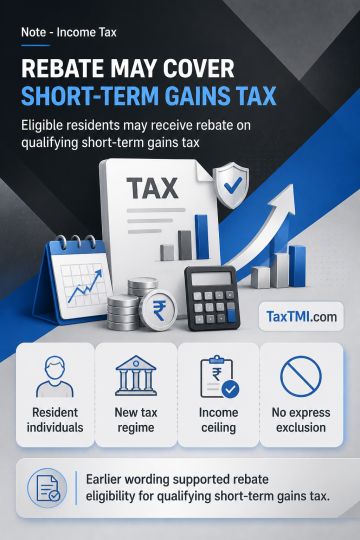
Income-tax rebate may extend to short-term capital gains tax when total-income conditions under the new regime are met.
Under the pre-restriction statutory formulation, a resident individual taxable under section 115BAC(1A) and within the prescribed total-income ceiling is analysed as eligible for section 87A rebate against income-tax on total income, including tax on qualifying short-term capital gains under section 111A. Section 111A fixes the special-rate computation but contains no express rebate exclusion. The explicit exclusion for specified long-term gains in section 112A(6) supports this distinction. Later limiting language in section 87A must be applied according to the statutory period concerned.
Case Laws Income Tax
Show AI Summary
Extended reassessment limitation permits reopening on qualifying book entries, independently of disputes over whether seized cash entries are assets.
Extended limitation under section 149(1)(b) may operate where books, documents or evidence reveal escaped income meeting the prescribed monetary threshold and represented as an asset, qualifying expenditure, or entries in books of account. These categories operate disjunctively; qualifying book entries may therefore provide an independent jurisdictional basis without resolving whether cash entries are assets. Handwritten and digital records may be treated as books where possession, control, corroboration, and attribution establish their nexus with the taxpayer.
Case Laws Income Tax
Show AI Summary
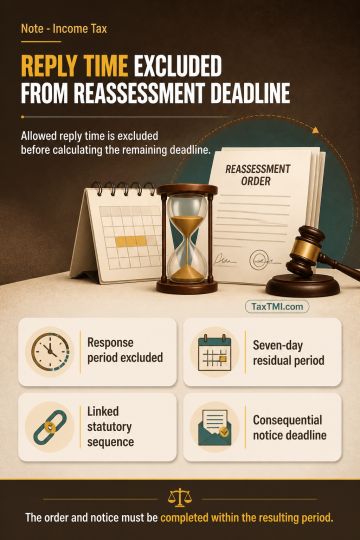
Reassessment limitation requires exclusion of allowed reply time, followed by a finite statutory period for consequential notice issuance.
Under the former reassessment framework, the time or extended time allowed for responding to a Section 148A(b) show-cause notice is excluded when computing limitation for the consequential notice. If the period remaining immediately after that exclusion does not exceed seven days, the sixth proviso supplies a seven-day residual period. The Section 148A(d) order and reassessment notice form a linked statutory sequence and must be completed within the resulting limitation period.
Case Laws Money Laundering
Show AI Summary
Pre-cognizance hearing protects proposed accused in money-laundering complaints by making prior hearing essential before valid cognizance.
Section 44 of the PMLA removes committal to the Special Court but does not exclude the criminal complaint procedure incorporated through Sections 46 and 65. Section 71 gives priority to the PMLA only where an actual inconsistency exists. Where the BNSS governs cognizance, the first proviso to Section 223(1) requires a meaningful hearing for the proposed accused before cognizance. The safeguard is distinct from exemptions from complainant examination, is mandatory and substantive, and permits submissions on legal sufficiency and prima facie material without converting the stage into a merits trial.
Case Laws Income Tax
Show AI Summary
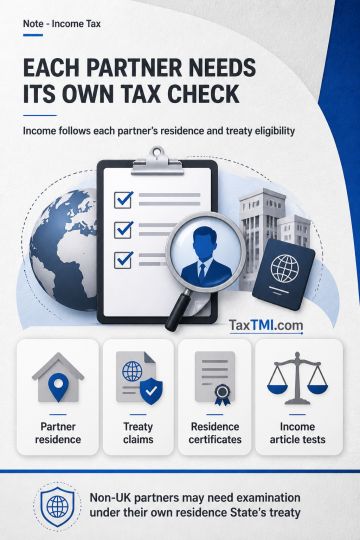
Partner-specific treaty entitlement requires transparent partnership income to follow each partner's residence, preventing automatic technical-service characterization of legal fees.
For fiscally transparent UK partnerships, Indian-source receipts must be allocated and tested according to each partner's residence and treaty entitlement. India-UK treaty residence applies only to income taxed in the United Kingdom as income of a UK resident. Non-UK resident partners may require examination under India's treaty with their own residence State. Domestic fees-for-technical-services characterisation does not replace treaty analysis, particularly for legal and professional services. Treaty claims require residence certificates, prescribed information, and factual examination of applicable income articles, fixed-base or permanent-establishment tests, and other taxing conditions.
Case Laws IBC
Show AI Summary
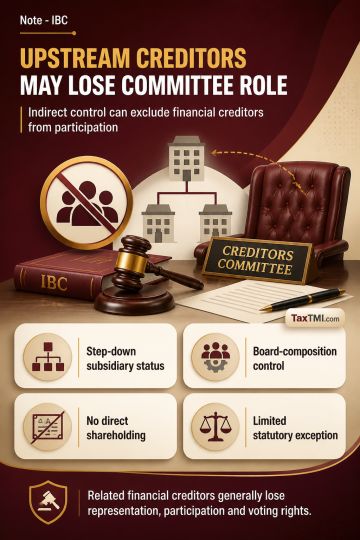
Indirect corporate control can classify an upstream financial creditor as a related party, excluding it from creditor committee participation.
Related-party classification under section 5(24) of the Insolvency and Bankruptcy Code extends to an upstream body corporate where the corporate debtor is its step-down subsidiary, even without direct shareholding. Companies Act concepts permit subsidiary status through control exercised by another subsidiary of the holding company. Board-composition control is an independent basis for related-party status. A related financial creditor is excluded from representation, participation and voting in the Committee of Creditors under the first proviso to section 21(2), subject to the limited statutory exception.
Case Laws GST
Show AI Summary
Extended GST limitation requires fraud, wilful misstatement or suppression, while distinct scrutiny discrepancies may independently support demand proceedings.
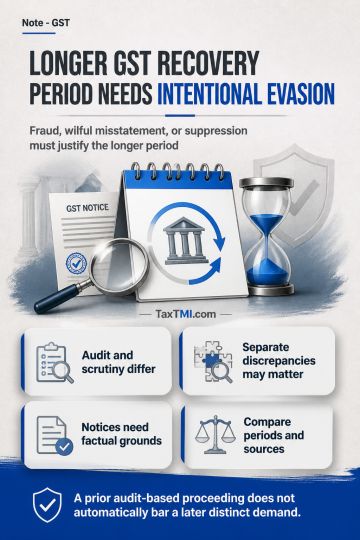
Extended limitation under Section 74 applies only where unpaid or short-paid tax, erroneous refund, or wrongly availed or utilised input tax credit is attributable to fraud, wilful misstatement, or suppression of facts intended to evade tax. Audit under Section 65 and return scrutiny under Section 61 are distinct processes, and either may lead to proceedings under Section 73 or Section 74. A prior audit-based proceeding does not automatically bar a later Section 74 demand founded on a materially distinct discrepancy in return or reconciliation data. The notice must specify its factual grounds, and duplication must be assessed by comparing the factual basis, periods, source material, and legal allegations.
Case Laws GST
Show AI Summary
Blocked construction input tax credit: taxable rental income does not override restrictions for property built on the taxpayer's own account.
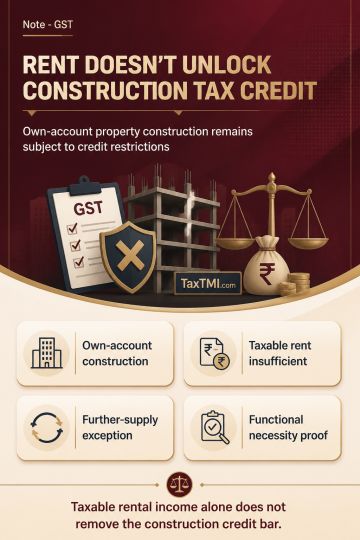
Input tax credit for goods, services and works contract services used to construct immovable property is subject to the overriding restrictions in Section 17(5), notwithstanding a business nexus under Section 16. Renting is a taxable supply of services but does not by itself satisfy the exception for further supply of works contract services or remove the own-account construction bar. A plant, plant-and-machinery, or qualifying foundation-and-structural-support claim requires fact-specific proof of functional necessity; taxable rental income alone is insufficient. Timely availment, statutory disclosure and the conditions for fraud-based proceedings, interest and penalty require separate assessment.
Case Laws Indian Laws
Show AI Summary
Betting on skill games remains distinct from protected skill play when money is risked on uncertain outcomes.
Entry 34 of List II is analysed as extending to betting on uncertain outcomes even when the underlying game substantially involves skill. The legal inquiry separates the game from an outcome-linked monetary stake: skill classification does not itself immunise wagering. A genuine participation fee for a skill competition may differ from betting, depending on the payment's character, the event structure and its connection to potential gain. State laws may target wagering in cyber space, while public-order competence requires a real and proximate nexus with community-wide disruption.
Case Laws Benami Property
Show AI Summary
Benami fund routing requires proof of consideration, holding and benefit; formal invoices alone may not establish genuine commercial credits.
Benami character under Section 2(9)(A) depends on the real relationship between the property holder, provider of consideration and intended beneficiary. Cash deposits routed through entities linked to an alleged benamidar and transferred by RTGS may support an inference of beneficial ownership when formal invoices, ledgers and tax records lack independent commercial corroboration. Bank funds and proceeds fall within the broad concept of property. Sworn statements, banking records and surrounding circumstances must be assessed together; the party alleging benami bears the initial burden, though evidentiary burdens may shift on proved facts.

TMI Notes

Back

All TMI Notes

Showing Results for :
Reset Filters
No Records Found

TMI Notes

Comparison of section 343 "Deemed accumulated income." between the Income-Tax Act, 2025 (as passed) and the Income-Tax Bill, 2025 (as originally introduced)

11 September, 2025

Contents
Acts
Rules & Regulations
Summary
Note

Note

-

Bookmark

(New) -

Download

Print

Print

Section 343 Deemed accumulated income.

Income-tax Act, 2025

At a Glance

The provided texts comprise two versions of a statutory provision titled "Deemed accumulated income" dealing with registered non-profit organisations: (a) Clause 343 of the Income Tax Bill, 2025 (Old Version) and (b) Section 343 as enacted in the Income-tax Act, 2025. They address calculation of a portion of regular income treated as "deemed accumulated income" and prescribe investment/deposit modes. The changes alter the reference points for reductions and slightly modify the obligation to invest. Affected parties are registered non-profit organisations and the tax department; no explicit effective date is stated in the documents.

Background & Scope

Statutory hooks: both texts are framed as Clause/Section 343 within the Income Tax Bill/Act, 2025, and they interact with sections 341, 342 and 350 as referenced. The subject matter is the taxation/administration of income of registered non-profit organisations - specifically a deemed accumulation rule. The documents provide no further definitions or explanatory notes beyond the clause text itself.

Statutory Provision Mode

Text & Scope

  • Both versions provide a two-paragraph provision. Core content in the Old Bill (Clause 343) is: (1) The regular income, reduced by the application of income and accumulated income u/s 342, to the extent of 15% of regular income, shall be considered deemed accumulated income and shall be invested or deposited in any of the modes permitted u/s 350; (2) such deemed accumulated income shall not be considered accumulated income for purposes of section 342.
  • The enacted Section 343 alters the text as follows: (1) Regular income is reduced by application of income "as per the provisions of section 341 and accumulated or set apart income u/s 342," to the extent of 15% of regular income, and "where such deemed accumulated income is invested or deposited, it shall be invested or deposited in any of the modes permitted u/s 350"; (2) the same exclusion from section 342 is retained.
  • Coverage: The provision establishes an amount equal to 15% of regular income (subject to stated reductions) as "deemed accumulated income" for registered non-profit organisations, and addresses investment/deposit modalities and non-treatment as accumulated income u/s 342.

Interpretation

The texts supply limited interpretive guidance. Legislative intent can only be partially inferred from word choice differences. The Bill's language appears to mandate that the deemed amount "shall be invested or deposited" in modes u/s 350. The enacted section softens that imperative by qualifying it: "where such deemed accumulated income is invested or deposited, it shall be invested or deposited in any of the modes permitted u/s 350." That change suggests a legislative choice to avoid imposing an absolute duty to invest the deemed amount - instead constraining the manner of investment if the amount is in fact invested or deposited. The enacted text also adds an express cross-reference to section 341 regarding "application of income," and inserts the phrase "set apart" when referencing income u/s 342; these additions refine the base from which the 15% is calculated.

Exceptions/Provisos

No separate provisos, exceptions, thresholds or timing conditions are included in either text beyond the 15% quantification and the exclusion in paragraph (2). No transitional, compliance, or penalty provisions are stated.

Interplay

Both texts expressly cross-refer to sections 341, 342 and 350. The Bill text references only section 342 for reductions and section 350 for investment modes. The enacted section explicitly references section 341 for "application of income" and expands the description of section 342 to include "accumulated or set apart income." The enactment conditions the requirement to use modes u/s 350 on an actual investment/deposit taking place. The documents do not quote sections 341, 342 or 350; thus specifics of those interactions beyond the referral language are not stated in the documents.

Practical Implications

  • Compliance and risk areas: The Bill's mandatory language ("shall be invested or deposited...") imposes a clear duty to invest the deemed 15% in section 350 modes, potentially exposing organisations to compliance risk if they do not invest. The enacted wording shifts to a conditional statement, which may reduce the risk of finding a formal failure strictly on the basis that the deemed amount was not invested, while still restricting allowable investment modes where an organisation does invest or deposit the amount. This is a material compliance distinction for administrators and practitioners assessing mandatory obligations versus permitted actions.
  • Calculation base: The enacted addition of section 341 as a reduction point and the express inclusion of "set apart" income u/s 342 clarifies (relative to the Bill) the items that reduce the regular income before applying the 15% test. This narrows uncertainty about whether application u/s 341 reduces the base for deemed accumulated income; under the enacted text, it explicitly does. Practitioners will need to consult section 341 and section 342 to determine which amounts are deductible for computing the 15% base.
  • Record-keeping/evidence: Given the provision's focus on application/set-aside and investment/deposit, organisations should maintain contemporaneous records documenting (a) amounts applied pursuant to section 341, (b) amounts accumulated or set apart u/s 342, (c) the computation of the 15% deemed amount, and (d) evidence of any investment/deposit and the mode used (to show compliance with section 350 if an investment/deposit occurs). The documents do not specify particular forms or timelines for such records, so general good record-keeping is implied but not mandated in the text.

Key Takeaways

  • Both texts create a deemed accumulated income equal to 15% of regular income subject to certain reductions and exclude that deemed amount from the operation of section 342.
  • The Old Bill mandated that the deemed amount "shall be invested or deposited" in modes u/s 350; the enacted section qualifies that requirement by making the section 350 constraint applicable "where such deemed accumulated income is invested or deposited."
  • The enacted text expressly references section 341 and refers to "accumulated or set apart income" u/s 342 as reductions, whereas the Bill referenced only section 342 in the reduction context.
  • The enacted change narrows the instances in which an absolute investment duty can be asserted and clarifies the deduction base, affecting compliance obligations and potential challenges.
  • No procedural, effective date, penalty, or illustrative examples are provided in either document; these details are "Not stated in the document."

Differences between the Provisions and Practical Impact

  • Textual difference on reduction of regular income: Bill - "reduced by the application of income and accumulated income u/s 342"; Act - "reduced by the application of income as per the provisions of section 341 and accumulated or set apart income u/s 342."
    • Practical impact: The Act clarifies that application u/s 341 affects the base and expressly captures amounts "set apart" u/s 342, reducing ambiguity about what reduces regular income for the 15% calculation. Practitioners must therefore examine both sections 341 and 342 to compute the base accurately.
  • Obligation to invest/deposit: Bill - mandatory phrasing ("shall be invested or deposited in any of the modes permitted u/s 350"); Act - conditional phrasing ("where such deemed accumulated income is invested or deposited, it shall be invested or deposited in any of the modes permitted u/s 350").
    • Practical impact: The Bill creates a clearer, potentially enforceable duty to invest the deemed amount in specified modes, increasing compliance exposure. The Act appears to limit enforcement to cases where an investment/deposit actually occurs, allowing for circumstances where the deemed amount may remain uninvested without triggering the specific investment-mode requirement (though tax consequences from non-investment, if any, are not stated).
  • Terminology refinement: Act adds "set apart" and cross-references section 341; Bill lacks those specific descriptors.
    • Practical impact: Semantic refinement can alter scope of deductible/offset amounts and may affect disputes over what constitutes "accumulated" versus "set apart" income; the Act's explicit language reduces interpretive disputes by calling attention to both concepts.

Action Points

  • Review and apply sections 341 and 342 to calculate the reduction base before computing the 15% deemed accumulated income (Act text requires consideration of section 341; Bill text does not expressly do so).
  • Maintain detailed records documenting any application, accumulation, or set-aside of income and the computation of the deemed 15% amount, and evidence of any investment/deposit and the mode used u/s 350, since the statute conditions acceptable modes on a deposit/investment occurring.
  • Where an organisation intends to invest/deposit the deemed amount, ensure the chosen mode aligns with section 350; if uncertain, consult section 350 text (not provided here) for permitted instruments.
  • Monitor whether authorities treat failure to invest the deemed amount as a breach in light of the enacted conditional language; the documents contain no penalty or remedial mechanism, therefore "Not stated in the document."

Full Text:

Section 343 Deemed accumulated income.

Topics

Acts Income Tax