Loading...

⚠ ✕
❮ Top
☎ Help
☰
×

By creating an account you can:

Logo TaxTMI
Call Us / Help / Feedback✕

Contact Us At :

✉ E-mail: [email protected]

✆ To Call / Whatsapp, Check Contact Us

FAQs :

To know Frequently Asked Questions, Check FAQs

Most Asked Video Tutorials :

For more tutorials, Check Video Tutorials

Submit Feedback/Suggestion :

Email :
Please provide your email address so we can follow up on your feedback.
Category :
Description :
Min 15 characters 0/2000
Make Most of Text Search ✕
  1. Checkout this video tutorial: How to search effectively on TaxTMI.
  2. Put words in double quotes for exact word search, eg: "income tax"
  3. Avoid noise words such as : 'and, of, the, a'
  4. Sort by Relevance to get the most relevant document.
  5. Press Enter to add multiple terms/multiple phrases, and then click on Search to Search.
  6. Text Search
  7. The system will try to fetch results that contains ALL your words.
  8. Once you add keywords, you'll see a new 'Search In' filter that makes your results even more precise.
  9. Text Search
╳
Add to...
You have not created any category. Kindly create one to bookmark this item!
✕
Create New Category
Hide
Title :
Description :
❮❮ Hide
❮ Default View
Expand ❯❯
Close ✕
🔎 Filters / Advanced Search ❯
TEXT

Press 'Enter' to add multiple search terms. Rules for Better Search

Search In
Main Text + AI Text ❯
  • Main Text
  • Main Text + AI Text
  • AI Text
Law:
---- All Laws---- ❯
  • ---- All Laws----
  • Benami Property
  • Bill
  • Central Excise
  • Companies Law
  • Customs
  • DGFT
  • FEMA
  • GST
  • GST - States
  • IBC
  • Income Tax
  • Indian Laws
  • Money Laundering
  • SEBI
  • SEZ
  • Service Tax
  • VAT / Sales Tax
Types:
---- All Types ---- ❯
  • ---- All Types ----
  • Act Rules
  • Case Laws
  • Circulars
  • Manuals
  • News
  • Notifications
Sort By: ?
In Sort By 'Default', exact matches for text search are shown at the top, followed by the remaining results in their regular order.
Relevance Default Date
☰   Show Results ❯
    Consolidated Show Cause Notices under Sections 73 and 74 and Taxability of School Affiliation Servic...
    Fraudulent Input Tax Credit from Non-Existent Suppliers: Application of Sections 16, 74 and 155 of t...
    Case Laws Money Laundering
    Prolonged Pre-Trial Incarceration and Bail under Section 45 of the Prevention of Money-Laundering Ac...
    Case Laws Income Tax
    Prospective Operation of Section 56(2)(x)(b) in Stamp-Value Difference Cases Involving Immovable Pro...
    Seizure of Cash under Section 67 of the CGST Act and Interest on Illegal Retention
    Case Laws Income Tax
    Disallowance of Salary Expenditure for Allegedly Non-Genuine Services under Section 37
    Case Laws Income Tax
    Fair Market Value of Unquoted Equity Shares Under Section 56(2)(viib) and Rule 11UA
    Refund of Excess IGST Paid on Exports Following Clerical Error in FORM GSTR-3B
    Revocation of Cancellation of GST Registration for Non-Filing of Returns under Section 30 and Rule 2...
    Case Laws Income Tax
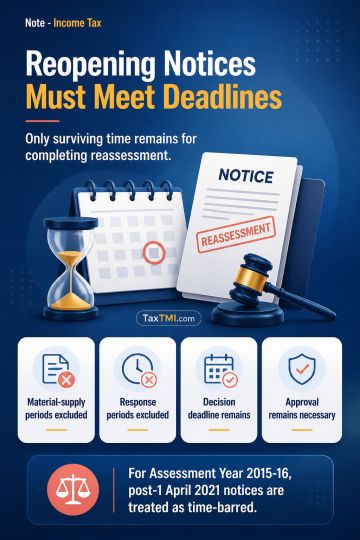
    TOLA, Section 149 and the Surviving-Time Test for Reassessment Proceedings
    Case Laws Customs
    Provisional Release of Unseized Imported Food Consignments under the Customs Act, 1962
    Case Laws Customs
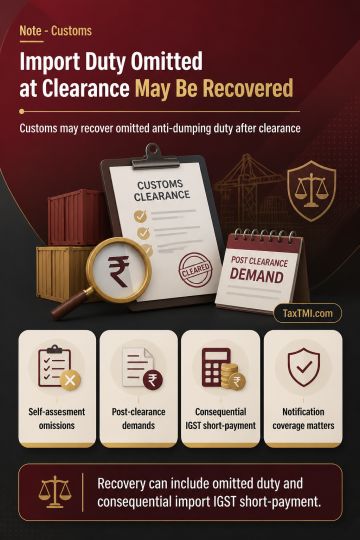
    Recovery of Unpaid Anti-Dumping Duty After Self-Assessment Under Section 28 of the Customs Act, 1962
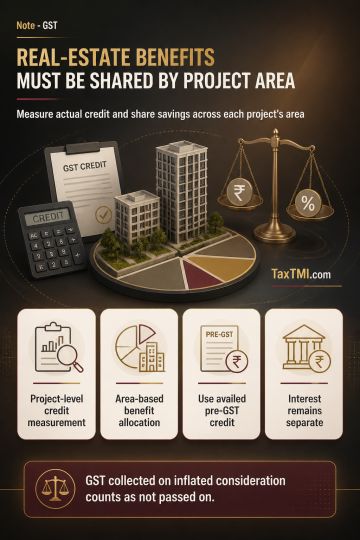
    Project-Wise Anti-Profiteering Methodology in Real Estate under Section 171 of the Central Goods and...
    Case Laws Income Tax
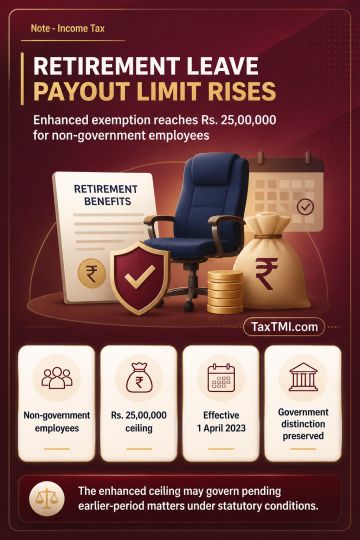
    Retirement Leave Encashment Exemption under Section 10(10AA)(ii) and Retrospective Application of No...
    Transit-State Jurisdiction under GST: Limits on Detention and Penalty in External Inter-State Suppli...
    Post-Facto Shareholder Ratification of Diversion of Preferential Issue Proceeds under the PFUTP Regu...
    Case Laws Income Tax
    Section 195 Withholding on Payments to Non-Residents: Royalty, Fees for Technical Services and Busin...
    Penalty: Scope of "Any Person" under Section 122(1A) of the Central Goods and Services Tax Act, 2017
    Recovery of Corporate Debtor Premises and Proof of Tenancy, Lease or Licence Rights under the Insolv...
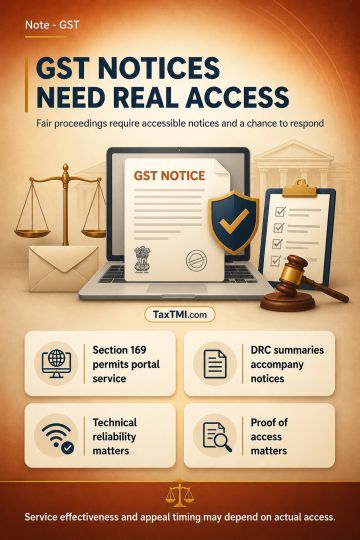
    Service of GST Notices through the Common Portal: Statutory Validity and Practical Accessibility
❮
❯
❯❯
Maximize Maximize Maximize
0 / 200
Expand Note
Add to Folder

No Folders have been created

+

Are you sure you want to delete "My most important" ?

NOTE:

Notes
Showing Results for :
Reset Filters
Results Found:
Show All Summaries Hide All Summaries
Case Laws GST
Show AI Summary
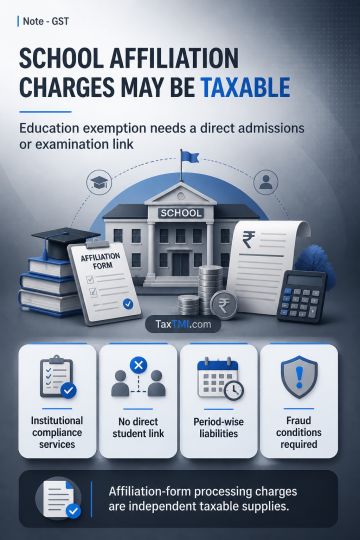
School affiliation services fall outside educational exemption without a direct nexus to admissions or examination conduct.
Consolidated show cause notices may combine financial years governed by Sections 73 and 74 where liabilities are segregated period-wise, each component independently meets limitation and notice requirements, the additional ingredients for fraud-based proceedings are satisfied, and no actual prejudice arises. School affiliation and affiliation-form processing charges are independent taxable supplies where they concern institutional eligibility and compliance, rather than directly and immediately relating to student admission or the conduct of examinations. A broad connection with education does not satisfy the educational-services exemption.
Case Laws GST
Show AI Summary
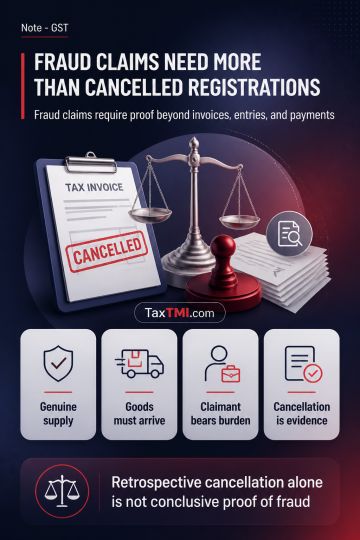
Fraudulent input tax credit requires proof of fictitious supplies, absent goods receipt, and fraud-linked self-assessment, not cancellation alone.
Input tax credit from allegedly non-existent suppliers depends on proof of genuine supply and actual receipt of goods or services, not merely invoices, accounting entries, or banking-channel payments. Section 155 places the burden of establishing ITC eligibility on the claimant. Section 74 requires more than ineligible credit: the wrongful availment must be linked to fraud, wilful misstatement, or suppression to evade tax. Retrospective supplier-registration cancellation is relevant evidence but is not conclusive. A fraud-based notice must disclose facts showing fictitious suppliers, absence of supply, and a basis for inferring the recipient's knowledge or participation.
Case Laws Money Laundering
Show AI Summary
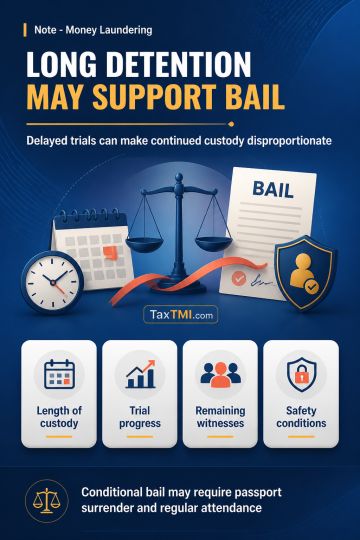
Prolonged pre-trial incarceration may justify conditional PMLA bail when delayed trials make continued detention constitutionally disproportionate.
Section 45 of the Prevention of Money-Laundering Act remains the stringent ordinary bail threshold, requiring prosecutorial opportunity and, on opposition, reasonable grounds to believe that the accused is not guilty and unlikely to offend while on bail. Article 21 nevertheless requires a separate, fact-sensitive inquiry where prolonged pre-trial detention and an unrealistic trial timetable make custody disproportionate. Relevant factors include custody length, trial progress, remaining witnesses, secured documentary evidence, source of delay, predicate-case status, and risks of absconding or witness interference. Conditions such as passport surrender, attendance, non-contact directions, and residence disclosure may safeguard the trial.
Case Laws Income Tax
Show AI Summary
Prospective operation of stamp-value taxation prevents retrospective application where property agreements and substantial payments predate the charging provision.
Section 56(2)(x)(b) applies to immovable property received for inadequate consideration only where its temporal and valuation conditions are satisfied. A stamp-value difference alone does not establish taxability. Where consideration was fixed and substantial payments or contractual performance occurred before the charging provision commenced, later conveyance or registration does not by itself attract the later charge. Agreement-date valuation is available only for covered transactions where consideration was fixed and paid, wholly or partly, through prescribed banking or electronic modes on or before the agreement date. The tax authority must identify the correct statutory basis and provide a meaningful opportunity to respond.
Case Laws GST
Show AI Summary
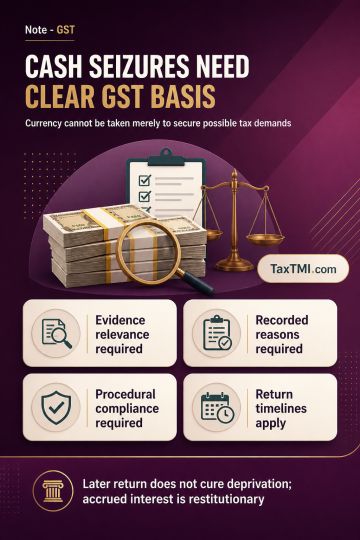
GST cash seizure limits require statutory relevance and restitutionary interest for unlawfully retained currency following searches.
GST seizure powers cannot be used to take cash as a general investigative measure or security for a possible tax demand. Currency is excluded from goods, and "things" is confined contextually to articles useful or relevant as evidence in GST proceedings. Valid seizure and retention require recorded statutory reasons, procedural compliance and observance of return timelines. Unauthorised retention engages property protections; later return does not cure the deprivation, and accrued interest is restitutionary rather than delayed-refund interest.
Case Laws Income Tax
Show AI Summary
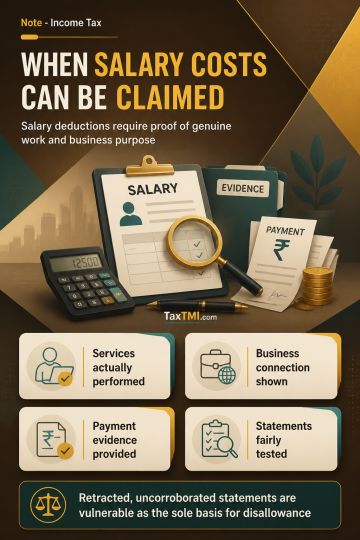
Salary expense genuineness requires proof of actual services, business purpose, and fair testing of adverse third-party statements.
Under Section 37(1), salary expenditure is deductible only where it is actually incurred wholly and exclusively for business purposes and is supported by proof of genuine employment, services rendered, business nexus, and payment. Bank transfers and accounting entries alone are not conclusive. Where a third-party statement is central to an allegation of non-genuine salary, the taxpayer should receive disclosure and a meaningful opportunity to rebut it, including cross-examination where appropriate. A retracted and uncorroborated statement is vulnerable as the sole basis for disallowance.
Case Laws Income Tax
Show AI Summary
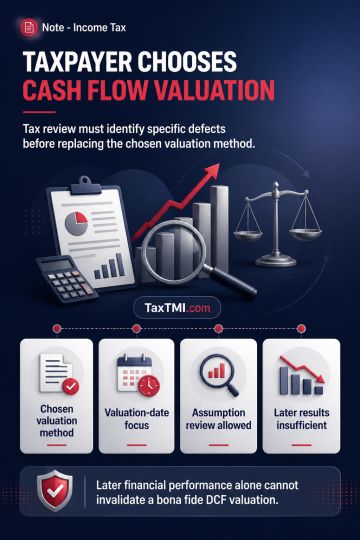
Discounted cash flow valuation remains taxpayer-selected under prescribed rules, while tax scrutiny must identify specific valuation-date defects.
The taxpayer may elect a prescribed DCF valuation for unquoted equity shares, and scrutiny of that method does not permit substitution with Net Asset Value merely because it produces a lower fair market value. The Assessing Officer may examine projections, discount rates, terminal assumptions, computations and source data, but rejection requires demonstrably wrong facts, material errors, a wholly erroneous basis or objectively unsupported assumptions. Subsequent financial performance cannot alone invalidate a bona fide DCF valuation; the relevant inquiry remains the reasonableness of valuation-date information.
Case Laws GST
Show AI Summary
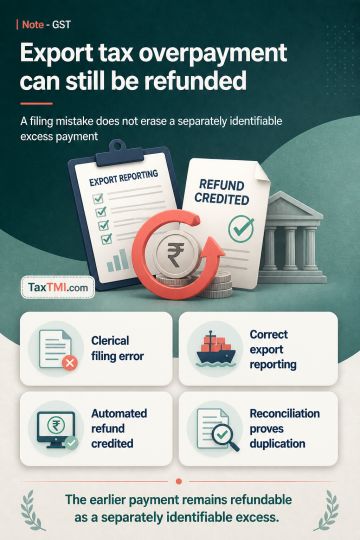
Excess IGST on exports remains refundable when later correction triggers automated refund and reconciliation proves duplicate payment.
Refund of excess IGST paid on zero-rated exports may arise where turnover and tax are mistakenly entered under non-zero-rated supplies in FORM GSTR-3B while export invoices and shipping bills are correctly reported in FORM GSTR-1. If the exporter then pays the same IGST in the correct zero-rated field and the automated refund is credited against that later payment, the earlier payment remains a separately identifiable potential excess; its claim is not a repeat request for the same export-tax refund.
Case Laws GST
Show AI Summary
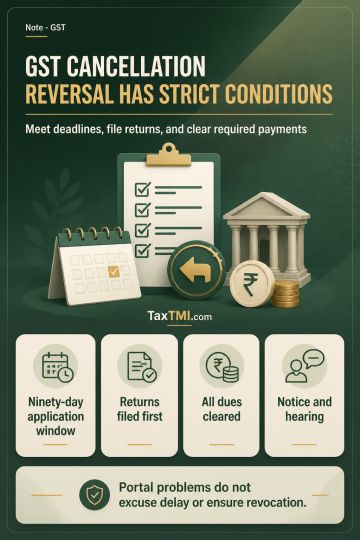
GST registration revocation requires timely application, return compliance, payment of dues, and a reasoned statutory decision.
GST registration revocation after cancellation for return default is a conditional, time-bound process. An application under Section 30 and Rule 23 must ordinarily be filed within ninety days, subject to prescribed extension, and cannot be made until pending returns are filed and tax, interest, penalty and late fee are paid. Portal non-acceptance may permit online or physical submission where technically unavailable, but does not condone delay or ensure revocation. The competent authority must assess statutory eligibility, sufficient grounds and compliance while following notice and hearing requirements before rejection.
Case Laws Income Tax
Show AI Summary
Reassessment limitation under TOLA requires final notices to issue within surviving time and satisfy statutory safeguards.
Reassessment limitation under TOLA is a jurisdictional restraint. Transitional notices issued between 1 April 2021 and 30 June 2021 are treated as Section 148A(b) show-cause notices, but only the surviving time remaining until 30 June 2021 is available for completing the reassessment process. Periods for supply of material and the assessee's response are excluded, but the Section 148A(d) decision, statutory approval and final Section 148 notice must issue within the remaining period. For Assessment Year 2015-16, post-1 April 2021 notices are treated as time-barred.
Case Laws Customs
Show AI Summary
Unseized food consignments cannot face indefinite detention without lawful seizure, valid sampling, and prompt assessment.
Provisional release of an unseized imported food consignment is not mechanically governed by Section 110A, which applies to goods seized under Section 110. Customs may examine, test, verify and reassess imports, but indefinite retention without a seizure memorandum or disclosed reasons connecting the goods with confiscation is not justified. Food sampling should follow the specialised food-safety process through an authorised officer. A valid food-safety report may support conditional clearance, while classification, duty liability, confiscation and adjudication remain open. Revenue may be protected through proportionate security.
Case Laws Customs
Show AI Summary
Anti-dumping duty recovery permits post-clearance demands and consequential import IGST where self-assessment omitted an applicable levy.
Unpaid anti-dumping duty omitted during self-assessment may be pursued through the customs recovery procedure without prior appellate modification of the self-assessment. The recovery framework applies to anti-dumping duty through statutory incorporation of provisions concerning assessment, non-levy, short-levy, interest and recovery. Where anti-dumping duty is chargeable, it forms part of the aggregate value used to compute IGST on imports, potentially creating a consequential IGST short-payment. Recovery requires accurate assessment of notification coverage, product, origin, rate, valuation, limitation and procedural safeguards.
Case Laws GST
Show AI Summary
Project-wise anti-profiteering requires actual input tax credit measurement and area-based allocation of benefits to real-estate purchasers.
Real-estate anti-profiteering under Section 171 requires project-level identification of additional input tax credit and allocation of the saving across total project area on a per-square-foot basis. Purchase value may quantify credit attributable to project expenditure, but turnover or collections cannot serve as the allocation basis. The comparison must use pre-GST credit actually availed rather than merely available credit. GST collected on consideration inflated by an undistributed benefit forms part of the amount not passed on and remains distinct from statutory interest.
Case Laws Income Tax
Show AI Summary
Retirement leave encashment exemption applies under the enhanced notified ceiling while preserving non-government employee classification and statutory conditions.
Section 10(10AA)(ii) governs retirement leave-encashment exemption for non-Government employees, subject to the ten-month earned-leave measure, average-salary computation, and the notified monetary ceiling. Notification No. 31/2023 specifies an enhanced ceiling of Rs. 25,00,000, is deemed effective from 1 April 2023, and certifies that retrospective effect causes no adverse effect. The enhanced ceiling is treated as a remedial rationalisation of an existing exemption and may govern pending earlier-period matters, while preserving the distinction between Government and non-Government employees.
Case Laws GST
Show AI Summary
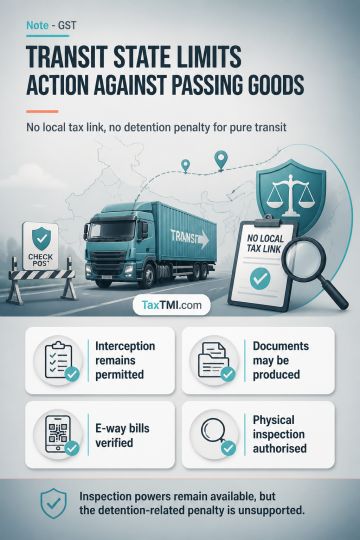
Transit GST jurisdiction limits detention penalties for documented inter-State supplies lacking a local taxable nexus.
Transit-State jurisdiction under GST permits interception, document production, e-way bill verification and authorised physical inspection of goods moving through an intermediate State. It does not, in a pure transit movement, support detention-related penalty for an external inter-State supply where origin and destination lie outside the intercepting State, no tax is payable there, and there is no evidence of diversion, local supply, fictitious or mismatched documents, or mismatch of goods. Cross-empowerment is administrative and does not create an independent territorial taxable nexus.
Case Laws SEBI
Show AI Summary
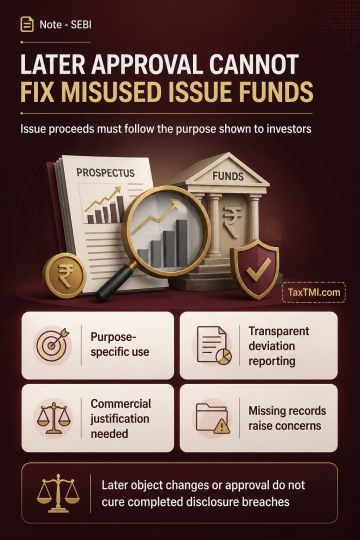
Shareholder ratification cannot cure preferential-issue fund diversion when disclosed objectives are abandoned, triggering securities-market fraud and disclosure concerns.
Post-facto shareholder approval cannot retrospectively validate diversion of preferential-issue proceeds contrary to issue-specific objects disclosed to shareholders and the market. A special resolution authorises the issue but does not permit unrestricted use of proceeds. Periodic deviation reporting, audit-committee review and utilisation disclosures promote transparency; they do not enable diversion followed by later regularisation. Immediate diversion, inadequate commercial justification and missing documentation may indicate that disclosed objects were not genuinely intended to be performed. Later amendment of corporate objects or shareholder ratification cannot cure a completed securities-market disclosure breach.
Case Laws Income Tax
Show AI Summary
Cross-border software payments require copyright-right, technical-service, and permanent-establishment analysis before withholding obligations are determined under applicable treaties.
Section 195 requires withholding only from a remittance to a non-resident that includes income chargeable in India. For software, royalty depends on transfer of copyright rights, not merely the right to install, access, use, or distribute a copyrighted article under restrictive terms. Where a DTAA is more beneficial, its royalty and FTS definitions control; treaty FTS may require technology to be made available. Amounts that are neither royalty nor FTS require consideration as business profits, ordinarily taxable only where profits are attributable to a permanent establishment. Composite payments require component-wise allocation and analysis.
Case Laws GST
Show AI Summary
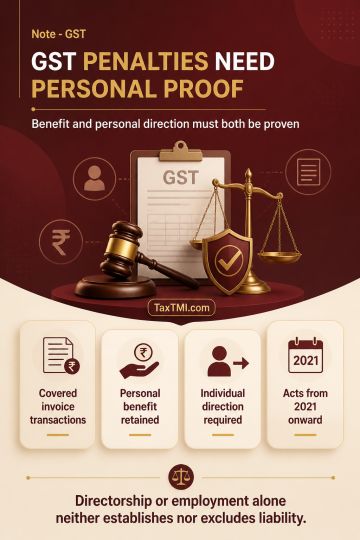
Personal GST penalty requires proof that the beneficiary retained benefit and directed a covered invoice or credit transaction.
Section 122(1A) may impose personal GST penalty on a registered or unregistered person only for a covered invoice or input tax credit transaction. Liability requires cumulative proof that the individual retained an identifiable personal benefit and that the transaction was conducted at that person's instance. Directorship, employment, registration, signature authority, or association with the taxable entity neither independently establishes nor excludes liability. Proceedings require transaction-specific and person-specific allegations and findings. The provision operates prospectively for underlying acts or transactions occurring on or after 01.01.2021.
Case Laws IBC
Show AI Summary
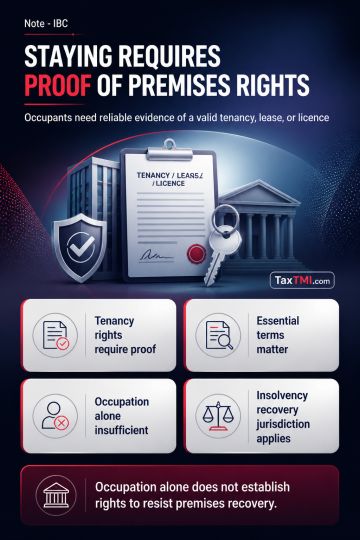
Proof of tenancy rights governs insolvency recovery of corporate-debtor premises from occupants lacking enforceable possessory interests.
Where premises form part of the corporate debtor's assets, Sections 18 and 25 of the Insolvency and Bankruptcy Code, 2016 require the resolution professional to take custody, control, preservation and protection measures. An occupant resisting recovery must prove a subsisting tenancy, leasehold interest or enforceable licence through reliable evidence of the parties' intended relationship and its essential terms. Permission to stock goods or conduct limited business activity, prolonged occupation, and business or utility records do not independently create rights in the premises. Section 60(5)(c) supports insolvency jurisdiction over asset-recovery measures connected with the insolvency estate.
Case Laws GST
Show AI Summary
GST portal service requires statutory validity and practical accessibility before ex parte adjudication can fairly proceed.
GST portal service is a statutory method under Section 169, but its use in an ex parte demand proceeding depends on effective accessibility and a meaningful opportunity to reply and be heard. Rule 142 requires electronic DRC-01 and DRC-07 summaries to operate alongside the underlying show-cause notice and reasoned order. Portal placement, complete communication, e-mail transmission, technical reliability and proof of actual access may determine whether service is effective, whether waiver applies, and whether appellate limitation begins.

TMI Notes

Back

All TMI Notes

Showing Results for :
Reset Filters
No Records Found

TMI Notes

Comparison of section 301 "Interpretation." between the Income-Tax Act, 2025 (as passed) and the Income-Tax Bill, 2025 (as originally introduced)

10 September, 2025

Contents
Acts
Rules & Regulations
Summary
Note

Note

-

Bookmark

(New) -

Download

Print

Print

Section 301 Interpretation

Income-tax Act, 2025

At a Glance

The document is Clause 301 of the Income Tax Bill, 2025 (Old Version) titled "Interpretation" within the Chapter on special procedure for assessment of search cases. It supplies definitions and scope for terms such as "block period", "requisition", "requisitioned items", "search", "seized items", "the last of the authorisations" and "undisclosed income". It matters because these definitions frame assessment, seizure and requisition proceedings u/ss 247-248 and related provisions; affected parties include taxpayers subject to search/requisition, authorised officers and the tax department.

Background & Scope

Statutory hooks: Clause 301 is situated in the Income Tax Bill, 2025, under the Chapter dealing with "Special procedure for assessment of search cases". It supplies interpretive definitions to be used "in this Chapter". The clause explicitly references sections 247 and 248 (search and requisition) for the operative processes it supports. The Clause provides definitions that govern temporal scope ("block period"), material objects subject to requisition/seizure ("requisitioned items", "seized items"), process milestones ("the last of the authorisations") and the core fiscal concept used in such proceedings ("undisclosed income").

Statutory Provision Mode

Text & Scope

Clause 301 provides definitional scope for terms used in the Chapter:

  • "block period": Aggregate of two components-(i) six tax years preceding the tax year in which the search was initiated or any requisition was made; and (ii) the period from 1 April of the tax year in which the search/requisition was made up to the date of execution of the last authorisation for such search/requisition.
  • "requisition": Requisition of books of account, other documents or any assets u/s 248.
  • "requisitioned items": Books of account, other documents or money, bullion, jewellery or other valuable article or thing requisitioned u/s 248.
  • "search": A search initiated u/s 247.
  • "seized items": Books of account, other documents or money, bullion, jewellery or other valuable article or thing seized u/s 247.
  • "the last of the authorisations": Deemed executed-(i) for search: on conclusion of search as recorded in the last panchnama drawn in relation to any person in whose case the warrant of authorisation has been issued, irrespective of whether any seizure is recorded; (ii) for requisition: on actual receipt of the books of account, documents or assets by the Authorised Officer.
  • "undisclosed income": Two limbs-(i) money, bullion, jewellery, virtual digital asset or other valuable article or thing or any expenditure or any income based on entries in books/documents/transactions representing wholly or partly income or property not disclosed for purposes of the Act in respect of the block period; or (ii) any expense, exemption, deduction or allowance claimed under the Act which is found to be incorrect, in respect of the block period.

Interpretation

The Clause employs temporal and material markers to delineate the ambit of "undisclosed income" and the period for which such income will be examined ("block period"). The first limb of "undisclosed income" focuses on tangible and intangible assets (including "virtual digital asset") and entries/transactions that reflect nondisclosure. The second limb separately addresses incorrect fiscal claims-expenses, exemptions, deductions or allowances-claimed under the Act. The inclusion of both tangible assets and accounting entries suggests a dual focus on physical seizure and documentary/book-entry analysis within the block period. The text signals that the last panchnama in relation to any person is determinative for the conclusion of a search, thus providing a concrete procedural milestone for the operation of time-bound rules linked to the block period.

Exceptions/Provisos

No express exceptions or provisos beyond the two-part structure of the "block period" and the two-limbed definition of "undisclosed income" are included within Clause 301. Specific carve-outs, thresholds or exclusions are Not stated in the document.

Illustrations

  • Example 1: A search initiated on 15 December of tax year Y (warrants executed for multiple persons) will have block period component (i) the six tax years preceding Y, and (ii) from 1 April of Y to the date recorded as conclusion in the last panchnama-this determines the period within which alleged undisclosed income is assessed.
  • Example 2: Books of account seized u/s 247 containing entries asserting certain expenses claimed as deductions for the block period could be treated as evidence of "undisclosed income" under limb (g)(i) or as an incorrect deduction under limb (g)(ii), depending on factual findings made during assessment.

Interplay

Clause 301 repeatedly cross-references sections 247 and 248 for the operative acts of search and requisition. The Clause also depends on "panchnama" as a procedural record to mark the conclusion of search operations. No other Rules, Notifications or Circulars are mentioned in Clause 301. Any application of this Clause in relation to other provisions of the Bill or the Act is Not stated in the document.

Differences between Clause 301 (Old Version) and Section 301 (Income-tax Act, 2025) and Practical Impact

  • Scope marker/heading: The Bill (Clause 301) uses "In this Chapter"; the Act (Section 301) uses "For the purposes of this Part".
    • Practical impact: Terminology shift (Chapter vs Part) is largely stylistic but may reflect reorganisation of the statute; no substantive legal change is indicated in the texts provided.
  • Definitions added/omitted: The Bill contains explicit definitions of "requisitioned items" and "seized items" (books, documents, money, bullion, jewellery or other valuable articles seized/requisitioned u/ss 247/248). The Act text omits these two separate definitions.
    • Practical impact: Omitting explicit labels for "seized items" and "requisitioned items" in the Act reduces immediate textual clarity about what the statute contemplates when referencing seized or requisitioned property. Procedure and evidential handling that depend on named categories may require reliance on the general description in other clauses or on rules/guidance; this increases potential interpretive work for assessors and advisers.
  • Placement and labelling of "the last of the authorisations": Both texts contain a provision deeming when "the last of the authorisations" is executed, with identical operative sub-clauses for search (conclusion as recorded in last panchnama) and requisition (actual receipt). The Bill lists this at (f) while the Act lists similar text at (d).
    • Practical impact: No substantive change; re-lettering only affects cross-references in other sections and transitional drafting adjustments.
  • "Undisclosed income" formulation: The Bill sets out "undisclosed income" in a two-part structure (g)(i) and (g)(ii): (i) items/entries/transactions representing undisclosed income; or (ii) any expense/exemption/deduction/allowance claimed under the Act which is found to be incorrect. The Act consolidates the concept under (e), merging the two ideas into one continuous sentence and, per the appended note, corrects a typographical error ("or or any" corrected to "or any").
    • Practical impact: Substantively the Act appears to preserve both limbs of the Bill's definition, but the Act's merged wording could affect syntactic clarity and the parsing of whether the second limb is an alternative or a continuation. The corrigenda indicates only a textual correction, not a policy change.
  • Terminology for virtual assets: Both texts expressly include "virtual digital asset" in the list of items capable of constituting undisclosed income.
    • Practical impact: Confirms legislative intent to treat virtual assets on par with traditional valuables in search/requisition contexts.
  • Minor editorial differences: The Bill uses semicolons and clause divisions (a)-(g); the Act uses (a)-(e) with subclauses.
    • Practical impact: Largely drafting-style; may require attention in drafting cross-references and rules.

Practical Implications

  • Compliance and risk areas: The Clause identifies a multi-year window ("block period") for investigation of undisclosed income, incorporating both the six preceding tax years and the year-of-search period up to the last authorisation. Taxpayers subject to search/requisition must be cognisant that both physical assets (including VDA) and documentary entries for that combined period are within scope.
  • Record-keeping/evidence points: Because "requisitioned items" and "seized items" explicitly include books of account and various forms of valuables, maintaining contemporaneous documentation, clear provenance and substantiation of claimed expenses/exemptions for the block period will be essential. The Clause makes the panchnama the operative record for concluding a search; therefore preservation and contestation of panchnama contents may be critical in subsequent proceedings.

Key Takeaways

  • Clause 301 defines "block period" as six tax years preceding the tax year of search/requisition plus the part of that tax year up to the last authorisation.
  • Both physical assets (including money, bullion, jewellery and virtual digital assets) and documentary/book entries are captured within "undisclosed income".
  • The Clause separately recognises incorrect claims of expense, exemption, deduction or allowance as constitutive of "undisclosed income".
  • Procedural milestone: the last panchnama (for searches) and actual receipt by Authorised Officer (for requisition) determine the completion of authorisation for temporal calculations.
  • "Requisitioned items" and "seized items" are separately defined to include books of account and valuables, thus clarifying the kinds of materials that can be requisitioned or seized u/ss 247-248.
  • The Clause does not set out exceptions, thresholds, rights of persons from whom items are seized/requisitioned, or detailed procedural safeguards-those are Not stated in the document.
  • References to other legislative instruments, dates of effect, appeals or procedures post-seizure/requisition are Not stated in the document.

Full Text:

Section 301 Interpretation

Topics

Acts Income Tax