Loading...

⚠ ✕
❮ Top
☎ Help
☰
×

By creating an account you can:

Logo TaxTMI
Call Us / Help / Feedback✕

Contact Us At :

✉ E-mail: [email protected]

✆ To Call / Whatsapp, Check Contact Us

FAQs :

To know Frequently Asked Questions, Check FAQs

Most Asked Video Tutorials :

For more tutorials, Check Video Tutorials

Submit Feedback/Suggestion :

Email :
Please provide your email address so we can follow up on your feedback.
Category :
Description :
Min 15 characters 0/2000
Make Most of Text Search ✕
  1. Checkout this video tutorial: How to search effectively on TaxTMI.
  2. Put words in double quotes for exact word search, eg: "income tax"
  3. Avoid noise words such as : 'and, of, the, a'
  4. Sort by Relevance to get the most relevant document.
  5. Press Enter to add multiple terms/multiple phrases, and then click on Search to Search.
  6. Text Search
  7. The system will try to fetch results that contains ALL your words.
  8. Once you add keywords, you'll see a new 'Search In' filter that makes your results even more precise.
  9. Text Search
╳
Add to...
You have not created any category. Kindly create one to bookmark this item!
✕
Create New Category
Hide
Title :
Description :
❮❮ Hide
❮ Default View
Expand ❯❯
Close ✕
🔎 Filters / Advanced Search ❯
TEXT

Press 'Enter' to add multiple search terms. Rules for Better Search

Search In
Main Text + AI Text ❯
  • Main Text
  • Main Text + AI Text
  • AI Text
Law:
---- All Laws---- ❯
  • ---- All Laws----
  • Benami Property
  • Bill
  • Central Excise
  • Companies Law
  • Customs
  • DGFT
  • FEMA
  • GST
  • GST - States
  • IBC
  • Income Tax
  • Indian Laws
  • Money Laundering
  • SEBI
  • SEZ
  • Service Tax
  • VAT / Sales Tax
Types:
---- All Types ---- ❯
  • ---- All Types ----
  • Act Rules
  • Case Laws
  • Circulars
  • Manuals
  • News
  • Notifications
Sort By: ?
In Sort By 'Default', exact matches for text search are shown at the top, followed by the remaining results in their regular order.
Relevance Default Date
☰   Show Results ❯
    Case Laws Income Tax
    Retirement Leave Encashment Exemption under Section 10(10AA)(ii) and Retrospective Application of No...
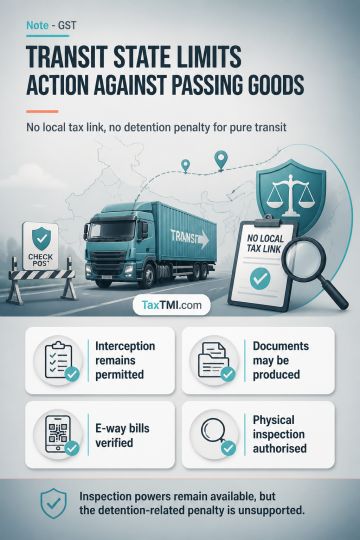
    Transit-State Jurisdiction under GST: Limits on Detention and Penalty in External Inter-State Suppli...
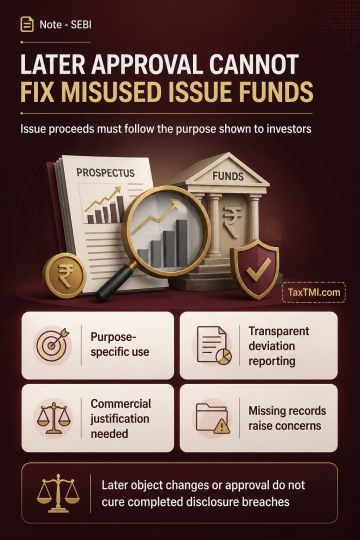
    Post-Facto Shareholder Ratification of Diversion of Preferential Issue Proceeds under the PFUTP Regu...
    Case Laws Income Tax
    Section 195 Withholding on Payments to Non-Residents: Royalty, Fees for Technical Services and Busin...
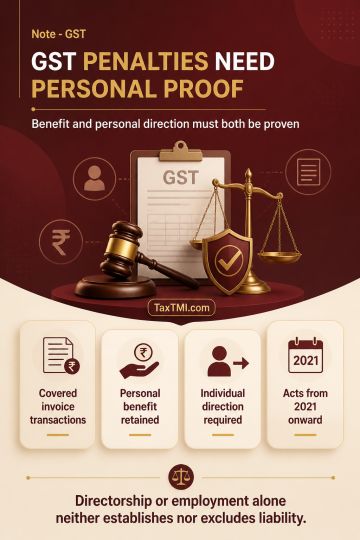
    Penalty: Scope of "Any Person" under Section 122(1A) of the Central Goods and Services Tax Act, 2017
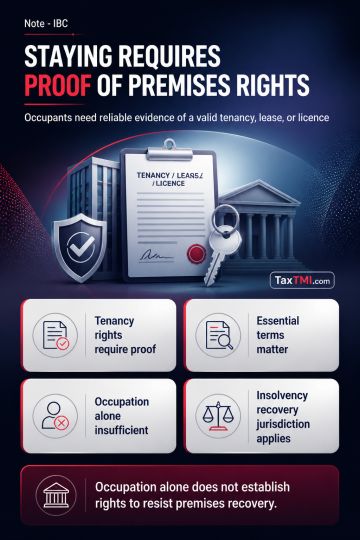
    Recovery of Corporate Debtor Premises and Proof of Tenancy, Lease or Licence Rights under the Insolv...
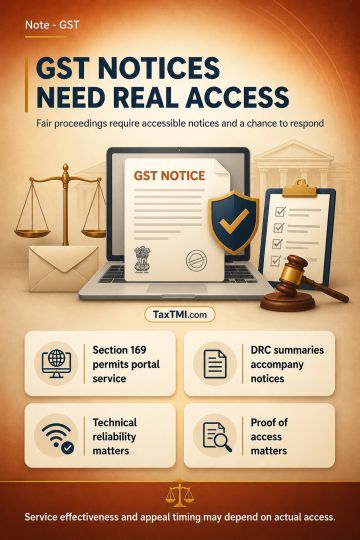
    Service of GST Notices through the Common Portal: Statutory Validity and Practical Accessibility
    Case Laws Income Tax
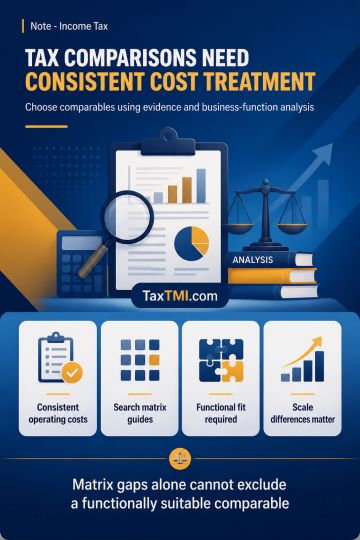
    TNMM Comparability: Operating Items, Search Matrix and Functional Analysis under Rule 10B
    Case Laws Customs
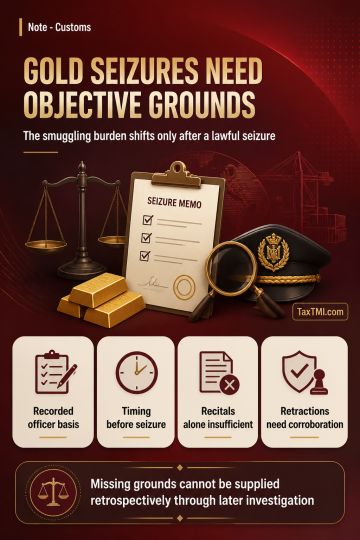
    Validity of Gold Seizure under Section 110 and the Conditional Reverse Burden under Section 123 of t...
    Case Laws Income Tax
    Deduction under Section 80GGC: Genuineness of Political Contributions and Evidentiary Burden
    Post-Death Determination of GST Liability and Estate-Limited Recovery from Legal Heirs
    Non-Confirmation of Seizure under Section 37A of FEMA and the Requirement of Recorded Reasons to Bel...
    Case Laws Companies Law
    Oppression and Mismanagement Proceedings under Sections 241 and 242: Corporate Authority During Pend...
    Case Laws Benami Property
    Benami Claims in Self-Acquired Property: Rejection of Plaint and the Limits of the Fiduciary-Capacit...
    Case Laws Income Tax
    Reopening of Assessment under Sections 147 and 148: Reason to Believe, Tangible Material and Change ...
    Case Laws Income Tax
    Penalty under Section 270A on Disallowance of Political Donation Deduction under Section 80GGC
    Case Laws Income Tax
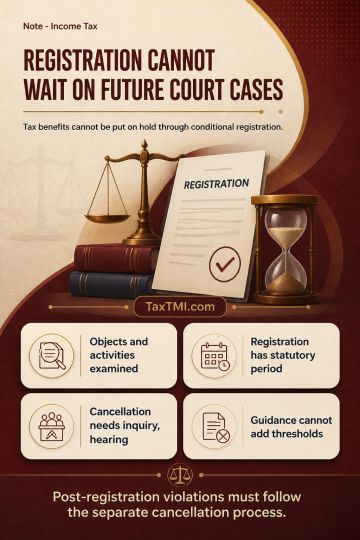
    Conditional Registration under Section 12AB and the Limits of Commissioner's Statutory Powers
    Case Laws Customs
    Transaction Value, Rule 12 and Enhancement Based on Consent Letters in Customs Valuation: Limits of ...
    GST on Assignment of Leasehold Rights: Distinguishing Transfer of Immovable Property from Supply of ...
    Case Laws Income Tax
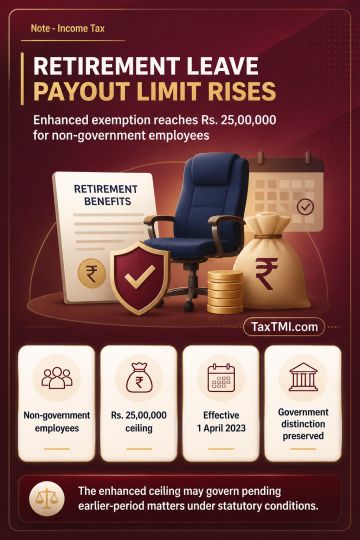
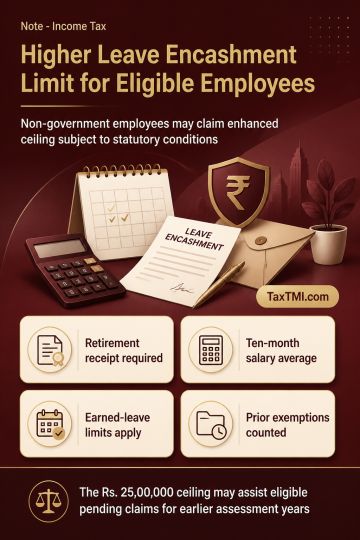
    Leave Encashment Exemption for Non-Government Employees under Section 10(10AA)(ii) and the Enhanced ...
❮
❯
❯❯
Maximize Maximize Maximize
0 / 200
Expand Note
Add to Folder

No Folders have been created

+

Are you sure you want to delete "My most important" ?

NOTE:

Notes
Showing Results for :
Reset Filters
Results Found:
Show All Summaries Hide All Summaries
Case Laws Income Tax
Show AI Summary
Retirement leave encashment exemption applies under the enhanced notified ceiling while preserving non-government employee classification and statutory conditions.
Section 10(10AA)(ii) governs retirement leave-encashment exemption for non-Government employees, subject to the ten-month earned-leave measure, average-salary computation, and the notified monetary ceiling. Notification No. 31/2023 specifies an enhanced ceiling of Rs. 25,00,000, is deemed effective from 1 April 2023, and certifies that retrospective effect causes no adverse effect. The enhanced ceiling is treated as a remedial rationalisation of an existing exemption and may govern pending earlier-period matters, while preserving the distinction between Government and non-Government employees.
Case Laws GST
Show AI Summary
Transit GST jurisdiction limits detention penalties for documented inter-State supplies lacking a local taxable nexus.
Transit-State jurisdiction under GST permits interception, document production, e-way bill verification and authorised physical inspection of goods moving through an intermediate State. It does not, in a pure transit movement, support detention-related penalty for an external inter-State supply where origin and destination lie outside the intercepting State, no tax is payable there, and there is no evidence of diversion, local supply, fictitious or mismatched documents, or mismatch of goods. Cross-empowerment is administrative and does not create an independent territorial taxable nexus.
Case Laws SEBI
Show AI Summary
Shareholder ratification cannot cure preferential-issue fund diversion when disclosed objectives are abandoned, triggering securities-market fraud and disclosure concerns.
Post-facto shareholder approval cannot retrospectively validate diversion of preferential-issue proceeds contrary to issue-specific objects disclosed to shareholders and the market. A special resolution authorises the issue but does not permit unrestricted use of proceeds. Periodic deviation reporting, audit-committee review and utilisation disclosures promote transparency; they do not enable diversion followed by later regularisation. Immediate diversion, inadequate commercial justification and missing documentation may indicate that disclosed objects were not genuinely intended to be performed. Later amendment of corporate objects or shareholder ratification cannot cure a completed securities-market disclosure breach.
Case Laws Income Tax
Show AI Summary
Cross-border software payments require copyright-right, technical-service, and permanent-establishment analysis before withholding obligations are determined under applicable treaties.
Section 195 requires withholding only from a remittance to a non-resident that includes income chargeable in India. For software, royalty depends on transfer of copyright rights, not merely the right to install, access, use, or distribute a copyrighted article under restrictive terms. Where a DTAA is more beneficial, its royalty and FTS definitions control; treaty FTS may require technology to be made available. Amounts that are neither royalty nor FTS require consideration as business profits, ordinarily taxable only where profits are attributable to a permanent establishment. Composite payments require component-wise allocation and analysis.
Case Laws GST
Show AI Summary
Personal GST penalty requires proof that the beneficiary retained benefit and directed a covered invoice or credit transaction.
Section 122(1A) may impose personal GST penalty on a registered or unregistered person only for a covered invoice or input tax credit transaction. Liability requires cumulative proof that the individual retained an identifiable personal benefit and that the transaction was conducted at that person's instance. Directorship, employment, registration, signature authority, or association with the taxable entity neither independently establishes nor excludes liability. Proceedings require transaction-specific and person-specific allegations and findings. The provision operates prospectively for underlying acts or transactions occurring on or after 01.01.2021.
Case Laws IBC
Show AI Summary
Proof of tenancy rights governs insolvency recovery of corporate-debtor premises from occupants lacking enforceable possessory interests.
Where premises form part of the corporate debtor's assets, Sections 18 and 25 of the Insolvency and Bankruptcy Code, 2016 require the resolution professional to take custody, control, preservation and protection measures. An occupant resisting recovery must prove a subsisting tenancy, leasehold interest or enforceable licence through reliable evidence of the parties' intended relationship and its essential terms. Permission to stock goods or conduct limited business activity, prolonged occupation, and business or utility records do not independently create rights in the premises. Section 60(5)(c) supports insolvency jurisdiction over asset-recovery measures connected with the insolvency estate.
Case Laws GST
Show AI Summary
GST portal service requires statutory validity and practical accessibility before ex parte adjudication can fairly proceed.
GST portal service is a statutory method under Section 169, but its use in an ex parte demand proceeding depends on effective accessibility and a meaningful opportunity to reply and be heard. Rule 142 requires electronic DRC-01 and DRC-07 summaries to operate alongside the underlying show-cause notice and reasoned order. Portal placement, complete communication, e-mail transmission, technical reliability and proof of actual access may determine whether service is effective, whether waiver applies, and whether appellate limitation begins.
Case Laws Income Tax
Show AI Summary
TNMM comparability requires consistent operating-cost treatment and FAR-based selection, while search matrices cannot replace evidence-led functional analysis.
TNMM requires consistent computation of operating profit and operating cost for the tested party and comparables. A provision for doubtful debts connected with sales and trade receivables may be an operating expense, as may routine business levies; income-tax on profits remains excluded. A search matrix is a disciplined evidentiary tool, not a statutory bar to an out-of-matrix comparable. Inclusion requires proof of functional fit, filter satisfaction and reasons for its absence, while rejection cannot rest solely on matrix absence. FAR analysis, segmental reliability and material scale differences govern comparability.
Case Laws Customs
Show AI Summary
Reasonable belief in gold seizure requires recorded objective grounds before the reverse burden for smuggling can arise.
Gold seizure under Section 110 requires the proper officer to hold, before seizure, objectively supportable reasons to believe that goods are liable to confiscation. For gold, Section 123 shifts the burden of disproving smuggling only after a lawful seizure made in reasonable belief that the gold is smuggled. A general panchnama recital, foreign markings, high purity, or an uncorroborated retracted statement cannot alone establish that foundation. Reasons must exist contemporaneously and cannot be supplied retrospectively through later investigation.
Case Laws Income Tax
Show AI Summary
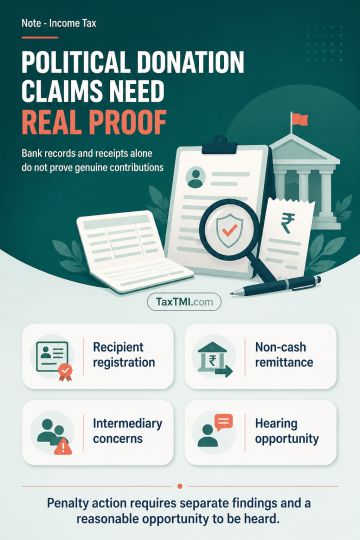
Political contribution deductions require proof that payments are genuine, not merely bank transfers, receipts, and recipient registration.
Registration of the recipient political party, non-cash remittance, banking records and donation receipts are necessary evidentiary facts for a political-contribution deduction, but do not conclusively prove a genuine contribution. Where credible material indicates an accommodation-entry arrangement involving return of funds through intermediaries, the claimant must substantiate the transaction and address taxpayer-specific circumstances. General allegations about a recipient cannot alone displace a claim without a sufficient nexus to the taxpayer's own payment. Penalty initiation requires separate determination of under-reporting or misreporting and a reasonable opportunity of hearing.
Case Laws GST
Show AI Summary
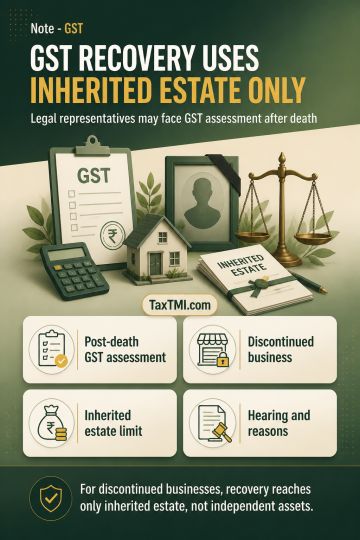
Estate-limited GST recovery permits post-death assessment of legal representatives while protecting heirs' independent assets after business discontinuance.
Section 93 permits post-death GST determination against a legal representative where a liable person dies. If the business is discontinued, tax, interest and penalty may be recovered only from the deceased's inherited estate and only within its capacity; the heir's independent assets remain outside that limit. Proceedings may be initiated without a pre-death notice, but must be addressed to the legal representative in that capacity, follow the applicable adjudication process, and provide hearing and a reasoned order.
Case Laws FEMA
Show AI Summary
Recorded reasons to believe govern foreign-asset seizure; non-confirmation requires appellate resolution before contradictory adjudication proceeds.
Section 37A permits seizure of equivalent domestic assets only where the authorised officer records written reasons to believe that foreign assets are held in contravention of FEMA. The competent authority must examine the material after hearing both sides and either confirm or set aside seizure. A reasoned non-confirmation based on an absent statutory threshold is substantive on seizure, though it does not finally decide the underlying contravention. Pending appeal, the adjudicating authority cannot displace that finding or adopt a contrary premise; Section 37A(4) applies only to confirmed seizure.
Case Laws Companies Law
Show AI Summary
Unstayed tribunal dismissal leaves former directors without corporate authority while banks follow valid company instructions amid management disputes.
Where an oppression and mismanagement petition has been dismissed, a pending appeal without an appellate stay does not itself restore a former director's authority or suspend the dismissal's operative effect. Sections 241 and 242 require statutory prejudice and prescribed Tribunal findings; procedural irregularities in director removal may be relevant but do not alone establish oppression. Banks should ordinarily follow formally authorised company instructions rather than decide unresolved management disputes, unless a binding judicial or statutory restraint applies.
Case Laws Benami Property
Show AI Summary
Benami property claims cannot be recast through wills or employment-based trust when pleadings assert beneficial ownership.
Benami-property claims based on a claimant's payment for property titled in another person's name may fall within the statutory definition when the property is alleged to be held for that claimant's benefit. A Will, succession claim, or other later instrument does not provide an independent basis of title where the pleaded foundation is restoration of beneficial ownership. The statutory scheme prohibits benami arrangements, bars enforcement of claimed beneficial ownership, and treats prohibited re-transfers as invalid; self-acquired title in the named holder's name does not displace the pleaded funding arrangement.
Case Laws Income Tax
Show AI Summary
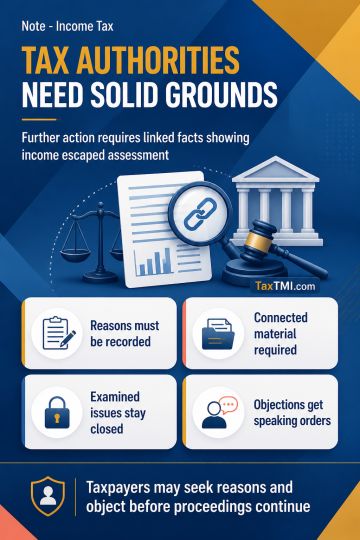
Reason to believe in reassessment requires tangible material, a live nexus, and recorded reasons; review of examined issues is barred.
Income-tax reassessment under Sections 147 and 148 is permissible only where recorded reasons, assessed at the time of notice, disclose a bona fide reason to believe that chargeable income escaped assessment. Final proof is unnecessary at that stage, but relevant tangible material must have a rational, live link to escapement. Reopening cannot be used to review an issue consciously examined and decided in the original scrutiny; nor can later or extraneous material supplement the recorded reasons. The taxpayer may seek the reasons, file focused objections, and receive a speaking order before reassessment continues.
Case Laws Income Tax
Show AI Summary
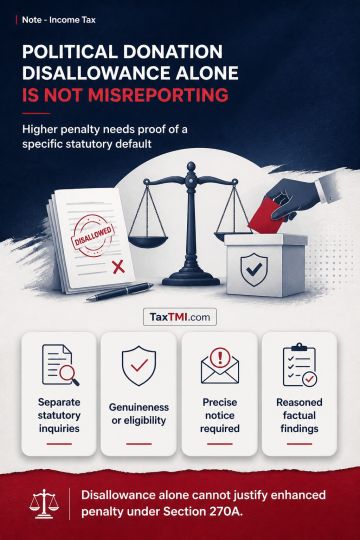
Political-donation deduction disallowance does not itself establish misreporting; enhanced penalty requires proof of a specific statutory default.
Disallowance of a political-contribution deduction under Section 80GGC and imposition of penalty under Section 270A are separate statutory inquiries. An adverse finding on genuineness or eligibility may raise assessed or reassessed income, but cannot alone establish misreporting. Enhanced penalty requires proof that the taxpayer's conduct falls within a specific Section 270A(9) category, supported by a precise notice and reasoned factual findings.
Case Laws Income Tax
Show AI Summary
Conditional charitable registration cannot suspend tax benefits pending litigation outside the statutory grant and cancellation framework.
Section 12AB permits the authority, after inquiry into objects, genuine activities and material legal compliance, to grant registration for the statutory period or reject the application. It does not create a contingent form of registration whose tax consequences await future litigation. Post-registration violations must be addressed through the separate cancellation process, requiring inquiry and hearing. Conditions in prescribed forms or administrative guidance may operationalise statutory duties but cannot create extra-statutory eligibility thresholds, future-conduct obligations or anticipatory cancellation consequences. Binding jurisdictional rulings remain applicable unless stayed, modified or reversed.
Case Laws Customs
Show AI Summary
Transaction value reassessment requires disclosed comparable evidence, while protest-qualified consent preserves appellate rights against enhanced customs valuation.
Transaction value under Section 14 and Rule 3 is the primary basis for valuing imported goods. Rule 12 permits rejection only where an objectively sustainable reasonable doubt persists after considering further information; on request, the grounds must be disclosed in writing and a hearing afforded. Redetermination must follow Rules 4 to 9 sequentially and rely on demonstrably comparable import data. Written acceptance of reassessment may dispense with a speaking order under Section 17(5), but protest-qualified or provisional-clearance correspondence may preserve the statutory right to appeal.
Case Laws GST
Show AI Summary
Leasehold rights assignment may fall outside GST when the lessee permanently transfers the entire proprietary estate.
GST treatment of assignment of leasehold rights turns on whether the lessee has made a complete transfer of its existing estate or continues to provide occupation or enjoyment. Where the assignor transfers the whole residual term, possession, building and associated rights, retains no reversionary or controlling interest, and the assignee succeeds directly to obligations towards the original lessor, the transaction may be characterised as transfer of benefits arising out of land rather than a supply of services. Labels such as premium, salami or transfer fee are not conclusive.
Case Laws Income Tax
Show AI Summary
Leave encashment exemption: Non-government employees may claim the enhanced notified ceiling subject to statutory computation conditions.
Retirement leave encashment received by employees other than Central or State Government employees falls under Section 10(10AA)(ii). Exemption depends on retirement, the ten-month earned-leave limit, average salary for the preceding ten months, earned-leave entitlement restrictions, aggregate limits, and prior exempt receipts. The enhanced notified ceiling of Rs. 25,00,000, deemed to operate from 1 April 2023, is treated in the Tribunal approach discussed as a beneficial rationalisation available to eligible pending claims for earlier assessment years, without displacing the statutory computation conditions.

TMI Notes

Back

All TMI Notes

Showing Results for :
Reset Filters
No Records Found

TMI Notes

Back

All TMI Notes

Comparison of Section 118 "Carry forward and set off of losses and unabsorbed depreciation in business reorganisation of co-operative banks." between the Income-Tax Act, 2025 (as passed) and the Income-Tax Bill, 2025 (as originally introduced)

2 September, 2025

Contents
Acts
Rules & Regulations
Summary
Note

Note

-

Bookmark

(New) -

Download

Print

Print

Section 118 Carry forward and set off of losses and unabsorbed depreciation in business reorganisation of co-operative banks.

Income-tax Act, 2025

At a Glance

Clause 118 (Old Version) of the Income Tax Bill, 2025 proposes rules for carry forward and set off of accumulated business losses and unabsorbed depreciation on amalgamation and demerger of co-operative banks. It affects successor, amalgamating, demerged and resulting co-operative banks, and sets eligibility conditions relating to prior banking activity, fixed asset holding thresholds and continuity of business. Effective date or decision date: Not stated in the document.

Background & Scope

Statutory hook: Clause 118 (Bill) sits within the set-off and carry-forward framework of the Income Tax Bill, 2025 and cross-refers to section 112 for the concept of losses and to section 65 for defined words concerning amalgamation/demerger/business reorganisation. The clause covers two principal events: amalgamation (where a successor bank may set-off predecessor losses) and demerger (where losses/depreciation directly or not directly relatable to transferred undertakings are treated differently). Definitions provided in the clause include "accumulated business loss", "unabsorbed depreciation" and cross-references for terms like "amalgamation" and "demerger".

Statutory Provision Mode

Text & Scope

Clause 118 applies where a co-operative bank undergoes business reorganisation by amalgamation or demerger during a tax year. Key textual elements:

  • Amalgamation (sub-s. (1)): Where amalgamation occurs during the tax year, the accumulated business loss and unabsorbed depreciation of the predecessor bank may be set off against the income of the successor bank for that tax year "as if the business reorganisation had not taken place", with all other set-off/carry-forward and depreciation rules of the Act applying accordingly.
  • Demerger (sub-s. (2)): If demerger occurs during the tax year-(a) losses/depreciation directly relatable to the transferred undertaking follow the undertaking to the resulting bank in full; (b) where not directly relatable, losses/depreciation must first be apportioned between demerged and resulting banks in proportion to asset distribution and then carried forward and set off against their respective incomes.
  • Carry-forward limitation (sub-s. (3)): The accumulated loss may be carried forward only up to eight tax years immediately succeeding the tax year in which such loss was first computed in the hands of the predecessor-in-business.
  • Eligibility conditions (sub-s. (4)): Conditions on predecessor and successor banks: predecessor engaged in banking for >=3 years and holding >=3/4 of book value of fixed assets continuously for two years prior to reorganisation; successor to hold >=3/4 of book value of predecessor's fixed assets for five years immediately succeeding reorganisation, continue the predecessor's business for minimum five years, and "fulfil such other conditions, as prescribed".
  • Executive power (sub-s. (5)): Central Government may, by notification, specify other conditions (excluding those in sub-s. (4)(b)(iii)) to ensure genuineness of the reorganisation.
  • Consequence of non-compliance (sub-s. (6)): If prescribed/notified conditions are not complied with, set-off of accumulated business loss or unabsorbed depreciation made in any tax year in the hands of the successor bank shall be deemed income of the successor bank chargeable to tax for the year of non-compliance.
  • Treated periods (sub-s. (7)): The tax year is split into two deemed different tax years for set-off/carry-forward purposes across the date of reorganisation.
  • Definitions (sub-s. (8)): Defines "accumulated business loss", cross-references meanings in s.65, and defines "unabsorbed depreciation" for the section's purposes.

Interpretation

The clause manifests legislative intent to preserve tax continuity on business reorganisation of co-operative banks: losses and unabsorbed depreciation follow the business (or the undertaking) subject to qualifying conditions intended to prevent opportunistic tax planning. The clause frames the relief "as if the business reorganisation had not taken place", signalling a substantive carry-over approach rather than fresh computation. The eight-year carry-forward cap indicates a temporal limitation on utilisation of predecessor losses.

Exceptions/Provisos

Not stated in the document: any specific carve-outs for particular types of co-operative banks, transitional provisions, or special rules for cross-border elements. The clause does provide exceptions by way of conditions: failure to comply with prescribed/notified conditions converts set-off into taxable income in the year of non-compliance.

Illustrations

  • Illustration 1: A predecessor co-operative bank computes a loss in Year 1 and is amalgamated with a successor bank in Year 3. Under sub-s. (1), the successor may set off that accumulated business loss against its income for the amalgamation year as if amalgamation had not occurred, subject to the other provisions of the Act and eligibility conditions. (No numerical computation provided in the text.)
  • Illustration 2: A demerger occurs where some losses are directly attributable to a transferred undertaking; per sub-s. (2)(a) the entire directly relatable loss goes to the resulting co-operative bank to carry forward and set off. (No allocation mechanics beyond asset-proportional apportionment for non-directly relatable losses are specified.)

Interplay

The clause expressly interacts with section 112 (referenced for computation/carry-forward entitlement) and section 65 (definitions for amalgamation/demerger). It also contemplates subordinate legislation ("prescribed" conditions and Central Government notifications). No mention is made of interplay with other specific notifications, rules, or circulars in the document.

Differences & Practical Impact

This section identifies textual differences between Section 118 (as enacted in the Income-tax Act, 2025) and Clause 118 (Old Version) of the Income Tax Bill, 2025 and summarises the practical impact of each change. All comparisons are limited to the two provided documents.

  • Terminology - "tax year" vs "previous year"/"tax year": The enacted Section 118 (Document 1) uses the phrase "in a case where the amalgamation has taken place during the previous year" in sub-section (1), while Clause 118 (Old Version, Document 2) uses "where amalgamation takes place during the tax year".
    • Practical impact: Potential interpretive variance as "previous year" is the statutory term generally used in income-tax law; "tax year" could be read differently. The Bill (old) consistently refers to "tax year" whereas the enacted section mixes "previous year" (s.118(1)) and "tax year" elsewhere; this may affect timing and computation of losses unless harmonised elsewhere.
  • Eight-year carry forward limit: Clause 118 (Old Version) contains an express eight-tax-year limitation on carrying forward accumulated loss (sub-section (3)). The enacted Section 118 (Document 1) omits this eight-year limitation entirely.
    • Practical impact: Removing the explicit eight-year cap in the enacted text potentially allows carry forward beyond eight years, subject to other provisions of the Act; this is a materially favourable change for successor banks compared with the Bill (old) if no other limiting provision applies.
  • Placement and numbering of defined terms: Clause 118 (Old Version) places definitions in sub-section (8) with the label "In this section,--" and defines "accumulated business loss"; the enacted Section 118 uses sub-section (7) labelled "For the purposes of this section, --" and defines "accumulated loss", "unabsorbed depreciation", and cross-refers to meanings in section 65.
    • Practical impact: Substantively the enacted text changes the defined phrase "accumulated business loss" to "accumulated loss" and reorders/wordsmiths the definitions; the practical effect is terminological but not necessarily substantive unless other provisions in the Act use the precise term.
  • Qualification language relating to prescribed/notification conditions: Both texts provide for prescribed conditions. The Old Version (Document 2) in sub-section (4)(b)(iii) uses "fulfils such other conditions, as prescribed," and sub-section (5) permits the Central Government by notification to specify other conditions "other than the condition referred to in sub-section (4)(b)(iii)". The enacted Section 118 (Document 1) mirrors this but places the "other conditions" power in sub-section (4) and states them as "other than the condition referred to in sub-section (3)(b)(iii)".
    • Practical impact: The change in cross-references (from (4)(b)(iii) to (3)(b)(iii)) follows the renumbering in the enacted text; substance appears consistent but requires careful reading to link the correct sub-clauses. No substantive alteration of the executive power is apparent from the texts provided.
  • Condition sequencing and minimum periods: Both texts impose the predecessor bank having been engaged in banking for three or more years and holding 3/4 of book value continuously for two years prior; and the successor bank holding 3/4 of book value for five years and continuing the business for five years. The enacted version frames some of these as sub-section (3) and the Bill (old) frames them as sub-section (4).
    • Practical impact: Primarily numbering and drafting shifts; substantive conditions appear consistent between drafts except for the eight-year carry-forward clause omitted in the enacted text.
  • Terminology around loss description: The Old Version (Document 2) consistently uses "accumulated business loss"; the enacted Section (Document 1) uses "accumulated loss".
    • Practical impact: Potential alignment issue with other sections that reference "accumulated business loss"; readers should confirm internal cross-references to avoid ambiguity.

Practical Implications

  • Compliance and risk areas: Successor and resulting co-operative banks must document continuity of business and fixed asset book values to satisfy the 3/4 thresholds and prescribed conditions; failure converts previously claimed set-offs into taxable income for the year of non-compliance. Careful recordation across the two deemed tax years is necessary for correct set-off.
  • Record-keeping/evidence: The clause implies need for evidence proving the predecessor's three-year engagement in banking, two-year continuity of fixed asset holding, successor's five-year continuity and five-year asset holding, and the apportionment basis where losses are not directly attributable-documentation of asset registers, valuations, transfer records and allocation methodologies will be central.

Key Takeaways

  • Clause 118 permits set-off of predecessor co-operative bank losses and unabsorbed depreciation in amalgamation/demerger scenarios "as if" reorganisation had not occurred, subject to Act provisions and conditions.
  • An explicit eight-tax-year carry-forward limit is contained in the Bill (old) for accumulated business loss.
  • Qualification hinges on continuity conditions: predecessor's three-year banking activity and fixed asset thresholds; successor's five-year continuity and asset holding; and prescribed/notified conditions.
  • Non-compliance with conditions leads to prior set-offs being treated as taxable income in the year of non-compliance.
  • Demergers distinguish losses directly attributable to transferred undertakings (which travel in full) from those not directly attributable (which are apportioned by asset distribution).
  • Central Government retains power to specify additional conditions by notification (excluding certain prescribed conditions).
  • Deemed split of the tax year across the date of reorganisation affects set-off and carry-forward timing.

Full Text:

Section 118 Carry forward and set off of losses and unabsorbed depreciation in business reorganisation of co-operative banks.

Topics

Acts Income Tax