Loading...

⚠ ✕
❮ Top
☎ Help
☰
×

By creating an account you can:

Logo TaxTMI
Call Us / Help / Feedback✕

Contact Us At :

✉ E-mail: [email protected]

✆ To Call / Whatsapp, Check Contact Us

FAQs :

To know Frequently Asked Questions, Check FAQs

Most Asked Video Tutorials :

For more tutorials, Check Video Tutorials

Submit Feedback/Suggestion :

Email :
Please provide your email address so we can follow up on your feedback.
Category :
Description :
Min 15 characters 0/2000
Make Most of Text Search ✕
  1. Checkout this video tutorial: How to search effectively on TaxTMI.
  2. Put words in double quotes for exact word search, eg: "income tax"
  3. Avoid noise words such as : 'and, of, the, a'
  4. Sort by Relevance to get the most relevant document.
  5. Press Enter to add multiple terms/multiple phrases, and then click on Search to Search.
  6. Text Search
  7. The system will try to fetch results that contains ALL your words.
  8. Once you add keywords, you'll see a new 'Search In' filter that makes your results even more precise.
  9. Text Search
╳
Add to...
You have not created any category. Kindly create one to bookmark this item!
✕
Create New Category
Hide
Title :
Description :
❮❮ Hide
❮ Default View
Expand ❯❯
Close ✕
🔎 Filters / Advanced Search ❯
TEXT

Press 'Enter' to add multiple search terms. Rules for Better Search

Search In
Main Text + AI Text ❯
  • Main Text
  • Main Text + AI Text
  • AI Text
Law:
---- All Laws---- ❯
  • ---- All Laws----
  • Benami Property
  • Bill
  • Central Excise
  • Companies Law
  • Customs
  • DGFT
  • FEMA
  • GST
  • GST - States
  • IBC
  • Income Tax
  • Indian Laws
  • Money Laundering
  • SEBI
  • SEZ
  • Service Tax
  • VAT / Sales Tax
Types:
---- All Types ---- ❯
  • ---- All Types ----
  • Act Rules
  • Case Laws
  • Circulars
  • Manuals
  • News
  • Notifications
Sort By: ?
In Sort By 'Default', exact matches for text search are shown at the top, followed by the remaining results in their regular order.
Relevance Default Date
☰   Show Results ❯
    Concessional GST on Works Contracts for Co-operative Spinning Mills: Government Entity Status and Pr...
    Case Laws Customs
    Abetment and Knowing Use of False Import Documents under Sections 112(a) and 114AA
    Subcontracted Services on Own Account and the Intermediary Exclusion under Section 2(13)
    Case Laws Customs
    Classification of Two-Ton Ductless Split Air Conditioners under Tariff Item 8415 82 10
    Case Laws Income Tax
    Transfer Pricing of Pre-Conversion Interest on Compulsorily Convertible Debentures
    Case Laws Customs
    Clubbing of Contrived Split Consignments under Rule 2(a) and Valuation of a Dismantled Motorcycle
    GST on Corporate Guarantees: Substantive Liability, Deemed Valuation and Judicial Relief
    Case Laws Income Tax
    Employee Secondment under the India-USA DTAA: Employment Rights, Reimbursements and Included Service...
    Pre-deposit Under Section 112 and Independent Compliance with Tribunal Filing Fees
    Case Laws Income Tax
    TDS on Interest Paid by Co-operative Banks to Non-Member Co-operative Societies under Section 194A(3...
    Input Tax Credit and Supplier Non-Payment: Statutory Limits on Mechanical Reversal Under Section 16(...
    Case Laws Customs
    Appellate Jurisdiction over Goods Imported as Baggage under Sections 129A and 129DD of the Customs A...
    Monetary Limits for Departmental GST Appeals under Section 120 and Circular No. 207/1/2024-GST
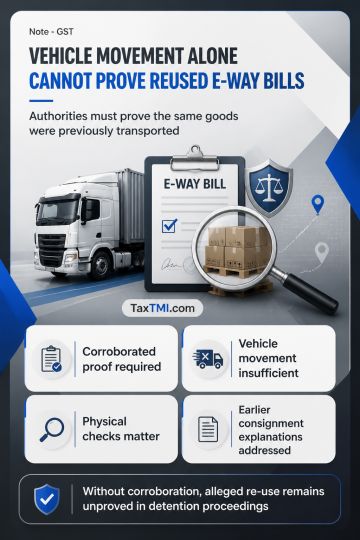
    Alleged Re-use of E-Way Bills under Section 129: Evidentiary Burden in Detention Proceedings
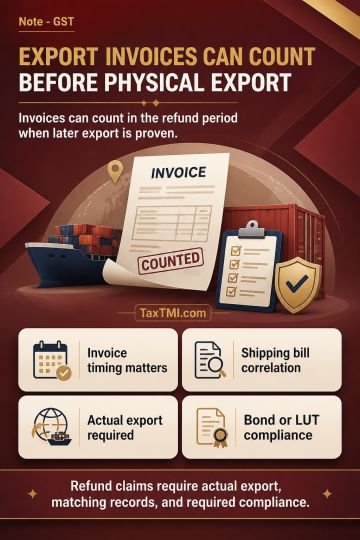
    Turnover of Zero-Rated Supply Under Rule 89(4): Invoice Period and Subsequent Physical Export
    Case Laws Income Tax
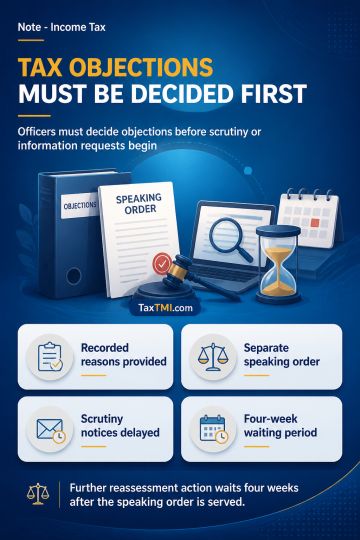
    Reassessment Proceedings: Speaking Disposal of Objections Before Scrutiny Under Sections 143(2) and ...
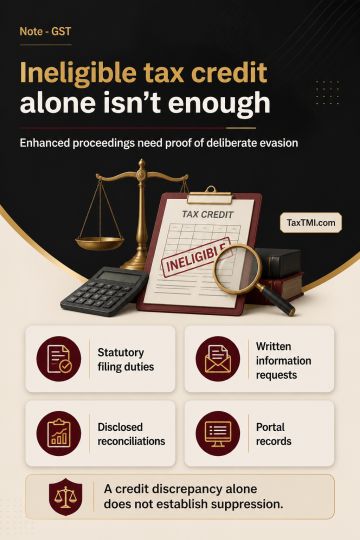
    Suppression of Facts under Explanation 2 to Section 74 of the CGST Act in Cases of Ineligible Input ...
    Case Laws Customs
    Classification of Low-Ethoxylated Non-Ionic Fatty Alcohol Ethoxylates under Headings 3402 and 3824
    Case Laws Customs
    Seizure and Detention of Imported Cars under Sections 110, 110A and 124 of the Customs Act, 1962
    Case Laws Companies Law
    Lifting the Corporate Veil Where Promoter Shareholding Is Allegedly Dissipated Despite Judicial Assu...
❮
❯
❯❯
Maximize Maximize Maximize
0 / 200
Expand Note
Add to Folder

No Folders have been created

+

Are you sure you want to delete "My most important" ?

NOTE:

Notes
Showing Results for :
Reset Filters
Results Found:
Show All Summaries Hide All Summaries
Case Laws GST
Show AI Summary
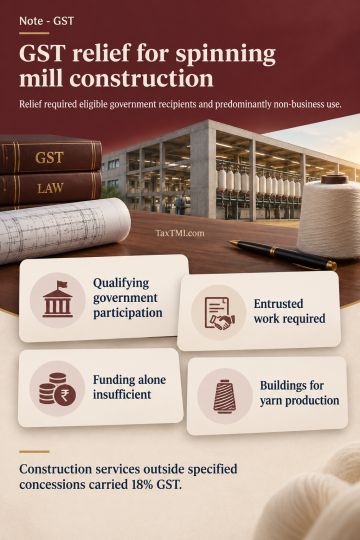
Non-business construction concessions for spinning mills require eligible recipient status and predominantly non-industrial use of the constructed buildings.
For the disputed period, the works-contract concession required both an eligible governmental recipient and structures predominantly meant for use other than commerce, industry, business or profession. Government Entity status required evidence of the recipient's constitution and qualifying governmental participation, while procurement had to relate to entrusted work. Project funding, tender approval and supervision did not by themselves establish governmental constitution or control. The spinning-mill factory buildings and allied works were intended for yarn production and related commercial activities. The residual construction-services entry carried aggregate GST of 18% for services outside the specified concessional entries.
Case Laws Customs
Show AI Summary
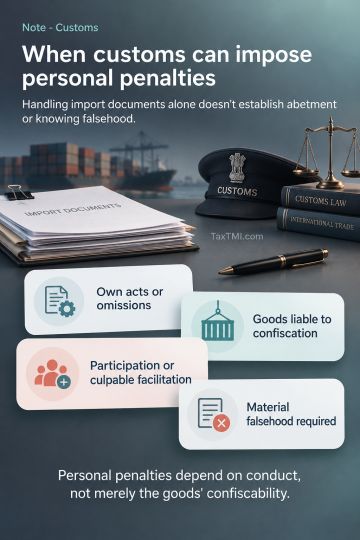
Import document handling alone does not establish customs abetment or knowing use of materially false declarations.
Personal customs penalties depend on the person's own conduct, not merely on the confiscability of imported goods. Under Section 112(a) of the Customs Act, 1962, liability may arise from a person's own act or omission rendering goods liable to confiscation or from abetment of such conduct. The direct limb can operate on a strict-liability basis where a person's own act or omission renders goods confiscable; an allegation of abetment instead requires evidence of participation or culpable facilitation. Section 114AA requires knowing or intentional making, signing or use, or causing the making, signing or use, of a declaration, statement or document that is materially false or incorrect in customs business.
Case Laws GST
Show AI Summary
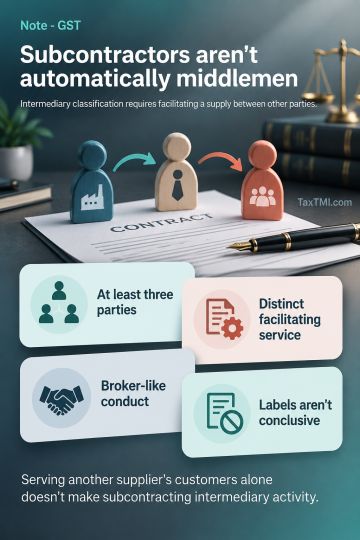
Subcontracted services performed on own account are not intermediary services merely because they support overseas recruitment and customer-facing activities.
Intermediary classification under Section 2(13) of the IGST Act distinguishes arranging or facilitating supplies between other persons from supplying services on one's own account. The intermediary framework requires at least three parties, a main supply and a distinct ancillary facilitating supply, with conduct resembling that of a broker or agent. Subcontracting the whole or part of a service is not intermediary activity merely because performance supports another supplier's business or involves its customers. Neither a bilateral agreement, contractual label nor remuneration method is conclusive.
Case Laws Customs
Show AI Summary
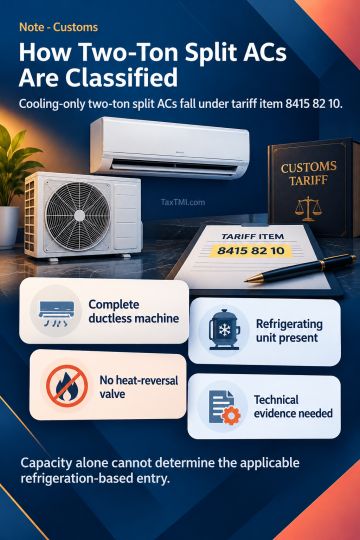
Split air conditioner classification requires capacity and refrigeration features to be assessed against the applicable tariff hierarchy.
Classification of ductless split air conditioners depends on the complete tariff description and the machine's technical characteristics. A complete, cooling-only, two-ton split air conditioner incorporating a refrigerating unit and lacking a heat-reversal valve falls within tariff item 8415 82 10 rather than the general split-system item 8415 10 10. Item 8415 82 10 inherits its parent subheading's refrigerating-unit requirement, while item 8415 83 10 requires the absence of such a unit. Capacity alone does not establish the applicable refrigeration-based entry. Technical evidence should establish whether the goods are a complete machine and identify their capacity and operating features.
Case Laws Income Tax
Show AI Summary
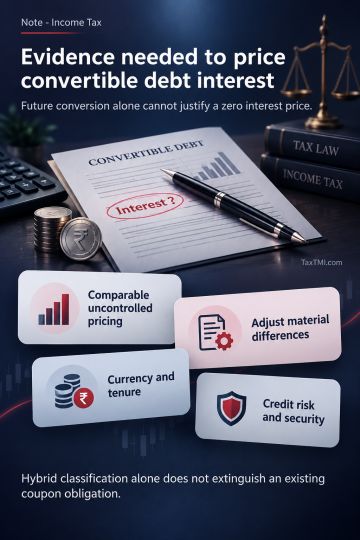
Convertible debenture interest requires evidence-based pricing before conversion; future equity conversion alone cannot establish a nil arm's length price.
Pre-conversion interest on compulsorily convertible debentures (CCDs) issued to a non-resident associated enterprise requires arm's length pricing. Compulsory future conversion and hybrid classification do not, by themselves, establish a nil price or extinguish an existing coupon obligation. Rule 10AB's Other Method requires a price charged, paid or expected in comparable uncontrolled circumstances, with reasonably accurate adjustments for material differences under Rule 10B. Currency, benchmark date, tenure, credit risk, security, non-redemption and conversion benefits affect comparability; a conventional bank lending rate is not automatically comparable to a long-tenor CCD.
Case Laws Customs
Show AI Summary
Split motorcycle consignments require evidence of deliberate fragmentation for composite classification, with valuation assessed independently of classification.
Clubbing of split consignments for customs classification depends on proof that apparently separate imports form one deliberately fragmented transaction, not merely on the possibility of assembly. Rule 2(a) extends a tariff heading to an incomplete article possessing the essential character of the complete article and also covers a complete article presented disassembled. A change of tariff heading alone does not establish that the transaction value is inaccurate; substantive misdescription of the goods requires separate evidentiary consideration. Replacement value must follow the prescribed sequence of methods.
Case Laws GST
Show AI Summary
Corporate guarantee taxation depends on distinguishing taxable supply from valuation, particularly for unpaid support between related businesses.
GST on corporate guarantees requires separate consideration of whether a taxable supply exists and how that supply is valued. Section 7(1)(c) and Schedule I encompass qualifying supplies between related or distinct persons without consideration when made in the course or furtherance of business. Rule 28(2) deems the value of a guarantee furnished to a banking company or financial institution for a related recipient in India to be one per cent of the guaranteed amount per annum or actual consideration, whichever is higher. Where the recipient is eligible for full input tax credit, the proviso treats the value declared in the invoice as the value of the supply.
Case Laws Income Tax
Show AI Summary
Employee secondment taxation depends on employment rights, service consideration and demonstrable transfer of technical capability to host entities.
Local operational control and a stated suspension of foreign employment do not, by themselves, resolve whether underlying foreign employment rights survive. Under Article 12(4)(b) of the India-USA DTAA, technical or consultancy services must make technical knowledge, experience, skill, know-how or processes available, or involve development and transfer of a technical plan or design. Under the knowledge-transfer limb, the recipient must acquire a capability it can use independently; the mere application of expertise or presence of qualified personnel is insufficient. Recovery at actual cost and absence of markup do not, by themselves, establish that a foreign enterprise's receipt is non-taxable.
Case Laws GST
Show AI Summary
GST appellate pre-deposits may be satisfied by verified earlier payments after demand reduction, but filing fees remain independently payable.
When the first appellate authority substantially reduces the disputed tax demand, an earlier deposit may be sufficient to satisfy the Tribunal-stage requirement, subject to verification. Sufficiency depends on the reduced liability, the applicable appellate requirements and the amount actually deposited; a first appellate payment does not automatically eliminate the additional obligation. Tribunal filing fees under Section 112(7) operate independently of pre-deposit. Where a fee shortfall and earlier deposit require verification, proof of fee payment and verification of the deposit precede consideration of admission.
Case Laws Income Tax
Show AI Summary
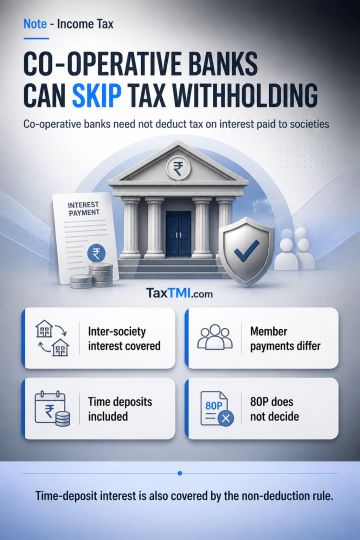
Inter-co-operative society interest exemption preserves non-deduction by co-operative banks when depositors are co-operative societies under the statutory withholding framework.
Section 194A(3)(v) separately addresses interest paid by a co-operative bank to a member and interest paid by a co-operative society to another co-operative society. The exclusion of co-operative banks is confined to the member-payment limb; a co-operative bank remains a co-operative society for the inter-co-operative society limb. Paragraph 42.7 of Circular No. 19/2015 preserves non-deduction, including time-deposit interest, where the depositor is a co-operative society. Section 80P does not determine this withholding obligation.
Case Laws GST
Show AI Summary
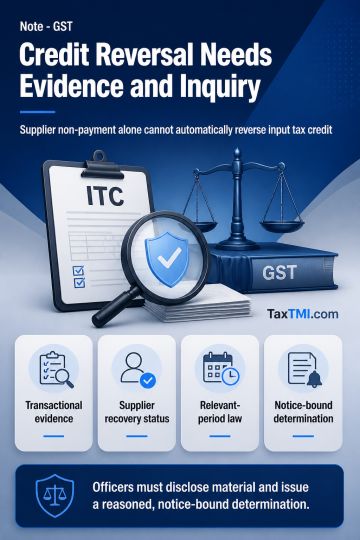
Input tax credit reversal requires evidence linking supplier non-payment to recipient ineligibility and a reasoned statutory inquiry.
Input tax credit under Section 16(2)(c) remains conditional on actual payment of tax to Government, but supplier non-payment or retrospective cancellation cannot by itself justify reversal. The recipient must establish eligibility through transactional evidence, while the proper officer must investigate the particular supply, disclose supplier-default and recovery material, apply the law applicable to the relevant period, and issue a reasoned, notice-bound determination. Supplier recovery status and protection against duplicate collection are material considerations.
Case Laws Customs
Show AI Summary
Baggage-related customs appeals proceed through statutory revision when the jurisdictional exclusion applies to passenger imports.
The first proviso to section 129A(1) excludes Appellate Tribunal jurisdiction over an order under section 128A relating to goods imported or exported as baggage. The decisive issue is the order's connection with baggage, not disputes concerning confiscation, declaration, duty, personal effects, concealment, concession, or penalty. Articles carried by an international passenger in luggage or on the person may constitute baggage. Section 129DD provides revision before the Central Government, ordinarily within three months, subject to a further period on sufficient cause.
Case Laws GST
Show AI Summary
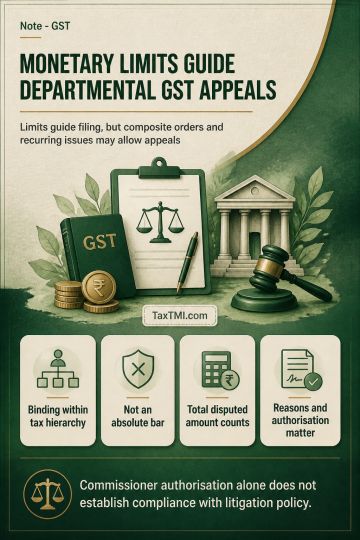
Departmental GST appeal monetary limits regulate officers, while composite orders and proven recurring issues may permit appeals.
Sections 120 and 168 of the Central Goods and Services Tax Act, 2017 make monetary-limit directions binding within the Central tax hierarchy, while they regulate the executive decision to file rather than create an inflexible jurisdictional bar before the Tribunal. In a composite order disposing of multiple appeals or demand notices, the relevant amount is the total disputed tax, interest, penalty or late fee, as applicable. The recurring or interpretative-issue exclusion requires a reasoned, case-specific basis, and Commissioner authorisation does not itself establish compliance with the litigation policy.
Case Laws GST
Show AI Summary
E-way bill re-use allegations require corroborated proof identifying the same goods; vehicle movement alone cannot establish contravention.
Alleged re-use of invoices and e-way bills requires the seizing authority to establish through positive, corroborated evidence that the intercepted goods are the same consignment previously transported under those documents. Toll data, vehicle movements and photographs may justify inquiry but do not alone prove prior delivery, identity of goods or re-use. Where invoices and e-way bills accompany the goods and physical verification shows no discrepancy, the authority must investigate and address any explanation of a different earlier consignment. Cases involving absent or expired transport documents remain factually distinct.
Case Laws GST
Show AI Summary
Zero-rated supply turnover includes export invoices from the refund period when actual export is subsequently established under bond or LUT.
Under Rule 89(4), invoice values for goods invoiced before or at removal for export under bond or Letter of Undertaking may be included in zero-rated turnover for the relevant refund period, although physical export occurs later. The invoice and removal determine period-wise attribution for the refund formula, while actual export remains essential to sustain the claim. Shipping bills, bills of export and related export records must correlate with the export invoices to establish that the goods were ultimately exported. Compliance with valuation, input tax credit eligibility and bond or Letter of Undertaking conditions remains necessary.
Case Laws Income Tax
Show AI Summary
Reassessment objections require speaking disposal and a four-week pause before scrutiny or information requests can begin.
Under the pre-amendment Section 148 framework, reassessment jurisdiction must be resolved before merits-stage scrutiny begins. The Assessing Officer must furnish recorded reasons when requested, permit objections, and decide them through a separate speaking order. A Section 143(2) notice commences scrutiny, while a Section 142(1) notice is a substantive inquiry step; neither may issue before objections are decided. Following rejection, a four-week period from service of the speaking order must be allowed before further reassessment action, preserving an effective opportunity to challenge reopening.
Case Laws GST
Show AI Summary
Suppression of facts requires proof of deliberate tax evasion; ineligible input tax credit alone cannot support enhanced proceedings.
Section 74 permits enhanced tax determination for wrongly availed or utilised input tax credit only where fraud, wilful misstatement, or suppression of facts to evade tax is established. Wrong or ineligible credit is distinct from substantive credit eligibility and cannot, without evidence of deliberate conduct and intent, amount to suppression. Under historical Explanation 2, suppression required either omitted information legally required in prescribed filings or failure to provide information sought in writing; both operate subject to the statutory evasion requirement. Disclosed reconciliations and portal records materially weaken a bare allegation of non-declaration.
Case Laws Customs
Show AI Summary
Organic surface-active agent classification requires water solubility and stability; phase-separating low-ethoxylated products fall outside Heading 3402.
Classification of low-ethoxylated non-ionic fatty alcohol ethoxylates under Heading 3402 requires satisfaction of the cumulative water test in Chapter Note 3. At the prescribed concentration, temperature, and standing period, the product must both remain a transparent or translucent liquid, or stable emulsion, without phase separation and reduce water surface tension to the stated threshold. Non-ionic character or surface activity alone is insufficient. Where a low-ethoxylated product separates into layers and fails the solubility and stability requirement, Heading 3824 may be considered after exclusion from Heading 3402.
Case Laws Customs
Show AI Summary
Lawful customs seizure requires recorded confiscation grounds, formal restraint where needed, and timely notice; detention cannot bypass safeguards.
Customs seizure of an imported car requires recorded reason to believe that it is liable to confiscation. A panchnama restraint cannot replace a lawful seizure order, an undertaking where seized goods remain in custody, or a served non-dealing order where seizure is impracticable. Section 110(2) requires prompt notice under Section 124, subject only to the prescribed extension mechanism. Prolonged effective detention cannot postpone those safeguards. Provisional release under Section 110A applies only to goods lawfully seized and cannot validate an earlier detention without statutory authority.
Case Laws Companies Law
Show AI Summary
Corporate veil-piercing permits forensic scrutiny in execution where promoter-controlled entities may dissipate shareholding despite judicial assurances.
Corporate veil-piercing in execution is an exceptional response where promoters allegedly use layered entities and securities transactions to deplete shareholding represented as security through judicial assurances. Separate personality remains the rule, and control or ownership alone does not suffice; there must be a nexus between control, misuse of the corporate form, and frustration of enforcement. A forensic audit reconstructs share movements, pledges, sales, financing, approvals, disclosures, and fund flows, distinguishing legitimate enforcement of pre-existing security from coordinated asset dissipation.

TMI Notes

Back

All TMI Notes

Showing Results for :
Reset Filters
No Records Found

TMI Notes

Comparison of Section 108 "Set off of losses under same head of income." between the Income-Tax Act, 2025 (as passed) and the Income-Tax Bill, 2025 (as originally introduced)

1 September, 2025

Contents
Acts
Rules & Regulations
Summary
Note

Note

-

Bookmark

(New) -

Download

Print

Print

Section 108 Set off of losses under same head of income.

Income-tax Act, 2025

At a Glance

These materials compare Clause 108 of the Income Tax Bill, 2025 - (Old Version) with Section 108 as enacted in the Income-tax Act, 2025. Both provisions regulate intra-head set-off of losses, including the special rules for capital gains. The provisions affect taxpayers who realise losses and gains under the same head (notably capital gains) and the tax administration that applies set-off rules. Effective date or decision date: Not stated in the document.

Background & Scope

Statutory hook: Chapter VII, "Set off, or Carry Forward and Set off of Losses," Income-tax Act/Bill, 2025. The clauses address intra-head set-off of losses. The text explicitly excludes "Capital gains" from the general rule in sub-section (1) and then dedicates sub-section (2) to rules for capital gains losses u/ss 72 to 90. Definitions of "short-term capital asset" and "long-term capital asset" are Not stated in the document. Cross-references: sections 72 to 90 are referenced as the computational framework for capital gains; the content of those sections is Not stated in the document.

Statutory Provision Mode

Text & Scope

Clause 108 (Old Version) contains two operative parts:

  • Sub-section (1): A general rule for the same head (excluding capital gains). If the net result from any source under any head of income (other than "Capital gains") is a loss for a tax year, the assessee may set off such loss against income from any other source under the same head for that tax year.

  • Sub-section (2): Specific rules for capital gains losses computed u/ss 72-90. Losses arising from transfer of a capital asset are classified by whether the asset is long-term or short-term and the set-off permitted differs accordingly:

    • (a) Loss arising from transfer of a long-term capital asset shall be set off only against gains, if any, from transfer of another long-term capital asset.

    • (b) Loss arising from transfer of a short-term capital asset shall be set off against gains, if any, from transfer of any capital asset.

Interpretation

Legislative intent as expressed by the text: the statute draws a distinction between capital gains and other income heads. It preserves the conventional tax treatment that long-term capital losses are more restricted - they cannot be used to offset short-term capital gains or other forms of income - whereas short-term capital losses are more freely available against gains from any capital asset. The language indicates an intent to confine cross-category set-off within the capital gains head to protect the treatment accorded to long-term capital gains (often taxed differently) while allowing short-term losses to mitigate capital gains across categories.

Exceptions/Provisos

No provisos, exceptions, time-limits or carry-forward rules are stated in Clause 108 of the Bill. Carry-forward of unabsorbed losses, conditions for set-off in subsequent years, or special carve-outs (e.g., for specified transactions) are Not stated in the document.

Illustrations

  • Example 1: Taxpayer A has, in one tax year, a loss of Rs. 100,000 on transfer of a short-term equity holding (short-term capital loss) and a gain of Rs. 80,000 on transfer of a long-term property (long-term capital gain). Under Clause 108(2)(b) the short-term capital loss can be set off against the long-term capital gain. (All numeric facts hypothetical but consistent with the text.)

  • Example 2: Taxpayer B has a long-term capital loss of Rs. 50,000 from sale of a long-term asset and a short-term capital gain of Rs. 30,000 in the same year. Under Clause 108(2)(a) the long-term loss cannot be set off against the short-term gain; it may be set off only against gains from transfer of another long-term capital asset. If no such gains exist, set-off in that year is precluded by Clause 108(2)(a).

Interplay

Clause 108 cross-references sections 72 to 90 as the computational framework for capital gains: the Bill contemplates that capital gains/loss computation, classification and quantum will be governed by those sections. Other interactions - for example with provisions on carry-forward and set-off across subsequent years, tax rates, or special exemptions - are Not stated in the document.

Summary of Differences between Clause 108 of the Income Tax Bill, 2025 - (Old Version) with Section 108 of the Income-tax Act, 2025

  • Structure and Wording of Capital Gains Set-off Rules
    Difference: Section 108(2) of the Act divides capital asset losses into two specific categories: (a) short-term capital asset loss set off against income from any other capital asset; and (b) long-term capital asset loss set off only against income from any other long-term capital asset. The Bill (Clause 108(2)) reverses the emphasis and frames the rule as: (a) loss from a long-term capital asset shall be set off only against gains (if any) from transfer of another long-term capital asset; (b) loss from a short-term capital asset shall be set off against gains (if any) from transfer of any capital asset.

    Practical impact: The Act's text appears to permit short-term losses to be set off against any other capital asset income (which would include both STCG and LTCG), and long-term losses only against other long-term capital income. The Bill's text expressly states the converse ordering but functionally is similar except for phrasing: Bill explicitly allows short-term losses to be set off against gains from any capital asset (including long-term), and restricts long-term losses to long-term gains only. The primary practical consequence is clarity: the Bill is explicit that long-term capital losses cannot be used against short-term capital gains, whereas the Act also contains that restriction but phrases the short-term rule as set off against "any other capital asset" which may be read the same; the Bill's framing is marginally clearer on the directional limitation for long-term losses.

  • Placement and Minor Wording Variations
    Difference: The Act uses the heading "(2) Where the net result of computation of income made for any tax year u/ss 72 to 90 in respect of-" followed by two subparagraphs (a) and (b) specifying short-term and long-term capital assets. The Bill uses "(2) Any loss, as a result of computation made u/ss 72 to 90, for any tax year, arising from transfer of a capital asset as arrived at under a similar computation made for the tax year in respect of any other capital asset being,--" followed by (a) and (b).

    Practical impact: This is a drafting difference only; the Bill's version is slightly more verbose and emphasizes that the loss is "arising from transfer of a capital asset." No substantive change in coverage is evident from the texts provided.

  • Explicit Cross-References to "Capital gains" Exclusion
    Difference: Both texts exclude "Capital gains" from clause (1) by the parenthetical "(other than "Capital gains")" when addressing set-off under the same head. There is no substantive difference here.

    Practical impact: No change; both provisions maintain capital gains as a special category requiring separate rules under clause (2).

  • Overall Substance
    Difference: There is no substantive divergence in the fundamental rule that losses under the same head can be set off against other sources within that head and that capital gains have specialized set-off rules distinguishing short-term and long-term losses. The Bill's text is slightly different in ordering and phraseology concerning which category of loss can be set off against which gains.

    Practical impact: Tax practitioners can treat the provisions as substantively aligned; however, reliance on the enacted Act (Section 108) rather than the Bill text is necessary for certainty. The practical effect on taxpayers' ability to set off capital losses appears unchanged: long-term capital losses are confined to long-term capital gains, whereas short-term capital losses may be applied against gains from any capital asset.

Practical Implications

  • Compliance and risk areas: Taxpayers must correctly classify capital asset transfers as short-term or long-term (classification rules Not stated in the document) because the permissible intra-head set-off depends on that classification. Misclassification could lead to incorrect set-off, reassessment risk, or tax litigation.
  • Record-keeping/evidence: Though the Bill does not prescribe records, taxpayers will need contemporaneous evidence of acquisition date, sale date, and computation of capital gains/losses (Not stated in the document as express requirements). Retention of documentation supporting holding period and computation is implied by the need to establish short-term vs long-term status.
  • Tax planning constraints: The rule restricting long-term capital losses to long-term gains limits the utility of such losses to offset short-term gains or other capital gains in the year - affecting timing strategies for disposal of assets where taxpayers seek to utilise losses against higher taxed or immediate gains.

Key Takeaways

  • Clause 108 distinguishes general intra-head set-off (excluding capital gains) from specific capital gains set-off rules.
  • Long-term capital losses are limited to set-off only against long-term capital gains in the same year.
  • Short-term capital losses can be set-off against gains from transfer of any capital asset in the same year.
  • The Old Version (Bill) and the enacted Section 108 are substantively consistent; differences are primarily in ordering and phrasing.
  • The Bill does not state definitions of short-term/long-term, carry-forward rules, effective date, or administrative procedures - these are Not stated in the document.
  • Accurate classification of capital assets and maintenance of records supporting holding periods and computations are essential for correct application.
  • Absence of express exceptions or cross-year carry-forward language in Clause 108 means readers must consult other provisions (Not stated here) for such rules.

Full Text:

Section 108 Set off of losses under same head of income.

Topics

Acts Income Tax