Loading...

⚠ ✕
❮ Top
☎ Help
☰
×

By creating an account you can:

Logo TaxTMI
Call Us / Help / Feedback✕

Contact Us At :

✉ E-mail: [email protected]

✆ To Call / Whatsapp, Check Contact Us

FAQs :

To know Frequently Asked Questions, Check FAQs

Most Asked Video Tutorials :

For more tutorials, Check Video Tutorials

Submit Feedback/Suggestion :

Email :
Please provide your email address so we can follow up on your feedback.
Category :
Description :
Min 15 characters 0/2000
Make Most of Text Search ✕
  1. Checkout this video tutorial: How to search effectively on TaxTMI.
  2. Put words in double quotes for exact word search, eg: "income tax"
  3. Avoid noise words such as : 'and, of, the, a'
  4. Sort by Relevance to get the most relevant document.
  5. Press Enter to add multiple terms/multiple phrases, and then click on Search to Search.
  6. Text Search
  7. The system will try to fetch results that contains ALL your words.
  8. Once you add keywords, you'll see a new 'Search In' filter that makes your results even more precise.
  9. Text Search
╳
Add to...
You have not created any category. Kindly create one to bookmark this item!
✕
Create New Category
Hide
Title :
Description :
❮❮ Hide
❮ Default View
Expand ❯❯
Close ✕
🔎 Filters / Advanced Search ❯
TEXT

Press 'Enter' to add multiple search terms. Rules for Better Search

Search In
Main Text + AI Text ❯
  • Main Text
  • Main Text + AI Text
  • AI Text
Law:
---- All Laws---- ❯
  • ---- All Laws----
  • Benami Property
  • Bill
  • Central Excise
  • Companies Law
  • Customs
  • DGFT
  • FEMA
  • GST
  • GST - States
  • IBC
  • Income Tax
  • Indian Laws
  • Money Laundering
  • SEBI
  • SEZ
  • Service Tax
  • VAT / Sales Tax
Types:
---- All Types ---- ❯
  • ---- All Types ----
  • Act Rules
  • Case Laws
  • Circulars
  • Manuals
  • News
  • Notifications
Sort By: ?
In Sort By 'Default', exact matches for text search are shown at the top, followed by the remaining results in their regular order.
Relevance Default Date
☰   Show Results ❯
    Case Laws Income Tax
    Dependent Agent Permanent Establishment under Article 5(5) of the India-Switzerland DTAA: Authority,...
    Case Laws Customs
    Proper Officer Jurisdiction for Customs Show Cause Notices under Sections 2(34), 17, 28 and 124
    Case Laws Money Laundering
    Provisional Attachment of Pre-Offence Property as Proceeds of Crime or Equivalent Value under the PM...
    Disciplinary Suspension of Resolution Professionals Across Ongoing CIRPs: Proportionality, Hearing a...
    Electronic Authentication of GST Demand Proceedings: Rule 26(3), Sections 75, 160 and 169
    Large-Scale GST Evasion Prosecutions: Cognizable and Non-Bailable Classification under Section 132 a...
    Case Laws Customs
    Country of Origin Certificates and Preferential Customs Duty under Notification No. 46/2011-Customs ...
    Refund of Accumulated Input Tax Credit on Packing Materials under Section 54(3)(ii) of the CGST Act
    Detention of Goods in Transit: Consequences of Delay in Notice under Section 129(3)
    Case Laws Income Tax
    Section 192 TDS on Leave Travel Concession and the Effect of Subsisting Judicial Restraint
    Cross-Segment Price Manipulation in Stock Derivatives under the SEBI Act and PFUTP Regulations
    Case Laws Income Tax
    Enhanced Rate of Tax u/s 115BBE: Survey Surrenders of Excess Stock and Cash: Business Income, Deemed...
    Retention of Seized Mobile Phones and Bank Debit Cards Beyond the Section 67(7) Period
    Case Laws Customs
    Classification of Disposable Analytical Cartridges under Chapter 90 and Heading 3926
    Reasoned and Speaking Appellate Orders u/s 107 of the CGST Act: Duty to Decide Material Grounds of A...
    Pre-Movement E-Way Bill Compliance and Section 129 Detention for Undocumented Goods in Transit
    Case Laws Income Tax
    Faceless Reassessment Jurisdiction: Retrospective Validation under Section 147A and Automated Alloca...
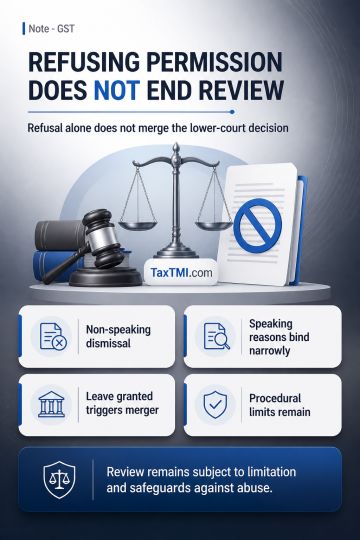
    Doctrine of Merger: Effect of Non-Speaking and Speaking Dismissal of Special Leave Petitions on Merg...
    Case Laws Indian Laws
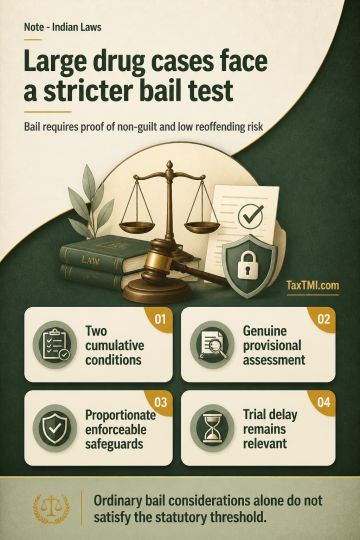
    Section 37 of the NDPS Act: Twin Conditions for Grant of Bail in Commercial Quantity Cases
    Case Laws Customs
    Pilferage of Imported Goods: Approval, Custody and Duty Liability under the Customs Act, 1962
❮
❯
❯❯
Maximize Maximize Maximize
0 / 200
Expand Note
Add to Folder

No Folders have been created

+

Are you sure you want to delete "My most important" ?

NOTE:

Notes
Showing Results for :
Reset Filters
Results Found:
Show All Summaries Hide All Summaries
Case Laws Income Tax
Show AI Summary
Dependent agent permanent establishment requires proven habitual contractual authority; liaison, administrative support, and customer contact alone remain insufficient.
Dependent agent permanent establishment under Article 5(5) requires proof that an Indian person has authority to negotiate and enter contracts for the foreign enterprise and habitually exercises that authority. Customer liaison, account management, administrative support, communication of pre-approved terms, document routing, and assistance with online standard-form contracting fall short unless Indian personnel substantively determine essential terms or routinely bring negotiations to a binding commercial conclusion. Formal offshore execution is not decisive where local personnel effectively control material negotiations. Corporate association, economic dependence, and independent-agent considerations cannot replace proof of the positive authority and habitual-exercise requirements.
Case Laws Customs
Show AI Summary
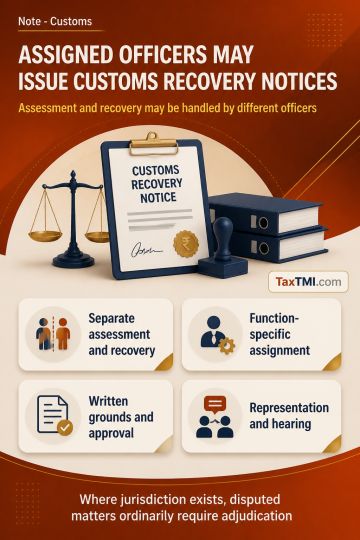
Proper-officer jurisdiction permits assigned customs officers to issue recovery notices without having performed the original assessment.
Customs show-cause jurisdiction requires both appointment as an officer of customs and function-specific assignment as the proper officer. Assessment under Section 17 and recovery under Section 28 are distinct functions; the original assessing officer need not alone issue a recovery notice. Retrospective validation of qualifying officers' proper-officer status applies independently of the preserved historical recovery regime. Confiscation and penalty proceedings require written grounds, prescribed prior approval, representation, and hearing. Where jurisdiction exists, disputed facts, evidence, limitation, and procedural compliance ordinarily require determination through adjudication.
Case Laws Money Laundering
Show AI Summary
Equivalent-value attachment permits securing untainted pre-offence assets only when unavailable criminal proceeds, valuation, and statutory risk are established.
Pre-offence property is ordinarily not directly derived from later scheduled-offence activity, but may be provisionally attached as equivalent value where actual proceeds are unavailable. Such attachment requires identification and reasoned valuation of the alleged proceeds, material showing their unavailability, and recorded reasons to believe that non-attachment risks concealment, transfer, or other frustration of confiscation. A later use of illicit funds to repay loans, construction borrowing, or secured obligations may separately establish a direct or indirect nexus. Section 24 presumptions do not replace the foundational requirements for attachment.
Case Laws IBC
Show AI Summary
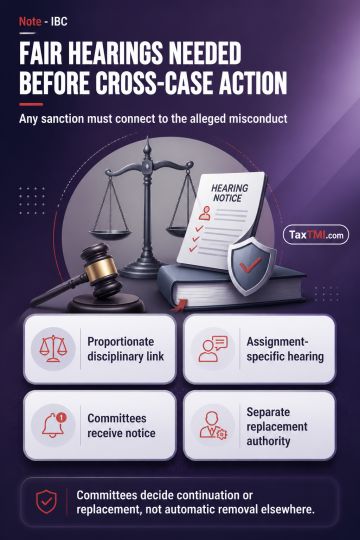
Cross-assignment disciplinary suspension requires proportionate, assignment-specific hearing while creditor committees retain statutory control over replacement decisions.
Where disciplinary misconduct concerns one CIRP, cross-assignment suspension requires a proportionate link to the pleaded charge, supporting material and hearing afforded. Section 220(2) permits disciplinary sanctions after hearing, while Regulation 13(7) requires intimation to Committees of Creditors and the Adjudicating Authority. On the prima facie construction applied, intimation informs each Committee's decision on continuation or replacement rather than automatically removing the professional from unrelated ongoing assignments. The Board's regulatory role and the Committee's replacement power remain distinct but connected.
Case Laws GST
Show AI Summary
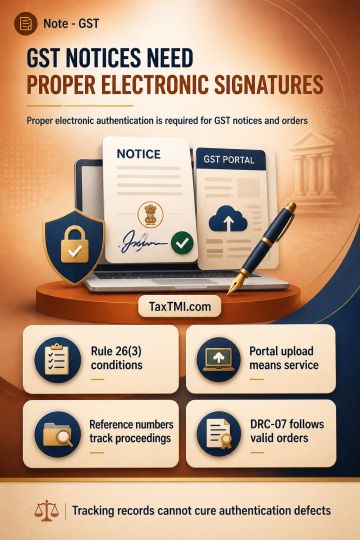
Electronic authentication of GST notices requires prescribed signatures; portal uploads, reference numbers, and DRC summaries cannot independently validate proceedings.
Rule 26(3) makes electronic issuance and authentication by digital signature, e-signature, or a notified verification mode cumulative conditions for GST notices and orders. A portal upload concerns service, while a system-generated reference number, DRC summary, or DIN performs tracking or procedural functions; none independently establishes the authorised officer's authentication. Section 169 governs service rather than validity, and Section 160 does not ordinarily cure a defect preventing attribution of the instrument to the competent officer. DRC-01 cannot replace the statutory notice, and DRC-07 supports recovery only upon a valid order.
Case Laws GST
Show AI Summary
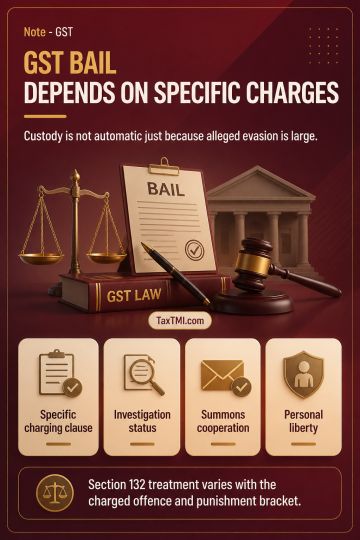
GST bail classification requires precise Section 132 charging clauses, with investigation status, cooperation and proportionality governing custodial necessity.
GST-evasion bail adjudication requires a case-specific assessment of custodial necessity rather than an automatic consequence of the alleged tax magnitude, Magistrate-triability, or a maximum five-year sentence. Section 132 classification depends on the precise offence clause and punishment bracket, not merely on the alleged quantum of evasion. Relevant considerations include the stage of investigation, cooperation with summons, security of evidence, individual role, risks of absconding or interference, proportionality, and personal liberty under Article 21.
Case Laws Customs
Show AI Summary
Certificate-specific origin verification prevents preferential-duty denial based solely on unrelated suspect certificates or supplier doubts.
Preferential customs-duty treatment requires compliance with applicable rules of origin and reliable proof that imported goods qualify as originating. A country-of-origin certificate is important evidence but does not remove the importer's duty to possess supporting origin information and exercise reasonable care. Challenges to preferential treatment must be certificate-specific and consignment-specific: an adverse finding concerning identified certificates cannot, without direct evidence, invalidate separate certificates. Customs verification should identify the particular proof of origin, alleged defect and material linking it to the import, while fraud, suppression or misrepresentation independently established may support substantive action.
Case Laws GST
Show AI Summary
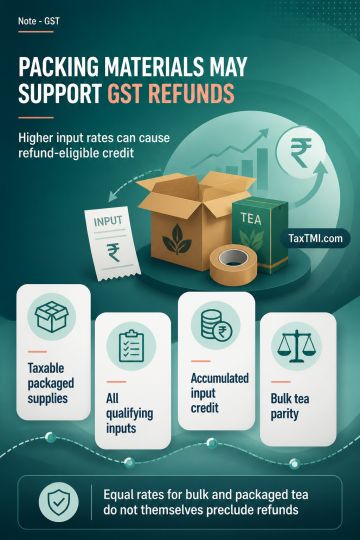
Packing-material input tax credit may support inverted-duty refunds when higher-rated inputs cause accumulation for taxable packaged supplies.
Refund of accumulated input tax credit under Section 54(3)(ii) may arise where packing materials used to make taxable packaged outward supplies bear a higher tax rate than the outward supply and generate the accumulation. The inquiry extends to all qualifying inputs and is not limited to a principal raw material. Parity between the rate on bulk tea and packaged tea does not itself preclude refund if higher-taxed packing materials used for the packaged supply are the cause of unutilised credit.
Case Laws GST
Show AI Summary
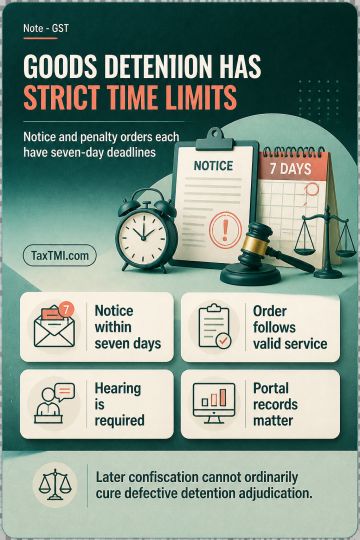
Mandatory detention timelines require timely notice, hearing and penalty order, preventing prolonged restraint of goods in transit.
Section 129(3) establishes a mandatory two-stage timeline: issuance of the penalty notice within seven days of formal detention or seizure, followed by a penalty order within seven days of legally effective service. The periods are independent, and compliance at one stage cannot cure delay at the other. Service, portal timestamps and the electronic records required under Rule 142 are material to chronology. Penalty requires a hearing, while payment under protest may still require a reasoned order to preserve appellate access. Later confiscation action cannot ordinarily cure a defective detention adjudication.
Case Laws Income Tax
Show AI Summary
Subsisting judicial restraint on leave travel concession withholding prevents employer default while preserving employees' underlying tax liability.
A subsisting judicial restraint expressly prohibiting deduction from leave travel concession reimbursements governs the employer's withholding conduct for the covered period. Non-deduction in compliance with that restraint cannot constitute failure to discharge an enforceable duty under Sections 192 and 201, even if the underlying exemption claim is later found substantively unavailable. The restraint does not eliminate employee-level tax liability. For unprotected periods, foreign-leg or circuitous travel claims remain outside the domestic-travel condition, and payer protection may depend on proving employee return filing, income inclusion and tax payment through Form 26A.
Case Laws SEBI
Show AI Summary
Cross-segment price manipulation examines whether futures orders artificially influence option executions, engaging anti-fraud rules, director responsibility, and interim safeguards.
Cross-segment price manipulation may arise where aggressive futures orders alter the last traded price or visible order-book conditions so that larger, sentimentally opposite options orders obtain favourable execution. The relevant inquiry considers the integrated sequence of resting orders, aggressive executions, cancellations, timing, concentration, price impact and delta-adjusted exposure. Anti-fraud prohibitions cover manipulative devices, false appearances of trading and price manipulation, while opposite futures and options positions alone do not establish misconduct. Director liability requires responsibility for business conduct, or consent, connivance or neglect.
Case Laws Income Tax
Show AI Summary
Survey surrender characterisation determines whether excess stock and cash are taxed as business income or under special deemed-income provisions.
The special regime in Section 115BBE is consequential: it applies only after the amount is properly brought within a specified deeming provision, and a survey surrender, book entry or return description cannot itself create that character. Mixed stock forming part of ordinary business inventory and credibly explained through business records may be assessed as business income at normal rates. Similarly, excess cash may be treated as business income where a commercial source is satisfactorily established and no separate or non-business source is shown.
Case Laws GST
Show AI Summary
Statutory limits on GST seizure require return of retained mobile phones and debit cards without a valid extension.
Section 67(7) establishes a six-month return rule where no notice in respect of seized goods is issued. Any further period requires sufficient cause, action by the proper officer, and a maximum further period of six months; ongoing investigation cannot replace an actual extension order. Although Section 67(7) uses "goods" while Section 67(2) also covers documents, books and things, its application to seized mobile phones and bank debit cards indicates that classification cannot be used to avoid the temporal restriction where articles are held under statutory seizure.
Case Laws Customs
Show AI Summary
Analytical cartridge classification follows functional integration and sole-use suitability, not plastic composition, disposability, or general consumable character.
STA micro-cuvettes containing an enclosed steel ball are assessed as complete functional components of a blood-coagulation analyser, rather than merely as plastic laboratory articles. Classification turns on their objective design, analytical role, exclusive or principal suitability and absence of practical general use. Chapter 90 Note 2 requires consideration of an independent specific heading first and then classification of other dedicated parts or accessories with the relevant instrument. Disposable or single-use status and plastic composition do not by themselves establish classification as residual plastic articles.
Case Laws GST
Show AI Summary
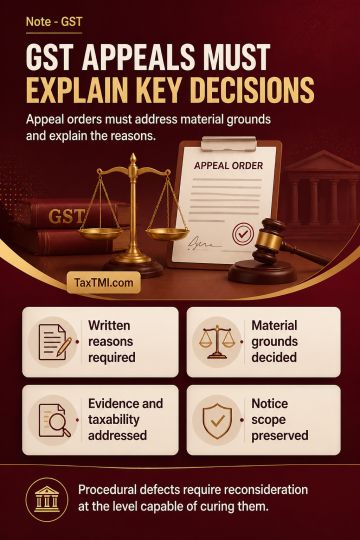
Speaking appellate orders require findings on material GST appeal grounds, ensuring fair hearings and meaningful higher review.
Section 107(12) requires a written appellate order identifying material points for determination, deciding them, and giving reasons. Formulaic confirmation of original assessment does not establish independent appellate consideration, particularly where jurisdiction, notice, evidence, quantification, taxability, section 74 conditions, interest, or penalty are contested. Sections 74 and 75 require a defined notice, disclosure of relied-upon material, effective hearing, and reasoned determination within the notice's scope. Where procedural defects arise at the original stage as well as on appeal, reconsideration must occur at the level capable of curing the foundational defect without expanding the show-cause case.
Case Laws GST
Show AI Summary
Pre-movement e-way bill compliance requires invoices and transport records before dispatch, while later documents cannot cure undocumented transit.
Pre-movement e-way bill compliance requires issuance of an invoice at or before removal, generation of the e-way bill before road movement, and carriage of both records during transit. Where goods are intercepted without either record, the contravention arises upon commencement of undocumented movement; documents generated only after interception cannot retrospectively establish compliance. Such documents may still be considered with other contemporaneous evidence when assessing bona fides or alleged intent to evade tax. Section 129 detention proceedings remain subject to notice, hearing, electronic-summary and statutory-timeline requirements.
Case Laws Income Tax
Show AI Summary
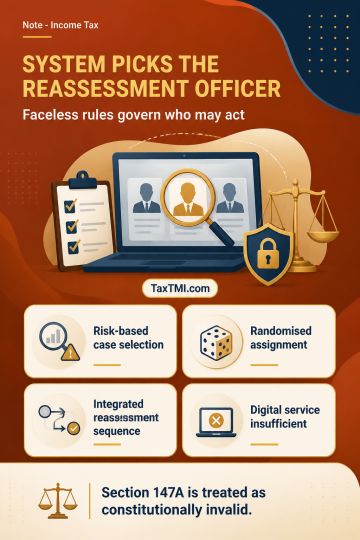
Automated allocation in reassessment determines officer jurisdiction, while retrospective validation cannot bypass continuing faceless-scheme requirements.
Section 151A and the e-Assessment of Income Escaping Assessment Scheme, 2022 require covered reassessment functions and section 148 notice issuance through automated allocation. Risk-based selection of cases is distinct from randomised allocation of the officer authorised to act. Sections 148A and 148 form an integrated reassessment sequence, so general concurrent jurisdiction, administrative instructions or digital service cannot substitute for the prescribed faceless allocation. Section 147A did not amend the continuing statutory and scheme-based allocation requirements and is treated as constitutionally invalid.
Case Laws GST
Show AI Summary
Doctrine of merger distinguishes refusal of special leave from appellate disposal, preserving review subject to independent procedural limits.
Under Article 136, a refusal of special leave remains a discretionary leave-stage determination. A non-speaking dismissal does not merge the challenged lower-court decision into a Supreme Court order, affirm its reasoning, or automatically create res judicata. A speaking refusal may bind only as to legal propositions expressly declared under Article 141, without producing merger. Merger arises when leave is granted and appellate jurisdiction is exercised. Review, writ, and remanded proceedings remain subject to independent procedural requirements, including limitation and safeguards against abuse.
Case Laws Indian Laws
Show AI Summary
NDPS commercial-quantity bail requires independent proof of non-guilt and low reoffending risk alongside proportionate safeguards.
Section 37 of the NDPS Act imposes cumulative bail conditions in commercial-quantity cases: the court must find reasonable grounds to believe the accused is not guilty and unlikely to reoffend while on bail. These requirements supplement ordinary bail factors and demand a genuine, provisional assessment of credible material. Personal liberty and trial delay remain relevant, but must be reconciled with the statutory threshold. Bail conditions, including verification safeguards for foreign nationals, must be proportionate, genuine and capable of enforcement.
Case Laws Customs
Show AI Summary
Approved customs custodians bear duty for proven pilferage during custody, but not for losses before their approval takes effect.
Customs-duty liability for pilfered imported goods arises only where pilferage occurs after unloading in a customs area while goods are held by an approved custodian. Approval is indispensable; factual control or statutory custody alone does not impose this liability for a period before approval. Importer duty exemption for pre-clearance pilferage operates alongside the custodian's revenue liability. Pilferage must be proved through contemporaneous records and cannot be presumed from every cargo discrepancy, shortage, or loss.

TMI Notes

Back

All TMI Notes

Showing Results for :
Reset Filters
No Records Found

TMI Notes

Back

All TMI Notes

Jurisdiction and Procedure for Tax Recovery : Clause 414 of the Income Tax Bill, 2025 Vs. Section 223 of the Income-tax Act, 1961

1 July, 2025

Contents
Acts
Rules & Regulations
Summary
Note

Note

-

Bookmark

(New) -

Download

Print

Print

Clause 414 Tax Recovery Officer by whom recovery is to be effected.

Income Tax Bill, 2025

Introduction

The process of tax recovery is a critical aspect of revenue administration, ensuring that tax dues assessed and demanded are effectively realized by the authorities. Clause 414 of the Income Tax Bill, 2025, which deals with the "Tax Recovery Officer by whom recovery is to be effected", represents a core procedural provision for the enforcement of tax recovery. This clause determines the jurisdiction and powers of the Tax Recovery Officer (TRO) in cases where recovery of tax arrears is necessary, especially when the assessee has multiple connections to different jurisdictions or possesses assets spread across various locations. The provision is substantially similar to Section 223 of the Income-tax Act, 1961, and is operationalized in practice through Rule 117B of the Income-tax Rules, 1962, which prescribes the form and manner in which statements (certificates) for recovery are to be drawn up.

This commentary provides a detailed examination of Clause 414, analyzing its structure, legislative intent, and practical implications. A comparative analysis is undertaken with Section 223 of the Income-tax Act, 1961, highlighting similarities, changes, and their potential effects. The interaction with Rule 117B of the Income-tax Rules, 1962, is also explored, considering procedural aspects and compliance requirements. The analysis is structured to provide a comprehensive understanding for practitioners, policymakers, and taxpayers alike.

Objective and Purpose

The primary objective of Clause 414 is to provide a clear and efficient legal framework for the identification of the appropriate Tax Recovery Officer empowered to take action for recovery of tax dues under the Income Tax Bill, 2025. The provision is designed to address scenarios where the assessee's business activities, residence, or assets are located in multiple jurisdictions, thus requiring a coordinated approach to recovery.

The legislative intent is rooted in ensuring that the process of tax recovery is not hampered by jurisdictional ambiguities. By specifying the TRO's jurisdiction and providing for inter-jurisdictional cooperation, the provision seeks to expedite recovery, minimize administrative delays, and prevent evasion of tax dues through dispersal of assets.

The historical background of this provision can be traced to the need for robust enforcement mechanisms in tax statutes, particularly in the wake of increased mobility of assets and the complexity of business operations. The provision also reflects policy considerations of administrative efficiency, fairness to taxpayers, and accountability of the tax administration.

Detailed Analysis of Clause 414 of the Income Tax Bill, 2025

1. Sub-section (1): Determination of Jurisdiction

Clause 414(1) lays down the primary rule for determining which Tax Recovery Officer is competent to effect recovery u/s 413 (presumably the provision dealing with the issuance of recovery certificates or similar instruments under the new Bill).

  • Clause 414(1)(a): The TRO within whose jurisdiction the assessee carries on business or profession, or has the principal place of business or profession.
  • Clause 414(1)(b): The TRO within whose jurisdiction the assessee resides or any of his movable or immovable property is situated.

The provision further clarifies that the "jurisdiction for this purpose" is to be determined as per the orders or directions issued by the Board (Central Board of Direct Taxes), or by any income-tax authority not below the rank of Commissioner, who is authorized by the Board pursuant to Section 241.

Key Features and Interpretation:

  • The provision ensures that the TRO's jurisdiction is not arbitrary but is assigned according to formal orders, enhancing predictability and legal certainty.
  • The dual criteria-business/profession location and residence/property location-reflect the realities of modern taxpayers, whose business and personal assets may be geographically dispersed.
  • The reference to orders or directions of the Board or authorized Commissioner provides flexibility to adapt jurisdictional assignments as per administrative needs.

2. Sub-section (2): Multi-jurisdictional Recovery and Transfer of Certificate

Clause 414(2) addresses the situation where an assessee has property in more than one TRO's jurisdiction. It provides two triggers for inter-jurisdictional cooperation:

  • (a) Inability to recover the entire amount by sale of property within the original TRO's jurisdiction;
  • (b) Opinion that such transfer is necessary for expediting or securing recovery.

In such cases, the original TRO may send the certificate (or a certified copy specifying the amount to be recovered) to another TRO as specified in sub-section (1)(b). The receiving TRO is then empowered to recover the amount as if the certificate had been drawn up by him.

Key Features and Interpretation:

  • The provision is designed to ensure that the recovery process is not stymied by jurisdictional limitations, especially for high-value or complex cases involving multiple assets.
  • The transfer mechanism is triggered both by actual inability to recover (objective criteria) and by the opinion of expediency (subjective criteria), providing necessary discretion to the TRO.
  • The requirement of certification (in the prescribed manner) for partial recovery ensures procedural integrity and prevents duplication or over-recovery.
  • The provision maintains the chain of authority and accountability, as the receiving TRO acts under the same legal mandate as the original TRO.

3. Prescribed Certification and Form (Interaction with Rule 117B)

While Clause 414 does not itself prescribe the form or manner of certification, it references the need for certification "as prescribed". This is where Rule 117B of the Income-tax Rules, 1962, becomes relevant. Rule 117B mandates that statements u/s 222 or 223 (and by extension, under Clause 414) must be drawn up in Form No. 57.

Key Features:

  • The use of a standardized form ensures uniformity, completeness, and legal sufficiency of recovery certificates.
  • The form likely contains details such as the amount to be recovered, identification of the assessee, particulars of assets, and certification by the TRO.
  • This procedural safeguard is essential to prevent errors, omissions, or disputes regarding the amount or identity of assets to be recovered.

Comparative Analysis with Section 223 of the Income-tax Act, 1961

Textual and Structural Similarities

A close reading reveals that Clause 414 of the Income Tax Bill, 2025, is largely modeled on Section 223 of the Income-tax Act, 1961. Both provisions:

  • Define the competent TRO as the one in whose jurisdiction the assessee carries on business, resides, or has property.
  • Provide for transfer of recovery certificates in cases involving multiple jurisdictions.
  • Reference the assignment of jurisdiction by the Board or authorized officers.
  • Require certification in the prescribed manner for partial recovery.

The language and structure are nearly identical, reflecting a deliberate legislative choice to maintain continuity in the recovery framework.

Key Differences and Developments

  • Reference to Authorizing Authority: Section 223 refers to the "Principal Chief Commissioner or Chief Commissioner or Principal Commissioner or Commissioner" authorized u/s 120, whereas Clause 414 refers to "any income-tax authority not below the rank of Commissioner who is authorized in this behalf by the Board in pursuance of section 241". This may reflect a streamlining or updating of administrative hierarchy under the new Bill.
  • Reference to Related Provisions: Section 223 is linked to action u/s 222 (certificate for recovery), while Clause 414 refers to Section 413. This is a result of renumbering or restructuring in the 2025 Bill, but the substantive mechanism remains unchanged.
  • Terminology and Modernization: The Bill uses slightly modernized language (e.g., "the Tax Recovery Officer by whom the certificate is drawn up" instead of "competent to take action"), but the practical effect is the same.

Interaction with Rule 117B of the Income-tax Rules, 1962

Rule 117B prescribes the form (Form No. 57) for statements u/s 222 or 223. Although the 2025 Bill may update the numbering of sections, unless new rules are notified, the existing procedural rule and form would continue to apply mutatis mutandis.

  • Procedural Consistency: The continued use of Form No. 57 ensures that the administrative process for drawing up and transmitting recovery certificates remains consistent across legislative transitions.
  • Legal Sufficiency: Failure to use the prescribed form could render recovery proceedings vulnerable to challenge on grounds of procedural irregularity.
  • Potential for Update: The new Bill may necessitate updates to the Rules to align references and ensure clarity, but the substantive requirement for certification and formality is likely to be retained.

Ambiguities and Issues in Interpretation

  • Subjective Discretion: The provision empowers the TRO to form an "opinion" regarding the necessity of inter-jurisdictional transfer. While this is necessary for administrative flexibility, it could be subject to judicial scrutiny in cases of alleged arbitrariness or mala fide.
  • Jurisdictional Overlaps: In complex cases involving multiple businesses or widespread assets, there may be disputes regarding the appropriate TRO, especially where assets are transferred or relocated during the pendency of proceedings.
  • Procedural Lapses: Non-compliance with certification or form requirements could lead to legal challenges, potentially delaying recovery.

Practical Implications

1. For Tax Authorities

  • Administrative Efficiency: The provision allows for seamless transfer and coordination between TROs, reducing bottlenecks in recovery.
  • Discretion and Accountability: TROs are empowered with discretion to determine when inter-jurisdictional cooperation is necessary, but are bound by formal procedures and documentation.
  • Jurisdictional Clarity: The clear delineation of jurisdiction prevents overlapping actions and potential legal challenges from assessees based on procedural grounds.

2. For Taxpayers

  • Legal Certainty: Taxpayers are informed in advance about which TROs may take action, reducing the risk of arbitrary or multiple recovery proceedings.
  • Procedural Safeguards: The requirement of prescribed certification and formal transfer minimizes the risk of double recovery or procedural unfairness.
  • Potential for Multi-jurisdictional Proceedings: Taxpayers with assets in multiple locations may face recovery actions from more than one TRO, but within a structured and regulated process.

3. For Legal and Tax Advisors

  • Advisory Role: Advisors must analyze the location of clients' assets and business operations to anticipate possible jurisdictions for recovery actions.
  • Dispute Resolution: In case of disputes regarding jurisdiction or procedural compliance, advisors must scrutinize the adherence to prescribed procedures and forms.

Conclusion

Clause 414 of the Income Tax Bill, 2025, represents a continuation and refinement of the established legal framework for tax recovery in India. By clearly defining the jurisdiction of Tax Recovery Officers and providing a structured mechanism for inter-jurisdictional cooperation, the provision balances administrative efficiency with procedural safeguards for taxpayers. The close alignment with Section 223 of the Income-tax Act, 1961, ensures continuity and predictability, while minor updates reflect administrative modernization.

The interaction with Rule 117B and the prescribed forms underscores the importance of procedural compliance in enforcement actions. While the provision grants necessary discretion to tax authorities, it also embeds safeguards against abuse or error. As business structures and asset holdings become more complex, the importance of such clear, robust recovery mechanisms will only increase. Future reforms may focus on further clarifying administrative hierarchies, updating procedural rules, and leveraging technology for more efficient inter-jurisdictional cooperation in tax recovery.


Full Text:

Clause 414 Tax Recovery Officer by whom recovery is to be effected.

Topics

Acts Income Tax