Loading...

⚠ ✕
❮ Top
☎ Help
☰
×

By creating an account you can:

Logo TaxTMI
Call Us / Help / Feedback✕

Contact Us At :

✉ E-mail: [email protected]

✆ To Call / Whatsapp, Check Contact Us

FAQs :

To know Frequently Asked Questions, Check FAQs

Most Asked Video Tutorials :

For more tutorials, Check Video Tutorials

Submit Feedback/Suggestion :

Email :
Please provide your email address so we can follow up on your feedback.
Category :
Description :
Min 15 characters 0/2000
Make Most of Text Search ✕
  1. Checkout this video tutorial: How to search effectively on TaxTMI.
  2. Put words in double quotes for exact word search, eg: "income tax"
  3. Avoid noise words such as : 'and, of, the, a'
  4. Sort by Relevance to get the most relevant document.
  5. Press Enter to add multiple terms/multiple phrases, and then click on Search to Search.
  6. Text Search
  7. The system will try to fetch results that contains ALL your words.
  8. Once you add keywords, you'll see a new 'Search In' filter that makes your results even more precise.
  9. Text Search
╳
Add to...
You have not created any category. Kindly create one to bookmark this item!
✕
Create New Category
Hide
Title :
Description :
❮❮ Hide
❮ Default View
Expand ❯❯
Close ✕
🔎 Filters / Advanced Search ❯
TEXT

Press 'Enter' to add multiple search terms. Rules for Better Search

Search In
Main Text + AI Text ❯
  • Main Text
  • Main Text + AI Text
  • AI Text
Law:
---- All Laws---- ❯
  • ---- All Laws----
  • Benami Property
  • Bill
  • Central Excise
  • Companies Law
  • Customs
  • DGFT
  • FEMA
  • GST
  • GST - States
  • IBC
  • Income Tax
  • Indian Laws
  • Money Laundering
  • SEBI
  • SEZ
  • Service Tax
  • VAT / Sales Tax
Types:
---- All Types ---- ❯
  • ---- All Types ----
  • Act Rules
  • Case Laws
  • Circulars
  • Manuals
  • News
  • Notifications
Sort By: ?
In Sort By 'Default', exact matches for text search are shown at the top, followed by the remaining results in their regular order.
Relevance Default Date
☰   Show Results ❯
    Project-Wise Anti-Profiteering Methodology in Real Estate under Section 171 of the Central Goods and...
    Case Laws Income Tax
    Retirement Leave Encashment Exemption under Section 10(10AA)(ii) and Retrospective Application of No...
    Transit-State Jurisdiction under GST: Limits on Detention and Penalty in External Inter-State Suppli...
    Post-Facto Shareholder Ratification of Diversion of Preferential Issue Proceeds under the PFUTP Regu...
    Case Laws Income Tax
    Section 195 Withholding on Payments to Non-Residents: Royalty, Fees for Technical Services and Busin...
    Penalty: Scope of "Any Person" under Section 122(1A) of the Central Goods and Services Tax Act, 2017
    Recovery of Corporate Debtor Premises and Proof of Tenancy, Lease or Licence Rights under the Insolv...
    Service of GST Notices through the Common Portal: Statutory Validity and Practical Accessibility
    Case Laws Income Tax
    TNMM Comparability: Operating Items, Search Matrix and Functional Analysis under Rule 10B
    Case Laws Customs
    Validity of Gold Seizure under Section 110 and the Conditional Reverse Burden under Section 123 of t...
    Case Laws Income Tax
    Deduction under Section 80GGC: Genuineness of Political Contributions and Evidentiary Burden
    Post-Death Determination of GST Liability and Estate-Limited Recovery from Legal Heirs
    Non-Confirmation of Seizure under Section 37A of FEMA and the Requirement of Recorded Reasons to Bel...
    Case Laws Companies Law
    Oppression and Mismanagement Proceedings under Sections 241 and 242: Corporate Authority During Pend...
    Case Laws Benami Property
    Benami Claims in Self-Acquired Property: Rejection of Plaint and the Limits of the Fiduciary-Capacit...
    Case Laws Income Tax
    Reopening of Assessment under Sections 147 and 148: Reason to Believe, Tangible Material and Change ...
    Case Laws Income Tax
    Penalty under Section 270A on Disallowance of Political Donation Deduction under Section 80GGC
    Case Laws Income Tax
    Conditional Registration under Section 12AB and the Limits of Commissioner's Statutory Powers
    Case Laws Customs
    Transaction Value, Rule 12 and Enhancement Based on Consent Letters in Customs Valuation: Limits of ...
    GST on Assignment of Leasehold Rights: Distinguishing Transfer of Immovable Property from Supply of ...
❮
❯
❯❯
Maximize Maximize Maximize
0 / 200
Expand Note
Add to Folder

No Folders have been created

+

Are you sure you want to delete "My most important" ?

NOTE:

Notes
Showing Results for :
Reset Filters
Results Found:
Show All Summaries Hide All Summaries
Case Laws GST
Show AI Summary
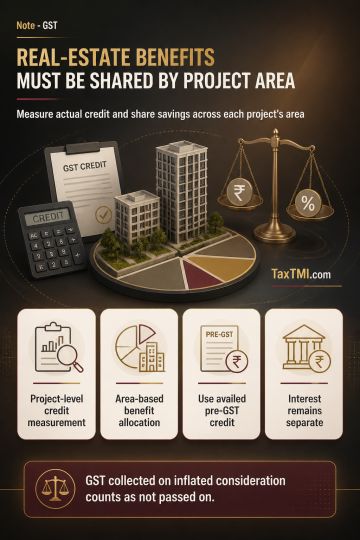
Project-wise anti-profiteering requires actual input tax credit measurement and area-based allocation of benefits to real-estate purchasers.
Real-estate anti-profiteering under Section 171 requires project-level identification of additional input tax credit and allocation of the saving across total project area on a per-square-foot basis. Purchase value may quantify credit attributable to project expenditure, but turnover or collections cannot serve as the allocation basis. The comparison must use pre-GST credit actually availed rather than merely available credit. GST collected on consideration inflated by an undistributed benefit forms part of the amount not passed on and remains distinct from statutory interest.
Case Laws Income Tax
Show AI Summary
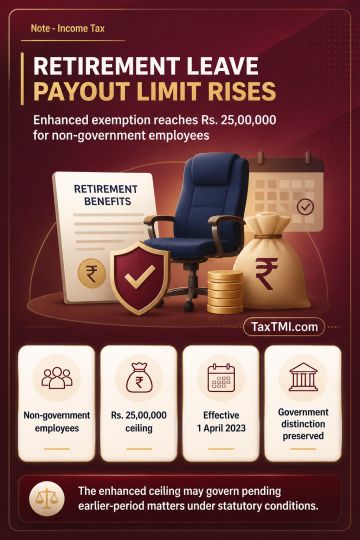
Retirement leave encashment exemption applies under the enhanced notified ceiling while preserving non-government employee classification and statutory conditions.
Section 10(10AA)(ii) governs retirement leave-encashment exemption for non-Government employees, subject to the ten-month earned-leave measure, average-salary computation, and the notified monetary ceiling. Notification No. 31/2023 specifies an enhanced ceiling of Rs. 25,00,000, is deemed effective from 1 April 2023, and certifies that retrospective effect causes no adverse effect. The enhanced ceiling is treated as a remedial rationalisation of an existing exemption and may govern pending earlier-period matters, while preserving the distinction between Government and non-Government employees.
Case Laws GST
Show AI Summary
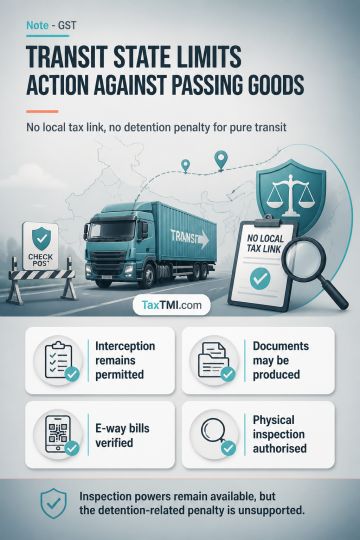
Transit GST jurisdiction limits detention penalties for documented inter-State supplies lacking a local taxable nexus.
Transit-State jurisdiction under GST permits interception, document production, e-way bill verification and authorised physical inspection of goods moving through an intermediate State. It does not, in a pure transit movement, support detention-related penalty for an external inter-State supply where origin and destination lie outside the intercepting State, no tax is payable there, and there is no evidence of diversion, local supply, fictitious or mismatched documents, or mismatch of goods. Cross-empowerment is administrative and does not create an independent territorial taxable nexus.
Case Laws SEBI
Show AI Summary
Shareholder ratification cannot cure preferential-issue fund diversion when disclosed objectives are abandoned, triggering securities-market fraud and disclosure concerns.
Post-facto shareholder approval cannot retrospectively validate diversion of preferential-issue proceeds contrary to issue-specific objects disclosed to shareholders and the market. A special resolution authorises the issue but does not permit unrestricted use of proceeds. Periodic deviation reporting, audit-committee review and utilisation disclosures promote transparency; they do not enable diversion followed by later regularisation. Immediate diversion, inadequate commercial justification and missing documentation may indicate that disclosed objects were not genuinely intended to be performed. Later amendment of corporate objects or shareholder ratification cannot cure a completed securities-market disclosure breach.
Case Laws Income Tax
Show AI Summary
Cross-border software payments require copyright-right, technical-service, and permanent-establishment analysis before withholding obligations are determined under applicable treaties.
Section 195 requires withholding only from a remittance to a non-resident that includes income chargeable in India. For software, royalty depends on transfer of copyright rights, not merely the right to install, access, use, or distribute a copyrighted article under restrictive terms. Where a DTAA is more beneficial, its royalty and FTS definitions control; treaty FTS may require technology to be made available. Amounts that are neither royalty nor FTS require consideration as business profits, ordinarily taxable only where profits are attributable to a permanent establishment. Composite payments require component-wise allocation and analysis.
Case Laws GST
Show AI Summary
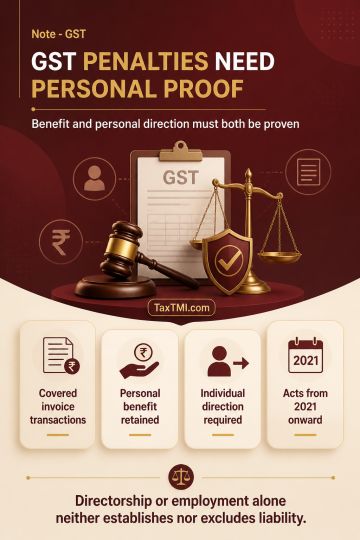
Personal GST penalty requires proof that the beneficiary retained benefit and directed a covered invoice or credit transaction.
Section 122(1A) may impose personal GST penalty on a registered or unregistered person only for a covered invoice or input tax credit transaction. Liability requires cumulative proof that the individual retained an identifiable personal benefit and that the transaction was conducted at that person's instance. Directorship, employment, registration, signature authority, or association with the taxable entity neither independently establishes nor excludes liability. Proceedings require transaction-specific and person-specific allegations and findings. The provision operates prospectively for underlying acts or transactions occurring on or after 01.01.2021.
Case Laws IBC
Show AI Summary
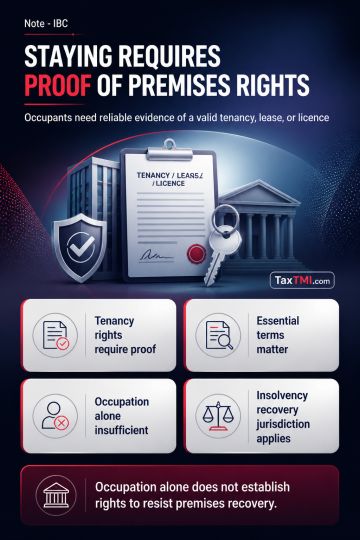
Proof of tenancy rights governs insolvency recovery of corporate-debtor premises from occupants lacking enforceable possessory interests.
Where premises form part of the corporate debtor's assets, Sections 18 and 25 of the Insolvency and Bankruptcy Code, 2016 require the resolution professional to take custody, control, preservation and protection measures. An occupant resisting recovery must prove a subsisting tenancy, leasehold interest or enforceable licence through reliable evidence of the parties' intended relationship and its essential terms. Permission to stock goods or conduct limited business activity, prolonged occupation, and business or utility records do not independently create rights in the premises. Section 60(5)(c) supports insolvency jurisdiction over asset-recovery measures connected with the insolvency estate.
Case Laws GST
Show AI Summary
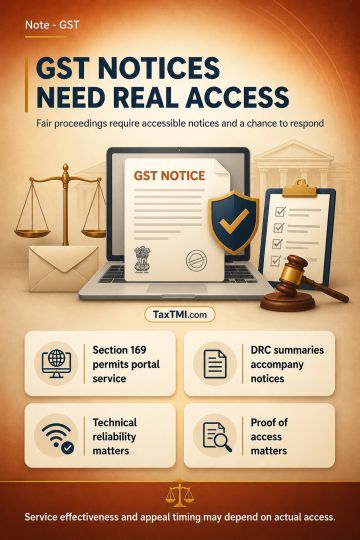
GST portal service requires statutory validity and practical accessibility before ex parte adjudication can fairly proceed.
GST portal service is a statutory method under Section 169, but its use in an ex parte demand proceeding depends on effective accessibility and a meaningful opportunity to reply and be heard. Rule 142 requires electronic DRC-01 and DRC-07 summaries to operate alongside the underlying show-cause notice and reasoned order. Portal placement, complete communication, e-mail transmission, technical reliability and proof of actual access may determine whether service is effective, whether waiver applies, and whether appellate limitation begins.
Case Laws Income Tax
Show AI Summary
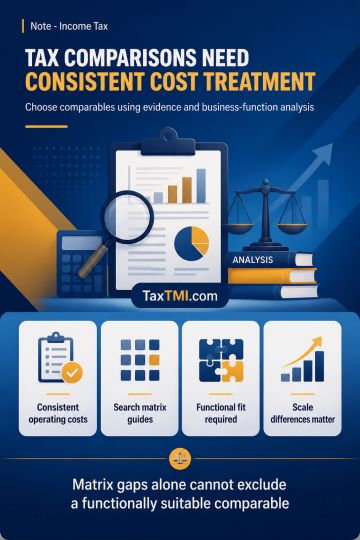
TNMM comparability requires consistent operating-cost treatment and FAR-based selection, while search matrices cannot replace evidence-led functional analysis.
TNMM requires consistent computation of operating profit and operating cost for the tested party and comparables. A provision for doubtful debts connected with sales and trade receivables may be an operating expense, as may routine business levies; income-tax on profits remains excluded. A search matrix is a disciplined evidentiary tool, not a statutory bar to an out-of-matrix comparable. Inclusion requires proof of functional fit, filter satisfaction and reasons for its absence, while rejection cannot rest solely on matrix absence. FAR analysis, segmental reliability and material scale differences govern comparability.
Case Laws Customs
Show AI Summary
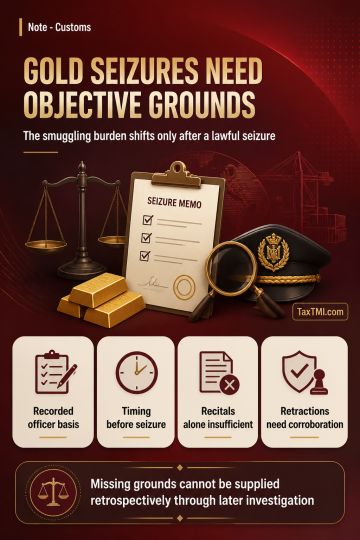
Reasonable belief in gold seizure requires recorded objective grounds before the reverse burden for smuggling can arise.
Gold seizure under Section 110 requires the proper officer to hold, before seizure, objectively supportable reasons to believe that goods are liable to confiscation. For gold, Section 123 shifts the burden of disproving smuggling only after a lawful seizure made in reasonable belief that the gold is smuggled. A general panchnama recital, foreign markings, high purity, or an uncorroborated retracted statement cannot alone establish that foundation. Reasons must exist contemporaneously and cannot be supplied retrospectively through later investigation.
Case Laws Income Tax
Show AI Summary
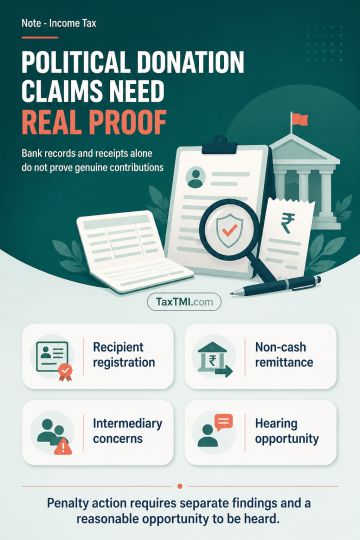
Political contribution deductions require proof that payments are genuine, not merely bank transfers, receipts, and recipient registration.
Registration of the recipient political party, non-cash remittance, banking records and donation receipts are necessary evidentiary facts for a political-contribution deduction, but do not conclusively prove a genuine contribution. Where credible material indicates an accommodation-entry arrangement involving return of funds through intermediaries, the claimant must substantiate the transaction and address taxpayer-specific circumstances. General allegations about a recipient cannot alone displace a claim without a sufficient nexus to the taxpayer's own payment. Penalty initiation requires separate determination of under-reporting or misreporting and a reasonable opportunity of hearing.
Case Laws GST
Show AI Summary
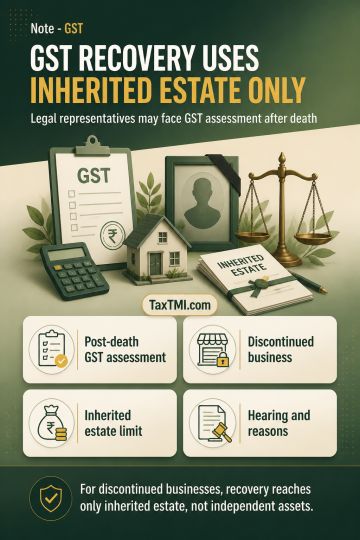
Estate-limited GST recovery permits post-death assessment of legal representatives while protecting heirs' independent assets after business discontinuance.
Section 93 permits post-death GST determination against a legal representative where a liable person dies. If the business is discontinued, tax, interest and penalty may be recovered only from the deceased's inherited estate and only within its capacity; the heir's independent assets remain outside that limit. Proceedings may be initiated without a pre-death notice, but must be addressed to the legal representative in that capacity, follow the applicable adjudication process, and provide hearing and a reasoned order.
Case Laws FEMA
Show AI Summary
Recorded reasons to believe govern foreign-asset seizure; non-confirmation requires appellate resolution before contradictory adjudication proceeds.
Section 37A permits seizure of equivalent domestic assets only where the authorised officer records written reasons to believe that foreign assets are held in contravention of FEMA. The competent authority must examine the material after hearing both sides and either confirm or set aside seizure. A reasoned non-confirmation based on an absent statutory threshold is substantive on seizure, though it does not finally decide the underlying contravention. Pending appeal, the adjudicating authority cannot displace that finding or adopt a contrary premise; Section 37A(4) applies only to confirmed seizure.
Case Laws Companies Law
Show AI Summary
Unstayed tribunal dismissal leaves former directors without corporate authority while banks follow valid company instructions amid management disputes.
Where an oppression and mismanagement petition has been dismissed, a pending appeal without an appellate stay does not itself restore a former director's authority or suspend the dismissal's operative effect. Sections 241 and 242 require statutory prejudice and prescribed Tribunal findings; procedural irregularities in director removal may be relevant but do not alone establish oppression. Banks should ordinarily follow formally authorised company instructions rather than decide unresolved management disputes, unless a binding judicial or statutory restraint applies.
Case Laws Benami Property
Show AI Summary
Benami property claims cannot be recast through wills or employment-based trust when pleadings assert beneficial ownership.
Benami-property claims based on a claimant's payment for property titled in another person's name may fall within the statutory definition when the property is alleged to be held for that claimant's benefit. A Will, succession claim, or other later instrument does not provide an independent basis of title where the pleaded foundation is restoration of beneficial ownership. The statutory scheme prohibits benami arrangements, bars enforcement of claimed beneficial ownership, and treats prohibited re-transfers as invalid; self-acquired title in the named holder's name does not displace the pleaded funding arrangement.
Case Laws Income Tax
Show AI Summary
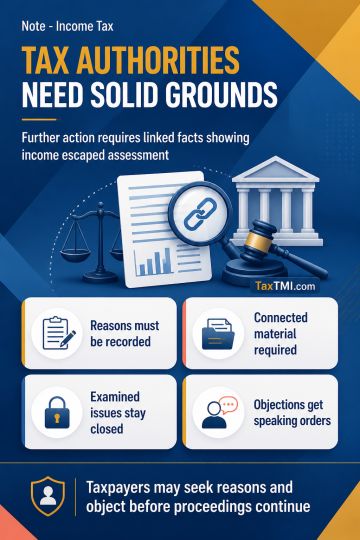
Reason to believe in reassessment requires tangible material, a live nexus, and recorded reasons; review of examined issues is barred.
Income-tax reassessment under Sections 147 and 148 is permissible only where recorded reasons, assessed at the time of notice, disclose a bona fide reason to believe that chargeable income escaped assessment. Final proof is unnecessary at that stage, but relevant tangible material must have a rational, live link to escapement. Reopening cannot be used to review an issue consciously examined and decided in the original scrutiny; nor can later or extraneous material supplement the recorded reasons. The taxpayer may seek the reasons, file focused objections, and receive a speaking order before reassessment continues.
Case Laws Income Tax
Show AI Summary
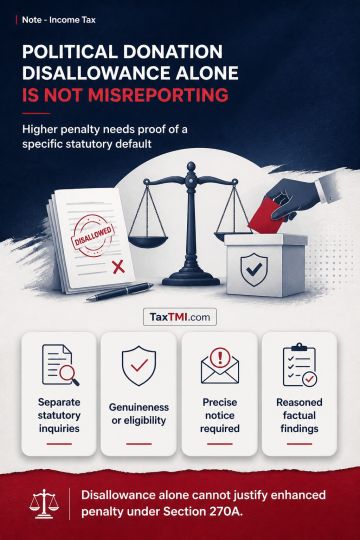
Political-donation deduction disallowance does not itself establish misreporting; enhanced penalty requires proof of a specific statutory default.
Disallowance of a political-contribution deduction under Section 80GGC and imposition of penalty under Section 270A are separate statutory inquiries. An adverse finding on genuineness or eligibility may raise assessed or reassessed income, but cannot alone establish misreporting. Enhanced penalty requires proof that the taxpayer's conduct falls within a specific Section 270A(9) category, supported by a precise notice and reasoned factual findings.
Case Laws Income Tax
Show AI Summary
Conditional charitable registration cannot suspend tax benefits pending litigation outside the statutory grant and cancellation framework.
Section 12AB permits the authority, after inquiry into objects, genuine activities and material legal compliance, to grant registration for the statutory period or reject the application. It does not create a contingent form of registration whose tax consequences await future litigation. Post-registration violations must be addressed through the separate cancellation process, requiring inquiry and hearing. Conditions in prescribed forms or administrative guidance may operationalise statutory duties but cannot create extra-statutory eligibility thresholds, future-conduct obligations or anticipatory cancellation consequences. Binding jurisdictional rulings remain applicable unless stayed, modified or reversed.
Case Laws Customs
Show AI Summary
Transaction value reassessment requires disclosed comparable evidence, while protest-qualified consent preserves appellate rights against enhanced customs valuation.
Transaction value under Section 14 and Rule 3 is the primary basis for valuing imported goods. Rule 12 permits rejection only where an objectively sustainable reasonable doubt persists after considering further information; on request, the grounds must be disclosed in writing and a hearing afforded. Redetermination must follow Rules 4 to 9 sequentially and rely on demonstrably comparable import data. Written acceptance of reassessment may dispense with a speaking order under Section 17(5), but protest-qualified or provisional-clearance correspondence may preserve the statutory right to appeal.
Case Laws GST
Show AI Summary
Leasehold rights assignment may fall outside GST when the lessee permanently transfers the entire proprietary estate.
GST treatment of assignment of leasehold rights turns on whether the lessee has made a complete transfer of its existing estate or continues to provide occupation or enjoyment. Where the assignor transfers the whole residual term, possession, building and associated rights, retains no reversionary or controlling interest, and the assignee succeeds directly to obligations towards the original lessor, the transaction may be characterised as transfer of benefits arising out of land rather than a supply of services. Labels such as premium, salami or transfer fee are not conclusive.

TMI Notes

Back

All TMI Notes

Showing Results for :
Reset Filters
No Records Found

TMI Notes

Back

All TMI Notes

Valuation of Inventory and Securities under Indian Tax Law : Clause 277 of the Income Tax Bill, 2025 and Section 145A of the Income-tax Act, 1961

9 June, 2025

Contents
Acts
Rules & Regulations
Summary
Note

Note

-

Bookmark

(New) -

Download

Print

Print

Clause 277 Method of accounting in certain cases.

Income Tax Bill, 2025

Introduction

The method of accounting for the purposes of determining income chargeable under the head "Profits and gains of business or profession" is a cornerstone of the Indian income-tax regime. Both Clause 277 of the proposed Income Tax Bill, 2025 and the existing Section 145A of the Income-tax Act, 1961, address the manner in which inventories, purchases, sales, and securities are to be valued for tax computation. The proper valuation of these items is critical, as it directly impacts the income reported and the resultant tax liability. Clause 277 seeks to consolidate, clarify, and, in some respects, modify the approach to inventory and securities valuation as compared to Section 145A. Both provisions are closely linked to the Income Computation and Disclosure Standards (ICDS), which provide the technical framework for the computation of taxable income. The legislative intent is to ensure consistency, transparency, and uniformity in the valuation process, thereby reducing litigation and ambiguity. This commentary provides a comprehensive analysis of Clause 277, examines its objectives, detailed provisions, practical implications, and compares it with the existing Section 145A, highlighting similarities, differences, and the potential impact on stakeholders.

Objective and Purpose

The primary objective of both Clause 277 and Section 145A is to prescribe a uniform and methodical approach to the valuation of inventory and securities for tax purposes. The valuation of inventory is not merely an accounting exercise; it directly affects the computation of business profits and, consequently, the taxable income. The legislative background reveals that prior to the introduction of Section 145A, there was considerable divergence in the methods adopted by taxpayers, leading to disputes and inconsistent tax treatment. The introduction of ICDS and the subsequent legislative amendments aimed to create a standardised approach, reducing the scope for subjective interpretation. Clause 277 in the Income Tax Bill, 2025, seeks to further this objective by expressly aligning the valuation mechanisms with the ICDS notified under the new regime, while also incorporating certain clarificatory and procedural modifications. The provision is intended to provide legal certainty, ensure compliance with accounting standards, and address issues that have arisen under the current law.

Detailed Analysis of Clause 277 of the Income Tax Bill, 2025

Clause 277 is structured into five sub-clauses, each addressing a specific aspect of the valuation of inventory, purchases, sales, and securities. Each sub-clause is analysed below:

1. Sub-clause (1): General Provisions for Valuation

  • Valuation of Inventory (Clause (i)): Inventory must be valued at the lower of actual cost or net realisable value (NRV), computed according to the ICDS notified u/s 276(2). This is consistent with the principle of prudence and aligns with standard accounting practice, ensuring that income is not overstated by carrying inventory at inflated values.
  • Adjustment for Taxes, Duties, Cess, or Fees (Clause (ii)): The value of purchases, sales, and inventory must be adjusted to include any tax, duty, cess, or fee actually paid or incurred to bring the goods or services to their present location and condition. This ensures that the cost basis reflects the total expenditure necessary to acquire or produce the goods, including statutory levies, and prevents manipulation of income by excluding such costs.
  • Valuation of Certain Securities (Clause (iii)): For securities not listed on a recognised stock exchange, or listed but not quoted regularly, the valuation must be at actual cost as initially recognised per ICDS. This provision prevents the use of notional or estimated values for illiquid securities, thereby reducing subjectivity and potential abuse.
  • Valuation of Other Securities (Clause (iv)): For all other securities (i.e., those regularly quoted on a recognised stock exchange), the valuation is at the lower of actual cost or NRV as per ICDS. This recognises the market-driven value for liquid securities, ensuring that unrealised losses are recognised, but not unrealised gains.

2. Sub-clause (2): Special Provisions for Scheduled Banks and Public Financial Institutions

This sub-clause provides that for scheduled banks or public financial institutions holding securities as inventory, the valuation must be as per ICDS, taking into account the Reserve Bank of India (RBI) guidelines. This recognises the special regulatory environment applicable to such entities and ensures that tax valuation is harmonised with prudential norms prescribed by the RBI.

3. Sub-clause (3): Category-wise Comparison for Securities

The comparison between actual cost and NRV for securities is to be made category-wise, rather than on an individual security basis. This is a significant procedural detail, as it allows for aggregation within categories, potentially smoothing out valuation fluctuations and aligning with practical portfolio management approaches.

4. Sub-clause (4): Definition of Taxes, Duties, Cess, or Fees

Any tax, duty, cess, or fee under any law in force is to be included in the valuation, irrespective of any right arising as a consequence of such payment. This clarifies that contingent or recoverable statutory levies are not to be excluded from the cost base, closing a potential loophole and ensuring consistency.

5. Sub-clause (5): Definition of Public Financial Institution

"Public financial institution" is defined by reference to section 2(72) of the Companies Act, 2013, ensuring that the term is interpreted consistently across statutes.

Practical Implications

The practical implications of Clause 277 are significant for businesses, financial institutions, and tax administrators:

  • Uniformity and Certainty: By mandating the use of ICDS and clarifying the treatment of taxes, duties, and securities, Clause 277 promotes uniformity in tax computation and reduces litigation.
  • Compliance Requirements: Taxpayers will need to ensure that their accounting systems are aligned with ICDS and that all relevant statutory levies are included in the cost base. This may require changes to ERP systems and internal controls.
  • Impact on Taxable Income: The requirement to include all statutory levies in the cost base may increase the value of inventory and reduce reported profits in the short term, but ensures that income is not artificially inflated or deflated.
  • Special Treatment for Banks and Financial Institutions: The reference to RBI guidelines recognises the unique nature of financial sector inventory (securities), ensuring that tax treatment does not conflict with prudential regulation.
  • Category-wise Valuation: This approach may benefit taxpayers by allowing losses in one security to offset gains in another within the same category, potentially reducing volatility in reported income.

Comparative Analysis with Section 145A of the Income-tax Act, 1961

A detailed comparison between Clause 277 and the existing Section 145A reveals both continuity and change. The following analysis addresses each key provision:

1. Valuation of Inventory

  • Section 145A: Inventory is to be valued at the lower of actual cost or NRV, in accordance with ICDS notified u/s 145(2).
  • Clause 277: The same principle is retained, but the reference is to ICDS notified under the new section 276(2). The language is nearly identical, preserving the substance of the existing law.
  • Implication: There is no substantive change in the principle; the shift is primarily to align with the restructured provisions of the new Income Tax Bill.

2. Adjustment for Statutory Levies

  • Section 145A: Requires the inclusion of any tax, duty, cess, or fee actually paid or incurred in the valuation of purchases, sales, and inventory.
  • Clause 277: Uses similar language, with a slight modification in phrasing ("valuation of purchase and sale of goods or services and valuation of inventory shall be adjusted to include..."). The substantive requirement is unchanged.
  • Implication: The approach is consistent, ensuring that the total cost reflects all statutory levies, closing loopholes for tax avoidance.

3. Valuation of Unlisted or Illiquid Securities

  • Section 145A: Unlisted securities, or those listed but not regularly quoted, are to be valued at actual cost as initially recognised per ICDS.
  • Clause 277: Repeats this requirement, with the reference updated to ICDS under the new section.
  • Implication: The principle of conservatism is maintained, preventing manipulation of values for illiquid securities.

4. Valuation of Listed Securities

  • Section 145A: Securities other than those covered above are to be valued at the lower of actual cost or NRV as per ICDS.
  • Clause 277: Mirrors this provision, ensuring continuity in the treatment of marketable securities.
  • Implication: The approach allows for recognition of unrealised losses but not gains, consistent with accounting prudence.

5. Special Provisions for Banks and Financial Institutions

  • Section 145A (Proviso): For scheduled banks and public financial institutions, securities are to be valued as per ICDS, after considering RBI guidelines.
  • Clause 277(2): Contains an equivalent provision, ensuring that the unique regulatory environment of these entities is respected.
  • Implication: The provision prevents conflicts between tax law and prudential regulation, maintaining systemic stability.

6. Category-wise Valuation

  • Section 145A (Proviso): The comparison of actual cost and NRV for securities is to be made category-wise.
  • Clause 277(3): Repeats this requirement, ensuring a practical and fair approach to portfolio valuation.
  • Implication: Aggregation within categories can mitigate the impact of market volatility on reported income.

7. Treatment of Taxes, Duties, Cess, or Fees

  • Section 145A (Explanation 1): Clarifies that all such payments are to be included in the cost base, even if a right arises as a consequence of such payment.
  • Clause 277(4): Contains an equivalent clarification, ensuring that contingent or recoverable levies are not excluded.
  • Implication: This closes a potential loophole where taxpayers might otherwise exclude certain statutory levies from the cost base.

8. Definitions

  • Section 145A (Explanation 2): Provides definitions for "public financial institution", "recognised stock exchange", and "scheduled bank" by reference to other statutes.
  • Clause 277(5): Only defines "public financial institution" by reference to the Companies Act, 2013. Other definitions are presumably addressed elsewhere in the new Bill or are considered sufficiently clear.
  • Implication: The omission of certain definitions may reflect a streamlining of the statutory text or a reliance on cross-references in the new legislative framework.

Key Differences and Potential Issues

While the substantive provisions of Clause 277 and Section 145A are closely aligned, a few differences and potential issues merit attention:

  • Reference to ICDS: The shift from section 145(2) to section 276(2) in Clause 277 reflects the reorganisation of the statute. Taxpayers and practitioners will need to familiarise themselves with the new cross-references.
  • Definitions: The omission of certain definitions in Clause 277 could lead to interpretational issues unless addressed elsewhere in the Bill.
  • Scope of "Goods or Services": Clause 277(1)(ii) refers to "goods or services", whereas Section 145A refers to "goods". This may reflect an intention to clarify that the provision applies equally to service providers, addressing potential ambiguities under the current law.
  • Procedural Clarity: The structure of Clause 277, with separate sub-clauses and explicit cross-references, may enhance clarity and ease of compliance.

Comparative Perspective: International Practices

The approach adopted in Clause 277 and Section 145A is broadly consistent with international accounting and tax standards, such as International Financial Reporting Standards (IFRS) and US Generally Accepted Accounting Principles (GAAP), which also require inventory to be valued at the lower of cost or market/NRV. The specific requirement to include statutory levies in the cost base is a distinctive feature of Indian tax law, reflecting the complex indirect tax environment.

Potential for Litigation and Need for Clarification

Despite the detailed provisions, certain areas may give rise to disputes:

  • Interpretation of "category-wise": The definition of categories for the purpose of securities valuation may be contested, especially for diversified portfolios.
  • Inclusion of Recoverable Taxes: The requirement to include taxes, duties, etc., even if recoverable, may be challenged by taxpayers seeking to exclude amounts for which they have a right of refund or credit.
  • Alignment with ICDS: Any divergence between ICDS and generally accepted accounting principles may lead to adjustments and disputes, particularly for multinational entities.

Conclusion

Clause 277 of the Income Tax Bill, 2025, represents a continuation and consolidation of the principles established in Section 145A of the Income-tax Act, 1961, with certain clarificatory and procedural refinements. The provision seeks to ensure uniformity, transparency, and legal certainty in the valuation of inventory and securities for tax purposes, aligning with the ICDS and accommodating the special regulatory environment applicable to banks and financial institutions. While the substantive approach remains largely unchanged, the explicit inclusion of "services", streamlined definitions, and clearer cross-references may enhance compliance and reduce litigation. However, certain interpretational challenges, particularly regarding category-wise valuation and the inclusion of statutory levies, may persist and require judicial clarification or further legislative guidance. The alignment of tax computation with accounting standards and regulatory guidelines is essential for maintaining the integrity of the tax system and ensuring that reported profits reflect economic reality. Clause 277, in conjunction with the ICDS, provides a robust framework for achieving these objectives, while also accommodating the evolving business and regulatory environment.


Full Text:

Clause 277 Method of accounting in certain cases.

Topics

Acts Income Tax