Loading...

⚠ ✕
❮ Top
☎ Help
☰
×

By creating an account you can:

Logo TaxTMI
Call Us / Help / Feedback✕

Contact Us At :

✉ E-mail: [email protected]

✆ To Call / Whatsapp, Check Contact Us

FAQs :

To know Frequently Asked Questions, Check FAQs

Most Asked Video Tutorials :

For more tutorials, Check Video Tutorials

Submit Feedback/Suggestion :

Email :
Please provide your email address so we can follow up on your feedback.
Category :
Description :
Min 15 characters 0/2000
Make Most of Text Search ✕
  1. Checkout this video tutorial: How to search effectively on TaxTMI.
  2. Put words in double quotes for exact word search, eg: "income tax"
  3. Avoid noise words such as : 'and, of, the, a'
  4. Sort by Relevance to get the most relevant document.
  5. Press Enter to add multiple terms/multiple phrases, and then click on Search to Search.
  6. Text Search
  7. The system will try to fetch results that contains ALL your words.
  8. Once you add keywords, you'll see a new 'Search In' filter that makes your results even more precise.
  9. Text Search
╳
Add to...
You have not created any category. Kindly create one to bookmark this item!
✕
Create New Category
Hide
Title :
Description :
❮❮ Hide
❮ Default View
Expand ❯❯
Close ✕
🔎 Filters / Advanced Search ❯
TEXT

Press 'Enter' to add multiple search terms. Rules for Better Search

Search In
Main Text + AI Text ❯
  • Main Text
  • Main Text + AI Text
  • AI Text
Law:
---- All Laws---- ❯
  • ---- All Laws----
  • Benami Property
  • Bill
  • Central Excise
  • Companies Law
  • Customs
  • DGFT
  • FEMA
  • GST
  • GST - States
  • IBC
  • Income Tax
  • Indian Laws
  • Money Laundering
  • SEBI
  • SEZ
  • Service Tax
  • VAT / Sales Tax
Types:
---- All Types ---- ❯
  • ---- All Types ----
  • Act Rules
  • Case Laws
  • Circulars
  • Manuals
  • News
  • Notifications
Sort By: ?
In Sort By 'Default', exact matches for text search are shown at the top, followed by the remaining results in their regular order.
Relevance Default Date
☰   Show Results ❯
    Monetary Limits for Departmental GST Appeals under Section 120 and Circular No. 207/1/2024-GST
    Alleged Re-use of E-Way Bills under Section 129: Evidentiary Burden in Detention Proceedings
    Turnover of Zero-Rated Supply Under Rule 89(4): Invoice Period and Subsequent Physical Export
    Case Laws Income Tax
    Reassessment Proceedings: Speaking Disposal of Objections Before Scrutiny Under Sections 143(2) and ...
    Suppression of Facts under Explanation 2 to Section 74 of the CGST Act in Cases of Ineligible Input ...
    Case Laws Customs
    Classification of Low-Ethoxylated Non-Ionic Fatty Alcohol Ethoxylates under Headings 3402 and 3824
    Case Laws Customs
    Seizure and Detention of Imported Cars under Sections 110, 110A and 124 of the Customs Act, 1962
    Case Laws Companies Law
    Lifting the Corporate Veil Where Promoter Shareholding Is Allegedly Dissipated Despite Judicial Assu...
    Consolidated Show Cause Notices under Sections 73 and 74 and Taxability of School Affiliation Servic...
    Fraudulent Input Tax Credit from Non-Existent Suppliers: Application of Sections 16, 74 and 155 of t...
    Case Laws Money Laundering
    Prolonged Pre-Trial Incarceration and Bail under Section 45 of the Prevention of Money-Laundering Ac...
    Case Laws Income Tax
    Prospective Operation of Section 56(2)(x)(b) in Stamp-Value Difference Cases Involving Immovable Pro...
    Seizure of Cash under Section 67 of the CGST Act and Interest on Illegal Retention
    Case Laws Income Tax
    Disallowance of Salary Expenditure for Allegedly Non-Genuine Services under Section 37
    Case Laws Income Tax
    Fair Market Value of Unquoted Equity Shares Under Section 56(2)(viib) and Rule 11UA
    Refund of Excess IGST Paid on Exports Following Clerical Error in FORM GSTR-3B
    Revocation of Cancellation of GST Registration for Non-Filing of Returns under Section 30 and Rule 2...
    Case Laws Income Tax
    TOLA, Section 149 and the Surviving-Time Test for Reassessment Proceedings
    Case Laws Customs
    Provisional Release of Unseized Imported Food Consignments under the Customs Act, 1962
    Case Laws Customs
    Recovery of Unpaid Anti-Dumping Duty After Self-Assessment Under Section 28 of the Customs Act, 1962
❮
❯
❯❯
Maximize Maximize Maximize
0 / 200
Expand Note
Add to Folder

No Folders have been created

+

Are you sure you want to delete "My most important" ?

NOTE:

Notes
Showing Results for :
Reset Filters
Results Found:
Show All Summaries Hide All Summaries
Case Laws GST
Show AI Summary
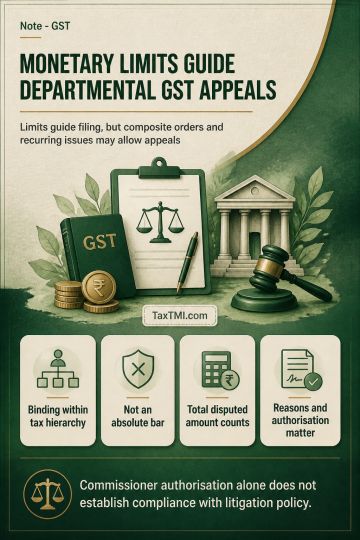
Departmental GST appeal monetary limits regulate officers, while composite orders and proven recurring issues may permit appeals.
Sections 120 and 168 of the Central Goods and Services Tax Act, 2017 make monetary-limit directions binding within the Central tax hierarchy, while they regulate the executive decision to file rather than create an inflexible jurisdictional bar before the Tribunal. In a composite order disposing of multiple appeals or demand notices, the relevant amount is the total disputed tax, interest, penalty or late fee, as applicable. The recurring or interpretative-issue exclusion requires a reasoned, case-specific basis, and Commissioner authorisation does not itself establish compliance with the litigation policy.
Case Laws GST
Show AI Summary
E-way bill re-use allegations require corroborated proof identifying the same goods; vehicle movement alone cannot establish contravention.
Alleged re-use of invoices and e-way bills requires the seizing authority to establish through positive, corroborated evidence that the intercepted goods are the same consignment previously transported under those documents. Toll data, vehicle movements and photographs may justify inquiry but do not alone prove prior delivery, identity of goods or re-use. Where invoices and e-way bills accompany the goods and physical verification shows no discrepancy, the authority must investigate and address any explanation of a different earlier consignment. Cases involving absent or expired transport documents remain factually distinct.
Case Laws GST
Show AI Summary
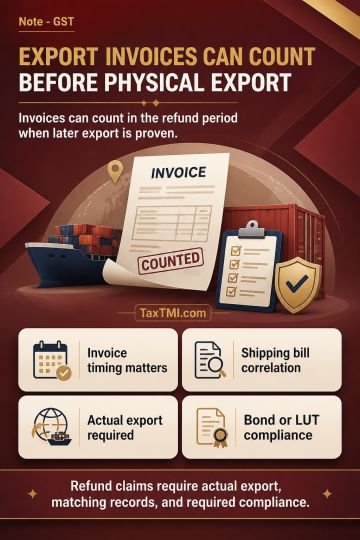
Zero-rated supply turnover includes export invoices from the refund period when actual export is subsequently established under bond or LUT.
Under Rule 89(4), invoice values for goods invoiced before or at removal for export under bond or Letter of Undertaking may be included in zero-rated turnover for the relevant refund period, although physical export occurs later. The invoice and removal determine period-wise attribution for the refund formula, while actual export remains essential to sustain the claim. Shipping bills, bills of export and related export records must correlate with the export invoices to establish that the goods were ultimately exported. Compliance with valuation, input tax credit eligibility and bond or Letter of Undertaking conditions remains necessary.
Case Laws Income Tax
Show AI Summary
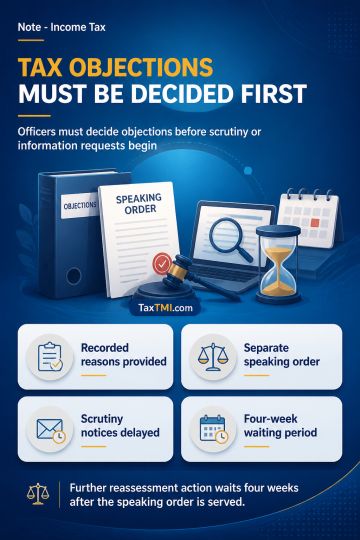
Reassessment objections require speaking disposal and a four-week pause before scrutiny or information requests can begin.
Under the pre-amendment Section 148 framework, reassessment jurisdiction must be resolved before merits-stage scrutiny begins. The Assessing Officer must furnish recorded reasons when requested, permit objections, and decide them through a separate speaking order. A Section 143(2) notice commences scrutiny, while a Section 142(1) notice is a substantive inquiry step; neither may issue before objections are decided. Following rejection, a four-week period from service of the speaking order must be allowed before further reassessment action, preserving an effective opportunity to challenge reopening.
Case Laws GST
Show AI Summary
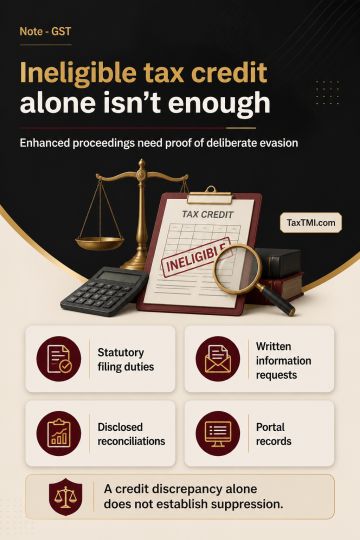
Suppression of facts requires proof of deliberate tax evasion; ineligible input tax credit alone cannot support enhanced proceedings.
Section 74 permits enhanced tax determination for wrongly availed or utilised input tax credit only where fraud, wilful misstatement, or suppression of facts to evade tax is established. Wrong or ineligible credit is distinct from substantive credit eligibility and cannot, without evidence of deliberate conduct and intent, amount to suppression. Under historical Explanation 2, suppression required either omitted information legally required in prescribed filings or failure to provide information sought in writing; both operate subject to the statutory evasion requirement. Disclosed reconciliations and portal records materially weaken a bare allegation of non-declaration.
Case Laws Customs
Show AI Summary
Organic surface-active agent classification requires water solubility and stability; phase-separating low-ethoxylated products fall outside Heading 3402.
Classification of low-ethoxylated non-ionic fatty alcohol ethoxylates under Heading 3402 requires satisfaction of the cumulative water test in Chapter Note 3. At the prescribed concentration, temperature, and standing period, the product must both remain a transparent or translucent liquid, or stable emulsion, without phase separation and reduce water surface tension to the stated threshold. Non-ionic character or surface activity alone is insufficient. Where a low-ethoxylated product separates into layers and fails the solubility and stability requirement, Heading 3824 may be considered after exclusion from Heading 3402.
Case Laws Customs
Show AI Summary
Lawful customs seizure requires recorded confiscation grounds, formal restraint where needed, and timely notice; detention cannot bypass safeguards.
Customs seizure of an imported car requires recorded reason to believe that it is liable to confiscation. A panchnama restraint cannot replace a lawful seizure order, an undertaking where seized goods remain in custody, or a served non-dealing order where seizure is impracticable. Section 110(2) requires prompt notice under Section 124, subject only to the prescribed extension mechanism. Prolonged effective detention cannot postpone those safeguards. Provisional release under Section 110A applies only to goods lawfully seized and cannot validate an earlier detention without statutory authority.
Case Laws Companies Law
Show AI Summary
Corporate veil-piercing permits forensic scrutiny in execution where promoter-controlled entities may dissipate shareholding despite judicial assurances.
Corporate veil-piercing in execution is an exceptional response where promoters allegedly use layered entities and securities transactions to deplete shareholding represented as security through judicial assurances. Separate personality remains the rule, and control or ownership alone does not suffice; there must be a nexus between control, misuse of the corporate form, and frustration of enforcement. A forensic audit reconstructs share movements, pledges, sales, financing, approvals, disclosures, and fund flows, distinguishing legitimate enforcement of pre-existing security from coordinated asset dissipation.
Case Laws GST
Show AI Summary
School affiliation services fall outside educational exemption without a direct nexus to admissions or examination conduct.
Consolidated show cause notices may combine financial years governed by Sections 73 and 74 where liabilities are segregated period-wise, each component independently meets limitation and notice requirements, the additional ingredients for fraud-based proceedings are satisfied, and no actual prejudice arises. School affiliation and affiliation-form processing charges are independent taxable supplies where they concern institutional eligibility and compliance, rather than directly and immediately relating to student admission or the conduct of examinations. A broad connection with education does not satisfy the educational-services exemption.
Case Laws GST
Show AI Summary
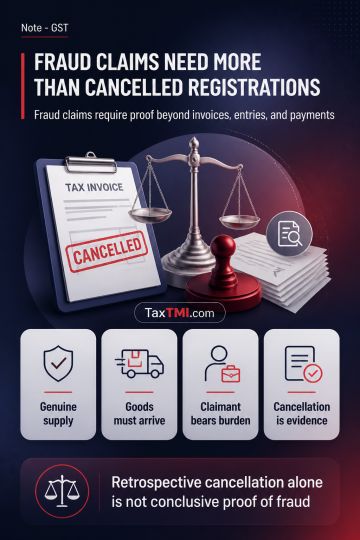
Fraudulent input tax credit requires proof of fictitious supplies, absent goods receipt, and fraud-linked self-assessment, not cancellation alone.
Input tax credit from allegedly non-existent suppliers depends on proof of genuine supply and actual receipt of goods or services, not merely invoices, accounting entries, or banking-channel payments. Section 155 places the burden of establishing ITC eligibility on the claimant. Section 74 requires more than ineligible credit: the wrongful availment must be linked to fraud, wilful misstatement, or suppression to evade tax. Retrospective supplier-registration cancellation is relevant evidence but is not conclusive. A fraud-based notice must disclose facts showing fictitious suppliers, absence of supply, and a basis for inferring the recipient's knowledge or participation.
Case Laws Money Laundering
Show AI Summary
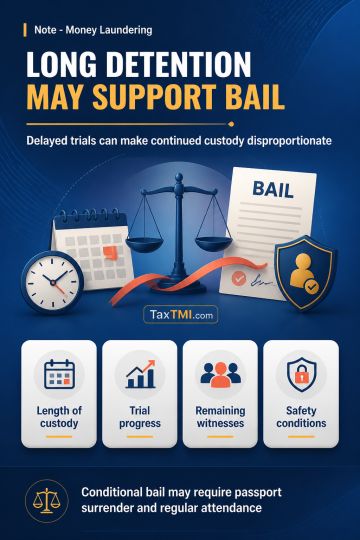
Prolonged pre-trial incarceration may justify conditional PMLA bail when delayed trials make continued detention constitutionally disproportionate.
Section 45 of the Prevention of Money-Laundering Act remains the stringent ordinary bail threshold, requiring prosecutorial opportunity and, on opposition, reasonable grounds to believe that the accused is not guilty and unlikely to offend while on bail. Article 21 nevertheless requires a separate, fact-sensitive inquiry where prolonged pre-trial detention and an unrealistic trial timetable make custody disproportionate. Relevant factors include custody length, trial progress, remaining witnesses, secured documentary evidence, source of delay, predicate-case status, and risks of absconding or witness interference. Conditions such as passport surrender, attendance, non-contact directions, and residence disclosure may safeguard the trial.
Case Laws Income Tax
Show AI Summary
Prospective operation of stamp-value taxation prevents retrospective application where property agreements and substantial payments predate the charging provision.
Section 56(2)(x)(b) applies to immovable property received for inadequate consideration only where its temporal and valuation conditions are satisfied. A stamp-value difference alone does not establish taxability. Where consideration was fixed and substantial payments or contractual performance occurred before the charging provision commenced, later conveyance or registration does not by itself attract the later charge. Agreement-date valuation is available only for covered transactions where consideration was fixed and paid, wholly or partly, through prescribed banking or electronic modes on or before the agreement date. The tax authority must identify the correct statutory basis and provide a meaningful opportunity to respond.
Case Laws GST
Show AI Summary
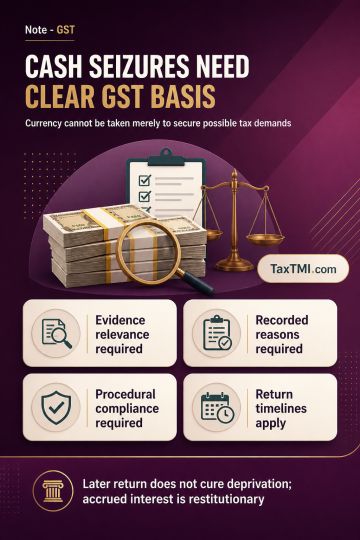
GST cash seizure limits require statutory relevance and restitutionary interest for unlawfully retained currency following searches.
GST seizure powers cannot be used to take cash as a general investigative measure or security for a possible tax demand. Currency is excluded from goods, and "things" is confined contextually to articles useful or relevant as evidence in GST proceedings. Valid seizure and retention require recorded statutory reasons, procedural compliance and observance of return timelines. Unauthorised retention engages property protections; later return does not cure the deprivation, and accrued interest is restitutionary rather than delayed-refund interest.
Case Laws Income Tax
Show AI Summary
Salary expense genuineness requires proof of actual services, business purpose, and fair testing of adverse third-party statements.
Under Section 37(1), salary expenditure is deductible only where it is actually incurred wholly and exclusively for business purposes and is supported by proof of genuine employment, services rendered, business nexus, and payment. Bank transfers and accounting entries alone are not conclusive. Where a third-party statement is central to an allegation of non-genuine salary, the taxpayer should receive disclosure and a meaningful opportunity to rebut it, including cross-examination where appropriate. A retracted and uncorroborated statement is vulnerable as the sole basis for disallowance.
Case Laws Income Tax
Show AI Summary
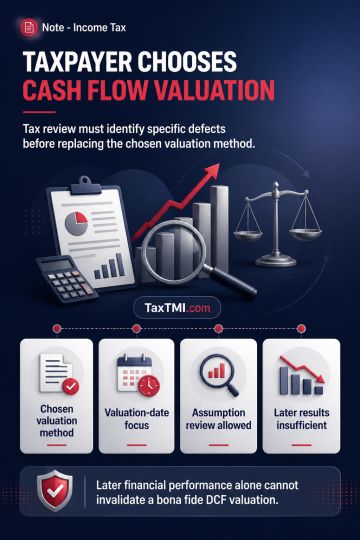
Discounted cash flow valuation remains taxpayer-selected under prescribed rules, while tax scrutiny must identify specific valuation-date defects.
The taxpayer may elect a prescribed DCF valuation for unquoted equity shares, and scrutiny of that method does not permit substitution with Net Asset Value merely because it produces a lower fair market value. The Assessing Officer may examine projections, discount rates, terminal assumptions, computations and source data, but rejection requires demonstrably wrong facts, material errors, a wholly erroneous basis or objectively unsupported assumptions. Subsequent financial performance cannot alone invalidate a bona fide DCF valuation; the relevant inquiry remains the reasonableness of valuation-date information.
Case Laws GST
Show AI Summary
Excess IGST on exports remains refundable when later correction triggers automated refund and reconciliation proves duplicate payment.
Refund of excess IGST paid on zero-rated exports may arise where turnover and tax are mistakenly entered under non-zero-rated supplies in FORM GSTR-3B while export invoices and shipping bills are correctly reported in FORM GSTR-1. If the exporter then pays the same IGST in the correct zero-rated field and the automated refund is credited against that later payment, the earlier payment remains a separately identifiable potential excess; its claim is not a repeat request for the same export-tax refund.
Case Laws GST
Show AI Summary
GST registration revocation requires timely application, return compliance, payment of dues, and a reasoned statutory decision.
GST registration revocation after cancellation for return default is a conditional, time-bound process. An application under Section 30 and Rule 23 must ordinarily be filed within ninety days, subject to prescribed extension, and cannot be made until pending returns are filed and tax, interest, penalty and late fee are paid. Portal non-acceptance may permit online or physical submission where technically unavailable, but does not condone delay or ensure revocation. The competent authority must assess statutory eligibility, sufficient grounds and compliance while following notice and hearing requirements before rejection.
Case Laws Income Tax
Show AI Summary
Reassessment limitation under TOLA requires final notices to issue within surviving time and satisfy statutory safeguards.
Reassessment limitation under TOLA is a jurisdictional restraint. Transitional notices issued between 1 April 2021 and 30 June 2021 are treated as Section 148A(b) show-cause notices, but only the surviving time remaining until 30 June 2021 is available for completing the reassessment process. Periods for supply of material and the assessee's response are excluded, but the Section 148A(d) decision, statutory approval and final Section 148 notice must issue within the remaining period. For Assessment Year 2015-16, post-1 April 2021 notices are treated as time-barred.
Case Laws Customs
Show AI Summary
Unseized food consignments cannot face indefinite detention without lawful seizure, valid sampling, and prompt assessment.
Provisional release of an unseized imported food consignment is not mechanically governed by Section 110A, which applies to goods seized under Section 110. Customs may examine, test, verify and reassess imports, but indefinite retention without a seizure memorandum or disclosed reasons connecting the goods with confiscation is not justified. Food sampling should follow the specialised food-safety process through an authorised officer. A valid food-safety report may support conditional clearance, while classification, duty liability, confiscation and adjudication remain open. Revenue may be protected through proportionate security.
Case Laws Customs
Show AI Summary
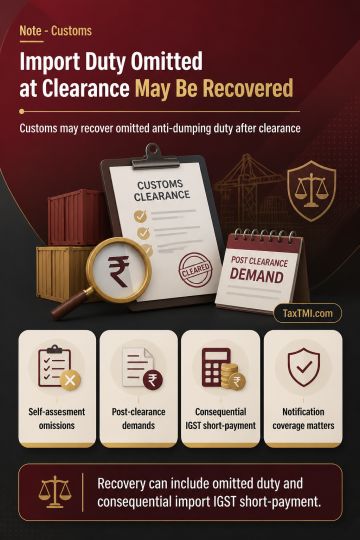
Anti-dumping duty recovery permits post-clearance demands and consequential import IGST where self-assessment omitted an applicable levy.
Unpaid anti-dumping duty omitted during self-assessment may be pursued through the customs recovery procedure without prior appellate modification of the self-assessment. The recovery framework applies to anti-dumping duty through statutory incorporation of provisions concerning assessment, non-levy, short-levy, interest and recovery. Where anti-dumping duty is chargeable, it forms part of the aggregate value used to compute IGST on imports, potentially creating a consequential IGST short-payment. Recovery requires accurate assessment of notification coverage, product, origin, rate, valuation, limitation and procedural safeguards.

TMI Notes

Back

All TMI Notes

Showing Results for :
Reset Filters
No Records Found

TMI Notes

Back

All TMI Notes

Legal and Administrative Framework Determining the Jurisdiction of Assessing Officers : Clause 242 of the Income Tax Bill, 2025 Vs. Section 124 of the Income-tax Act, 1961

29 May, 2025

Contents
Acts
Rules & Regulations
Summary
Note

Note

-

Bookmark

(New) -

Download

Print

Print

Clause 242 Jurisdiction of Assessing Officers.

Income Tax Bill, 2025

Introduction

Clause 242 of the Income Tax Bill, 2025, sets out the statutory framework governing the jurisdiction of Assessing Officers (AOs) under the proposed new regime. This provision is central to the administration of income tax, as it determines which AO is empowered to assess a particular taxpayer based on geographical or functional criteria. The concept of jurisdiction is crucial, as it directly impacts the validity of assessments, the rights of taxpayers, and the smooth functioning of the tax administration. Section 124 of the Income-tax Act, 1961, serves as the current statutory provision on the same subject. It has been the bedrock for resolving jurisdictional disputes and clarifying the powers and responsibilities of AOs since its enactment. With the introduction of Clause 242 in the 2025 Bill, the legislature appears to be aiming for greater clarity, modernization, and alignment with evolving administrative needs. The following commentary offers a detailed analysis of Clause 242, discussing its objectives, the legislative intent, its detailed provisions, practical implications, and a comparative analysis with Section 124 of the 1961 Act.

Objective and Purpose

The primary objective of Clause 242 is to delineate the jurisdiction of AOs with precision, thereby minimizing disputes and ensuring efficient tax administration. The provision seeks to:

  • Establish clear criteria for jurisdiction based on the location of business, profession, or residence.
  • Provide mechanisms for resolving jurisdictional disputes between different AOs or tax authorities.
  • Set time limits and procedural bars on when and how a taxpayer can challenge the jurisdiction of an AO.
  • Ensure that AOs retain their statutory powers over income arising within their assigned areas, even if there are disputes or ambiguities regarding jurisdiction.

Historically, jurisdictional challenges have been a significant source of litigation and administrative inefficiency. The legislative intent behind Clause 242 is to codify established principles, incorporate best practices, and address ambiguities or gaps that have arisen under the 1961 Act.

Detailed Analysis of Clause 242 of the Income Tax Bill, 2025

Clause 242 is structured into six sub-clauses, each addressing a specific aspect of jurisdiction:

Sub-clause (1): Determination of Jurisdiction Based on Area and Nature of Person

This sub-clause provides that an AO, vested with jurisdiction over a specified area by virtue of directions or orders u/s 241(1), (2), or (3), shall have jurisdiction:

  • (a) For persons carrying on business or profession: If the place of business or profession is situated within the area, or if the business/profession is conducted in more than one place, the principal place within the area determines jurisdiction.
  • (b) For other persons: Jurisdiction is based on the person's residence within the area.

This approach reflects the principle of territorial jurisdiction, aligning the AO's authority with the taxpayer's principal place of business or residence. It ensures administrative convenience and accessibility for both taxpayers and tax authorities.

Sub-clause (2): Resolution of Jurisdictional Disputes

When a question arises regarding whether an AO has jurisdiction to assess a particular person, the matter is to be determined by the "specified income-tax authority." This provides an internal administrative mechanism for resolving jurisdictional disputes, thereby reducing the scope for protracted litigation.

Sub-clause (3): Disputes Involving Multiple Authorities

If the jurisdictional question involves areas under different specified income-tax authorities, the following process applies:

  • (a) By the concerned specified authority: The authorities involved attempt to resolve the matter among themselves.
  • (b) If disagreement persists: The Central Board of Direct Taxes (CBDT) or an authority specified by the Board, through notification, will determine the question.

This hierarchical resolution mechanism ensures that disputes are escalated appropriately and resolved at the highest administrative level when necessary.

Sub-clause (4): Limitation on Challenging Jurisdiction

This sub-clause restricts the time frame within which a person can challenge the jurisdiction of the AO. The limitations are as follows:

  • (a) Where a return is filed: The challenge must be made within one month from the date of service of notice u/s 268(1) or 270(8), or before completion of assessment, whichever is earlier.
  • (b) Where no return is filed: The challenge must be made before the expiry of the time allowed by notice u/s 268(1) or 280(2) for filing the return, or u/s 271(2) for show cause, whichever is earlier.
  • (c) Where action is taken u/s 247 or 248: The challenge must be made within one month from the date of service of notice u/s 153C(2) of the 1961 Act or section 294(1)(a), or before completion of assessment, whichever is earlier.

By imposing strict timelines, this sub-clause aims to prevent belated objections that could disrupt or invalidate assessment proceedings.

Sub-clause (5): Referral of Jurisdictional Challenge

If an assessee raises a jurisdictional objection within the prescribed time, and the AO is not satisfied with the correctness of the claim, the AO must refer the matter for determination under sub-clause (2) or (3) before completing the assessment. This ensures that the assessment is not finalized until the jurisdictional question is resolved, thereby protecting taxpayer rights.

Sub-clause (6): Powers of Assessing Officers

This sub-clause provides that, notwithstanding anything in Clause 242 or any directions/orders u/s 241, every AO shall have all the powers conferred under the Act in respect of income accruing, arising, or received within the area over which he has jurisdiction. This ensures that AOs are fully empowered to act within their allocated jurisdiction, and that technicalities do not impede their statutory functions.

Practical Implications

The practical effects of Clause 242 are far-reaching:

  • For Taxpayers: There is clarity on which AO will handle their assessment, reducing uncertainty and the risk of multiple or conflicting assessments. The strict time bars on challenging jurisdiction mean that taxpayers must be vigilant and proactive if they wish to raise objections.
  • For Assessing Officers: The provision provides legal certainty and administrative backing, allowing AOs to proceed with assessments without fear of protracted jurisdictional disputes. The obligation to refer unresolved objections to higher authorities protects the process from arbitrariness.
  • For the Tax Administration: Centralized mechanisms for resolving disputes and the ability to escalate deadlocks to the Board ensure that the system remains efficient and responsive. The preservation of AO powers ensures continuity of tax collection and enforcement.

Comparative Analysis with Section 124 of the Income-tax Act, 1961

A close reading of Clause 242 and Section 124 reveals substantial similarities in structure and intent, but also certain notable differences and updates.

Similarities

  • Territorial Jurisdiction: Both provisions base the AO's jurisdiction on the principal place of business or residence of the taxpayer (Clause 242(1); Section 124(1)).
  • Resolution Mechanism: Both provide for administrative resolution of jurisdictional questions, escalating to higher authorities or the CBDT if necessary (Clause 242(2)-(3); Section 124(2)).
  • Limitation on Challenges: Both restrict the time frame for challenging jurisdiction, linking it to service of notice or completion of assessment (Clause 242(4); Section 124(3)).
  • Referral of Disputes: Both require the AO to refer unresolved jurisdictional objections for determination before assessment is completed (Clause 242(5); Section 124(4)).
  • Powers of AO: Both provisions confer full statutory powers on the AO within their jurisdiction (Clause 242(6); Section 124(5)).

Differences and Updates

  1. Reference to Preceding Sections:
    • Clause 242 refers to directions/orders u/s 241 of the 2025 Bill, whereas Section 124 refers to section 120 of the 1961 Act. This reflects the renumbering and reorganization of provisions in the new Bill.
  2. Specification of Authorities:
    • Section 124(2) explicitly lists authorities such as Principal Director General, Director General, Chief Commissioner, Commissioner, etc., whereas Clause 242 uses the generic term "specified income-tax authority." This may be intended to provide flexibility for future administrative reforms or restructuring.
  3. Cross-References to Notices and Sections:
    • Clause 242(4) refers to notices u/ss 263(1), 268(1), 270(8), 280(2), 271(2), 247, 248, 153C(2), and 294(1)(a), whereas Section 124(3) refers to notices u/ss 115WD, 139, 142, 115WE, 143, 115WH, 148, 115WF, 144, 132, 132A, 153A, and 153C. The new Bill appears to consolidate or renumber certain procedural provisions, possibly to streamline procedures or adapt to changes in tax administration (such as faceless assessments).
  4. Action under Search and Seizure:
    • Section 124(3)(c) specifically addresses actions u/ss 132 and 132A (search and seizure), referencing post-search assessment notices. Clause 242(4)(c) refers to actions u/ss 247 or 248 and notices u/s 153C(2) of the 1961 Act or section 294(1)(a), suggesting a possible change in the procedural framework for search-related assessments in the new Bill.
  5. Language and Structure:
    • Clause 242 adopts a more streamlined and generalized language, possibly to accommodate future administrative changes, including digital or centralized assessment systems.
  6. Non obstante Clause:
    • Both provisions include a non obstante clause in the final sub-section, reinforcing the AO's powers irrespective of any other directions or orders. However, Clause 242(6) refers to section 241(1)-(4), whereas Section 124(5) refers to section 120(1)-(2).

Comparative Table:-

Provision Section 124 of the Income-tax Act, 1961 Clause 242 of the Income Tax Bill, 2025 Key Differences / Observations
Basis of AO Jurisdiction Location of business/profession or residence, as per orders u/s 120(1) or (2). Same, but references orders u/s 241(1), (2), or (3). Section numbers updated to reflect the new Bill's structure.
Resolution of Jurisdictional Disputes By Principal DG/Director General/Chief Commissioner/Commissioner; Board is final arbiter. By "specified income-tax authority"; Board or its delegate is final arbiter. Terminology streamlined; likely to allow for more flexible administrative arrangements.
Time Bar for Challenging Jurisdiction Strict time limits based on service of notice or completion of assessment; covers various scenarios (returns, best judgment, search assessments). Similar time bars, but references to updated section numbers in the new Bill and cross-references to 1961 Act for certain notices. Reflects reorganization of procedural provisions; principle remains the same.
Procedure on Jurisdictional Objection AO must refer unresolved objections to higher authority before assessment. Same, with reference to new sub-clauses. No substantive change.
Non Obstante Clause (AO Powers) AO retains powers over income arising in their area, regardless of disputes. Same, with updated references. No substantive change.
Specificity and Clarity References to multiple designations (Principal DG, CCIT, etc.), reflecting complex hierarchy. Uses "specified income-tax authority", presumably defined elsewhere for clarity. Potentially streamlines administrative processes.
Coverage of Search/Seizure Assessments Explicit reference to sections 132, 132A, 153A, 153C (search and requisition assessments). References to sections 247, 248 (presumably new equivalents), and cross-references to section 153C(2) of 1961 Act. Reflects updated legislative framework.

Key Observations

  • While the structural and substantive framework remains largely unchanged, Clause 242 modernizes terminology and aligns cross-references with the new legislative scheme.
  • The use of "specified income-tax authority" rather than enumerating various designations may allow for greater flexibility as the administrative structure evolves.
  • The time limits and procedural bars on jurisdictional challenges are preserved, reflecting the legislative intent to prevent abuse of process and ensure timely assessments.
  • The preservation of AO powers, even in the face of jurisdictional disputes, is reaffirmed, ensuring continuity of tax administration.
  • The references to both new and existing section numbers (including cross-references to the 1961 Act) suggest a transitional approach, possibly to ensure that legacy cases are covered during the switch to the new regime.

Ambiguities and Potential Issues

Despite the clarity and continuity, certain potential issues and ambiguities merit attention:

  • Definition of "specified income-tax authority": The Bill's reliance on this term means that much will depend on how it is defined elsewhere. If not carefully defined, it could lead to confusion or administrative bottlenecks.
  • Transitional Provisions: The cross-referencing to sections of the 1961 Act (e.g., section 153C(2)) may create interpretive challenges during the transition period, especially if the corresponding provisions are not perfectly aligned.
  • Procedural Complexity: The multiple time bars and cross-references may be difficult for lay taxpayers to navigate, potentially leading to inadvertent forfeiture of rights.
  • Administrative Overlaps: While the use of "specified authority" streamlines the hierarchy, it may also blur lines of responsibility if not accompanied by clear administrative guidelines.

Practical Implications for Stakeholders

For Taxpayers

Taxpayers benefit from clear rules on which AO will handle their case, reducing the risk of multiple or overlapping assessments. However, the strict time limits for raising jurisdictional objections mean that taxpayers must be well-informed and act quickly if they wish to challenge the AO's authority. Failure to do so within the stipulated period will result in a waiver of the right to object.

For Tax Professionals and Advisors

Tax professionals must be vigilant in monitoring notices and deadlines, ensuring that any jurisdictional objections are raised promptly and with proper documentation. The streamlined escalation mechanism for disputes may reduce litigation, but also requires familiarity with the new administrative structure.

For Tax Administration

The provision enhances administrative efficiency by minimizing jurisdictional disputes and providing clear mechanisms for their resolution. The ability to escalate deadlocks to the Board ensures that disputes do not paralyze the assessment process.

Comparative Analysis with Other Jurisdictions

The approach adopted in Clause 242 is broadly consistent with international best practices, where tax authorities are vested with jurisdiction based on residence or location of business, and disputes are resolved administratively with limited scope for judicial intervention. The imposition of time bars on objections is also a common feature in advanced tax systems, aimed at ensuring finality and certainty in tax administration.

Conclusion

Clause 242 of the Income Tax Bill, 2025, represents a thoughtful and largely seamless modernization of the existing jurisdictional framework under Section 124 of the Income-tax Act, 1961. By preserving the core principles while updating terminology, cross-references, and administrative mechanisms, the provision balances the interests of taxpayers, tax professionals, and the revenue authorities. The strict procedural bars on jurisdictional challenges, the clear escalation mechanisms for disputes, and the preservation of AO powers collectively foster an efficient and robust tax administration. While certain ambiguities and transitional challenges may arise, particularly regarding the definition of "specified income-tax authority" and the interplay with legacy provisions, these are not insurmountable and can be addressed through administrative guidance and judicial clarification as necessary. The provision's alignment with international best practices and its clear focus on efficiency and certainty mark it as a significant and positive development in Indian tax law.


Full Text:

Clause 242 Jurisdiction of Assessing Officers.

Topics

Acts Income Tax