Loading...

⚠ ✕
❮ Top
☎ Help
☰
×

By creating an account you can:

Logo TaxTMI
Call Us / Help / Feedback✕

Contact Us At :

✉ E-mail: [email protected]

✆ To Call / Whatsapp, Check Contact Us

FAQs :

To know Frequently Asked Questions, Check FAQs

Most Asked Video Tutorials :

For more tutorials, Check Video Tutorials

Submit Feedback/Suggestion :

Email :
Please provide your email address so we can follow up on your feedback.
Category :
Description :
Min 15 characters 0/2000
Make Most of Text Search ✕
  1. Checkout this video tutorial: How to search effectively on TaxTMI.
  2. Put words in double quotes for exact word search, eg: "income tax"
  3. Avoid noise words such as : 'and, of, the, a'
  4. Sort by Relevance to get the most relevant document.
  5. Press Enter to add multiple terms/multiple phrases, and then click on Search to Search.
  6. Text Search
  7. The system will try to fetch results that contains ALL your words.
  8. Once you add keywords, you'll see a new 'Search In' filter that makes your results even more precise.
  9. Text Search
╳
Add to...
You have not created any category. Kindly create one to bookmark this item!
✕
Create New Category
Hide
Title :
Description :
❮❮ Hide
❮ Default View
Expand ❯❯
Close ✕
🔎 Filters / Advanced Search ❯
TEXT

Press 'Enter' to add multiple search terms. Rules for Better Search

Search In
Main Text + AI Text ❯
  • Main Text
  • Main Text + AI Text
  • AI Text
Law:
---- All Laws---- ❯
  • ---- All Laws----
  • Benami Property
  • Bill
  • Central Excise
  • Companies Law
  • Customs
  • DGFT
  • FEMA
  • GST
  • GST - States
  • IBC
  • Income Tax
  • Indian Laws
  • Money Laundering
  • SEBI
  • SEZ
  • Service Tax
  • VAT / Sales Tax
Types:
---- All Types ---- ❯
  • ---- All Types ----
  • Act Rules
  • Case Laws
  • Circulars
  • Manuals
  • News
  • Notifications
Sort By: ?
In Sort By 'Default', exact matches for text search are shown at the top, followed by the remaining results in their regular order.
Relevance Default Date
☰   Show Results ❯
    Monetary Limits for Departmental GST Appeals under Section 120 and Circular No. 207/1/2024-GST
    Alleged Re-use of E-Way Bills under Section 129: Evidentiary Burden in Detention Proceedings
    Turnover of Zero-Rated Supply Under Rule 89(4): Invoice Period and Subsequent Physical Export
    Case Laws Income Tax
    Reassessment Proceedings: Speaking Disposal of Objections Before Scrutiny Under Sections 143(2) and ...
    Suppression of Facts under Explanation 2 to Section 74 of the CGST Act in Cases of Ineligible Input ...
    Case Laws Customs
    Classification of Low-Ethoxylated Non-Ionic Fatty Alcohol Ethoxylates under Headings 3402 and 3824
    Case Laws Customs
    Seizure and Detention of Imported Cars under Sections 110, 110A and 124 of the Customs Act, 1962
    Case Laws Companies Law
    Lifting the Corporate Veil Where Promoter Shareholding Is Allegedly Dissipated Despite Judicial Assu...
    Consolidated Show Cause Notices under Sections 73 and 74 and Taxability of School Affiliation Servic...
    Fraudulent Input Tax Credit from Non-Existent Suppliers: Application of Sections 16, 74 and 155 of t...
    Case Laws Money Laundering
    Prolonged Pre-Trial Incarceration and Bail under Section 45 of the Prevention of Money-Laundering Ac...
    Case Laws Income Tax
    Prospective Operation of Section 56(2)(x)(b) in Stamp-Value Difference Cases Involving Immovable Pro...
    Seizure of Cash under Section 67 of the CGST Act and Interest on Illegal Retention
    Case Laws Income Tax
    Disallowance of Salary Expenditure for Allegedly Non-Genuine Services under Section 37
    Case Laws Income Tax
    Fair Market Value of Unquoted Equity Shares Under Section 56(2)(viib) and Rule 11UA
    Refund of Excess IGST Paid on Exports Following Clerical Error in FORM GSTR-3B
    Revocation of Cancellation of GST Registration for Non-Filing of Returns under Section 30 and Rule 2...
    Case Laws Income Tax
    TOLA, Section 149 and the Surviving-Time Test for Reassessment Proceedings
    Case Laws Customs
    Provisional Release of Unseized Imported Food Consignments under the Customs Act, 1962
    Case Laws Customs
    Recovery of Unpaid Anti-Dumping Duty After Self-Assessment Under Section 28 of the Customs Act, 1962
❮
❯
❯❯
Maximize Maximize Maximize
0 / 200
Expand Note
Add to Folder

No Folders have been created

+

Are you sure you want to delete "My most important" ?

NOTE:

Notes
Showing Results for :
Reset Filters
Results Found:
Show All Summaries Hide All Summaries
Case Laws GST
Show AI Summary
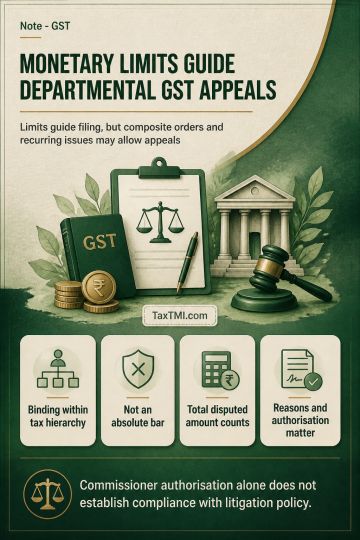
Departmental GST appeal monetary limits regulate officers, while composite orders and proven recurring issues may permit appeals.
Sections 120 and 168 of the Central Goods and Services Tax Act, 2017 make monetary-limit directions binding within the Central tax hierarchy, while they regulate the executive decision to file rather than create an inflexible jurisdictional bar before the Tribunal. In a composite order disposing of multiple appeals or demand notices, the relevant amount is the total disputed tax, interest, penalty or late fee, as applicable. The recurring or interpretative-issue exclusion requires a reasoned, case-specific basis, and Commissioner authorisation does not itself establish compliance with the litigation policy.
Case Laws GST
Show AI Summary
E-way bill re-use allegations require corroborated proof identifying the same goods; vehicle movement alone cannot establish contravention.
Alleged re-use of invoices and e-way bills requires the seizing authority to establish through positive, corroborated evidence that the intercepted goods are the same consignment previously transported under those documents. Toll data, vehicle movements and photographs may justify inquiry but do not alone prove prior delivery, identity of goods or re-use. Where invoices and e-way bills accompany the goods and physical verification shows no discrepancy, the authority must investigate and address any explanation of a different earlier consignment. Cases involving absent or expired transport documents remain factually distinct.
Case Laws GST
Show AI Summary
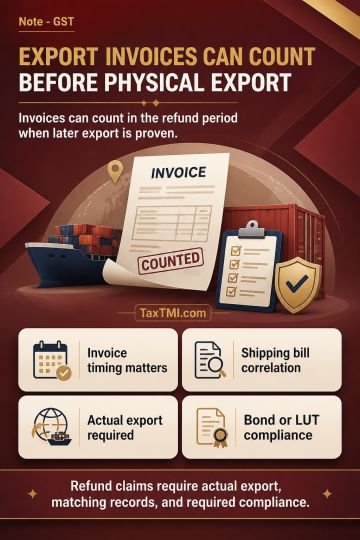
Zero-rated supply turnover includes export invoices from the refund period when actual export is subsequently established under bond or LUT.
Under Rule 89(4), invoice values for goods invoiced before or at removal for export under bond or Letter of Undertaking may be included in zero-rated turnover for the relevant refund period, although physical export occurs later. The invoice and removal determine period-wise attribution for the refund formula, while actual export remains essential to sustain the claim. Shipping bills, bills of export and related export records must correlate with the export invoices to establish that the goods were ultimately exported. Compliance with valuation, input tax credit eligibility and bond or Letter of Undertaking conditions remains necessary.
Case Laws Income Tax
Show AI Summary
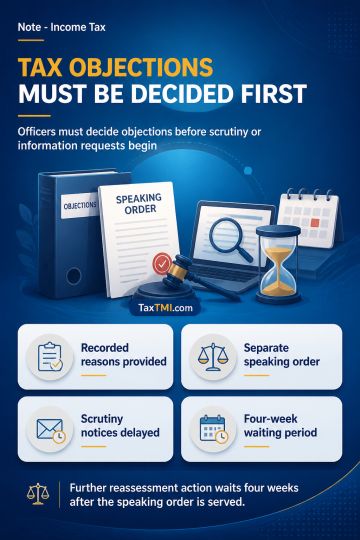
Reassessment objections require speaking disposal and a four-week pause before scrutiny or information requests can begin.
Under the pre-amendment Section 148 framework, reassessment jurisdiction must be resolved before merits-stage scrutiny begins. The Assessing Officer must furnish recorded reasons when requested, permit objections, and decide them through a separate speaking order. A Section 143(2) notice commences scrutiny, while a Section 142(1) notice is a substantive inquiry step; neither may issue before objections are decided. Following rejection, a four-week period from service of the speaking order must be allowed before further reassessment action, preserving an effective opportunity to challenge reopening.
Case Laws GST
Show AI Summary
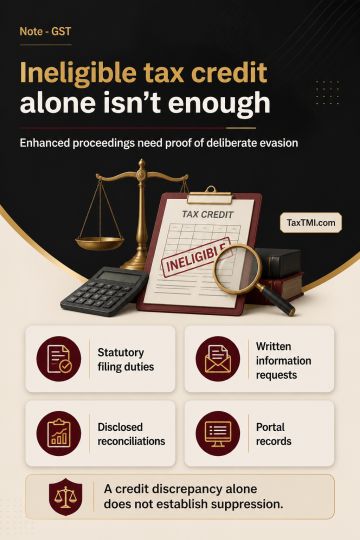
Suppression of facts requires proof of deliberate tax evasion; ineligible input tax credit alone cannot support enhanced proceedings.
Section 74 permits enhanced tax determination for wrongly availed or utilised input tax credit only where fraud, wilful misstatement, or suppression of facts to evade tax is established. Wrong or ineligible credit is distinct from substantive credit eligibility and cannot, without evidence of deliberate conduct and intent, amount to suppression. Under historical Explanation 2, suppression required either omitted information legally required in prescribed filings or failure to provide information sought in writing; both operate subject to the statutory evasion requirement. Disclosed reconciliations and portal records materially weaken a bare allegation of non-declaration.
Case Laws Customs
Show AI Summary
Organic surface-active agent classification requires water solubility and stability; phase-separating low-ethoxylated products fall outside Heading 3402.
Classification of low-ethoxylated non-ionic fatty alcohol ethoxylates under Heading 3402 requires satisfaction of the cumulative water test in Chapter Note 3. At the prescribed concentration, temperature, and standing period, the product must both remain a transparent or translucent liquid, or stable emulsion, without phase separation and reduce water surface tension to the stated threshold. Non-ionic character or surface activity alone is insufficient. Where a low-ethoxylated product separates into layers and fails the solubility and stability requirement, Heading 3824 may be considered after exclusion from Heading 3402.
Case Laws Customs
Show AI Summary
Lawful customs seizure requires recorded confiscation grounds, formal restraint where needed, and timely notice; detention cannot bypass safeguards.
Customs seizure of an imported car requires recorded reason to believe that it is liable to confiscation. A panchnama restraint cannot replace a lawful seizure order, an undertaking where seized goods remain in custody, or a served non-dealing order where seizure is impracticable. Section 110(2) requires prompt notice under Section 124, subject only to the prescribed extension mechanism. Prolonged effective detention cannot postpone those safeguards. Provisional release under Section 110A applies only to goods lawfully seized and cannot validate an earlier detention without statutory authority.
Case Laws Companies Law
Show AI Summary
Corporate veil-piercing permits forensic scrutiny in execution where promoter-controlled entities may dissipate shareholding despite judicial assurances.
Corporate veil-piercing in execution is an exceptional response where promoters allegedly use layered entities and securities transactions to deplete shareholding represented as security through judicial assurances. Separate personality remains the rule, and control or ownership alone does not suffice; there must be a nexus between control, misuse of the corporate form, and frustration of enforcement. A forensic audit reconstructs share movements, pledges, sales, financing, approvals, disclosures, and fund flows, distinguishing legitimate enforcement of pre-existing security from coordinated asset dissipation.
Case Laws GST
Show AI Summary
School affiliation services fall outside educational exemption without a direct nexus to admissions or examination conduct.
Consolidated show cause notices may combine financial years governed by Sections 73 and 74 where liabilities are segregated period-wise, each component independently meets limitation and notice requirements, the additional ingredients for fraud-based proceedings are satisfied, and no actual prejudice arises. School affiliation and affiliation-form processing charges are independent taxable supplies where they concern institutional eligibility and compliance, rather than directly and immediately relating to student admission or the conduct of examinations. A broad connection with education does not satisfy the educational-services exemption.
Case Laws GST
Show AI Summary
Fraudulent input tax credit requires proof of fictitious supplies, absent goods receipt, and fraud-linked self-assessment, not cancellation alone.
Input tax credit from allegedly non-existent suppliers depends on proof of genuine supply and actual receipt of goods or services, not merely invoices, accounting entries, or banking-channel payments. Section 155 places the burden of establishing ITC eligibility on the claimant. Section 74 requires more than ineligible credit: the wrongful availment must be linked to fraud, wilful misstatement, or suppression to evade tax. Retrospective supplier-registration cancellation is relevant evidence but is not conclusive. A fraud-based notice must disclose facts showing fictitious suppliers, absence of supply, and a basis for inferring the recipient's knowledge or participation.
Case Laws Money Laundering
Show AI Summary
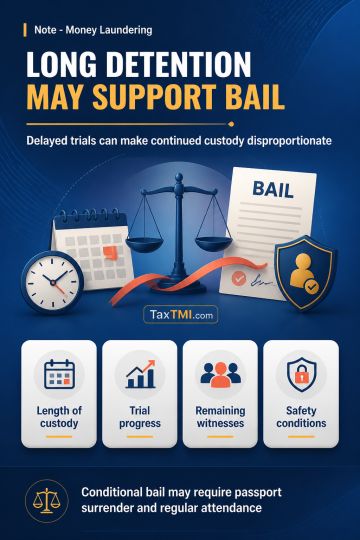
Prolonged pre-trial incarceration may justify conditional PMLA bail when delayed trials make continued detention constitutionally disproportionate.
Section 45 of the Prevention of Money-Laundering Act remains the stringent ordinary bail threshold, requiring prosecutorial opportunity and, on opposition, reasonable grounds to believe that the accused is not guilty and unlikely to offend while on bail. Article 21 nevertheless requires a separate, fact-sensitive inquiry where prolonged pre-trial detention and an unrealistic trial timetable make custody disproportionate. Relevant factors include custody length, trial progress, remaining witnesses, secured documentary evidence, source of delay, predicate-case status, and risks of absconding or witness interference. Conditions such as passport surrender, attendance, non-contact directions, and residence disclosure may safeguard the trial.
Case Laws Income Tax
Show AI Summary
Prospective operation of stamp-value taxation prevents retrospective application where property agreements and substantial payments predate the charging provision.
Section 56(2)(x)(b) applies to immovable property received for inadequate consideration only where its temporal and valuation conditions are satisfied. A stamp-value difference alone does not establish taxability. Where consideration was fixed and substantial payments or contractual performance occurred before the charging provision commenced, later conveyance or registration does not by itself attract the later charge. Agreement-date valuation is available only for covered transactions where consideration was fixed and paid, wholly or partly, through prescribed banking or electronic modes on or before the agreement date. The tax authority must identify the correct statutory basis and provide a meaningful opportunity to respond.
Case Laws GST
Show AI Summary
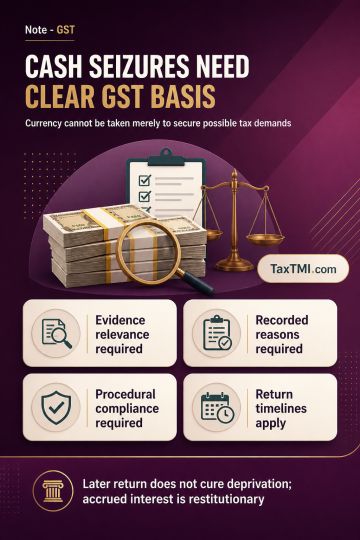
GST cash seizure limits require statutory relevance and restitutionary interest for unlawfully retained currency following searches.
GST seizure powers cannot be used to take cash as a general investigative measure or security for a possible tax demand. Currency is excluded from goods, and "things" is confined contextually to articles useful or relevant as evidence in GST proceedings. Valid seizure and retention require recorded statutory reasons, procedural compliance and observance of return timelines. Unauthorised retention engages property protections; later return does not cure the deprivation, and accrued interest is restitutionary rather than delayed-refund interest.
Case Laws Income Tax
Show AI Summary
Salary expense genuineness requires proof of actual services, business purpose, and fair testing of adverse third-party statements.
Under Section 37(1), salary expenditure is deductible only where it is actually incurred wholly and exclusively for business purposes and is supported by proof of genuine employment, services rendered, business nexus, and payment. Bank transfers and accounting entries alone are not conclusive. Where a third-party statement is central to an allegation of non-genuine salary, the taxpayer should receive disclosure and a meaningful opportunity to rebut it, including cross-examination where appropriate. A retracted and uncorroborated statement is vulnerable as the sole basis for disallowance.
Case Laws Income Tax
Show AI Summary
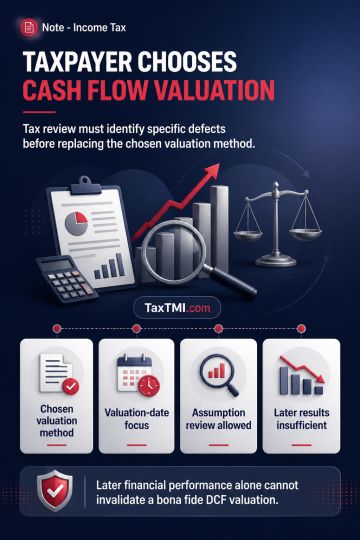
Discounted cash flow valuation remains taxpayer-selected under prescribed rules, while tax scrutiny must identify specific valuation-date defects.
The taxpayer may elect a prescribed DCF valuation for unquoted equity shares, and scrutiny of that method does not permit substitution with Net Asset Value merely because it produces a lower fair market value. The Assessing Officer may examine projections, discount rates, terminal assumptions, computations and source data, but rejection requires demonstrably wrong facts, material errors, a wholly erroneous basis or objectively unsupported assumptions. Subsequent financial performance cannot alone invalidate a bona fide DCF valuation; the relevant inquiry remains the reasonableness of valuation-date information.
Case Laws GST
Show AI Summary
Excess IGST on exports remains refundable when later correction triggers automated refund and reconciliation proves duplicate payment.
Refund of excess IGST paid on zero-rated exports may arise where turnover and tax are mistakenly entered under non-zero-rated supplies in FORM GSTR-3B while export invoices and shipping bills are correctly reported in FORM GSTR-1. If the exporter then pays the same IGST in the correct zero-rated field and the automated refund is credited against that later payment, the earlier payment remains a separately identifiable potential excess; its claim is not a repeat request for the same export-tax refund.
Case Laws GST
Show AI Summary
GST registration revocation requires timely application, return compliance, payment of dues, and a reasoned statutory decision.
GST registration revocation after cancellation for return default is a conditional, time-bound process. An application under Section 30 and Rule 23 must ordinarily be filed within ninety days, subject to prescribed extension, and cannot be made until pending returns are filed and tax, interest, penalty and late fee are paid. Portal non-acceptance may permit online or physical submission where technically unavailable, but does not condone delay or ensure revocation. The competent authority must assess statutory eligibility, sufficient grounds and compliance while following notice and hearing requirements before rejection.
Case Laws Income Tax
Show AI Summary
Reassessment limitation under TOLA requires final notices to issue within surviving time and satisfy statutory safeguards.
Reassessment limitation under TOLA is a jurisdictional restraint. Transitional notices issued between 1 April 2021 and 30 June 2021 are treated as Section 148A(b) show-cause notices, but only the surviving time remaining until 30 June 2021 is available for completing the reassessment process. Periods for supply of material and the assessee's response are excluded, but the Section 148A(d) decision, statutory approval and final Section 148 notice must issue within the remaining period. For Assessment Year 2015-16, post-1 April 2021 notices are treated as time-barred.
Case Laws Customs
Show AI Summary
Unseized food consignments cannot face indefinite detention without lawful seizure, valid sampling, and prompt assessment.
Provisional release of an unseized imported food consignment is not mechanically governed by Section 110A, which applies to goods seized under Section 110. Customs may examine, test, verify and reassess imports, but indefinite retention without a seizure memorandum or disclosed reasons connecting the goods with confiscation is not justified. Food sampling should follow the specialised food-safety process through an authorised officer. A valid food-safety report may support conditional clearance, while classification, duty liability, confiscation and adjudication remain open. Revenue may be protected through proportionate security.
Case Laws Customs
Show AI Summary
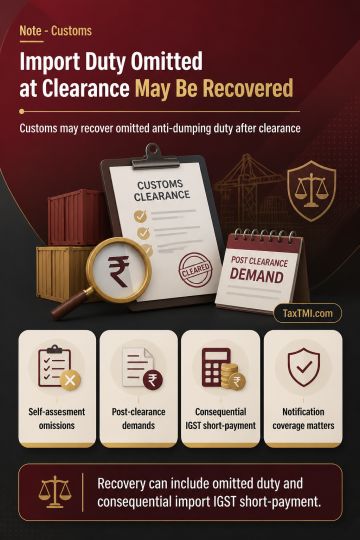
Anti-dumping duty recovery permits post-clearance demands and consequential import IGST where self-assessment omitted an applicable levy.
Unpaid anti-dumping duty omitted during self-assessment may be pursued through the customs recovery procedure without prior appellate modification of the self-assessment. The recovery framework applies to anti-dumping duty through statutory incorporation of provisions concerning assessment, non-levy, short-levy, interest and recovery. Where anti-dumping duty is chargeable, it forms part of the aggregate value used to compute IGST on imports, potentially creating a consequential IGST short-payment. Recovery requires accurate assessment of notification coverage, product, origin, rate, valuation, limitation and procedural safeguards.

TMI Notes

Back

All TMI Notes

Showing Results for :
Reset Filters
No Records Found

TMI Notes

Back

All TMI Notes

Evolution of Special Tax Regimes for Offshore Funds : Clause 208 of the Income Tax Bill, 2025 Vs. Section 115AB of the Income-tax Act, 1961

29 April, 2025

Contents
Acts
Rules & Regulations
Summary
Note

Note

-

Bookmark

(New) -

Download

Print

Print

Clause 208 Tax on income from units purchased in foreign currency or capital gains arising from their transfer.

Income Tax Bill, 2025

Introduction

Clause 208 of the Income Tax Bill, 2025 is a special statutory provision designed to govern the taxation of income earned by non-resident investors, specifically overseas financial organizations, from investments in units purchased in foreign currency and from capital gains arising from the transfer of such units. This clause is a successor to the existing Section 115AB of the Income-tax Act, 1961, a well-established provision that has, for decades, provided a concessional tax regime for offshore funds investing in India through specified channels. The evolution of this provision reflects India's ongoing efforts to attract foreign portfolio investment while ensuring tax clarity and compliance. The significance of these provisions lies in their impact on cross-border investments, the mutual fund industry, and India's image as an investment destination. By offering certainty and concessional tax rates, both Clause 208 and Section 115AB aim to foster the inflow of foreign capital, which is crucial for the development of domestic financial markets. At the same time, these provisions are tailored to prevent tax arbitrage and ensure that only qualifying entities benefit from the special regime. This commentary provides a detailed, itemized analysis of Clause 208, explores its legislative intent, practical implications, and addresses interpretational issues. It then undertakes a comprehensive comparative analysis with Section 115AB, highlighting both continuity and change, and concludes with observations on the likely impact and potential areas for further reform.

Objective and Purpose

The core objective of Clause 208, echoing that of Section 115AB, is to provide a special tax regime for overseas financial organizations (offshore funds) investing in units of mutual funds or the Unit Trust of India (UTI) using foreign currency. The legislative intent is twofold:

  1. Attracting Foreign Investment: By offering concessional tax rates and clear rules, the provision aims to incentivize foreign portfolio investment, thereby deepening the Indian capital markets and providing access to global capital for domestic enterprises.
  2. Ensuring Tax Certainty and Compliance: The provision sets out specific conditions, definitions, and compliance requirements to ensure that only genuine, regulated overseas financial entities benefit from the regime, thus preventing misuse and tax evasion.

Historically, Section 115AB was introduced in the early 1990s, a period marked by India's economic liberalization and opening up to foreign capital. The provision has since undergone amendments to keep pace with regulatory changes (such as the shift from the Foreign Exchange Regulation Act to the Foreign Exchange Management Act, and from the Companies Act, 1956 to the Companies Act, 2013), as well as evolving investment structures. Clause 208 of the Income Tax Bill, 2025 represents the next phase in this evolutionary process, aligning the law with current market realities, regulatory frameworks, and policy objectives.

Detailed Analysis of Clause 208 of the Income Tax Bill, 2025

Clause 208 is structured into three main sub-clauses, each addressing a distinct aspect of the tax regime for offshore funds.

1. Tax Rates on Specified Income

This clause 208(1) sets out the special tax rates applicable to different categories of income earned by an overseas financial organization (Offshore Fund):

Sl. No. Income Income-tax payable
1 Income received in respect of units purchased in foreign currency 10%
2 Long-term capital gains arising from the transfer of units purchased in foreign currency 12.5%
3 Total income as reduced by income referred to in 1 and 2 above Income-tax chargeable on such income (i.e., normal rates)

Interpretation and Implications:

  • Income from Units: Income (such as dividends or distributed income) received in respect of units purchased in foreign currency is taxed at a flat rate of 10%, providing a concessional regime compared to standard corporate or individual tax rates.
  • Long-Term Capital Gains (LTCG): LTCG arising from the transfer of such units is taxed at 12.5%, reflecting a recent increase (see comparative analysis below).
  • Other Income: Any income not covered under the above two heads is taxed at normal rates applicable to the entity, ensuring that the concessional regime is ring-fenced to specified income streams.
  • Aggregation: The provision requires aggregation of tax computed under each head for total tax liability, ensuring clarity and preventing double taxation.

2. Deductions and Computation of Gross Total Income

This clause 208(2) addresses the allowability of deductions and the computation of gross total income in two scenarios:

  1. Exclusive Income from Units or LTCG: Where the gross total income consists only of income from units or LTCG from their transfer, no deduction is allowed u/ss 26 to 61, section 93(1)(a) and (e), or under Chapter VIII.
  2. Mixed Income: Where the gross total income includes such income (from units or LTCG) along with other income:
    • The gross total income is to be reduced by the amount of such income (from units or LTCG); and
    • Deductions under Chapter VIII are allowed as if the reduced gross total income were the gross total income of the assessee.

Interpretation and Implications:

  • Ring-fencing of Concessional Income: The provision ensures that income eligible for concessional tax rates does not enjoy further deductions, thus preventing double benefits.
  • Fairness in Mixed Income Scenarios: Where the offshore fund has other income, deductions are allowed only against such other income, not against the concessional income, maintaining the integrity of the special regime.
  • Compliance Complexity: The requirement for precise segregation and computation of income streams may increase compliance burden for funds with complex portfolios.

3. Definitions

This clause 208(3) defines key terms for the purposes of Clause 208:

  • Overseas Financial Organisation: Any fund, institution, association, or body (incorporated or not) established under the laws of a country outside India, which:
    • Has entered into an arrangement for investment in India with a public sector bank, public financial institution, or a mutual fund specified in Schedule VII (Sl. No. 20 or 21); and
    • Such arrangement is approved by the Securities and Exchange Board of India (SEBI).
  • Public Financial Institution: As per section 2(72) of the Companies Act, 2013.
  • Unit: Unit of a mutual fund specified in Schedule VII (Sl. No. 20 or 21) or the Unit Trust of India.

Interpretation and Implications:

  • Strict Qualification Criteria: Only entities that meet the dual criteria of
    • (a) investment arrangement with specified Indian institutions, and
    • (b) SEBI approval, are eligible, ensuring regulatory oversight.
  • Updated References: The provision refers to the Companies Act, 2013 and Schedule VII, reflecting legislative updates and alignment with current regulatory frameworks.
  • Potential for Exclusion: Funds not meeting the precise definitional requirements, or investing through unapproved channels, do not benefit from the concessional regime.

Practical Implications

Clause 208, like its predecessor, has wide-ranging implications for various stakeholders:

  • Offshore Funds: The provision provides certainty and a competitive tax regime, making India an attractive destination for foreign portfolio investment. However, strict compliance with eligibility criteria and documentation is essential to avail the benefits.
  • Mutual Funds and UTI: The provision may increase flows into Indian mutual funds and UTI, boosting assets under management and market liquidity.
  • Regulators (SEBI, RBI): The requirement for SEBI approval and alignment with Indian financial institutions ensures regulatory oversight and prevents misuse.
  • Tax Administration: The clear segregation of income streams and denial of double deductions simplifies tax assessment but requires careful scrutiny of documentation and fund structures.
  • Market Impact: By offering a competitive, stable tax regime, the provision may enhance India's standing in global capital markets, though changes in rates (such as the increase in LTCG tax) may affect investment decisions.

Comparative Analysis: Clause 208 vs. Section 115AB

1. Scope and Structure

Both provisions apply to "overseas financial organisations" investing in units purchased in foreign currency, and both prescribe special tax rates for income from such units and capital gains from their transfer. However, Clause 208 streamlines the structure and updates references to align with contemporary legislation (e.g., Companies Act, 2013, instead of 1956). The definitions are consolidated and clarified, enhancing interpretive certainty.

2. Tax Rates

- Section 115AB: Originally provided a 10% rate for both income from units and long-term capital gains. The Finance (No. 2) Act, 2024, amended the rate for long-term capital gains to 12.5% for transfers on or after July 23, 2024.

- Clause 208: Directly incorporates the updated rates: 10% for income from units and 12.5% for long-term capital gains, thus codifying the recent amendment and providing a forward-looking framework. This harmonization of rates removes ambiguity about applicable rates for future transactions and reflects the legislative intent to align statutory law with recent policy changes.

3. Deductions and Exemptions

- Section 115AB: Prohibits deductions u/ss 28 to 44C, certain clauses of Section 57, and Chapter VI-A, and excludes the application of the second proviso to Section 48 for long-term capital gains.

- Clause 208: Prohibits deductions u/ss 26 to 61, Section 93(1)(a) and (e), and Chapter VIII. While the intent is similar-to prevent double benefits-the references to specific sections differ, reflecting the reorganization of the Income Tax Bill, 2025. The exclusion of the second proviso to Section 48 in Section 115AB, which relates to indexation benefits on capital gains, is not explicitly repeated in Clause 208, potentially requiring clarification to avoid interpretive disputes.

4. Definitions and Eligibility

- Section 115AB: Refers to mutual funds specified u/s 10(23D), public sector banks as defined in the same section, and public financial institutions as per Companies Act, 1956.

- Clause 208: Updates references to Schedule VII and the Companies Act, 2013, and clarifies the role of SEBI approval. The updated references bring the law in line with current statutes and regulatory practice, reducing the risk of interpretive confusion.

5. Procedural and Compliance Aspects

Both provisions require that the arrangement for investment be approved by SEBI. This ensures regulatory oversight and prevents abuse by non-genuine funds. However, Clause 208's language is more streamlined and avoids the piecemeal amendments that have characterized Section 115AB over the years. This should enhance compliance and reduce administrative burden.

6. Ambiguities and Potential Issues

- Indexation: Section 115AB explicitly denies indexation benefits for capital gains. Clause 208 is silent, which may create interpretive uncertainty unless clarified by rules or explanatory notes.

- Deduction References: The shift from Chapter VI-A (Section 115AB) to Chapter VIII (Clause 208) may have substantive implications, depending on how the chapters are structured in the new Bill.

- Definition of "Unit": The cross-references to Schedule VII in Clause 208 versus Section 10(23D) in Section 115AB may affect the scope of eligible investments, depending on how mutual funds are listed or defined in the respective schedules/sections.

Comparative Table: Key Provisions

Aspect Section 115AB of the Income-tax Act, 1961 Clause 208 of the Income Tax Bill, 2025
Eligible Assessee Overseas financial organisation (Offshore Fund) Overseas financial organisation (Offshore Fund)
Eligible Income Income from units & long-term capital gains Income from units & long-term capital gains
Tax Rate: Income from units 10% 10%
Tax Rate: Long-term capital gains 10% (prior to 23 July 2024); 12.5% (after) 12.5%
Deductions No deduction under Secs 28-44C, Section 57(i)/(iii), Chapter VI-A; no indexation No deduction under Secs 26-61, Section 93(1)(a)/(e), Chapter VIII
Approval Requirement Arrangement approved by SEBI Arrangement approved by SEBI
Definition of "Unit" Mutual fund under Section 10(23D) or UTI Mutual fund in Schedule VII or UTI
Reference to Companies Act Companies Act, 1956 Companies Act, 2013

Ambiguities and Issues in Interpretation

While both the old and new provisions are broadly clear, certain interpretational issues may arise:

  • Scope of "Units": The shift from Section 10(23D) to Schedule VII may require funds and tax authorities to carefully map which mutual funds are covered. Any changes in the list of eligible mutual funds could affect eligibility.
  • Eligibility Criteria: The requirement for SEBI approval and specific arrangements may exclude certain investment structures or funds investing through indirect or pooled vehicles.
  • Definition of "Foreign Currency": While Section 115AB provides a cross-reference to FEMA, Clause 208 is silent, though it may be presumed that the same definition applies.
  • Interaction with Other Provisions: The denial of deductions under specified sections may require careful computation, especially for funds with complex income streams.

Conclusion

Clause 208 of the Income Tax Bill, 2025 represents a considered continuation and modernization of the special tax regime for offshore funds investing in India. By codifying the updated concessional tax rates, refining definitions, and aligning with current statutory references, the provision maintains India's attractiveness as an investment destination while ensuring regulatory oversight and preventing abuse. The comparative analysis with Section 115AB reveals that the core principles and structure remain unchanged, with the main substantive change being the increase in the LTCG tax rate to 12.5%. The provision continues to balance the twin goals of attracting foreign investment and safeguarding the revenue base. Looking ahead, clarity regarding the scope of eligible mutual funds, the definition of foreign currency, and the interaction with other tax provisions will be important to ensure smooth implementation and continued investor confidence. Periodic review of tax rates and eligibility criteria may be warranted to keep pace with global competition and market developments.


Full Text:

Clause 208 Tax on income from units purchased in foreign currency or capital gains arising from their transfer.

Topics

Acts Income Tax