Loading...

⚠ ✕
❮ Top
☎ Help
☰
×

By creating an account you can:

Logo TaxTMI
Call Us / Help / Feedback✕

Contact Us At :

✉ E-mail: [email protected]

✆ To Call / Whatsapp, Check Contact Us

FAQs :

To know Frequently Asked Questions, Check FAQs

Most Asked Video Tutorials :

For more tutorials, Check Video Tutorials

Submit Feedback/Suggestion :

Email :
Please provide your email address so we can follow up on your feedback.
Category :
Description :
Min 15 characters 0/2000
Make Most of Text Search ✕
  1. Checkout this video tutorial: How to search effectively on TaxTMI.
  2. Put words in double quotes for exact word search, eg: "income tax"
  3. Avoid noise words such as : 'and, of, the, a'
  4. Sort by Relevance to get the most relevant document.
  5. Press Enter to add multiple terms/multiple phrases, and then click on Search to Search.
  6. Text Search
  7. The system will try to fetch results that contains ALL your words.
  8. Once you add keywords, you'll see a new 'Search In' filter that makes your results even more precise.
  9. Text Search
╳
Add to...
You have not created any category. Kindly create one to bookmark this item!
✕
Create New Category
Hide
Title :
Description :
❮❮ Hide
❮ Default View
Expand ❯❯
Close ✕
🔎 Filters / Advanced Search ❯
TEXT

Press 'Enter' to add multiple search terms. Rules for Better Search

Search In
Main Text + AI Text ❯
  • Main Text
  • Main Text + AI Text
  • AI Text
Law:
---- All Laws---- ❯
  • ---- All Laws----
  • Benami Property
  • Bill
  • Central Excise
  • Companies Law
  • Customs
  • DGFT
  • FEMA
  • GST
  • GST - States
  • IBC
  • Income Tax
  • Indian Laws
  • Money Laundering
  • SEBI
  • SEZ
  • Service Tax
  • VAT / Sales Tax
Types:
---- All Types ---- ❯
  • ---- All Types ----
  • Act Rules
  • Case Laws
  • Circulars
  • Manuals
  • News
  • Notifications
Sort By: ?
In Sort By 'Default', exact matches for text search are shown at the top, followed by the remaining results in their regular order.
Relevance Default Date
☰   Show Results ❯
    Case Laws Income Tax
    Retirement Leave Encashment Exemption under Section 10(10AA)(ii) and Retrospective Application of No...
    Transit-State Jurisdiction under GST: Limits on Detention and Penalty in External Inter-State Suppli...
    Post-Facto Shareholder Ratification of Diversion of Preferential Issue Proceeds under the PFUTP Regu...
    Case Laws Income Tax
    Section 195 Withholding on Payments to Non-Residents: Royalty, Fees for Technical Services and Busin...
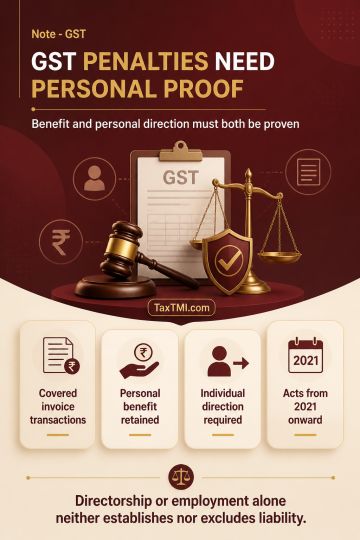
    Penalty: Scope of "Any Person" under Section 122(1A) of the Central Goods and Services Tax Act, 2017
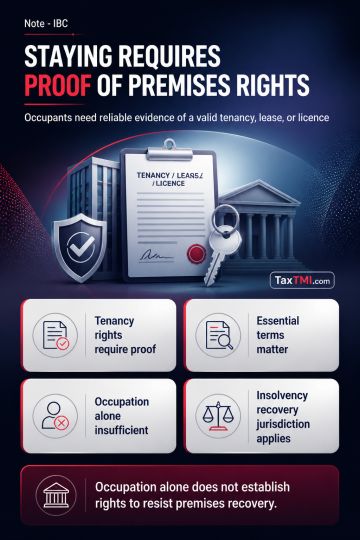
    Recovery of Corporate Debtor Premises and Proof of Tenancy, Lease or Licence Rights under the Insolv...
    Service of GST Notices through the Common Portal: Statutory Validity and Practical Accessibility
    Case Laws Income Tax
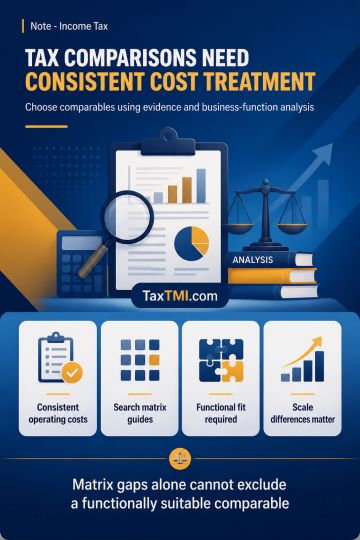
    TNMM Comparability: Operating Items, Search Matrix and Functional Analysis under Rule 10B
    Case Laws Customs
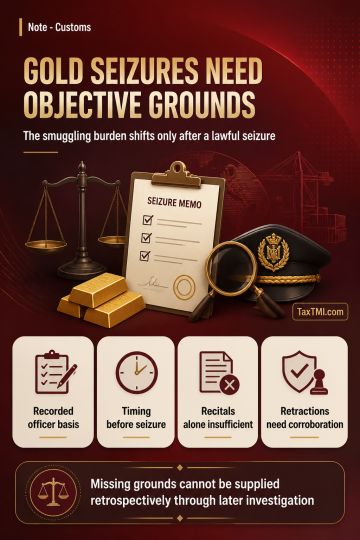
    Validity of Gold Seizure under Section 110 and the Conditional Reverse Burden under Section 123 of t...
    Case Laws Income Tax
    Deduction under Section 80GGC: Genuineness of Political Contributions and Evidentiary Burden
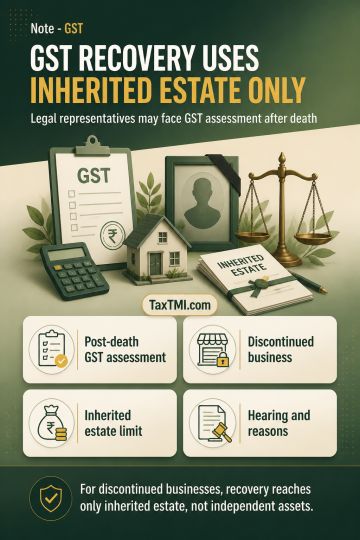
    Post-Death Determination of GST Liability and Estate-Limited Recovery from Legal Heirs
    Non-Confirmation of Seizure under Section 37A of FEMA and the Requirement of Recorded Reasons to Bel...
    Case Laws Companies Law
    Oppression and Mismanagement Proceedings under Sections 241 and 242: Corporate Authority During Pend...
    Case Laws Benami Property
    Benami Claims in Self-Acquired Property: Rejection of Plaint and the Limits of the Fiduciary-Capacit...
    Case Laws Income Tax
    Reopening of Assessment under Sections 147 and 148: Reason to Believe, Tangible Material and Change ...
    Case Laws Income Tax
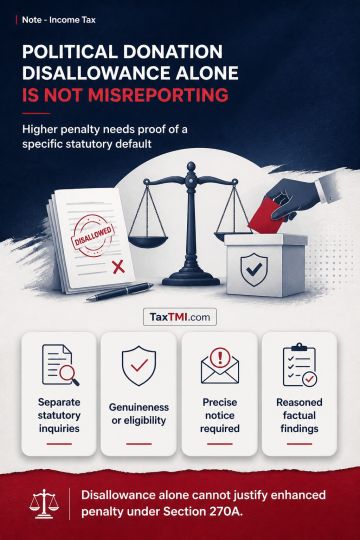
    Penalty under Section 270A on Disallowance of Political Donation Deduction under Section 80GGC
    Case Laws Income Tax
    Conditional Registration under Section 12AB and the Limits of Commissioner's Statutory Powers
    Case Laws Customs
    Transaction Value, Rule 12 and Enhancement Based on Consent Letters in Customs Valuation: Limits of ...
    GST on Assignment of Leasehold Rights: Distinguishing Transfer of Immovable Property from Supply of ...
    Case Laws Income Tax
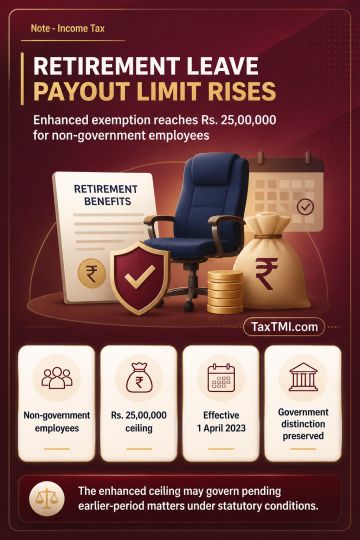
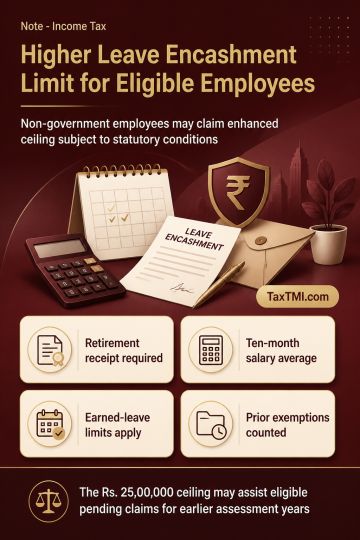
    Leave Encashment Exemption for Non-Government Employees under Section 10(10AA)(ii) and the Enhanced ...
❮
❯
❯❯
Maximize Maximize Maximize
0 / 200
Expand Note
Add to Folder

No Folders have been created

+

Are you sure you want to delete "My most important" ?

NOTE:

Notes
Showing Results for :
Reset Filters
Results Found:
Show All Summaries Hide All Summaries
Case Laws Income Tax
Show AI Summary
Retirement leave encashment exemption applies under the enhanced notified ceiling while preserving non-government employee classification and statutory conditions.
Section 10(10AA)(ii) governs retirement leave-encashment exemption for non-Government employees, subject to the ten-month earned-leave measure, average-salary computation, and the notified monetary ceiling. Notification No. 31/2023 specifies an enhanced ceiling of Rs. 25,00,000, is deemed effective from 1 April 2023, and certifies that retrospective effect causes no adverse effect. The enhanced ceiling is treated as a remedial rationalisation of an existing exemption and may govern pending earlier-period matters, while preserving the distinction between Government and non-Government employees.
Case Laws GST
Show AI Summary
Transit GST jurisdiction limits detention penalties for documented inter-State supplies lacking a local taxable nexus.
Transit-State jurisdiction under GST permits interception, document production, e-way bill verification and authorised physical inspection of goods moving through an intermediate State. It does not, in a pure transit movement, support detention-related penalty for an external inter-State supply where origin and destination lie outside the intercepting State, no tax is payable there, and there is no evidence of diversion, local supply, fictitious or mismatched documents, or mismatch of goods. Cross-empowerment is administrative and does not create an independent territorial taxable nexus.
Case Laws SEBI
Show AI Summary
Shareholder ratification cannot cure preferential-issue fund diversion when disclosed objectives are abandoned, triggering securities-market fraud and disclosure concerns.
Post-facto shareholder approval cannot retrospectively validate diversion of preferential-issue proceeds contrary to issue-specific objects disclosed to shareholders and the market. A special resolution authorises the issue but does not permit unrestricted use of proceeds. Periodic deviation reporting, audit-committee review and utilisation disclosures promote transparency; they do not enable diversion followed by later regularisation. Immediate diversion, inadequate commercial justification and missing documentation may indicate that disclosed objects were not genuinely intended to be performed. Later amendment of corporate objects or shareholder ratification cannot cure a completed securities-market disclosure breach.
Case Laws Income Tax
Show AI Summary
Cross-border software payments require copyright-right, technical-service, and permanent-establishment analysis before withholding obligations are determined under applicable treaties.
Section 195 requires withholding only from a remittance to a non-resident that includes income chargeable in India. For software, royalty depends on transfer of copyright rights, not merely the right to install, access, use, or distribute a copyrighted article under restrictive terms. Where a DTAA is more beneficial, its royalty and FTS definitions control; treaty FTS may require technology to be made available. Amounts that are neither royalty nor FTS require consideration as business profits, ordinarily taxable only where profits are attributable to a permanent establishment. Composite payments require component-wise allocation and analysis.
Case Laws GST
Show AI Summary
Personal GST penalty requires proof that the beneficiary retained benefit and directed a covered invoice or credit transaction.
Section 122(1A) may impose personal GST penalty on a registered or unregistered person only for a covered invoice or input tax credit transaction. Liability requires cumulative proof that the individual retained an identifiable personal benefit and that the transaction was conducted at that person's instance. Directorship, employment, registration, signature authority, or association with the taxable entity neither independently establishes nor excludes liability. Proceedings require transaction-specific and person-specific allegations and findings. The provision operates prospectively for underlying acts or transactions occurring on or after 01.01.2021.
Case Laws IBC
Show AI Summary
Proof of tenancy rights governs insolvency recovery of corporate-debtor premises from occupants lacking enforceable possessory interests.
Where premises form part of the corporate debtor's assets, Sections 18 and 25 of the Insolvency and Bankruptcy Code, 2016 require the resolution professional to take custody, control, preservation and protection measures. An occupant resisting recovery must prove a subsisting tenancy, leasehold interest or enforceable licence through reliable evidence of the parties' intended relationship and its essential terms. Permission to stock goods or conduct limited business activity, prolonged occupation, and business or utility records do not independently create rights in the premises. Section 60(5)(c) supports insolvency jurisdiction over asset-recovery measures connected with the insolvency estate.
Case Laws GST
Show AI Summary
GST portal service requires statutory validity and practical accessibility before ex parte adjudication can fairly proceed.
GST portal service is a statutory method under Section 169, but its use in an ex parte demand proceeding depends on effective accessibility and a meaningful opportunity to reply and be heard. Rule 142 requires electronic DRC-01 and DRC-07 summaries to operate alongside the underlying show-cause notice and reasoned order. Portal placement, complete communication, e-mail transmission, technical reliability and proof of actual access may determine whether service is effective, whether waiver applies, and whether appellate limitation begins.
Case Laws Income Tax
Show AI Summary
TNMM comparability requires consistent operating-cost treatment and FAR-based selection, while search matrices cannot replace evidence-led functional analysis.
TNMM requires consistent computation of operating profit and operating cost for the tested party and comparables. A provision for doubtful debts connected with sales and trade receivables may be an operating expense, as may routine business levies; income-tax on profits remains excluded. A search matrix is a disciplined evidentiary tool, not a statutory bar to an out-of-matrix comparable. Inclusion requires proof of functional fit, filter satisfaction and reasons for its absence, while rejection cannot rest solely on matrix absence. FAR analysis, segmental reliability and material scale differences govern comparability.
Case Laws Customs
Show AI Summary
Reasonable belief in gold seizure requires recorded objective grounds before the reverse burden for smuggling can arise.
Gold seizure under Section 110 requires the proper officer to hold, before seizure, objectively supportable reasons to believe that goods are liable to confiscation. For gold, Section 123 shifts the burden of disproving smuggling only after a lawful seizure made in reasonable belief that the gold is smuggled. A general panchnama recital, foreign markings, high purity, or an uncorroborated retracted statement cannot alone establish that foundation. Reasons must exist contemporaneously and cannot be supplied retrospectively through later investigation.
Case Laws Income Tax
Show AI Summary
Political contribution deductions require proof that payments are genuine, not merely bank transfers, receipts, and recipient registration.
Registration of the recipient political party, non-cash remittance, banking records and donation receipts are necessary evidentiary facts for a political-contribution deduction, but do not conclusively prove a genuine contribution. Where credible material indicates an accommodation-entry arrangement involving return of funds through intermediaries, the claimant must substantiate the transaction and address taxpayer-specific circumstances. General allegations about a recipient cannot alone displace a claim without a sufficient nexus to the taxpayer's own payment. Penalty initiation requires separate determination of under-reporting or misreporting and a reasonable opportunity of hearing.
Case Laws GST
Show AI Summary
Estate-limited GST recovery permits post-death assessment of legal representatives while protecting heirs' independent assets after business discontinuance.
Section 93 permits post-death GST determination against a legal representative where a liable person dies. If the business is discontinued, tax, interest and penalty may be recovered only from the deceased's inherited estate and only within its capacity; the heir's independent assets remain outside that limit. Proceedings may be initiated without a pre-death notice, but must be addressed to the legal representative in that capacity, follow the applicable adjudication process, and provide hearing and a reasoned order.
Case Laws FEMA
Show AI Summary
Recorded reasons to believe govern foreign-asset seizure; non-confirmation requires appellate resolution before contradictory adjudication proceeds.
Section 37A permits seizure of equivalent domestic assets only where the authorised officer records written reasons to believe that foreign assets are held in contravention of FEMA. The competent authority must examine the material after hearing both sides and either confirm or set aside seizure. A reasoned non-confirmation based on an absent statutory threshold is substantive on seizure, though it does not finally decide the underlying contravention. Pending appeal, the adjudicating authority cannot displace that finding or adopt a contrary premise; Section 37A(4) applies only to confirmed seizure.
Case Laws Companies Law
Show AI Summary
Unstayed tribunal dismissal leaves former directors without corporate authority while banks follow valid company instructions amid management disputes.
Where an oppression and mismanagement petition has been dismissed, a pending appeal without an appellate stay does not itself restore a former director's authority or suspend the dismissal's operative effect. Sections 241 and 242 require statutory prejudice and prescribed Tribunal findings; procedural irregularities in director removal may be relevant but do not alone establish oppression. Banks should ordinarily follow formally authorised company instructions rather than decide unresolved management disputes, unless a binding judicial or statutory restraint applies.
Case Laws Benami Property
Show AI Summary
Benami property claims cannot be recast through wills or employment-based trust when pleadings assert beneficial ownership.
Benami-property claims based on a claimant's payment for property titled in another person's name may fall within the statutory definition when the property is alleged to be held for that claimant's benefit. A Will, succession claim, or other later instrument does not provide an independent basis of title where the pleaded foundation is restoration of beneficial ownership. The statutory scheme prohibits benami arrangements, bars enforcement of claimed beneficial ownership, and treats prohibited re-transfers as invalid; self-acquired title in the named holder's name does not displace the pleaded funding arrangement.
Case Laws Income Tax
Show AI Summary
Reason to believe in reassessment requires tangible material, a live nexus, and recorded reasons; review of examined issues is barred.
Income-tax reassessment under Sections 147 and 148 is permissible only where recorded reasons, assessed at the time of notice, disclose a bona fide reason to believe that chargeable income escaped assessment. Final proof is unnecessary at that stage, but relevant tangible material must have a rational, live link to escapement. Reopening cannot be used to review an issue consciously examined and decided in the original scrutiny; nor can later or extraneous material supplement the recorded reasons. The taxpayer may seek the reasons, file focused objections, and receive a speaking order before reassessment continues.
Case Laws Income Tax
Show AI Summary
Political-donation deduction disallowance does not itself establish misreporting; enhanced penalty requires proof of a specific statutory default.
Disallowance of a political-contribution deduction under Section 80GGC and imposition of penalty under Section 270A are separate statutory inquiries. An adverse finding on genuineness or eligibility may raise assessed or reassessed income, but cannot alone establish misreporting. Enhanced penalty requires proof that the taxpayer's conduct falls within a specific Section 270A(9) category, supported by a precise notice and reasoned factual findings.
Case Laws Income Tax
Show AI Summary
Conditional charitable registration cannot suspend tax benefits pending litigation outside the statutory grant and cancellation framework.
Section 12AB permits the authority, after inquiry into objects, genuine activities and material legal compliance, to grant registration for the statutory period or reject the application. It does not create a contingent form of registration whose tax consequences await future litigation. Post-registration violations must be addressed through the separate cancellation process, requiring inquiry and hearing. Conditions in prescribed forms or administrative guidance may operationalise statutory duties but cannot create extra-statutory eligibility thresholds, future-conduct obligations or anticipatory cancellation consequences. Binding jurisdictional rulings remain applicable unless stayed, modified or reversed.
Case Laws Customs
Show AI Summary
Transaction value reassessment requires disclosed comparable evidence, while protest-qualified consent preserves appellate rights against enhanced customs valuation.
Transaction value under Section 14 and Rule 3 is the primary basis for valuing imported goods. Rule 12 permits rejection only where an objectively sustainable reasonable doubt persists after considering further information; on request, the grounds must be disclosed in writing and a hearing afforded. Redetermination must follow Rules 4 to 9 sequentially and rely on demonstrably comparable import data. Written acceptance of reassessment may dispense with a speaking order under Section 17(5), but protest-qualified or provisional-clearance correspondence may preserve the statutory right to appeal.
Case Laws GST
Show AI Summary
Leasehold rights assignment may fall outside GST when the lessee permanently transfers the entire proprietary estate.
GST treatment of assignment of leasehold rights turns on whether the lessee has made a complete transfer of its existing estate or continues to provide occupation or enjoyment. Where the assignor transfers the whole residual term, possession, building and associated rights, retains no reversionary or controlling interest, and the assignee succeeds directly to obligations towards the original lessor, the transaction may be characterised as transfer of benefits arising out of land rather than a supply of services. Labels such as premium, salami or transfer fee are not conclusive.
Case Laws Income Tax
Show AI Summary
Leave encashment exemption: Non-government employees may claim the enhanced notified ceiling subject to statutory computation conditions.
Retirement leave encashment received by employees other than Central or State Government employees falls under Section 10(10AA)(ii). Exemption depends on retirement, the ten-month earned-leave limit, average salary for the preceding ten months, earned-leave entitlement restrictions, aggregate limits, and prior exempt receipts. The enhanced notified ceiling of Rs. 25,00,000, deemed to operate from 1 April 2023, is treated in the Tribunal approach discussed as a beneficial rationalisation available to eligible pending claims for earlier assessment years, without displacing the statutory computation conditions.

TMI Notes

Back

All TMI Notes

Showing Results for :
Reset Filters
No Records Found

TMI Notes

Back

All TMI Notes

Continuing the legislative policy of incentivizing employment generation : Clause 146 of Income Tax Bill, 2025 vs. Section 80JJAA of Income Tax Act, 1961

18 April, 2025

Contents
Acts
Rules & Regulations
Summary
Note

Note

-

Bookmark

(New) -

Download

Print

Print

Clause 146 Deduction in respect of additional employee cost.

Income Tax Bill, 2025

Introduction

Clause 146 of the Income Tax Bill, 2025, introduces a statutory deduction in respect of "additional employee cost" for businesses, continuing the legislative policy of incentivizing employment generation. This provision, in essence, seeks to reward businesses that expand their workforce by offering a tax deduction of 30% of the additional employee cost for three consecutive tax years. The clause is a successor to and, in several respects, a re-enactment of Section 80JJAA of the Income-tax Act, 1961, which has been the cornerstone for such deductions for over two decades. The mechanism for compliance and reporting under this deduction is further detailed in Rule 19AB of the Income-tax Rules, 1962, which prescribes the form and manner of the accountant's report required to claim the deduction.

This commentary provides a comprehensive analysis of Clause 146, examining its objectives, operative provisions, and practical implications. It then undertakes a granular comparison with Section 80JJAA of the Income-tax Act, 1961 and Rule 19AB of the 1962 Rules, highlighting similarities, differences, and the legislative evolution. The discussion also considers interpretative challenges and compliance burdens, concluding with insights into the future direction of employment-linked tax incentives.

Objective and Purpose

The legislative intent behind Clause 146 is to promote formal employment by providing a fiscal incentive to businesses that increase their workforce. The deduction is designed to:

  • Encourage job creation in the formal sector;
  • Disincentivize cash-based or informal employment practices by requiring emoluments to be paid through traceable banking channels;
  • Promote long-term employment by restricting the deduction to employees who meet certain tenure thresholds;
  • Ensure that the incentive is not misused in cases of business restructuring, transfer, or mere reorganization;
  • Align with government policy objectives of inclusive economic growth and formalization of the labor market.

Historically, similar provisions have been introduced and refined since the late 1990s, reflecting the government's evolving approach to labor market interventions via tax policy. The shift from "additional wages paid to new workmen" to "additional employee cost" and the expansion to various sectors and business forms underscore the intent to make the incentive more inclusive and effective.

Detailed Analysis of Clause 146

1. Eligibility and Scope - Sub-sections (1) and (2)

Clause 146(1) applies to any assessee to whom Section 63 applies and whose gross total income includes profits and gains from business. The deduction is set at 30% of the "additional employee cost" incurred during the tax year. Sub-section (2) allows this deduction for three consecutive tax years, beginning with the year in which the employment is provided.

  • Scope of Assessee: The provision is broad, extending to all assessees with business income, subject to compliance with Section 63 (which likely pertains to audit requirements, akin to Section 44AB of the Income-tax Act, 1961).
  • Quantum and Duration: The deduction is substantial-30% of the additional employee cost for three years-making it a significant incentive for businesses to hire additional employees.

2. Conditions for Allowance - Sub-section (3)

Deduction is denied if:

  • The business is formed by splitting up or reconstruction of an existing business;
  • The business is acquired by transfer or business reorganization;
  • The assessee fails to furnish the prescribed accountant's report before the specified date.

These conditions are designed to prevent abuse of the provision by businesses that merely restructure or transfer existing operations without generating genuine new employment. The requirement for an accountant's report ensures a degree of third-party verification and compliance.

3. Exception for Revival - Sub-section (4)

An exception is carved out for businesses revived u/s 140(4) (presumably analogous to Section 33B of the Income-tax Act, 1961), allowing them to claim the deduction notwithstanding the splitting up or reconstruction restriction. This supports the policy of reviving sick industrial units.

4. Definitions and Exclusions - Sub-section (5)

a) Additional Employee Cost

Defined as the total emoluments paid/payable to additional employees during the tax year, or in the first year of a new business, all emoluments paid/payable to employees in that year. For existing businesses, the additional employee cost is nil if:

  • There is no increase in the number of employees compared to the preceding year; or
  • Emoluments are paid otherwise than by account payee cheque/draft, electronic clearing, or prescribed electronic modes.

b) Additional Employee

An "additional employee" is one whose employment increases the total number of employees as on the last day of the preceding tax year, but excludes:

  • Employees with emoluments exceeding Rs. 25,000 per month;
  • Employees for whom the government pays the entire Employees' Pension Scheme contribution;
  • Employees employed for less than 150 days (apparel/footwear/leather sectors) or 240 days (other sectors), with a carry-forward provision for those who meet the threshold in the succeeding tax year;
  • Employees not participating in a recognized provident fund.

c) Emoluments

"Emoluments" cover all sums paid or payable to an employee for employment, but exclude:

  • Employer contributions to pension/provident or other employee funds;
  • Lump-sum payments at termination, superannuation, or voluntary retirement (e.g., gratuity, severance, leave encashment, commuted pension).

5. Compliance and Reporting

A deduction is contingent upon furnishing a report of an accountant before the specified due date, with particulars as prescribed (likely by rules akin to Rule 19AB and Form 10DA).

Practical Implications

  • For Businesses: The provision offers a significant tax incentive, especially for labor-intensive sectors. However, it imposes strict compliance requirements, including payroll documentation, adherence to payment modes, and timely reporting.
  • For Employees: The provision indirectly promotes formal employment, provident fund participation, and discourages high-turnover or short-term contracts.
  • For Tax Administration: The provision demands robust verification and audit mechanisms, as the risk of inflated or fictitious employment claims is non-trivial.

Comparative Analysis with Section 80JJAA of the Income-tax Act, 1961

1. Structure and Scope

Both Clause 146 and Section 80JJAA provide for a 30% deduction of additional employee cost for three years. The eligibility conditions, quantum, and duration are substantially similar. However, certain drafting nuances and references differ, reflecting legislative modernization.

  • Applicability: Section 80JJAA applies to assessees subject to Section 44AB (tax audit), while Clause 146 refers to Section 63 (presumably the corresponding audit provision in the new Bill).
  • Business Types: Both provisions are agnostic to business type, covering all businesses with profits and gains.

2. Conditions and Exclusions

  • The anti-abuse conditions (splitting up, reconstruction, transfer, reorganization) are identical in both provisions.
  • The exception for revival of business (Section 33B in 80JJAA; Section 140(4) in Clause 146) is maintained, ensuring parity in policy for sick unit revival.
  • The requirement for an accountant's report, with particulars as prescribed, is present in both, though references to the relevant sections/rules differ due to the legislative framework.

3. Definitions

a) Additional Employee Cost

The definition and computation are nearly identical. Both provide that in the first year of a new business, all emoluments are treated as additional employee cost. For existing businesses, the cost is nil if there is no increase in employees or if emoluments are not paid through prescribed banking channels.

b) Additional Employee

The exclusion criteria for additional employees are the same:

  • Emoluments exceeding Rs. 25,000 per month;
  • Government fully pays Employees' Pension Scheme contribution;
  • Tenure less than 240 days (or 150 days for specified sectors), with the carry-forward/deeming provision;
  • Non-participation in recognized provident fund.

The only minor difference is the drafting style and explicit referencing to the relevant sections.

c) Emoluments

Both definitions are identical in substance, excluding employer contributions to funds and lump-sum terminal payments.

4. Sectoral Relaxation

Both provisions provide a relaxation for the apparel, footwear, and leather sectors by lowering the minimum days of employment from 240 to 150. The carry-forward mechanism for employees who meet the threshold in the succeeding year is also identically worded.

5. Compliance

Both provisions require an accountant's report, though the reference to the definition of "accountant" and the manner of furnishing the report may differ due to changes in the corresponding sections and rules in the new legislation.

6. Notable Differences

  • Section References: Clause 146 updates references to audit and revival sections, aligning with the new Bill's numbering and structure.
  • Drafting Clarity: The new clause is more succinct and modern in its language, potentially enhancing interpretative clarity.
  • Potential for Further Prescription: Clause 146 refers to "such other electronic mode as prescribed," leaving room for the rules to expand acceptable payment modes in the future, reflecting technological advancements.

Comparative Analysis with Rule 19AB of the Income-tax Rules, 1962

1. Purpose and Content

Rule 19AB prescribes the form and manner in which the accountant's report (Form 10DA) must be furnished to claim the deduction u/s 80JJAA. The rule is procedural, not substantive, but is critical for compliance.

2. Reporting Requirements

  • The report must be in Form 10DA, containing particulars about the additional employee cost, number of employees, emoluments paid, and compliance with all statutory conditions.
  • The report must be furnished along with the return of income, before the specified due date.

3. Alignment with Clause 146

Clause 146, while not prescribing the form, requires the furnishing of an accountant's report "as prescribed." It is expected that rules under the new Bill will mirror Rule 19AB, prescribing a similar (or updated) form and content for the report. The rationale and compliance burden remain the same.

4. Compliance Implications

  • For Assessees: The requirement for a detailed accountant's report imposes a documentation and verification burden, necessitating robust payroll and HR systems.
  • For Accountants: The reporting obligation requires careful verification of eligibility, quantum, and compliance with all conditions, increasing professional responsibility and potential liability.
  • For Tax Authorities: The standardized report facilitates easier verification and audit of claims, helping prevent abuse.

5. Potential Issues and Ambiguities

  • Interpretation of "Additional Employee": Determining whether an employee truly increases the workforce may be complex in cases of attrition and re-hiring.
  • Mode of Payment: With evolving payment technologies, the definition of "prescribed electronic modes" may require periodic updating.
  • Overlap in Tenure Calculation: The carry-forward provision for employees who cross the tenure threshold in the succeeding year may create administrative complexity.

Conclusion

Clause 146 of the Income Tax Bill, 2025, represents a continuation and refinement of the employment-linked deduction regime established u/s 80JJAA of the Income-tax Act, 1961. The provision is well-calibrated to incentivize genuine job creation, with robust anti-abuse safeguards and compliance requirements. Its alignment with the existing legal framework ensures continuity and familiarity for taxpayers and practitioners, while updated drafting and references accommodate legislative modernization.

The practical impact of Clause 146 will depend on the clarity of rules to be prescribed (especially regarding reporting and acceptable payment modes), the capacity of businesses to comply with documentation requirements, and the vigilance of tax authorities in verifying claims. As the economy and labor market evolve, further refinements may be necessary to address new forms of employment and payment, and to ensure the incentive continues to serve its intended purpose of fostering formal, long-term employment in India.


Full Text:

Clause 146 Deduction in respect of additional employee cost.

Topics

Acts Income Tax