

Loading...

⚠ ✕
❮ Top
☎ Help
Draft upto 3 replies to a
tax notice — FREE 🎉 ✕

150 credits · 30 days

• Basic Search → 1 Credit
• Advanced Search → 3 Credits
• Drafter → 20 to extract + 25 per issue
(≈ upto 2-3 drafts on us)

Already used our earlier 20-Credit Demo?
You are still eligible for this new 150-Credit Demo.

Activate your FREE Demo →
☰
×

By creating an account you can:

Logo TaxTMI
Call Us / Help / Feedback✕

Contact Us At :

✉ E-mail: [email protected]

✆ Call / WhatsApp at: +91 99117 96707

For more information, Check Contact Us

FAQs :

To know Frequently Asked Questions, Check FAQs

Most Asked Video Tutorials :

For more tutorials, Check Video Tutorials

Submit Feedback/Suggestion :

Email :
Please provide your email address so we can follow up on your feedback.
Category :
Description :
Min 15 characters 0/2000
Make Most of Text Search ✕
  1. Checkout this video tutorial: How to search effectively on TaxTMI.
  2. Put words in double quotes for exact word search, eg: "income tax"
  3. Avoid noise words such as : 'and, of, the, a'
  4. Sort by Relevance to get the most relevant document.
  5. Press Enter to add multiple terms/multiple phrases, and then click on Search to Search.
  6. Text Search
  7. The system will try to fetch results that contains ALL your words.
  8. Once you add keywords, you'll see a new 'Search In' filter that makes your results even more precise.
  9. Text Search
╳
Add to...
You have not created any category. Kindly create one to bookmark this item!
✕
Create New Category
Hide
Title :
Description :
❮❮ Hide
❮ Default View
Expand ❯❯
Close ✕
🔎 Filters / Advanced Search ❯
TEXT

Press 'Enter' to add multiple search terms. Rules for Better Search

Search In
Main Text + AI Text ❯
  • Main Text
  • Main Text + AI Text
  • AI Text
Category: ?
Categorized by AI
---- All Categories ---- ❯
  • ---- All Categories ----
  • Income Tax
  • GST
  • Customs, DGFT & SEZ
  • FEMA & RBI
  • Corp. Laws, SEBI & IBC
  • PMLA, Black Money & ED
  • Budget
  • News and Press Release
  • PTI News
Month:
---- All Months ---- ❯
  • ---- All Months ----
  • January
  • February
  • March
  • April
  • May
  • June
  • July
  • August
  • September
  • October
  • November
  • December
Year:
---- All Years ---- ❯
  • ---- All Years ----
  • 2026
  • 2025
  • 2024
  • 2023
  • 2022
  • 2021
  • 2020
  • 2019
  • 2018
  • 2017
  • 2016
  • 2015
  • 2014
  • 2013
  • 2012
  • 2011
Sort By: ?
In Sort By 'Default', exact matches for text search are shown at the top, followed by the remaining results in their regular order.
Relevance Default Date
    25th Meeting of SCO Ministers Responsible for Economic and Foreign Trade Activities Held in Tajikistan
    India–Nepal Inter-Governmental Sub-Committee on Trade, Transit and Cooperation to Control Unauthorised Trade Meets in New Delhi
    OnEMI Technology Solutions Limited’s Board Approves Fundraise of approximately ₹832 Crore through a Preferential Issue of Securities
    CGST Delhi South officers bust firm in fraudulent availment of ITC involving over Rs. 25.22 crore; proprietor arrested
    Net direct tax collection rises 13 pc to Rs 12.12 lakh cr till Sep 17 on higher advance tax mop-up
    Protean launches next-generation KYC Onboarding & Reporting Solution at Global Fintech Fest 2026
    Japan's central bank raises benchmark interest rate to 1.25 pc, highest in 31 years
    Net direct tax collection rises 13 pc to Rs 12.12 lakh cr till Sept 17 on higher advance tax mop-up
    SP Group backs Tata Sons listing, bolstering board's push despite Trusts' opposition
    Shapoor Mistry backs Tata Sons listing, calls it opportunity for greater accountability
    India Welcomes Passage of New Zealand Legislation to Give Effect to India-New Zealand FTA
    CCI approves acquisition of certain additional shareholding in Azure Power Global Limited by OMERS Infrastructure Asia Holdings Pte. Ltd.
    CCI approves acquisition of certain equity share capital of Great White Global Pvt Ltd by ISAF III Onshore Fund, India Special Assets Fund III, Specia...
    CCI approves acquisition of three professional cricket franchises: Rajasthan Royals (India), Paarl Royals (South Africa) and Barbados Royals (Barbados...
    India warns that Washington's Russia sanctions bill holds implications for bilateral ties, energy market
    Tata Sons in open revolt: Board reappoints Chandrasekaran, Trusts call it illegal
    Tata Trusts puts Rs 25,000 cr SP Group liquidity plan before Tata Sons board
    Tata turf war spills over: Board reappoints Chandrasekaran, Trusts call it illegal
    Scale up fishing capacity in EEZ, target high-value species for export: Minister to fishermen
❮
❯
❯❯
Maximize Maximize Maximize
0 / 200
Expand Note
Add to Folder

No Folders have been created

+

Are you sure you want to delete "My most important" ?

NOTE:

News
Showing Results for :
Reset Filters
Results Found:
Show All Summaries Hide All Summaries
September 18, 2026
Show AI Summary
Trade facilitation and digitalisation support regional economic cooperation through simpler customs procedures, paperless exchange, resilient supply chains, and MSME access.
Priority measures included expanded intra-SCO trade, lower trade costs, resilient and diversified supply chains, trusted multimodal connectivity, greater market access, simplified customs processes, paperless trade and electronic document exchange. Digital and cross-border payments and accessible trade finance were identified to enable MSMEs and start-ups to participate in trade and value chains. Ministers agreed an Action Plan for 2026-2030 for further approval and approved regulations for a special working group on creative-economy development.
September 18, 2026
Show AI Summary
Customs cooperation and trade facilitation advance electronic origin verification, pre-arrival information exchange, and safeguards against preferential trade misuse.
Customs cooperation and trade facilitation measures included pre-arrival information exchange, electronic verification of Certificates of Origin, and Customs automation and digitalisation. These measures are directed at facilitating legitimate trade while ensuring compliance with applicable rules and preventing misuse of preferential trade arrangements. Rail and road connectivity, freight movement, Integrated Check Posts and land-port infrastructure were reviewed to improve infrastructure utilisation and address operational bottlenecks affecting bilateral and transit trade.
September 18, 2026
Show AI Summary
Preferential equity issuance approved to strengthen capital, support digital lending expansion, and fund subsidiary operations subject to required approvals.
OnEMI Technology Solutions Limited has approved a preferential issue of equity shares to identified investors, subject to shareholder and requisite regulatory and statutory approvals. The issuance is proposed under the Companies Act, 2013, the SEBI capital-issue and disclosure framework, other applicable SEBI regulations, and applicable law. Seventy-five per cent of the additional capital raised is proposed for infusion into its wholly owned subsidiary to support lending, technology, digital capabilities and product expansion, while the remaining twenty-five per cent is proposed for general corporate purposes.
September 18, 2026
Show AI Summary
Fraudulent input tax credit claims through bogus invoices prompted arrest over alleged invoicing without actual supply of goods.
Alleged fraudulent availment, utilisation and passing on of inadmissible input tax credit involved invoices from purported suppliers found to be non-existent, non-functional, suspended or cancelled. Input tax credit was allegedly claimed without actual receipt of goods and passed on through invoices unsupported by corresponding supplies. Following investigation and recorded statements, the proprietor of an iron and steel trading firm was arrested under statutory arrest powers, while further investigation remains in progress.
September 18, 2026
Show AI Summary
Direct tax collections: stronger advance tax payments support growth in corporate, non-corporate, and securities transaction tax receipts.
Direct tax collections grew through September 17, supported principally by increased advance tax payments from corporate and non-corporate taxpayers. Gross collections exceeded Rs 14.32 lakh crore, while net collections, after refunds, exceeded Rs 12.12 lakh crore. Corporate tax collections grew more strongly than non-corporate tax collections, and Securities Transactions Tax receipts recorded significant growth. The trend indicated broad-based tax buoyancy, supported by underlying economic activity, taxpayer confidence and business performance.
September 18, 2026
Show AI Summary
Reusable consent-based KYC enables integrated onboarding, reporting, record updates and periodic re-verification for regulated financial institutions.
Central KYC-based onboarding enables regulated financial institutions to reuse a customer's existing verified identity record through the Central KYC Registry with customer consent. The integrated solution supports onboarding, KYC reporting, unsolicited notifications and re-KYC. It retrieves consented KYC records through CKYC APIs, uses facial matching or video-based customer identification for authentication, and applies AI-based duplicate detection. Reporting automates validation, image correction and real-time registry submission, while record updates and simplified periodic re-verification support the currency of institutional KYC information.
September 18, 2026
Show AI Summary
Benchmark interest rate normalisation raises borrowing costs while monetary policy monitors inflation, wage growth, currency risks, and economic recovery.
The Bank of Japan increased the uncollateralised overnight call rate from 1.0 per cent to 1.25 per cent, advancing monetary-policy normalisation after a prolonged period of near-zero or negative rates. The increase was assessed against gradual economic recovery, inflation near its target, wage growth, currency fluctuations, elevated crude oil prices, and external risks. Further tightening remains contingent on stable price increases, wage developments, and monitoring of other risks.
September 18, 2026
Show AI Summary
Direct tax collections reflect stronger advance tax payments, alongside increased corporate tax, securities transaction tax, and refund issuance.
Net direct-tax collections exceeded Rs 12.12 lakh crore through 17 September, reflecting 13 per cent growth following increased advance-tax receipts. Gross direct-tax collections exceeded Rs 14.32 lakh crore, while refunds exceeded Rs 2.20 lakh crore. Corporate-tax and non-corporate tax collections increased, as did Securities Transaction Tax collections. Advance-tax receipts exceeded Rs 5.22 lakh crore, comprising increased corporate advance tax and non-corporate advance tax payments.
September 18, 2026
Show AI Summary
Upper-layer NBFC listing compliance sharpens corporate governance conflict over public accountability, shareholder liquidity, and preservation of private ownership.
Tata Sons' status as an upper-layer non-banking financial company has brought its proposed public listing into focus after the Reserve Bank of India rejected its application to voluntarily surrender core investment company registration. Tata Sons is required to take steps to comply with the enhanced regulatory framework applicable to upper-layer NBFCs, which includes stock-market listing. Classified in 2022, Tata Sons did not meet the original listing deadline and had pursued deregistration after repaying debt.
September 18, 2026
Show AI Summary
Upper-layer NBFC compliance places Tata Sons on a listing-oriented path emphasising transparency, governance, shareholder visibility, and philanthropic continuity.
Reserve Bank of India rejection of Tata Sons' application to surrender its core investment company registration requires compliance with the upper-layer non-banking financial company regulatory framework. The resulting regulatory path is associated with public listing. Shapoor Mistry supports listing as a means to enhance transparency, shareholder visibility, and corporate governance accountability, while potentially clarifying the holding company's value and supporting a durable flow of value towards charitable activities without compromising Tata's philanthropic mission.
September 18, 2026
Show AI Summary
Duty-free market access will cover all covered exports upon entry into force under the bilateral free trade agreement.
Upon entry into force, the India-New Zealand Free Trade Agreement grants duty-free access in New Zealand for 100 per cent of Indian exports, including textiles and apparel, leather and footwear, engineering goods, pharmaceuticals, agriculture, and processed food products. It also provides enhanced preferential access to the Indian market for specified New Zealand exports. The Agreement further covers services, investment, professional, student and youth mobility, and cooperation in agricultural productivity, pharmaceuticals and medical devices, traditional medicine and AYUSH, technology, and trade facilitation.
September 18, 2026
Show AI Summary
Competition clearance for additional shareholding acquisition facilitates increased investment in Azure Power's renewable energy business by OMERS Infrastructure.
Competition approval has been granted for a proposed combination involving OMERS Infrastructure Asia Holdings Pte. Ltd.'s acquisition of certain additional shareholding in Azure Power Global Limited from CDPQ Infrastructures Asia Pte. Ltd. Azure Power Global Limited is the parent entity of the Azure group, which establishes and operates renewable energy plants and sells solar power in India.
September 18, 2026
Show AI Summary
Competition approval for interconnected acquisitions enables shared equity acquisition in Great White and sole control acquisition in ITVIS.
Competition-law approval covers an interconnected combination involving acquisition of 50% of Great White Global Private Limited's issued and paid-up equity share capital by EAAA Acquiring Entities and the Continuing Promoter group, through inter-connected steps using an acquisition special purpose vehicle that will merge into Great White. The combination also includes Mr. Mehul Shah's acquisition of sole control over ITVIS Innovations Private Limited.
September 18, 2026
Show AI Summary
Competition approval for acquiring three Royals franchises covers cross-border professional cricket franchise ownership interests and related transaction arrangements.
Competition Commission of India granted competition approval for the proposed combination involving Westview Cricket Limited and Poonawalla Sports and Fitness Private Limited acquiring the Rajasthan Royals, Paarl Royals and Barbados Royals professional cricket franchises. The franchises operate respectively in India, South Africa and Barbados, with Rajasthan Royals participating in the Indian Premier League T20 cricket tournament organised by the Board of Control for Cricket in India.
September 17, 2026
Show AI Summary
Sanctions bill permits punitive tariffs on oil and gas trading partners, raising energy-market and bilateral relationship concerns.
United States sanctions bill concerning Russia would authorize the President to impose sanctions on Russia and punitive tariffs of up to 100 per cent on nations importing Russian crude oil. The tariff mechanism may affect oil and gas trading partners, bilateral relations and global energy markets, with concern expressed over its implications for energy trade.
September 17, 2026
Show AI Summary
Secondary sanctions on Russian energy trade could expose major crude importers to punitive tariffs and economic pressure.
Congressional legislation targeting Russia and Iran would authorise sanctions against Russia's leadership, energy sector, and vessels facilitating evasion of oil-delivery restrictions. It would also permit punitive tariffs of up to 100 per cent on leading trading partners continuing to import Russian oil and gas. India has identified possible effects on bilateral economic relations and the international energy market, while maintaining that diversified sourcing is necessary for energy security and that its trade and economic interests will be protected.
September 17, 2026
Show AI Summary
Trust-nominated director consent shapes the contested chairmanship reappointment as regulatory classification renews pressure to consider a stock-market listing.
Validity of the reappointment is therefore contested under the company's internal governance framework despite the majority board vote, and the appointment is expected to be considered for ratification at the annual general meeting. The dispute also concerns the distinction between shareholder influence and directors' decision-making duties. A Trust sought to direct its nominee director to oppose a listing, but the director declined on the basis of independent director duties.
September 17, 2026
Show AI Summary
Selective capital reduction offers a proposed shareholder-liquidity route while preserving private-company status, subject to valuation and approval scrutiny.
Tata Trusts has placed before the Tata Sons board a framework for the Shapoorji Pallonji Group to monetise part of its Tata Sons shareholding without requiring a public listing. The transaction would be valued under Rule 11UA principles, completed in two tranches over 18 months, and require Tata Sons to commence a selective capital reduction process before the National Company Law Tribunal. Completion remains contingent on financing capacity, regulatory and tribunal approvals, and scrutiny of valuation, shareholder treatment, and the legal validity of the capital-reduction structure.
September 17, 2026
Show AI Summary
Board chair reappointment validity turns on mandatory nominee-director approval, amid separate listing-compliance and succession disputes.
Tata Sons' board reappointed its executive chairman by majority vote, but Tata Trusts contend that the resolution is void under the Articles of Association because both Trust-nominated directors must approve a chairmanship resolution. The dispute also concerns the effect of the chairman's earlier decision to step aside, an ongoing successor-selection process, and uncertainty over a nominee director's status following a failed general meeting. Separately, the rejection of Tata Sons' deregistration request has revived questions over compliance with the listing requirement applicable to an upper-layer non-banking financial company.
September 17, 2026
Show AI Summary
Deep-sea fishing access supports export-oriented harvesting of high-value species, with foreign-port high-seas landings recognised as exports.
Deep-sea fishing policy promotes expansion of fishing operations within India's Exclusive Economic Zone (EEZ) and on the high seas to increase fisherfolk income through exports of high-value species. High-seas catch classification has been altered so that fish caught on the high seas and offloaded at a foreign port are treated as exports rather than imports.

News

Back

All News

Showing Results for :
Reset Filters
No Records Found

News

Back

All News

Conference on “Financing India’s Journey towards Viksit Bharat” concludes in New Delhi

September 21, 2026

Contents
Summary
Note

Note

-

Bookmark

Print

Print

Day One focused on macroeconomic priorities, savings, investment and fiscal resilience; Day Two focused on agricultural transformation, energy transition and included short sessions on role of technology, banking and aspects of measuring GSDP

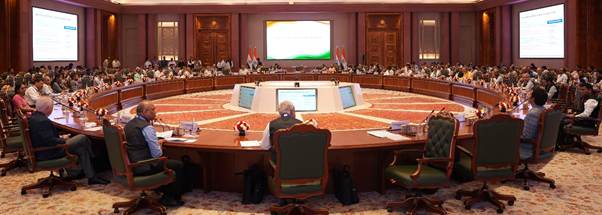
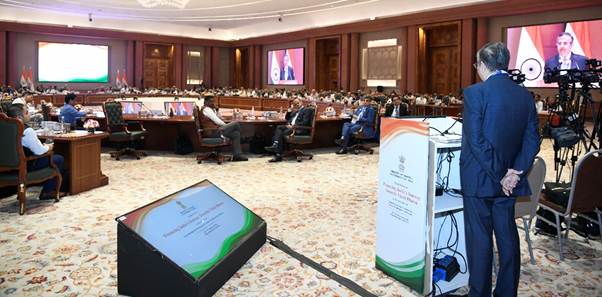
The Conference on “Financing India’s Journey towards Viksit Bharat” with Finance Ministers and Finance Secretaries of States and Union Territories with Legislature, experts from academia, industry, banking and policymaking, concluded in New Delhi, today. The conference witnessed series of deliberations across two days on India’s financing requirements and pathways for sustained, inclusive and broad-based growth.
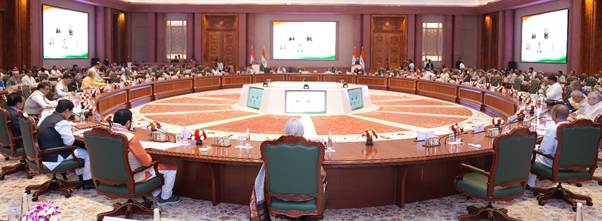
The two-day conference was attended by the Union Minister for Finance & Corporate Affairs and had the Chief Ministers of Assam, Delhi, Goa, Haryana, Jammu & Kashmir, Keralam, Manipur, Meghalaya, Nagaland; Deputy Chief Ministers of Arunachal Pradesh, Bihar, and Odisha; and Finance Ministers of Andhra Pradesh, Assam, Gujarat, Himachal Pradesh, Jharkhand, Maharashtra, Tamil Nadu, Tripura, UP, Uttarakhand, and West Bengal, besides senior officers of States and Ministry of Finance in attendance.
DAY ONE

On day one, Smt. Anuradha Thakur, Secretary, Department of Economic Affairs (DEA) Ministry of Finance, welcomed the participants and set out the context in the inaugural session.

Smt. Thakur highlighted that this first-of-its-kind Conference adopts a longer-term and broader canvas, bringing together issues related to public & private finance, assembling experts from academia, industry, banking and policymaking States shared their perspectives and underscored that the journey towards Viksit Bharat rests on deep complementarities and multi-tiered partnership between the Union & the States. She mentioned that macroeconomic stability and fiscal prudence have received global recognition, including four sovereign rating upgrades by major international rating agencies over the past 16–17 months, with JCR recently upgrading India by one notch from BBB+ to A-.
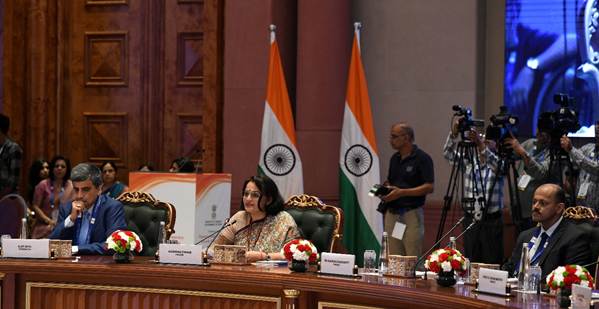
The DEA Secretary emphasised that the scale of transformation to attain Viksit Bharat could not be met by Government Budgets alone. Private-sector financing, innovative financing mechanisms and stronger cooperation across levels of government will play a critical role.

She informed the gathering that working groups, with participation from States, will take forward the thematic deliberations and identify sectoral financing requirements and actionable recommendations.

Shri Sudhir Shrivastava, former Additional Chief Secretary, Government of Maharashtra, made a presentation on States’ Financing Perspective in the inaugural session.
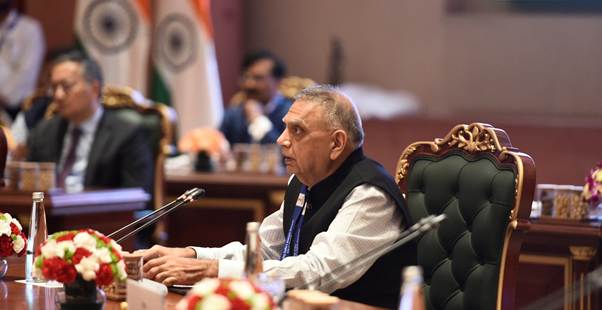
In his Keynote Address, Shri N.K. Singh, President and Life Trustee, Institute of Economic Growth, and Chairman, 15th Finance Commission (XVFC), highlighted India’s strong macroeconomic foundation, and noted the 7.8 per cent GDP growth in Q1 of FY 2026–27 and the recent upgrade by Japan Credit Rating Agency from BBB+ to A-.
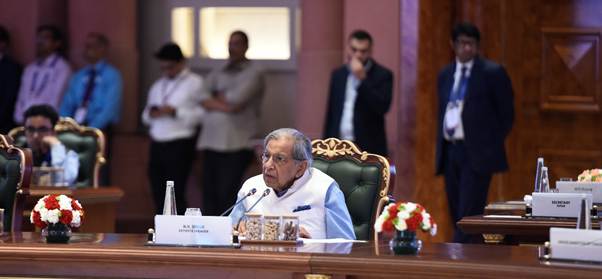
He emphasised that India’s gross domestic savings rate, currently around 34 per cent of GDP, needs to rise towards 38–40 per cent to sustain the 7–8 per cent growth required for Viksit Bharat. On fiscal sustainability, Shri Singh advocated State-wise debt sustainability assessments, and stressed greater fiscal transparency, including accounting for off-budget borrowings, guarantees, arrears and borrowings through State-owned entities. On revenue mobilisation, he observed that the larger opportunity lies in leveraging information rather than merely increasing tax rates. AI and machine learning, combined with existing tax databases, can help identify compliance gaps, broaden the effective tax base and improve revenue mobilisation. Shri Singh stressed the need to move from public finance to private capital, with public resources playing a catalytic role. He also emphasised predictable rules, enforceable contracts, faster dispute resolution and stronger investment treaties to facilitate domestic and foreign investment. On factor-market reforms, Shri Singh identified capital, labour and land as critical areas, touched upon our relatively higher cost of capital, emphasised labour productivity through skilling, apprenticeships and stronger university-industry linkages, and urged States to improve land-use efficiency, streamline approvals and strengthen digital land records.

THEMATIC SESSIONS

The first thematic session, “Macroeconomic Overview,” was moderated by Shri Ajay Seth, Chairman, Insurance Regulatory and Development Authority of India. Dr. Sajjid Z. Chinoy, Managing Director and Chief India Economist, J.P. Morgan, and Part-time Member, Prime Minister’s Economic Advisory Council (PM-EAC), delivered the keynote address in this thematic session.

The panel deliberated on three themes: “Enhancing Savings and Investment Rates for Viksit Bharat 2047,” presented by Dr. Samiran Chakraborty, Chief Economist, India, Citibank; “Fiscal Golden Rule at the State Level, Facilitated by Innovative Finance,” addressed by Prof. Ashima Goyal, Professor, Indira Gandhi Institute of Development Research, Mumbai; and “Strengthening Public Finances to Improve Fiscal Resilience and Mobilising Resources,” discussed by Prof. N. R. Bhanumurthy, Director, Madras School of Economics.

A special session featured Shri Uday Kotak, Founder and Non-Executive Director, Kotak Mahindra Bank.
DAY TWO

The second day commenced with as session on “Financing Agriculture Sector Transformation,” moderated by Dr. Devesh Chaturvedi, former Secretary, Department of Agriculture. The keynote address was delivered by Dr. Harsh Kumar Bhanwala, Public Interest Director and Chairman of MCX.

The panel examined “Market Access and Reliable Agricultural Financing,” with Shri Anil Kumar SG, Founder and Non-Executive Chairman, Samunnati; “Issues in Post-Harvest Marketing, Logistic Support, Infrastructure and Food Processing,” with Dr. Shoumitro Chatterjee, Assistant Professor, Johns Hopkins University, USA; and “Experience of IFAD on Financial Instruments that Could Be Scaled Up or Need to Be Explored in the Context of Agriculture Transformation,” with Dr. Marc De Sousa Shield, Country Director and Head, South Asia Hub, International Fund for Agricultural Development (IFAD).

The third thematic session, “Financing the Energy Transition,” was moderated by Shri Alok Kumar, former Secretary, Ministry of Power. Shri Tarun Kapoor, Advisor to the Prime Minister, delivered the keynote address for this session.

The panelists made presentations on “Financing Renewable Energy and Transmission Assets,” with Mr. Harsh Shah, Managing Director, IndiGrid; “Financing of Battery Energy Storage Systems (BESS), Pumped Storage Projects (PSP) and Other Energy Storage Solutions,” with Dr. Praveer Sinha, Managing Director and Chief Executive Officer, Tata Power; and “Financing Carbon Capture, Utilization and Storage (CCUS) and Designing a Carbon Credits Framework to Ensure Primacy for the Country’s NDC Targets,” with Mr. Rahul Kitchlu, Practice Manager and Head of Energy and Mining Sectors, South Asia Region, The World Bank.

All the sessions included experience-sharing by State Governments, providing an opportunity to exchange perspectives on financing priorities and challenges.

SPECIAL SESSIONS

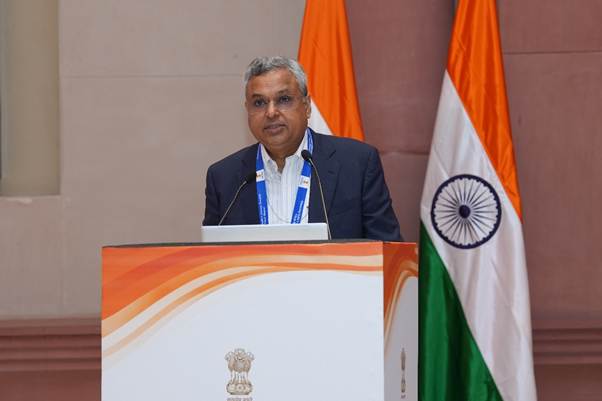
Two special-session presentations addressed emerging dimensions of India’s development journey. Dr. Saurabh Garg, Secretary, Ministry of Statistics and Programme Implementation (MoSPI), presented “Measuring India’s Viksit Bharat Journey: A Gross State Domestic Product (GSDP) Perspective”; and Shri S. Krishnan, Secretary, Ministry of Electronics and Information Technology (MeitY), spoke on “Role of New-Age Technology in India’s Journey Towards Viksit Bharat.”
CONCLUDING SESSION

In his remarks during the concluding session, Dr. V. Anantha Nageswaran, Chief Economic Adviser, Government of India, observed that the Conference had provided a valuable opportunity for the Union and States to move beyond discussions on resource generation and sharing, and deliberate collectively on financing India’s development over the next two decades. He noted that the quality of discussions and the openness with which States shared their perspectives had strongly established the case for holding the Conference annually. He emphasised that while India’s savings base was substantial and would need to grow further, significantly greater participation by private capital would be essential to mobilise the investment required for Viksit Bharat.
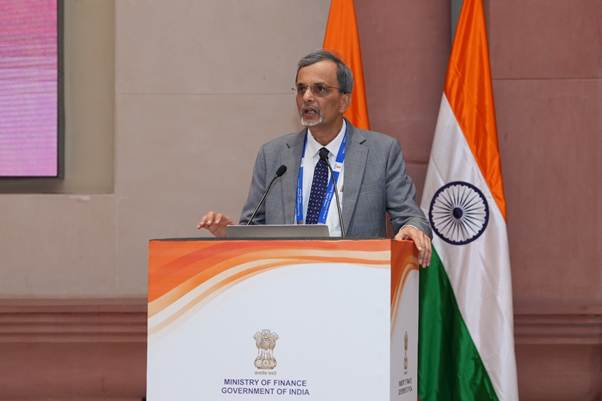
He outlined three priorities for States: creating an enabling environment for private investment through the availability of land, power and logistics, supported by effective single-window clearances; improving the quality of investment through robust project-preparation pipelines and credible project reports to facilitate access to domestic and multilateral finance, alongside directing credit towards underserved districts with growth potential; and strengthening States’ own capital expenditure despite fiscal constraints. In this context, he referred to Shri Sudhir Shrivastava’s proposal to raise capital outlay from approximately 2.4 per cent to 3 per cent of GSDP by 2031-32.

Emphasising that “Viksit Bharat depends on Viksit Rajya,” Dr. Nageswaran called for the practices shared by States, ongoing deregulation efforts and expert recommendations to be taken forward and translated into partnerships with clear responsibilities and timelines. He concluded by underscoring the dual imperative before India: sustaining the long-term development journey towards 2047 while accelerating resource mobilisation over the next five years, when global financing opportunities remain available.

Shri Challa Sreenivasulu Setty, Chairman, State Bank of India, addressed the topic of “Sources of Finance from Banking Sector”, in the concluding session of the two-day conference.

Topics

Acts Income Tax