

Loading...

Top
Help
×

By creating an account you can:

Logo TaxTMI
Call Us / Help / Feedback

Contact Us At :

E-mail: [email protected]

Call / WhatsApp at: +91 99117 96707

For more information, Check Contact Us

FAQs :

To know Frequently Asked Questions, Check FAQs

Most Asked Video Tutorials :

For more tutorials, Check Video Tutorials

Submit Feedback/Suggestion :

Email :
Please provide your email address so we can follow up on your feedback.
Category :
Description :
Min 15 characters 0/2000
Make Most of Text Search
  1. Checkout this video tutorial: How to search effectively on TaxTMI.
  2. Put words in double quotes for exact word search, eg: "income tax"
  3. Avoid noise words such as : 'and, of, the, a'
  4. Sort by Relevance to get the most relevant document.
  5. Press Enter to add multiple terms/multiple phrases, and then click on Search to Search.
  6. Text Search
  7. The system will try to fetch results that contains ALL your words.
  8. Once you add keywords, you'll see a new 'Search In' filter that makes your results even more precise.
  9. Text Search
Add to...
You have not created any category. Kindly create one to bookmark this item!
Create New Category
Hide
Title :
Description :
❮❮ Hide
Default View
Expand ❯❯
Close ✕
🔎 News - Adv. Search
TEXT SEARCH:

Press 'Enter' to add multiple search terms. Rules for Better Search

Search In:
Main Text + AI Text
  • Main Text
  • Main Text + AI Text
  • AI Text
Category: ?
Categorized by AI
---- All Categories ----
  • ---- All Categories ----
  • Income Tax
  • GST
  • Customs, DGFT & SEZ
  • FEMA & RBI
  • Corp. Laws, SEBI & IBC
  • PMLA, Black Money & ED
  • Budget
  • News and Press Release
  • PTI News
Month:
---- All Months ----
  • ---- All Months ----
  • January
  • February
  • March
  • April
  • May
  • June
  • July
  • August
  • September
  • October
  • November
  • December
Year:
---- All Years ----
  • ---- All Years ----
  • 2026
  • 2025
  • 2024
  • 2023
  • 2022
  • 2021
  • 2020
  • 2019
  • 2018
  • 2017
  • 2016
  • 2015
  • 2014
  • 2013
  • 2012
  • 2011
Sort By: ?
In Sort By 'Default', exact matches for text search are shown at the top, followed by the remaining results in their regular order.
Relevance Default Date
    India has immense opportunities in seafood sector: Andhra CM Naidu
    Mallcom invests Rs 100 crore in new Gujarat manufacturing facility
    Forex kitty jumps USD 938 mn to USD 682 bn
    Stock markets end marginally lower amid profit-taking post-RBI policy
    Rupee rises 81 paise to close at 94.93 against US dollar post RBI policy decision
    India should target USD 30 billion in marine product exports in five years: Union Minister Goyal
    Target seafood exports worth USD 30 bn in next 5 years: Goyal
    Gold plunges to Rs 1.58 lakh/10g as inflation fear overshadows bullion demand
    Bajaj Finance Personal Loans with Repayment Flexibility of up to 9 Years
    Kerala HC dismisses CMRL appeal against ED probe
    RBI announces slew of measures to boost foreign capital flow
    India's economic situation strong, new measures to attract higher capital inflows: RBI Guv Malhotra
    In a major reform, Government announces measures to deepen G-Sec market and facilitate greater Foreign Portfolio Investment (FPI) in equity segment
    Stock markets hold on to gains post RBI policy, measures to support rupee
    Forex reserve at healthy USD 682 bn, adequate to provide import cover for 11 months: RBI Guv
    RBI holds interest rates as oil shock clouds outlook; unveils measures to support rupee
    RBI raises FY27 inflation to 5.1 pc as higher fuel price impacts input costs
    FREQUENTLY ASKED QUESTIONS (FAQs) ON FIIs EXEMPTION
    FREQUENTLY ASKED QUESTIONS (FAQs) ON BIS EXEMPTION
    Govt issues Ordinance to exempt foreign investments in G-secs from capital gains tax
❯❯
Maximize Maximize Maximize
0 / 200
Expand Note
Add to Folder

No Folders have been created

+

Are you sure you want to delete "My most important" ?

NOTE:

News
Showing Results for :
Reset Filters
Results Found:
Show All Summaries Hide All Summaries
June 5, 2026
Show AI Summary
Blue economy and seafood exports drive India's aquaculture growth through sustainability, innovation, and infrastructure development.
India's seafood sector offers substantial expansion potential, with the country holding only a small share of the global seafood market. The discussion highlights the role of blue economy development in supporting coastal economic growth while preserving marine ecosystems, and identifies Andhra Pradesh as a major contributor through its fish production, shrimp production, and seafood export earnings. The stated growth strategy centres on improving quality, sustainability, traceability, innovation, and zero pollution in seafood production and exports.
June 5, 2026
Show AI Summary
Domestic manufacturing expansion drives localisation and import reduction at a new PPE facility in Gujarat.
PPE manufacturer Mallcom India Ltd has invested over Rs 100 crore in a new manufacturing facility at Sanand in Gujarat to expand domestic production capacity, strengthen localisation and reduce dependence on imports. The Sanand plant is the company's 17th manufacturing unit and produces items such as NBR and PU gloves, safety helmets and bump caps. It also supports local production of Protech PU gloves and a domestic tariff area unit at the site.
June 5, 2026
Show AI Summary
Foreign exchange reserves rise as foreign currency assets gain, while gold reserves decline and SDRs stay unchanged.
India's foreign exchange reserves increased by USD 938 million to USD 682.321 billion in the reporting week, driven mainly by a rise in foreign currency assets to USD 546.148 billion. Gold reserves declined to USD 112.6 billion, while Special Drawing Rights remained unchanged at USD 18.747 billion. India's reserve position with the IMF rose marginally to USD 4.826 billion.
June 5, 2026
Show AI Summary
RBI policy stance unchanged as rupee-support measures and weaker growth outlook drive profit-taking in equities
The Reserve Bank of India kept the policy repo rate unchanged at 5.25 per cent and retained a neutral stance while lowering its growth projection and signalling higher inflation pressures. It also announced measures to attract foreign capital and support the rupee, including tax relief for eligible foreign investors in government securities, concessional foreign-currency deposit terms for non-resident Indians, and subsidised hedging costs for specified overseas borrowing and FCNR(B) inflows.
June 5, 2026
Show AI Summary
Foreign capital inflow measures and forex liquidity support lift the rupee as policy rates remain unchanged.
The rupee appreciated after the Reserve Bank announced measures to support foreign capital inflows and strengthen forex liquidity, while stating that foreign exchange reserves provide a sufficient buffer against external shocks. The policy stance remained unchanged, with the Monetary Policy Committee retaining the repo rate at 5.25 per cent with a neutral stance despite revised inflation and growth projections. The measures included expansion of the Fully Accessible Route, removal of FPI concentration limits, extension of FCNR(B) hedging support, a PSU ECB swap window, and restoration of the export realisation period to nine months.
June 5, 2026
Show AI Summary
Marine product exports face a quality-led growth push through wider market access and trade support measures.
Marine product exports should be expanded through higher production, stronger quality standards and wider market reach, with the sector positioned for substantial growth over the next five years. The plan emphasizes reassessing current performance, reducing dependence on a small group of destinations and identifying new opportunities in the global seafood trade. Support is linked to the PM Matsya Sampada Yojana and recent free trade agreements covering multiple countries.
June 5, 2026
Show AI Summary
Seafood export growth strategy focuses on quality, value-added products, trade access, and stronger export infrastructure.
Seafood export policy is being pushed toward a higher-value, export-led model, with emphasis on raising production, improving quality, and expanding value-added processing. The stated objective is to expand seafood exports substantially over the next five years, while exporters are urged to reduce dependence on raw shrimp shipments and build branded value-added goods. Free trade agreements are expected to improve market access, alongside infrastructure support for inland states and export logistics reforms.
June 5, 2026
Show AI Summary
Inflation concerns and higher rate expectations weigh on gold prices as the reserve bank raises its inflation outlook.
Gold prices weakened as elevated oil rates, geopolitical tensions in West Asia, and expectations of higher global interest rates ressed investor sentiment. Market participants also tracked the US dollar and upcoming US labour data for direction on bullion prices amid inflation concerns. The Reserve Bank of India raised its retail inflation projection for 2026-27, citing higher global energy prices feeding into domestic fuel costs, and lowered its FY27 growth expectation.
June 5, 2026
Show AI Summary
Unsecured personal loans with flexible repayment, digital application, and eligibility-based pricing for varied financial needs.
Bajaj Finance Personal Loan is described as an unsecured lending product offering loan amounts from Rs. 40,000 to Rs. 55 lakh with repayment tenures of up to 108 months. The process is fully digital, with standard KYC and income documents required, while eligibility and interest rates depend on creditworthiness, income stability, debt obligations, and CIBIL score. An EMI calculator is provided to estimate monthly instalments, total interest, and total repayment before applying, and disbursement is stated to occur typically within 24 hours of approval, subject to verification and eligibility.
June 5, 2026
Show AI Summary
Money laundering investigation power survives without a predicate FIR, as tax settlement immunity does not bar PMLA proceedings.
The Kerala High Court upheld the Enforcement Directorate's power to continue a money laundering investigation under the Prevention of Money Laundering Act despite the absence of a registered FIR or complaint for the scheduled offence at the stage of civil inquiry powers. It refused to quash the ECIR and summons, holding that such action is aimed at ascertaining the existence of proceeds of crime. The Court further held that immunity under the Income Tax settlement framework does not extend to PMLA proceedings or other central laws.
June 5, 2026
Show AI Summary
Foreign capital access expands as investment limits ease, government securities widen and hedging support is extended for overseas borrowing.
Foreign capital inflows are being encouraged through wider access to government securities and equity instruments, along with the removal of several investment restrictions for overseas investors. The basket of specified government securities under the Fully Accessible Route is being expanded to include all new issuances of 15-year, 30-year and 40-year tenor G-secs, while short-term investment, concentration and individual security limits for Foreign Portfolio Investors under the General Route are being removed. Investment limits for Non-Resident Indians and Overseas Citizens of India in listed equity instruments are also being raised, and the facility is extended to all individual Persons Resident Outside India.
June 5, 2026
Show AI Summary
Capital inflows and inflation outlook shape RBI policy, with rates unchanged and outflow restrictions ruled out.
The Reserve Bank of India said India's economic situation remains strong and that recent policy measures are expected to support higher capital inflows and a healthy balance of payments. No target has been set for inflows, and no measure is under consideration to restrict capital outflows. The 4 per cent inflation target remains operative, while the central bank said it would raise rates only if inflation becomes persistent and generalised.
June 5, 2026
Show AI Summary
Foreign investment liberalisation expands equity access, revises G-Sec investment rules, and exempts certain G-Sec income from tax.
Foreign investment in Indian capital markets is being liberalised through measures intended to deepen the G-Sec market, expand access for individual Persons Resident Outside India and Foreign Portfolio Investors, and reduce operational and compliance frictions. Individual PROIs will be permitted to invest in equity instruments of listed Indian companies through the Portfolio Investment Scheme, with the individual investment cap raised from 5% to 10% in any company and the aggregate cap for all individual PROIs raised from 10% to 24%. The Foreign Exchange Management (Non-Debt Instruments) (Third Amendment) Rules, 2026 are being notified to implement this framework.
June 5, 2026
Show AI Summary
Rupee support measures: RBI holds repo rate steady and offers tax, swap, and hedging incentives for foreign inflows.
The Reserve Bank of India kept the policy repo rate unchanged at 5.25 per cent and maintained a neutral stance while announcing measures to attract foreign capital and support the rupee. The package removed tax on interest income and capital gains for eligible foreign investors in government securities, broadened access to sovereign bonds under the foreign investment route, and provided concessional foreign-currency swap and hedging support for specified overseas borrowing and non-resident deposit arrangements.
June 5, 2026
Show AI Summary
Foreign exchange reserves remain a strong buffer, with policy support aimed at orderly market conditions and balance of payments stability.
Foreign exchange reserves were described as healthy at USD 682.3 billion, with import cover of about 11 months and external debt coverage of 89.1 per cent. The reserves were presented as a strong buffer against external shocks, alongside the Reserve Bank's readiness to use regulatory and market-based instruments to preserve orderly market conditions if required. Policy support for the balance of payments was linked to measures such as trading partner agreements, full foreign direct investment in insurance, energy transition initiatives, easing of foreign direct investment restrictions, and liberalisation of the external commercial borrowing framework.
June 5, 2026
Show AI Summary
Neutral monetary stance and capital-inflow measures support the rupee amid inflation and growth risks
Monetary policy remained unchanged as the Monetary Policy Committee kept the benchmark repo rate at 5.25 per cent and continued with a neutral stance, while adopting a data-dependent approach in view of elevated global risks. The Reserve Bank lowered its growth projection for the year and revised inflation expectations upward, while cautioning that energy shocks and supply pressures could feed into wages and inflation expectations. Measures were also announced to attract foreign capital and support the rupee, including tax relief for eligible foreign investors in government securities, concessional foreign-exchange swaps, and subsidised hedging costs for fresh FCNR(B) deposits.
June 5, 2026
Show AI Summary
Inflation outlook rises as higher energy prices and input costs increase pressure on consumer price inflation.
Reserve Bank projected retail inflation for 2026-27 at 5.1 per cent, revising the earlier estimate upward because higher global energy prices are being passed through to petrol, diesel and other input costs. The statement said higher fuel prices are having a direct effect on headline inflation, with second-round effects likely to add further upward pressure on CPI inflation in the coming months.
June 5, 2026
Show AI Summary
FII taxation on Government Securities is proposed to shift toward exemption for interest and capital gains.
Under the Income-tax Act, 2025, FIIs are taxed on income from securities and capital gains under a separate framework, with securities income taxable at 20%, short-term capital gains taxable at 30% or 20% depending on coverage under concessional provisions, and long-term capital gains taxable at 12.5%. The proposed ordinance seeks to exempt interest income from Government Securities and capital gains arising on their transfer or redemption, while explaining the role of listed and unlisted securities, the absence of Securities Transaction Tax, and the holding-period rules for classification as short-term or long-term capital assets.
June 5, 2026
Show AI Summary
Government securities income exemption limits BIS tax relief to specified interest and capital gains from investment pool.
Income of the Bank for International Settlements from specified investments in Government Securities is proposed to be exempted under the ordinance. The exemption is confined to interest income earned from Government Securities and capital gains arising on transfer or redemption of Government Securities through the specified INR-denominated investment pool for central banks and official monetary authorities. It does not extend to all income earned by BIS in India or to other BIS operations.
June 5, 2026
Show AI Summary
Tax exemptions on government securities and expanded market access aim to boost foreign participation and capital inflows.
Tax exemptions were introduced on interest income and capital gains arising from the sale, exchange or transfer of government securities, extended to foreign institutional investors and the Bank for International Settlements, subject to prescribed information-reporting requirements. The amendment to the Income Tax Act was stated to take effect from 1 April through an ordinance under the President's ordinance-making power. The Reserve Bank of India also widened foreign participation in government and equity markets through additional access and relaxation measures.

News

Back

All News

Showing Results for :
Reset Filters
No Records Found

News

Back

All News

Showing Results for : Reset Filters
Corp. Laws, SEBI & IBC

IICA Hosts National Conference on “Redefining India’s Restructuring Ecosystem” to Mark a Decade of IBC and Celebrates Convocation of PGIP 6th Batch

June 15, 2026

Contents
Summary
Note

Note

-

Bookmark

Print

Print

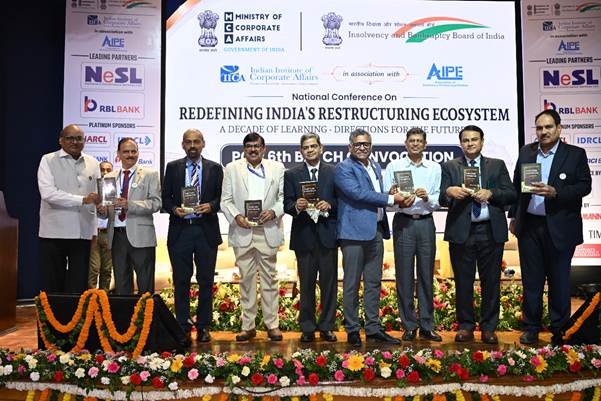
The Indian Institute of Corporate Affairs (IICA), under the Ministry of Corporate Affairs, Govt of India, in partnership with the Association of Insolvency Professional Entities (AIPE), successfully hosted the National Conference on “Redefining India’s Restructuring Ecosystem: A Decade of Learning – Directions for the Future” recently at the Pradhan Mantri Sangrahalaya Auditorium, Teen Murti Marg, New Delhi. The event also featured the Convocation Ceremony of the 6th Batch of the Post Graduate Insolvency Programme (PGIP), IICA’s flagship academic initiative for developing a highly skilled cadre of insolvency professionals.
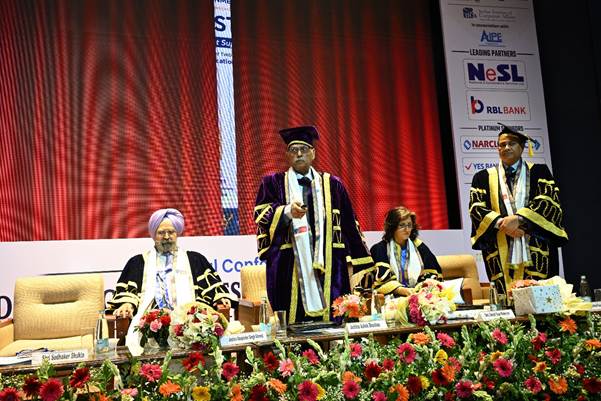
Justice Ashok Bhushan, Chairperson, National Company Law Appellate Tribunal (NCLAT), Chief Guest of the event, delivered the Convocation Address and reflected on the remarkable journey of the Insolvency and Bankruptcy Code (IBC) over the past decade. He observed that the IBC is no longer young, with its foundational questions having been authoritatively settled through a decade of landmark jurisprudence. Describing the period from 2016 to 2021 as the “era of establishment” and the current phase as the “era of refinement,” he noted that the Insolvency and Bankruptcy Code (Amendment) Act, 2026 reflects the maturity of a legislation that continues to evolve through practical experience and judicial guidance.

.
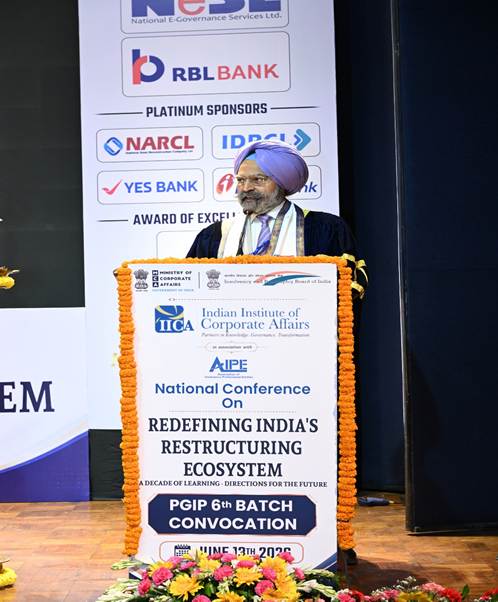
Justice Anupinder Singh Grewal, President, National Company Law Tribunal (NCLT), delivered the Keynote Address and traced the jurisprudential evolution of the IBC from its foundational pronouncements before the Hon’ble Supreme Court of India to the increasingly complex multi-party insolvency matters being adjudicated today. He emphasized the need for sustained judicial and institutional coordination to ensure timely and value-maximising resolution outcomes.

He also highlighted the importance of adopting the UNCITRAL Model Law on Cross-Border Insolvency to strengthen India's position as a trusted global restructuring destination.
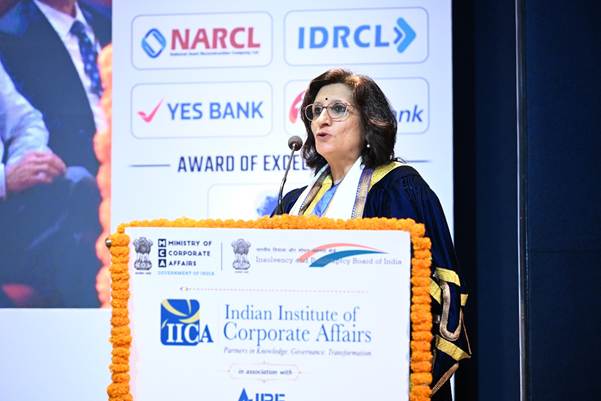
Smt. Deepti Gaur Mukerjee, IAS, Secretary, Ministry of Corporate Affairs, delivered the Special Address and described the Insolvency and Bankruptcy Code as a “behavioural revolution” in India’s financial and corporate ecosystem. Highlighting the transformative impact of the Code, she noted that nearly ₹4 lakh crore has been recovered through resolution processes, with creditors realizing approximately 170 per cent of liquidation value. She further observed that more than 32,000 cases have been settled before formal admission, preserving credit worth nearly ₹14 lakh crore, demonstrating the far-reaching behavioural changes brought about by the Code. Referring to the IBC (Amendment) Act, 2026, she described it as a landmark generational reform that will further strengthen India’s insolvency and restructuring framework.
Welcoming the distinguished guests and participants, Shri Gyaneshwar Kumar Singh, Director General & CEO, IICA, highlighted the significance of the Post Graduate Insolvency Programme, offered through IICA’s Centre for Insolvency and Bankruptcy under the leadership of Shri Sudhaker Shukla. He noted that the two-year full-time residential programme, designed and approved by the Insolvency and Bankruptcy Board of India (IBBI), enables graduates to register as Insolvency Professionals in lieu of the conventional ten-year experience requirement. Across seven batches, the programme has built an alumni network of 239 professionals, many of whom are actively handling insolvency assignments as registered Insolvency Professionals.

Drawing upon his association with the Insolvency and Bankruptcy Code as former Joint Secretary (Insolvency), Member of the IBBI Governing Board and Member Secretary of the Insolvency Law Committee, Shri Singh observed that “a reform is only as strong as the people who carry it.” He reaffirmed the Government’s commitment to strengthening India’s insolvency framework through progressive reforms in areas such as cross-border insolvency, pre-packaged resolutions and digital enablement in pursuit of the vision of Viksit Bharat

A major highlight of the event was the Convocation Ceremony of the 6th Batch of the Post Graduate Insolvency Programme (PGIP), IICA's flagship programme for developing insolvency professionals. A total of 40 students were conferred degrees and certificates by the distinguished dignitaries present on the dais, marking the successful completion of the programme by a new cohort of professionals equipped to contribute to India's evolving insolvency and restructuring ecosystem.
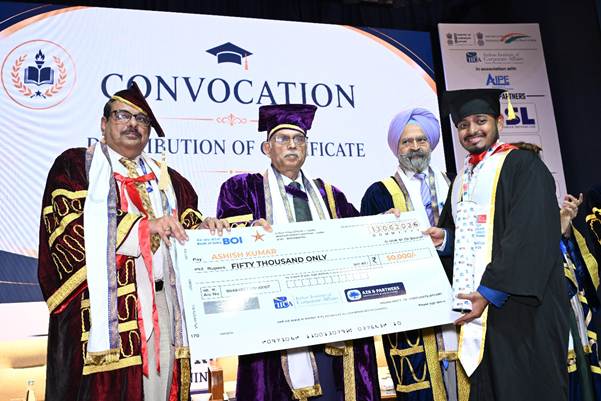
Recognising academic excellence, the Institute honoured the meritorious students of the graduating batch. Mr. Ashish Kumar secured the First Position and was awarded a cash prize of ₹50,000; Mr. Arun Kumar secured the Second Position and received a cash prize of ₹30,000; and Ms. K Geetha Vaishnavi secured the Third Position and was awarded a cash prize of ₹20,000. The awards were sponsored by AZB & Partners in recognition of academic excellence and professional merit. The awardees were felicitated for their outstanding academic performance, dedication, and commitment to professional excellence throughout the programme.

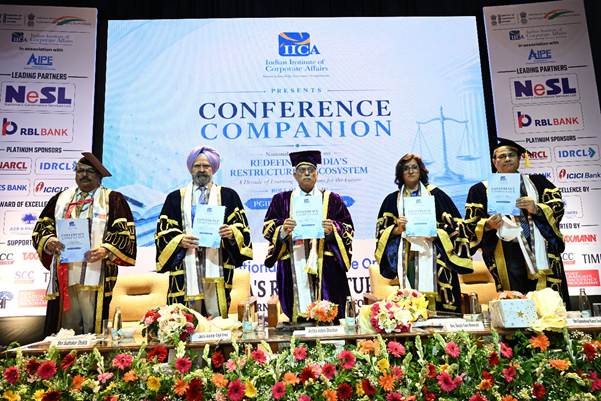
The National Conference Souvenir, documenting the evolution, jurisprudence and impact of the IBC over its first decade, was formally released. The PM Vidya Lakshmi merit-cum-means scholarship for PGIP students was announced, ensuring that talent rather than financial means determines access to premier insolvency education. The One Nation One Subscription (ONOS) platform was also extended to IICA, providing faculty, researchers and students seamless access to leading global academic journals, legal databases and knowledge resources.

These initiatives further strengthen IICA’s position as a premier institution for research, capacity building and knowledge dissemination in the fields of Insolvency and Bankruptcy, Corporate Governance, Corporate Social Responsibility (CSR), Financial Management, Business and Human Rights (BHR), Environmental, Social and Governance (ESG), and other areas of Corporate Affairs.

Following the Convocation Ceremony, the National Conference proceeded with a series of highly engaging technical sessions and panel discussions featuring eminent experts, policymakers, regulators, judicial authorities, insolvency professionals, academicians and industry leaders from India and abroad. Conducted in a hybrid mode, the Conference witnessed enthusiastic participation from delegates attending both in person and virtually, enabling broader engagement and knowledge exchange across the insolvency and restructuring ecosystem.

The Conference featured four high-impact thematic panel discussions addressing critical dimensions of India's evolving insolvency framework.

Renowned panellists from India and overseas shared global perspectives, international best practices and practical insights on insolvency law, restructuring frameworks, distressed asset markets, cross-border insolvency and technology-driven reforms.

The deliberations highlighted the growing maturity of India's insolvency regime and underscored the importance of aligning domestic reforms with global standards to support economic growth, investor confidence and ease of doing business.
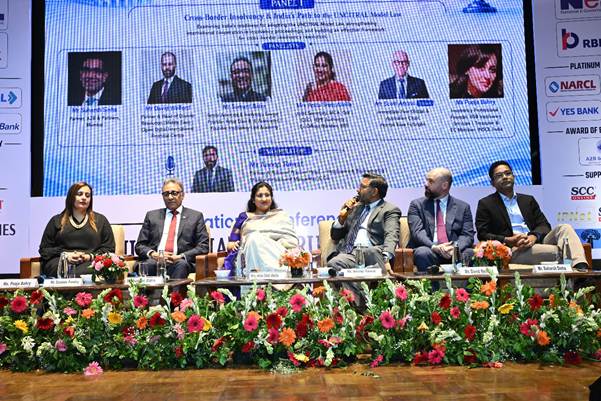
The first panel examined India's preparedness for adopting the UNCITRAL Model Law on Cross-Border Insolvency. Discussions focused on recognition and relief mechanisms, inter-jurisdictional cooperation, judicial readiness and regulatory preparedness required to position India as a credible participant in international insolvency proceedings.

Experts observed that the enabling provisions introduced through the IBC (Amendment) Act, 2026 mark a significant step towards establishing a modern cross-border insolvency framework aligned with global best practices.

The second panel deliberated on the newly introduced Creditor-Initiated Insolvency Resolution Process (CIIRP) and its potential to facilitate faster and more efficient resolution of stressed assets. The discussion also explored reforms required to strengthen pre-packaged insolvency mechanisms and examined the growing role of mediation, arbitration and other Alternative Dispute Resolution (ADR) mechanisms in reducing litigation, preserving value and improving stakeholder outcomes.

The third panel focused on the evolution of India's distressed asset market and the growing role of Asset Reconstruction Companies (ARCs), Alternative Investment Funds (AIFs) and institutional investors in enterprise turnaround and value creation. Participants discussed regulatory and market reforms needed to deepen the secondary market for stressed assets and facilitate rescue financing. The discussion highlighted emerging evidence demonstrating the IBC's success in preserving enterprise value and supporting business revival.
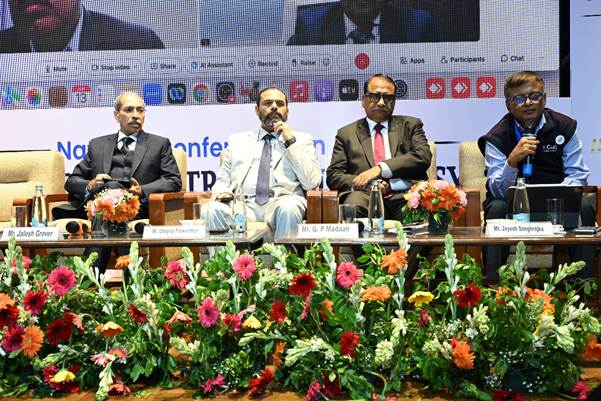
The final panel explored future-oriented reforms, including the development of early warning systems, financial health monitoring tools and resolvability frameworks for large enterprises. Experts also discussed the transformative potential of technology, artificial intelligence and integrated digital platforms in improving transparency, efficiency and timeliness across India's insolvency ecosystem.
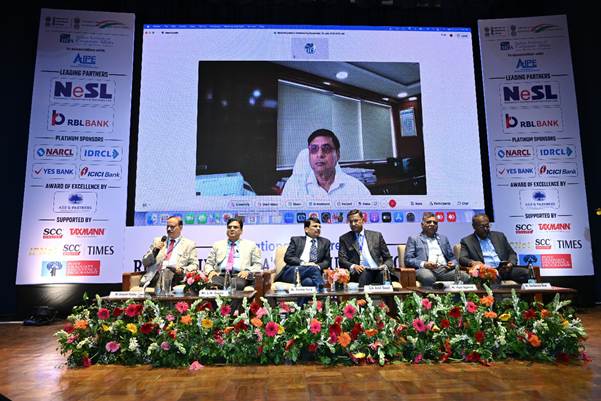
The Conference concluded with a Vote of Thanks proposed by Shri Sudhaker Shukla, Former Whole-Time Member, IBBI and Head, Centre for Insolvency and Bankruptcy, IICA, who expressed gratitude to the distinguished speakers, panellists, delegates, partners and participants for their valuable contributions.
The Conference reaffirmed the collective commitment of stakeholders towards strengthening India's insolvency and restructuring framework and charting a forward-looking roadmap for the next phase of reforms.

Topics

Acts Income Tax