

Loading...

Top
Help
×

By creating an account you can:

Logo TaxTMI
Call Us / Help / Feedback

Contact Us At :

E-mail: [email protected]

Call / WhatsApp at: +91 99117 96707

For more information, Check Contact Us

FAQs :

To know Frequently Asked Questions, Check FAQs

Most Asked Video Tutorials :

For more tutorials, Check Video Tutorials

Submit Feedback/Suggestion :

Email :
Please provide your email address so we can follow up on your feedback.
Category :
Description :
Min 15 characters 0/2000
Make Most of Text Search
  1. Checkout this video tutorial: How to search effectively on TaxTMI.
  2. Put words in double quotes for exact word search, eg: "income tax"
  3. Avoid noise words such as : 'and, of, the, a'
  4. Sort by Relevance to get the most relevant document.
  5. Press Enter to add multiple terms/multiple phrases, and then click on Search to Search.
  6. Text Search
  7. The system will try to fetch results that contains ALL your words.
  8. Once you add keywords, you'll see a new 'Search In' filter that makes your results even more precise.
  9. Text Search
Add to...
You have not created any category. Kindly create one to bookmark this item!
Create New Category
Hide
Title :
Description :
❮❮ Hide
Default View
Expand ❯❯
Close ✕
🔎 News - Adv. Search
TEXT SEARCH:

Press 'Enter' to add multiple search terms. Rules for Better Search

Search In:
Main Text + AI Text
  • Main Text
  • Main Text + AI Text
  • AI Text
Category: ?
Categorized by AI
---- All Categories ----
  • ---- All Categories ----
  • Income Tax
  • GST
  • Customs, DGFT & SEZ
  • FEMA & RBI
  • Corp. Laws, SEBI & IBC
  • PMLA, Black Money & ED
  • Budget
  • News and Press Release
  • PTI News
Month:
---- All Months ----
  • ---- All Months ----
  • January
  • February
  • March
  • April
  • May
  • June
  • July
  • August
  • September
  • October
  • November
  • December
Year:
---- All Years ----
  • ---- All Years ----
  • 2026
  • 2025
  • 2024
  • 2023
  • 2022
  • 2021
  • 2020
  • 2019
  • 2018
  • 2017
  • 2016
  • 2015
  • 2014
  • 2013
  • 2012
  • 2011
Sort By: ?
In Sort By 'Default', exact matches for text search are shown at the top, followed by the remaining results in their regular order.
Relevance Default Date
❯❯
Maximize Maximize Maximize
0 / 200
Expand Note
Add to Folder

No Folders have been created

+

Are you sure you want to delete "My most important" ?

NOTE:

News
Showing Results for :
Reset Filters
Results Found:
Show All Summaries Hide All Summaries
April 4, 2026
Show AI Summary
Payroll compliance mistakes demand accurate classification, timely deductions, and automated statutory checks to prevent audits and penalties.
Payroll compliance requires accurate employee classification, timely tax deduction, and correct statutory contribution management to avoid audits, penalties, and employee disputes. Common errors include misclassifying employees and contract workers, which can cause missed PF, ESI and TDS obligations, and incorrect or delayed TDS computation arising from failed declarations, salary changes, or tax regime switches. The compliance approach relies on onboarding checks, real-time recalculation, and automated deposit scheduling to reduce errors before they enter the payroll cycle.
April 4, 2026
Show AI Summary
Bribery allegations against a CGST officer trigger a CBI trap, arrest, and continuing investigation into corruption claims.
Bribery allegations led to a CBI trap and arrest of an Assistant Commissioner, CGST, Ratlam, after a private person or middleman allegedly demanded money for not initiating GST proceedings against the complainant's firm. The accused was caught red-handed while accepting a bribe through the middleman, with searches continuing at the accused's premises and investigation still in progress.
April 4, 2026
Show AI Summary
Mutual fund approval process for subscribing to eligible public issues under the Income-tax Act framework clarified.
Approval is sought by a mutual fund to subscribe to an eligible issue of public companies under Schedule XV(1)(z)(ii) of the Income-tax Act, 2025, through Form 190. The form must be filed three months before the issue of eligible capital with the prescribed details and documents, including mutual fund and management particulars, scheme details, SEBI and custodian records, audited financial statements, and approval documents relating to the public company's share issue.
April 4, 2026
Show AI Summary
Mutual fund approval for eligible public company issues depends on timely filing of Form 190.
A mutual fund must file Form 190 to seek approval for investment in the eligible issue of public companies under Schedule XV(1)(z)(ii) of the Income-tax Act, 2025. The form corresponds to the earlier Form 59A under the Income-tax Rules, 1962, and to the corresponding rule framework under the Income-tax Rules, 2026. The application is to be filed by the mutual fund itself, together with the documents specified in the form, three months before the issue of eligible capital. Approval for subscription is granted on the basis of the particulars furnished in Form 190.
April 4, 2026
Show AI Summary
Approval for issue of eligible capital under Schedule XV depends on Form 189 details, disclosures, and supporting documents.
Form 189 is the application for approval of issue of public companies under Schedule XV(1)(z)(i) of the Income-tax Act, 2025, and is filed by the public company three months before the issue of eligible capital. The form requires company particulars, management details, bankers and auditors, issue details, project details, and supporting documents such as incorporation certificate, audited financial statements, equity details, SEBI approval and any project report. Processed Form 189 leads to approval for issue of eligible capital on the basis of the details furnished.
April 4, 2026
Show AI Summary
Public company issue approval through Form 189 governs eligible capital issues and related deduction eligibility.
Form 189 is the prescribed application for approval of issue of public companies under Schedule XV(1)(z)(i) of the Income-tax Act, 2025. It is filed by the public company with supporting documents before the issue of eligible capital, and the approval is granted on the basis of the details furnished in the form. Individual contributions to the issue are stated to qualify for deduction under the Act.
April 4, 2026
Show AI Summary
Consolidated approval form standardises gratuity and superannuation fund compliance, replacing rule-based particulars with structured filing.
Introduction of consolidated Form 188 standardises the approval process for Gratuity Fund and Superannuation Fund applications under Part B of Schedule XI by replacing the earlier text-based particulars in Rule 95 and Rule 109. The form is filed by trustees or an authorised person only for initial approval, and it requires details of the employer, the fund, eligible employees, account maintenance, fund status, trustee verification, and supporting documents such as the trust deed, fund rules, and accounts where applicable.
April 4, 2026
Show AI Summary
Approval mechanism for gratuity and superannuation funds is standardised through Form 188 with structured compliance requirements.
Form 188 provides a standardised application mechanism for approval of Gratuity Funds and Superannuation Funds, replacing earlier rule-based procedural requirements. It is filed once by the trustees or an authorised person, with prescribed particulars and supporting documents such as the trust deed, fund rules, accounts, and balance sheet where applicable. The application is examined by the jurisdictional authority, which may seek clarifications and then grant approval, issue deficiency notice, or reject the application.
April 4, 2026
Show AI Summary
Appeal against fund recognition refusal uses Form 187, with supporting documents and filing within 60 days.
Appeal against refusal to recognise or withdrawal of recognition from a recognised provident fund, and refusal to approve or withdrawal of approval from a superannuation fund or gratuity fund, is filed in Form 187 by the employer, trustee, or authorised representative within 60 days of communication of the order. The form requires appellant particulars, fund details, grounds of appeal, verification, and supporting documents such as the impugned order, original application, proof of filing, authorisation, and fee challan.
April 4, 2026
Show AI Summary
Appeals for provident, superannuation and gratuity funds require Form 187, supporting documents and filing within 60 days.
Form 187 prescribes the appellate mechanism under the Income-tax Act, 2025 for matters concerning recognised provident funds, superannuation funds and approved gratuity funds, including appeals against orders affecting recognition, approval, withdrawal, cancellation or refusal of such status. The form is to be used by trustees, employers or other authorised persons representing the fund where an adverse order has been passed by the competent income-tax authority. Appeals must be filed within 60 days from communication of the order, and filing does not by itself operate as a stay unless specifically granted.
April 4, 2026
Show AI Summary
Customs enforcement along the India-Nepal border led to seizure of undocumented soft drinks and air conditioners.
Customs enforcement along the India-Nepal border led to seizure of soft drinks and air conditioners being moved without valid customs documents. A vehicle carrying 1,575 bottles of soft drinks was intercepted after the driver tried to flee, while two split air conditioners transported on bicycles were also recovered in a separate patrol operation. The goods, vehicle and bicycles were handed over to the Customs Department.
April 4, 2026
Show AI Summary
Indian pharmaceutical exports show sustained growth as formulations, biologicals, vaccines and Ayush products drive resilience.
Indian pharmaceutical exports recorded sustained growth in FY26, reaching nearly USD 29 billion by the end of February and increasing over the corresponding period in the previous financial year. The export performance was led by formulations, biologicals, vaccines and Ayush products, and was described as resilient despite global challenges, pricing pressures and trade volatility. The sector's overall value was placed at about USD 60 billion, with projected expansion to USD 130 billion by 2030.
April 4, 2026
Show AI Summary
Recognised Provident Fund recognition process requires trust deed compliance, supporting documents, scrutiny and ongoing investment and reporting obligations.
Application under Rule 40C seeks recognition of a provident fund so it qualifies as a Recognised Provident Fund for income-tax purposes. It applies to employers, trustees and existing funds seeking recognition on formation, conversion, amendment, merger or split. The form requires trust deed details, fund rules, investment policy, financial information and supporting documents, followed by scrutiny, possible revisions, issuance of recognition and ongoing compliance with investment, audit and reporting requirements.
April 4, 2026
Show AI Summary
Recognised Provident Fund recognition through Form 186 depends on disclosure, supporting documents, and compliance with trust conditions.
Form 186 is the prescribed application for seeking recognition of a provident fund as a Recognised Provident Fund for income-tax purposes. It is filed by the employer, trustees, or an existing trust seeking recognition, and is ordinarily a one-time application subject to refiling or intimation for material changes in the trust deed or fund rules. The form requires detailed disclosures and supporting documents, and on approval the fund attains RPF status with tax treatment governed by applicable statutory limits and conditions. Recognition may later be withdrawn for non-compliance.
April 4, 2026
Show AI Summary
Recognised provident fund accounting in Form 185 requires annual subscriber-wise records of contributions, interest, withdrawals, and balances.
Rule 294 requires recognised provident fund accounts to be prepared at intervals not exceeding twelve months, with a separate account maintained for each subscriber in Form 185. The form is maintained internally by the provident fund trust or authorised officers, and records subscriber particulars, opening balance, monthly contributions, interest, withdrawals or advances, closing balance, and verification. Part A is maintained separately for each subscriber, while Part B presents the same information in consolidated annual subscriber-wise form.
April 4, 2026
Show AI Summary
Recognised Provident Fund recordkeeping requires Form 185 to track contributions, interest, withdrawals, and annual balances.
Form No. 185 is the prescribed accounting format for individual subscriber records under a Recognised Provident Fund, maintained by trustees or authorised officers under the Income-tax Rules. It records annual subscriber-wise particulars such as contributions, interest credited, withdrawals or advances, opening and closing balances, and verification details. Part-A is kept for each subscriber, while Part-B is the annual consolidated abstract filed with the Assessing Officer.
April 4, 2026
Show AI Summary
Deduction audit report for petroleum and natural gas businesses requires deposit verification, withdrawal checks, and Chartered Accountant certification.
Form No. 183 is the prescribed audit report for claiming deduction under section 49 in the business of prospecting, extracting, or producing petroleum, natural gas, or both in India. It is furnished by a Chartered Accountant and verifies audit of the relevant books, timely deposit into the specified account, permitted use of withdrawals, disallowance of inadmissible expenditure, and transfer restrictions on assets acquired under the scheme. The form is filed annually before the return due date and requires supporting records of books, deposits, withdrawals, and asset transfers.
April 4, 2026
Show AI Summary
Supply chain disruption hits Bikaner snack exports as conflict delays shipments and raises freight and input costs.
West Asia conflict has disrupted Bikaner exports and imports, causing delays in shipments of bhujia, papad, namkeen and spices to Gulf and European markets. Traders report longer transit routes, container shortages, higher freight charges, rising raw material and packaging costs, and consignments stuck at ports or in transit, affecting the city's export-driven economy.
April 4, 2026
Show AI Summary
Audit report for petroleum and natural gas deduction claims requires certification, supporting records, and online filing compliance.
Form No. 183 is the prescribed audit report under Rule 291 read with Section 49 of the Income-tax Act, 2025 for an assessee engaged in the business of prospecting, extracting, or producing petroleum, natural gas, or both in India. It is mandatory where the deduction is claimed and must be certified by an Accountant. The form requires supporting books, financial statements, evidence of deposits and withdrawals from the specified account, and a computation showing that the deduction remains within the permissible limit.
April 4, 2026
Show AI Summary
Deduction claim audit report for tea, coffee and rubber businesses requires Chartered Accountant certification and compliance with deposit rules.
Form No. 182 is a statutory audit report for assessees engaged in growing and manufacturing tea, coffee or rubber who claim deduction under section 48. It must be furnished by a Chartered Accountant annually before the return due date and certifies audit of books, timely deposit in the specified account or approved scheme, withdrawal utilisation, disallowable amounts, asset transfers, and the deduction permissible. The form is now a smart, tabulated e-form with mandatory professional identifiers and standardised fields for e-filing and validation.

News

Back

All News

Showing Results for :
Reset Filters
No Records Found

News

Back

All News

Showing Results for : Reset Filters

Scheduled Commercial Banks (SCBs) Record Robust Credit Growth of 15.9% in FY 2025-26, Reflecting Strong Economic Activity and Credit Demand

May 5, 2026

Contents
Summary
Note

Note

-

Bookmark

Print

Print

Agriculture and Allied Sector Credit Growth Accelerates to 15.7% in FY 2025–26, up from 10.4% a year ago, reflecting Sustained Rural Demand and Improved Credit Flow

Industrial Credit Expands to 15% in FY 2025–26 as compared to 8.2% in the previous year, driven by Strong Momentum in MSME Lending

Services Sector Credit Growth Rises to 19%, up from 12% last year, with Notable Growth in NBFCs, Trade and Commercial Real Estate Segments

Personal Loans Grew by 16.2%, an increase from 11.7% in the previous year, with Strong Demand for Vehicle and Gold-Backed Loans and Steady Housing Credit

The Financial year 2025-26 ended with robust year-on-year (y-o-y) non-food credit growth of 15.9% *, marking a significant 497 basis points (bps) increase in growth from the corresponding period in 2025 (10.9%). The aggregate credit outstanding in Mar-2026 reached ₹212.9 lakh crore, ₹29.2 lakh crore higher than the previous year.   

Amidst a low-interest rate environment, Government aided Capex cycle supported by timely structural reforms, private investments are crowding-in and boosting domestic credit demand, reinstating confidence among corporate as well as individual borrowers on Indian economy.

Credit growth in FY 2025-26 has been broad-based led by services sector, followed by personal loan segment, agriculture and allied activities, and industry.

Sectoral Credit Deployment – Highlights:

Sectoral Credit Deployment (y-o-y growth in %)
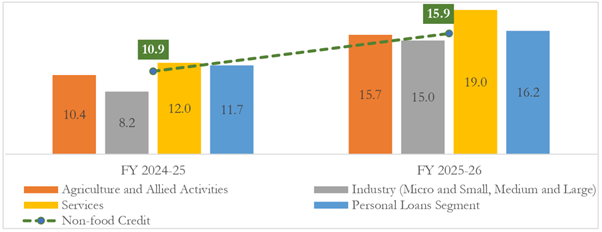
  • Agriculture and Allied Activities: Credit growth in this sector accelerated to 15.7%, 528 bps higher than 10.4% growth registered previous year, reflecting reinforced support for the farm sector. Sustained rural demand and formalization of rural credit has been attributing to the positive momentum in primary sector credit offtake in FY2025-26.
  • Industrial Sector: Credit deployment to the industrial sector expanded at almost double rate to 15.0%, vis-à-vis 8.2% growth registered last year. With a 33.1% y-o-y growth, ‘Micro and Small’ industries registered a 3.7 times higher credit growth in FY2025-26. Similar positive trends are witnessed for medium-scale industries where credit expanded by 21.7% y-o-y. Key drivers of industrial credit are: Infrastructure, Basic Metal and Metal Products, Chemicals and Chemical Products, Petroleum, Coal Products, and Nuclear Fuels etc.
  • Services Sector: Services sector credit, that contributes 28% to the overall credit, recorded a robust expansion of 19.0% y-o-y (compared to 12.0% recorded during the same period last year). The surge was primarily driven by high demand from segments like Non-Banking Financial Companies, trade, and commercial real estate.
  • Personal Loans Segment: The personal loan segment with 33% share in overall credit, expanded by 16.2% in FY 2025-26, 455 bps higher than credit growth (11.7%) registered a year ago. Growth remained steady in the housing segment, while vehicle loans and loans against gold jewellery continued to show strong momentum.

Robust credit growth demonstrates the resilient domestic economic environment and envisages enhanced appetite for credit across sectors of the Indian economy. Strong credit growth results in corporates and individuals availing credit facilities for business expansion and acquiring durable goods, further accelerating industrial activity by additional capacity building through investment in fixed assets, generating more employment opportunities. 

Against the challenging global backdrop surrounded by geo-economic fragmentation and geo-political pressures, the Indian economy has shown remarkable resilience and has been consistently the fastest growing major economies in the world.

Indian banking sector, the primary engine of economic growth is at best of its health with a well-capitalized balance sheet, historically low impaired assets and sustained profitability, augments the growth potentials of the economy. The persistent government effort in democratizing and formalizing credit has been resulting in broad based credit growth in the economy. 

*(Y-o-Y growth is calculated based on credit offtake as on Apr 4, 2025 against Mar 31, 2026. With effect from December 31, 2025, definition of last reporting fortnight has been changed to the last day of the month under the Banking Laws (Amendment) Act 2025. Accordingly, the y-o-y growth rates from December 2025 onwards are based on end-of-month data for the current year and data for the last reporting fortnight (as per old definition) for the corresponding month of the previous year)

Topics

Acts Income Tax