

Loading...

Top
Help
×

By creating an account you can:

Logo TaxTMI
Call Us / Help / Feedback

Contact Us At :

E-mail: [email protected]

Call / WhatsApp at: +91 99117 96707

For more information, Check Contact Us

FAQs :

To know Frequently Asked Questions, Check FAQs

Most Asked Video Tutorials :

For more tutorials, Check Video Tutorials

Submit Feedback/Suggestion :

Email :
Please provide your email address so we can follow up on your feedback.
Category :
Description :
Min 15 characters 0/2000
Make Most of Text Search
  1. Checkout this video tutorial: How to search effectively on TaxTMI.
  2. Put words in double quotes for exact word search, eg: "income tax"
  3. Avoid noise words such as : 'and, of, the, a'
  4. Sort by Relevance to get the most relevant document.
  5. Press Enter to add multiple terms/multiple phrases, and then click on Search to Search.
  6. Text Search
  7. The system will try to fetch results that contains ALL your words.
  8. Once you add keywords, you'll see a new 'Search In' filter that makes your results even more precise.
  9. Text Search
Add to...
You have not created any category. Kindly create one to bookmark this item!
Create New Category
Hide
Title :
Description :
❮❮ Hide
Default View
Expand ❯❯
Close ✕
🔎 News - Adv. Search
TEXT SEARCH:

Press 'Enter' to add multiple search terms. Rules for Better Search

Search In:
Main Text + AI Text
  • Main Text
  • Main Text + AI Text
  • AI Text
Category: ?
Categorized by AI
---- All Categories ----
  • ---- All Categories ----
  • Income Tax
  • GST
  • Customs, DGFT & SEZ
  • FEMA & RBI
  • Corp. Laws, SEBI & IBC
  • PMLA, Black Money & ED
  • Budget
  • News and Press Release
  • PTI News
Month:
---- All Months ----
  • ---- All Months ----
  • January
  • February
  • March
  • April
  • May
  • June
  • July
  • August
  • September
  • October
  • November
  • December
Year:
---- All Years ----
  • ---- All Years ----
  • 2026
  • 2025
  • 2024
  • 2023
  • 2022
  • 2021
  • 2020
  • 2019
  • 2018
  • 2017
  • 2016
  • 2015
  • 2014
  • 2013
  • 2012
  • 2011
Sort By: ?
In Sort By 'Default', exact matches for text search are shown at the top, followed by the remaining results in their regular order.
Relevance Default Date
    IFSCA Grants Nexent Capital GIFT City Investment Banking License
    India's exports rise 19.63 pc to USD 44.24 bn in Jul; trade deficit widens to $31.98 bn
    Vizhinjam port to commence EXIM operations from Aug 18: Kerala CM Satheesan
    Ratul Puri: Beyond Low-Cost Power to Clean Energy Reliability
    PMS Bazaar Collaborates with NSDL Database Management Limited (NDML Accreditation Agency) to Expand Access to SEBI Accredited Investor Certification
    Compounded annual growth rate of Manufacturing GVA at constant prices (2022-23 base) as per revised series during 2022-23 to 2025-26 is 10.88%
    National Company Law Tribunal (NCLT) Launches e-Inspection and e-Certified Copy Services
    The Government of India to launch the Central Bank Digital Currency (CBDC)-based Direct Benefit Transfer (DBT) in the Union Territories of Chandigarh ...
    India and the Southern African Customs Union (SACU) sign Terms of Reference (ToR) for negotiations towards a Preferential Trade Agreement
    Airtel ends all prepaid mobile plans offering 1.5 GB data per day with unlimited calls
    ED arrests IBC resolution professional
    Mumbai cops bust fake documents racket; four arrested
    After nine years at helm, N Chandra to exit Tata Sons amid expansion, governance standoff
    RBI invites comments on the Draft “Reserve Bank of India (Interest Rates on Loans and Advances) Directions, 2026”
    Sensex falls 188 pts amid elevated crude oil prices; Tata Group stocks decline after N Chandra's exit
    SJM urges govt to stand firm against US tariff pressure, calls for boycott of American products
    Union Minister of Commerce and Industry Shri Piyush Goyal Calls for Fair Trading Practices and Taking ‘Make in India’ from Local to Global
    Union Minister for Finance & Corporate Affairs Smt. Nirmala Sitharaman delivers keynote address at Seminar on “Role of the New Development Bank in M...
    Delhi HC halts processing of IT-returns of Supreme Court, high court judges
    Over 36,000 firms shut operations in Maharashtra in 5 yrs; Oppn claims graft, govt interference
❯❯
Maximize Maximize Maximize
0 / 200
Expand Note
Add to Folder

No Folders have been created

+

Are you sure you want to delete "My most important" ?

NOTE:

News
Showing Results for :
Reset Filters
Results Found:
Show All Summaries Hide All Summaries
August 13, 2026
Show AI Summary
Investment banking registration enables regulated cross-border offerings, listings, debt transactions and capital-market advisory through GIFT City.
IFSCA registration under the IFSCA (Capital Market Intermediaries) Regulations, 2025 authorises Nexent Capital IFSC Private Limited to operate as an investment banker from GIFT City. Permitted activities include management of initial and follow-on public offerings, SPAC and secondary listings, depository receipt issuances, debt capital-market transactions, and other capital-market advisory mandates. The firm proposes to provide transaction structuring, listing-readiness, execution and post-listing capital-markets support for companies seeking capital raising and listing opportunities through GIFT City's exchanges.
August 13, 2026
Show AI Summary
Merchandise export growth was driven by petroleum, electronics, engineering and marine goods, while rising imports widened the trade deficit.
India's merchandise exports increased in July, while imports also rose and widened the trade deficit. Export growth was attributed to higher overseas shipments of petroleum products, electronics, engineering goods and marine goods. Exports and imports both recorded growth during the April-July fiscal period, and exports to West Asian countries increased in July.
August 13, 2026
Show AI Summary
EXIM operations at international seaport to commence after customs clearance, bonded-area establishment, and temporary highway connectivity.
Vizhinjam International Seaport is scheduled to commence EXIM operations after Customs clearance, issuance of Customs notifications, establishment of a Customs-bonded area, and temporary connectivity to NH-66. The port had previously handled transshipment operations. A proposed transfer of a stake in the port concessionaire to a foreign shipping company remains under committee examination and requires Central Government consideration of strategic and security aspects.
August 13, 2026
Show AI Summary
Renewable energy reliability requires storage, grid readiness and ancillary service markets alongside competitive clean-power procurement.
Renewable energy procurement is shifting beyond lowest tariffs towards dependable, dispatchable and affordable clean power, assessed through capacity value, balancing capability and system economics. Storage-backed renewable and hybrid projects can improve renewable utilisation, reduce variability and curtailment, and support peak demand. Higher renewable penetration also requires supportive storage policies, timely approvals, aligned intrastate transmission planning, stronger distribution infrastructure, and market mechanisms for ramping reserves, frequency response and fast-response balancing services.
August 13, 2026
Show AI Summary
Accredited Investor certification facilitates eligible investors' access to alternative investment products, lower thresholds and applicable regulatory flexibilities.
SEBI's Accredited Investor framework enables eligible investors and entities to obtain certification that may allow lower minimum investment thresholds for Portfolio Management Services, Alternative Investment Funds and other alternative investment products, along with applicable regulatory flexibilities. PMS Bazaar and NSDL Database Management Limited's Accreditation Agency facilitate end-to-end applications, subject to required documentation and prescribed payment. Assistance is available to individual investors and eligible clients of investment providers without additional platform, service or processing charges, while prescribed certification fees remain payable.
August 13, 2026
Show AI Summary
Manufacturing GVA growth under the revised national accounts series highlights stable sectoral contribution and resilience-focused industrial measures.
Manufacturing performance is assessed under the revised National Accounts Statistics series using 2022-23 as the base year. Manufacturing's share of total Gross Value Added at current prices remained broadly stable through 2025-26, and Manufacturing GVA at constant prices achieved a compounded annual growth rate of 10.88% from 2022-23 to 2025-26. Production Linked Incentive schemes, logistics and industrial-corridor measures, semiconductor initiatives, and MSME support seek to strengthen domestic manufacturing, diversify supply chains, reduce import dependence, and improve resilience.
August 13, 2026
Show AI Summary
Electronic inspection and certified copies expand digital access to judicial records while supporting efficient case management and reduced delays.
NCLT has launched e-Inspection and e-Certified Copy Services for faster and more convenient access to judicial records and certified copies by advocates, litigants and other stakeholders. The services support a technology-enabled Registry framework and transparent, efficient justice delivery. Pendency monitoring, workload redistribution, Special Benches, maximisation of court time, and registration and listing guidelines are intended to improve case management, optimise limited judicial resources and reduce avoidable delays.
August 13, 2026
Show AI Summary
CBDC-based food subsidy transfers enable eligible beneficiaries to use Digital Rupee wallet credits for traceable foodgrain purchases.
CBDC-based Direct Benefit Transfer under the Pradhan Mantri Garib Kalyan Anna Yojana will credit eligible beneficiaries' food subsidies as programmable Digital Rupee tokens directly into CBDC wallets. Beneficiaries may use these credits to purchase foodgrains from empanelled merchants through secure, real-time and traceable payments, replacing conventional bank-account transfers. The model is intended to improve traceability, reduce leakages and cash handling, enable real-time monitoring of subsidy use, and provide a scalable framework for CBDC integration with welfare schemes.
August 13, 2026
Show AI Summary
Preferential trade agreement negotiations begin under agreed terms covering market access, origin rules, trade remedies and dispute settlement.
India and the Southern African Customs Union have signed Terms of Reference to commence negotiations for a Preferential Trade Agreement. Negotiations are envisaged on trade in goods and market access, rules of origin, customs procedures and trade facilitation, trade remedies including bilateral safeguards, sanitary and phytosanitary measures, technical barriers to trade, dispute settlement, and legal and horizontal provisions. The Terms of Reference establish the negotiating framework only; preferential tariff treatment and other operative commitments depend on conclusion of a final agreement.
August 12, 2026
Show AI Summary
Prepaid plan restructuring eliminates mid-tier daily-data options and channels subscribers toward higher-priced plans with expanded data access.
Bharti Airtel has discontinued prepaid plans combining 1.5 GB daily data allowances with unlimited calling, directing subscribers towards higher-priced plans with expanded data access, including unlimited 5G data. The restructuring reduces low-priced unlimited-data offerings and changes the pricing architecture for customers using discontinued mid-tier plans. Management links tariff repair to differentiated mobile-plan categories and sustained average revenue per user growth.
August 12, 2026
Show AI Summary
Insolvency professional conduct faces money-laundering allegations over re-admitted claims, creditor committee changes, and a connected resolution applicant.
Enforcement action under the Prevention of Money Laundering Act concerns allegations that an insolvency professional re-admitted claims earlier rejected as spurious and fraudulent during the Corporate Insolvency Resolution Process. The alleged re-admission altered the Committee of Creditors' composition and facilitated consideration of a resolution plan allegedly submitted for, and funded through an entity controlled by, a company promoter under investigation for diversion of bank-loan funds. Adverse findings reportedly included acting beyond authority by relying on fabricated and improperly submitted material.
August 12, 2026
Show AI Summary
Identity document forgery allegations prompt investigation into fraudulent Aadhaar updates and falsified government and educational certificates.
Alleged forgery and misuse of identity-related records are under investigation following operations at Aadhaar centres. Seized materials reportedly include forged birth, educational, residence, caste and citizenship certificates, records bearing forged signatures and seals, and equipment used for Aadhaar updates. Four persons were arrested in two operations for allegedly preparing forged records and using them to update Aadhaar cards. Cases have been registered under relevant provisions of the Bharatiya Nyay Sanhita, with investigation continuing into the extent of the alleged network.
August 12, 2026
Show AI Summary
Holding-company governance succession follows leadership departure, requiring transition planning amid unresolved strategy, capital allocation, board representation and listing questions.
Tata Sons' leadership succession and governance framework have become central following the chairman's decision not to seek reappointment when his term ends in February 2027. The board has been asked to decide on a successor promptly. Unresolved matters include the strategic roadmap, losses and capital requirements in newer businesses, board representation, capital allocation, an exit route for the Shapoorji Pallonji Group, and the possible listing of Tata Sons. Future leadership must manage these issues while improving returns from investment-intensive businesses and maintaining established operations.
August 12, 2026
Show AI Summary
Interest-rate regulation for loans and advances proposes harmonised fixed and floating loan-pricing principles across regulated entities.
Interest-rate regulation for loans and advances is proposed to be harmonised across all regulated entities through a principles-based framework for fixed-rate and floating-rate loans. The framework would be calibrated to each entity's nature, complexity and scale, while supporting monetary policy transmission, credit-risk-based pricing, and fair, non-discriminatory borrower treatment. It addresses divergent commercial-bank practices in determining the marginal cost of funds-based lending rate and its components, alongside limited regulatory coverage of fixed-rate loans. Separate final directions are intended for each category of regulated entity after consideration of feedback.
August 12, 2026
Show AI Summary
Elevated crude oil prices and Tata leadership transition drove broad equity market selling amid inflation concerns.
Indian equity markets declined amid elevated crude oil prices, inflation concerns and broad risk-off selling. Tata Group shares, particularly TCS, came under pressure after N. Chandrasekaran announced that he would not seek reappointment as Tata Sons Chairman when his current term ends. Crude oil prices approaching the USD 90-per-barrel level affected investor confidence because of potential inflationary effects, while uncertainty over United States-Iran negotiations and Strait of Hormuz shipping disruptions added to global energy market concerns.
August 12, 2026
Show AI Summary
Trade sovereignty and energy security underpin calls to resist tariff pressure and protect sensitive sectors in bilateral negotiations.
Trade sovereignty and energy security are advanced as grounds for resisting tariff pressure linked to Indian purchases of Russian crude. Bilateral trade negotiations should proceed through equality, reciprocity and mutual respect without compromising agriculture, dairy, energy security or strategic autonomy. Concerns are also raised over removal of e-commerce inventory restrictions for foreign direct investment and over proposed Merchant Discount Rate charges on UPI transactions. Withdrawal of the inventory measure and opposition to payment-provider charges are urged, alongside possible restrictions on United States technology and social-media companies and consumer boycotts of American goods and services.
August 12, 2026
Show AI Summary
Fair trading practices and circular production are promoted to strengthen Make in India and expand global market participation.
Trade and industrial policy messaging encourages businesses to digitise operations, adopt good manufacturing practices, follow fair trading practices, and promote recycling, reuse and a circular economy. Nine free trade agreements are identified as creating preferential market-access opportunities for Indian industry and businesses. MSMEs, entrepreneurs, farmers, fishermen, workers and the services sector are encouraged to expand Indian products and services globally, improve competitiveness through scale, and strengthen the quality, design and brand value associated with Make in India.
August 12, 2026
Show AI Summary
Private capital mobilisation requires credible long-term frameworks, risk-sharing mechanisms, and multilateral partnerships to strengthen infrastructure investment.
Private capital mobilisation in infrastructure and development finance depends on credible long-term frameworks, investor confidence, project bankability, and balanced risk allocation. Public capital is intended to catalyse rather than replace private investment. Key financing mechanisms include Viability Gap Funding, the Hybrid Annuity Model, credit enhancement, and Infrastructure Investment Trusts. Long-term investment visibility and coordinated connectivity are supported through the National Infrastructure Pipeline and PM Gati Shakti framework, alongside investment measures for freight, rail, waterways, and coastal cargo.
August 12, 2026
Show AI Summary
Judicial allowance exemptions under the new tax regime remain disputed, with return processing and resulting demands kept in abeyance.
Tax treatment of specified judicial allowances under the new income-tax regime is disputed. Statutory service-condition provisions are asserted to exclude allowances, including official residence, conveyance, sumptuary allowance and leave travel concession, from income computation and to override the Income-tax Act. Pending consideration, affected judges may show these amounts as receipts not in the nature of income, and their returns are not to be processed further. Any resulting demand remains in abeyance, while refundable amounts are withheld subject to the pending proceedings.
August 12, 2026
Show AI Summary
Corporate closure data highlights worker-claim treatment through insolvency adjudication and liquidation priority, while affected-worker information remains unmaintained.
Corporate closure data recorded 36,211 private companies in Maharashtra as liquidated, dissolved or struck off during the preceding five financial years. Central information is not maintained on workers affected by closures or special rehabilitation packages. In corporate insolvency resolution, employee and worker claims are adjudicated under orders of the adjudicating authority. In winding-up or liquidation, the liquidator deals with pending wages and other admissible statutory dues, subject to available funds and the statutory order of priority.

News

Back

All News

Showing Results for :
Reset Filters
No Records Found

News

Back

All News

Showing Results for : Reset Filters
News and Press Release

UPI completes 10 glorious years, Emerges as World’s Largest Real-Time Payments Platform, Anchoring India’s Digital Economy

May 1, 2026

Contents
Summary
Note

Note

-

Bookmark

Print

Print

Transaction volume surges nearly 12,000-fold in last 10 years, Value exceeds ₹314 lakh crore in FY 2025–26, reflecting deep nationwide adoption

Over 700 banks onboarded as UPI captures nearly 49% of global real-time payments, driving high-frequency retail usage and inclusive digital growth

The Unified Payments Interface (UPI), launched on 11 April 2016 by the National Payments Corporation of India (NPCI) under the regulatory oversight of the Reserve Bank of India (RBI), has emerged as the backbone of India’s digital payments ecosystem and a critical driver of financial inclusion.

Over a decade of operations, UPI has demonstrated extraordinary scale and momentum. Annual transaction volume expanded from just 2 crore transactions in FY 2016-17 to over 24,162 crore transactions in FY 2025-26, representing an almost 12,000‑fold surge in transaction volume. Parallelly, transaction value rose sharply from ₹0.07 lakh crore in FY 2016-17 to approximately ₹314 lakh crore in FY 2025-26, translating into a more than 4,000‑fold increase in transaction value.

This simultaneous expansion in both volume and value highlights UPI’s deepening role in supporting high‑frequency retail payments. The unprecedented scale, reliability, and interoperability achieved by UPI have received global recognition, with the International Monetary Fund (IMF) acknowledging it as the world’s largest real‑time payment system by transaction volume, underscoring India’s leadership in building scalable, inclusive, and innovative digital public infrastructure.


INDIA CELEBRATES 10 YEARS OF UPI

A Decade of Transforming India's Digital Payment Landscape

From 21 Banks & 0.01 Crore Transactions in a month in the Year 2016 to 700+ Banks & 2000+ crore Transactions in a month in the Year 2025


24,162 Crore

Annual Transactions (FY2026)

₹314 Lakh Crore

Annual Value

(FY2026)

66 Crore

Daily Average Transactions

₹0.86 Lakh Crore

Daily Average Value

(FY2026)


I.  The Decade in Numbers

UPI AT A GLANCE : KEY STATISTICS (NPCI)

Annual Transaction Volume (FY2025-26)

24,161.69 Crore

Annual Transaction Value (FY2025-26)

₹314 Lakh Crore

YoY Volume Growth (2025-2026)

30.0%

YoY Value Growth (2025-2026)

20.59%

Daily Average Transactions (2025)

66 Crore

Record Monthly Volume (March 2026)

2264 Crore (peak)

Record Monthly Value (March 2026)

₹29.53 Lakh Crore

Banks Live on UPI (As on March 2026)

703 Banks

Banks at Launch (April 2016)

21 Banks

First Month Transactions (April 2016)

373

Share of UPI in India's Digital Payments

85% (FY2025-26)

Share of Global Real-Time Volume

49% of World (2025)

Countries Accepting UPI

8 Countries


Annual Transaction Volume Growth (2016-2025)
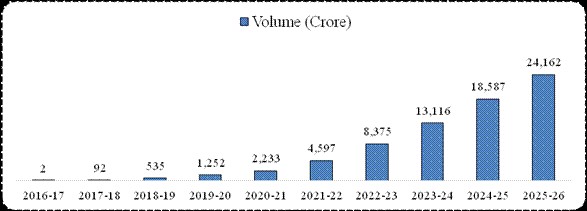
Fig 1: UPI Annual Transaction Volume in Crore| 

Annual Transaction Value Growth (2016-2025)
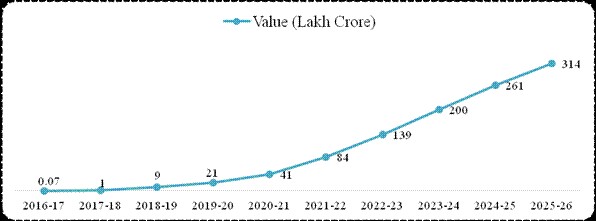
Fig 2: UPI Annual Transaction Value in ₹ Lakh Crore

II.  Monthly Performance, 2025

The Year 2025 marked a significant milestone in the growth trajectory of the Unified Payments Interface (UPI). Monthly transaction volumes crossed 2,000 crore transactions for the first time in August 2025, reaching 2,001 crore transactions, signalling a new scale of adoption. This momentum continued through the remainder of the year, with December 2025 recording 2,163 crore transactions, the highest monthly transaction volume in UPI’s decade‑long journey.

Over the course of the calendar year 2025, UPI processed approximately 22,000 crore transactions in total, translating into a daily average of about 60 crore transactions. This sustained high‑frequency usage reflects the deep penetration of digital payments across the country and the growing trust of citizens, merchants, and businesses in India’s digital payments ecosystem.
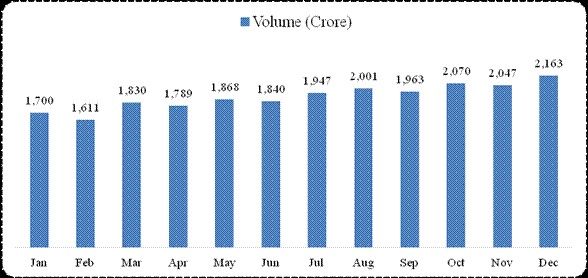
Fig 3: UPI Monthly Transaction Volume (2025)

III.  Ecosystem Strength, Banks, Apps & Geography

Banks Live on UPI, Unprecedented Participation

The Unified Payments Interface (UPI) has witnessed a steady and broad-based expansion in institutional participation since its launch. The number of banks live on UPI increased from 44 banks in FY 2016-17, the first year of operations, to 703 banks by FY 2025-26. This onboarding covers public sector banks, private banks, small finance banks, payment banks, and cooperative banks, enabling UPI's deep geographic reach. Each bank functions as a Remitter PSP (processing outgoing transactions) and/or a Beneficiary PSP (receiving funds), with NPCI monitoring performance metrics for all participants.
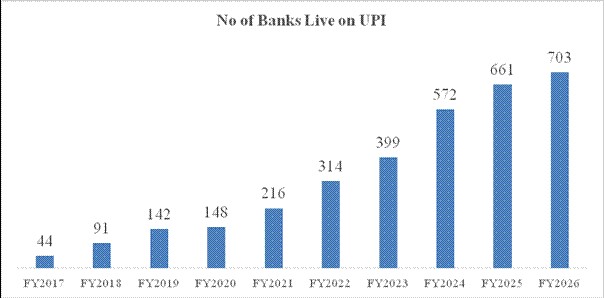
 

Fig 4: Number of Banks Live on UPI (FY2017–2026)


IV.  Transaction Segmentation, P2P & P2M Analysis

An analysis of UPI transactions highlights a clear divergence between volume and value across payment types. Person‑to‑merchant (P2M) transactions account for 63% of total transaction volume, reflecting UPI’s extensive use for high‑frequency, low‑value retail payments. In contrast, person‑to‑person (P2P) transactions dominate transaction value, contributing 71%, indicating their use for higher‑ticket transfers between individuals. This contrast underscores UPI’s dual role as a mass retail payments platform and a trusted channel for larger‑value fund transfers.
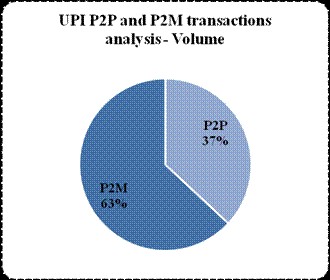
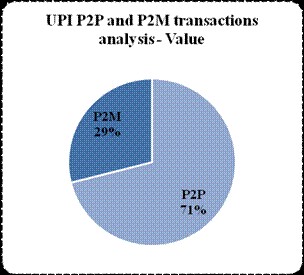
Fig 7: UPI P2P vs P2M Split — Volume & Value (H1 2025, 106.36 Billion Transactions)  |  Source: NPCI UPI Product Statistics


Transaction Distribution by Ticket Size, Micro-Payments Dominate

Fig 5: UPI P2P vs P2M Split, Volume & Value

In FY2026, UPI transactions totalling 24,162 crore reflected the platform’s deep integration into everyday digital payment usage across the country. with particularly robust momentum in the merchant segment. P2M transactions were largely driven by small-ticket payments, with 86% below ₹500, highlighting UPI’s deep integration into routine retail and day-to-day commerce, even as higher-value transactions continued to expand. P2P transactions also showed widespread usage for low-value transfers (59% below ₹500), while a significant 41% of transactions above ₹500 reflects UPI’s growing versatility in facilitating both regular personal payments and higher-value fund transfers.
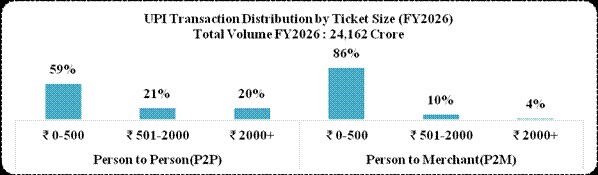


Fig 6: UPI transaction distribution by ticket size

V.  UPI on the World Stage

What began as a domestic payments innovation has today evolved into a global benchmark in digital payments.

As of 2024, India’s Unified Payments Interface (UPI) accounts for nearly 49 % percent of the world’s real-time payment transaction volume, a milestone recognized by the International Monetary Fund (IMF) in its report in June 2025.

With over 66 crores transactions processed daily, UPI has surpassed global payment network, reinforcing India’s position as the world leader in instant, secure, and inclusive digital payments.

Country / Region

Status

UAE

Operational, accepted at major merchant points; used by Indian diaspora

Singapore

Operational, linked with Singapore's PayNow for cross-border transfers

France

Operational, expanding Indian tourist payment acceptance

Bhutan

Operational, NPCI-enabled real-time cross-border payments

Nepal

Operational, accepted across the nation

Sri Lanka

Operational, Indian visitor and diaspora payments

Mauritius

Operational, integrated with local payment infrastructure

Qatar

 Operational.


VI.  The Road Ahead, UPI's Next Decade

The next decade of UPI is poised to drive even greater transformation in India’s digital payments landscape.  By bringing new users and merchants to the UPI Ecosystem, Government of India remains committed to enabling the next phase of UPI-led innovation and strengthening India’s digital payments ecosystem through continued policy support, technological advancement, and greater financial inclusion.

Topics

Acts Income Tax