Loading...

Top
Help
×

By creating an account you can:

Logo TaxTMI
Call Us / Help / Feedback

Contact Us At :

E-mail: [email protected]

Call / WhatsApp at: +91 99117 96707

For more information, Check Contact Us

FAQs :

To know Frequently Asked Questions, Check FAQs

Most Asked Video Tutorials :

For more tutorials, Check Video Tutorials

Submit Feedback/Suggestion :

Email :
Please provide your email address so we can follow up on your feedback.
Category :
Description :
Min 15 characters 0/2000
Make Most of Text Search
  1. Checkout this video tutorial: How to search effectively on TaxTMI.
  2. Put words in double quotes for exact word search, eg: "income tax"
  3. Avoid noise words such as : 'and, of, the, a'
  4. Sort by Relevance to get the most relevant document.
  5. Press Enter to add multiple terms/multiple phrases, and then click on Search to Search.
  6. Text Search
  7. The system will try to fetch results that contains ALL your words.
  8. Once you add keywords, you'll see a new 'Search In' filter that makes your results even more precise.
  9. Text Search
Add to...
You have not created any category. Kindly create one to bookmark this item!
Create New Category
Hide
Title :
Description :
❮❮ Hide
Default View
Expand ❯❯
Close ✕
🔎 News - Adv. Search
TEXT SEARCH:

Press 'Enter' to add multiple search terms. Rules for Better Search

Search In:
Main Text + AI Text
  • Main Text
  • Main Text + AI Text
  • AI Text
Category: ?
Categorized by AI
---- All Categories ----
  • ---- All Categories ----
  • Income Tax
  • GST
  • Customs, DGFT & SEZ
  • FEMA & RBI
  • Corp. Laws, SEBI & IBC
  • PMLA, Black Money & ED
  • Budget
  • News and Press Release
  • PTI News
Month:
---- All Months ----
  • ---- All Months ----
  • January
  • February
  • March
  • April
  • May
  • June
  • July
  • August
  • September
  • October
  • November
  • December
Year:
---- All Years ----
  • ---- All Years ----
  • 2026
  • 2025
  • 2024
  • 2023
  • 2022
  • 2021
  • 2020
  • 2019
  • 2018
  • 2017
  • 2016
  • 2015
  • 2014
  • 2013
  • 2012
  • 2011
Sort By: ?
In Sort By 'Default', exact matches for text search are shown at the top, followed by the remaining results in their regular order.
Relevance Default Date
❯❯
Maximize Maximize Maximize
0 / 200
Expand Note
Add to Folder

No Folders have been created

+

Are you sure you want to delete "My most important" ?

NOTE:

News
Showing Results for :
Reset Filters
Results Found:
Show All Summaries Hide All Summaries
March 31, 2026
Show AI Summary
Electronic audit report filing for registered non-profit organisations is mandatory, time-bound, and tied to exemption eligibility under the income-tax law.
Form 112 is the electronic audit report prescribed under section 348 of the Income-tax Act, 2025, for a registered non-profit organisation whose income exceeds the basic non-taxable limit. It must be filed annually through the e-filing portal, one month before the due date for the return of income, and cannot be edited after acknowledgment or filed offline. PAN is mandatory, and supporting documents include registration papers, audited financials, related forms, FCRA records, AIS, and TDS returns.
March 31, 2026
Show AI Summary
Research-academia collaboration in cement and construction advances joint innovation, training, and sector-wide capacity building.
Strengthening research-academia collaboration in the cement and construction sector is pursued through a Memorandum of Understanding between the National Council for Cement and Building Materials and Delhi Technological University. The arrangement is directed toward joint research and innovation in cement and concrete technologies, along with training opportunities for students, professionals and other stakeholders. It also supports skill development and capacity building across the sector, with an emphasis on sharing technical knowledge, best practices and industry-relevant expertise.
March 31, 2026
Show AI Summary
E-commerce export and courier trade reforms remove value caps, add Return to Origin processing, and simplify returns handling.
CBIC operationalised reforms for e-commerce exports and courier-based trade to improve ease of doing business, reduce logistics inefficiencies, and strengthen export competitiveness. The reforms remove the value cap on commercial courier export consignments, introduce a Return to Origin mechanism for uncleared or unclaimed imports after 15 days, and simplify re-import of returned or rejected goods through a risk-based approach and system-based processing.
March 31, 2026
Show AI Summary
Amendment to accumulated income purpose through Form 110 requires electronic filing and Assessing Officer decision.
FORM 110 is an electronic application for a registered non-profit organisation seeking approval to amend the original purpose for which income was accumulated or set apart for a particular tax-year. It is filed on the e-filing portal before expiry of the period prescribed under Form 109 and must include details of the earlier Form 109, the proposed amendment, the amount unapplied, the reasons for the change, and an undertaking. The application is then forwarded to the jurisdictional Assessing Officer for decision and order in the prescribed ITNS form under section 342(6).
March 31, 2026
Show AI Summary
Change of purpose for accumulated income requires online FN 110 filing and approval before amended utilisation.
FN 110 is the prescribed digital application for a registered non-profit organisation seeking approval to amend the original purpose stated in FN 109 for income accumulated or set apart for a particular tax year. The form is mandatory when such amendment is proposed, must be filed online through the e-filing portal, requires a valid PAN, and cannot be filed offline or edited after submission. After filing and acceptance in FN 111, the accumulated or set-apart amount may be applied toward the amended purpose as approved.
March 31, 2026
Show AI Summary
Accumulation or set-aside of income by non-profit organisations requires annual electronic disclosure in Form 109.
Form 109 is an annual electronic statement for a registered non-profit organisation to report regular income accumulated or set apart under section 342(1) of the Income Tax Act, 2025. It must be furnished on the e-filing portal before the due date for filing the return of income and includes details of the amount, purpose, period of accumulation, prior-year accumulations, and any non-application due to injunction or court order. The reported amount may be claimed in a subsequent return for application within five tax years.
March 31, 2026
Show AI Summary
Accumulation of income by non-profit organisations requires timely electronic filing of FN 109 with a valid PAN.
Registered non-profit organisations may furnish FN 109 electronically or digitally to indicate accumulation or setting apart of regular income under section 342(1) of the Income-tax Act, 2025, for application in subsequent tax years for a period not exceeding five tax years. The form is mandatory for claiming the accumulated or set-apart amount, must be filed by the return due date, requires a valid PAN, and is submitted online to the Commissioner of Income Tax (CPC) through the e-filing portal. It cannot be edited after submission or filed offline.
March 31, 2026
Show AI Summary
Deemed application for non-profit income requires electronic filing of Form 108 before the return due date.
Form 108 requires a registered non-profit organisation to electronically furnish a statement exercising the option under section 341(7) for treating regular income as deemed application under section 341(5). The annual filing is due before the return of income due date and covers computation of the shortfall in application and the reasons for that shortfall. A reported shortfall may be claimed as deemed application in the subsequent return of income.
March 31, 2026
Show AI Summary
Deemed application of income under FN 108 requires timely online filing by registered non-profit organisations.
Registered non-profit organisations may use FN 108 as the electronic statement for exercising the option to treat a shortfall in application of income as deemed application where income could not be applied because it was not received during the relevant tax year. The form is mandatory for such a claim, must be filed online by the return filing due date, requires a valid PAN, and cannot be edited after submission.
March 31, 2026
Show AI Summary
Registration and approval conditions under Form 107 govern validity, disclosure, commercial activity, and cancellation safeguards.
Form No. 107 is the written order passed by the jurisdictional Principal Commissioner or Commissioner on an application in Form No. 105 for regular registration or approval, rejection of the application, cancellation of registration or approval, or a mixed order granting one section code while rejecting another. It records applicant particulars, the unique registration or approval number, the section, date, nature of activity, validity period and relevant tax years, and where applicable the reasons for rejection or cancellation. The form also sets out conditions on application of income, commercial activities, books of account, compliance with law, and true and complete disclosure.
March 31, 2026
Show AI Summary
Registration and approval orders under Form 107 govern grant, rejection, cancellation, and validity periods for eligible applicants.
Form No. 107 is the written order by which the jurisdictional Principal Commissioner or Commissioner grants regular registration or approval, rejects the application, cancels registration or approval, or grants one section code while rejecting the other. It is passed on receipt of Form No. 105, ordinarily within six months from the end of the quarter in which the application is made. The order may issue a 16 digit alphanumeric Unique Registration Number, and the validity of regular registration or approval is generally five tax years, with stated exceptions extending validity in specified cases.
March 31, 2026
Show AI Summary
Provisional registration and approval conditions under Form 106 cover income use, commercial activity limits, and disclosure compliance.
Form No. 106 is the order through which the Commissioner of Income Tax (CPC) grants provisional registration or provisional approval, or rejects an application made in Form No. 104. It captures applicant details, the provisional registration or approval number, the period of validity, and the authority issuing the order. The form prescribes conditions on application of income, commercial activities, maintenance of separate books, compliance with law, and true disclosure, and it may be cancelled if false information is found or electronic filing requirements are not met.
March 31, 2026
Show AI Summary
Preferential allotment of equity shares under a resolution plan supports AI expansion, technology platforms, and working capital needs.
Preferential allotment of equity shares by a listed artificial intelligence and digital transformation company pursuant to a Resolution Plan approved by the National Company Law Tribunal and in compliance with applicable SEBI Regulations, the Companies Act, 2013 and stock exchange requirements. The allotment comprised equity shares issued to strategic investors in the public non-promoter category at a premium, with participation from alternative investment funds, strategic investors and high-net-worth individuals.
March 31, 2026
Show AI Summary
Provisional registration and approval under income tax rules require timely orders, a unique registration number, and compliance with filing requirements.
Provisional registration or provisional approval is granted through Form No. 106 after receipt of Form No. 104, with an order to be passed within one month from the end of the month of application. The provisional status remains valid for three tax years or up to six months from commencement of activities, whichever is earlier. The order issues a 16-digit Unique Registration Number and may later be cancelled after hearing if the application contains false or incorrect information or fails electronic filing and verification requirements.
March 31, 2026
Show AI Summary
Form 105 governs regular registration and approval of non-profit organisations, with filing, validity, documents, and re-application rules.
Form No. 105 is the electronic application for regular registration or regular approval of specified non-profit organisations and allied funds under the Income-tax Act, 2025. It covers applicants seeking registration to claim benefits available to registered non-profit organisations, and applicants seeking approval so that donations received may qualify for donor deduction. The form requires details of identity, formation, existing registration, income, office bearers, beneficial ownership, activities, assets, liabilities, and supporting documents. It also provides for filing timelines, validity periods, re-application, withdrawal, and correction of erroneous details before the order is passed.
March 31, 2026
Show AI Summary
EMI calculators support smarter personal loan planning by helping borrowers assess repayments, tenure, and borrowing capacity in advance.
Personal loan planning increasingly depends on EMI calculators that allow borrowers to estimate monthly instalments, compare loan scenarios, adjust tenure for affordability, and assess the total cost of borrowing before applying. By entering the loan amount, tenure, and interest rate, applicants can review repayment obligations in advance and align borrowing decisions with monthly income and budget capacity, thereby supporting more disciplined financial planning and reducing the risk of over-borrowing. The personal loan product is presented as a flexible digital lending option with an online application process, minimal documentation, and fast approval features.
March 31, 2026
Show AI Summary
Income tax return forms notified for assessment year 2026-27, setting filing eligibility across taxpayer categories and updated returns.
Income Tax Department notified all income tax return forms for assessment year 2026-27, enabling individuals, businesses and other entities to file returns for income earned in financial year 2025-26. The notification covers ITR forms 1 to 7 as well as ITR-U for updated returns, with the return-filing deadline for individuals and other non-audited taxpayers stated as 31 July. ITR-1 (Sahaj) is available to resident individuals with total annual income up to Rs 50 lakh deriving income from salary, one house property, other sources and agricultural income up to Rs 5,000. ITR-4 (Sugam) applies to individuals, Hindu Undivided Families and firms other than limited liability partnerships having total annual income up to Rs 50 lakh and income from business or profession. ITR-2 is for individuals and HUFs without business or professional income but having capital gains, while ITR-3 is for individuals and HUFs with income from proprietary business or profession.
March 31, 2026
Show AI Summary
Regular registration and approval for non-profit organisations through a common online form with event-based filing rules.
Form No. 105 is the common online application for regular registration of a non-profit organisation and for regular approval of a registered non-profit organisation or specified funds so that donor deductions may be available. It is mandatory only for applicants seeking these benefits, requires PAN, must be furnished electronically to the jurisdictional Principal Commissioner or Commissioner, and is filed within the prescribed time limits depending on commencement of activities, expiry of provisional status, expiry of existing registration or approval, inoperative registration, or modification of objects. The form is generally event-based, the regular registration or approval is ordinarily valid for five tax years, and a one-time re-application, withdrawal within seven days, correction before the order, and specified supporting documents are permitted.
March 31, 2026
Show AI Summary
Provisional registration and approval for non-profit organisations under Form 104 are granted through a simplified electronic application process.
Form No. 104 is the common electronic application for provisional registration or provisional approval for eligible non-profit organisations, registered non-profit organisations, regimental funds, and non-public funds established by the armed forces. It requires prescribed identification, incorporation, registration, ownership, return-filing, and supporting document details, and must be filed with the Commissioner of Income Tax (CPC) through the e-filing portal. Provisional registration or approval is granted through a written order with a Unique Registration Number, may be cancelled for false or non-compliant filings, may be surrendered if no exemption benefits were ever claimed, and may be withdrawn within seven days of filing.
March 31, 2026
Show AI Summary
Provisional registration and approval for non-profit organisations depend on online Form No. 104, mandatory PAN, and commenced activities rules.
Form No. 104 is the common electronic application for provisional registration under section 332(3) and provisional approval under section 354(2) for applicants whose activities have not commenced. It is filed online with the Commissioner of Income Tax (CPC), who must pass an order in Form No. 106 within one month from the end of the month of filing, unless the application is non-est. The provisional registration or approval is valid for three tax years or up to six months from commencement of activities, whichever is earlier, and may be cancelled for false information or defective filing. PAN is mandatory, offline filing is not permitted, and the form cannot be edited after submission.

News

Back

All News

Showing Results for :
Reset Filters
No Records Found

News

Back

All News

Showing Results for : Reset Filters
News and Press Release

Flash Report on Central Sector Infrastructure Projects worth ₹150 crore and above

April 25, 2026

Contents
Summary
Note

Note

-

Bookmark

Print

Print

PAIMANA Portal Tracks 1,941 Infrastructure Projects worth ₹41.50 lakh crore as of March 2026

The Ministry of Statistics and Programme Implementation (MoSPI) continues to strengthen monitoring of Central Sector infrastructure projects through its PAIMANA platform, enabling improved tracking, timely reviews, and data-driven decision-making across Ministries. The portal tracks 1,941 Infrastructure Projects worth of ₹41.50 lakh crore as of March 2026.

Key Highlights

  • As of March 2026, 1,941 ongoing infrastructure projects, with a total revised cost of ₹41.50 lakh crore, are being monitored across 17 Central Ministries/Departments. The cumulative expenditure incurred on these projects stands at ₹19.93 lakh crore, accounting for approximately 48.02 per cent of the revised project cost, indicating steady progress in project implementation.
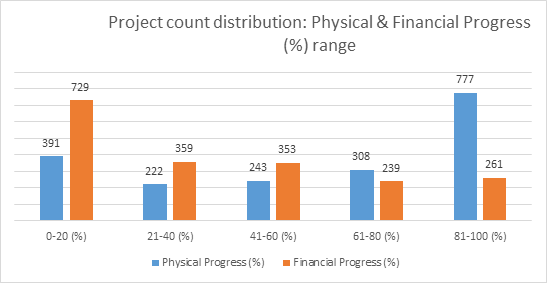
  • A significant proportion of projects are at advanced stages, with 777 projects (~40%) achieving over 80% physical progress, while 261 (~13%) have crossed 80% financial completion. The data also reflects a balanced pipeline, with projects distributed across early and advanced stages of implementation.
  • The Transport & Logistics sector (as per the DEA’s Harmonized Master List) accounts for the highest number of ongoing projects (1428 projects), with revised estimates of ₹22.66 lakh crore underscoring priority to connectivity-driven infrastructure growth.
  • 1,941 ongoing infrastructure projects include 786 Mega projects (project cost of ₹1,000 crore & above) with an original cost of ₹30.48 lakh crore, and 1,155 Major projects (project cost below ₹1,000 crore and up to ₹150 crore) amounting to ₹5.41 lakh crore.
  • Physical and financial progress broadly move in tandem, with a large number of projects clustered at the initial (0–20%) and advanced (81–100%) stages, indicating a pipeline of newly-started projects alongside many nearing completions. While physical progress exceeds financial progress in the 81–100% range, financial progress is relatively higher in the early stages, reflecting upfront expenditure patterns in project implementation.
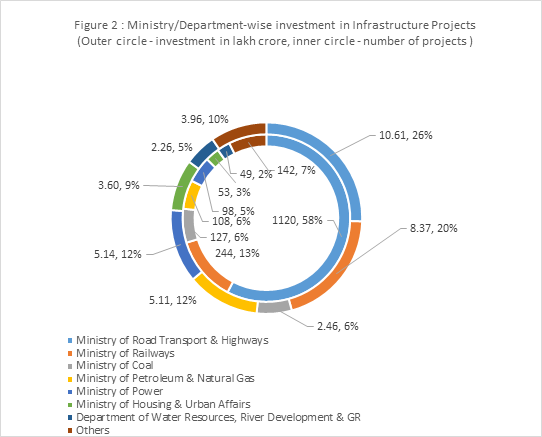
2.   Ministry/ Departments-wise progress of Infrastructure Projects

  • Ministry of Road Transport & Highways accounts for the highest number of projects, with 1120 projects (58%), and a share of total revised project cost of ₹10.61 lakh crore (26%), highlighting its central role in national infrastructure development.
  • Ministry of Railways is implementing 244 projects (13%), and also commands the largest share of total revised project cost at ₹8.37 lakh crore (20%).
  • Ministry of Coal accounts for implementing 127 projects (6%), with a total revised project cost of ₹2.46 lakh crore (6%).
  • The Ministry of Petroleum & Natural Gas, Ministry of Power, Ministry of Housing & Urban Affairs, and the Department of Water Resources, River Development & GR are implementing 108, 98, 53, and 49 projects, with associated revised costs of ₹5.11 lakh crore, ₹5.14 lakh crore, ₹3.6 lakh crore, and ₹2.26 lakh crore, respectively.
  • The remaining 142 projects (7%), with a total revised cost of ₹3.96 lakh crore (10%), are distributed across various Ministries/Departments including Higher Education, Civil Aviation, Steel, Telecommunications, Labour & Employment, Ports, Shipping & Waterways, Health & Family Welfare, Mines, DPIIT, and Sports. (Refer Annexure I)
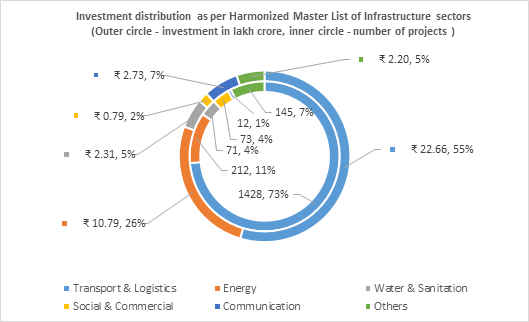
3.   Sector-wise (as per DEA’s Harmonized Master List of Infrastructure) Progress of Infrastructure Projects

  • Transport & Logistics remains the dominant sector, accounting for 55% of total revised cost (₹22.66 lakh crore) across 1,428 projects (73 % of the total Projects), underscoring the central role of Roads & Highways, Railways, Aviation, Urban Public Transport, Shipping, and Inland Waterways in economic integration and logistics efficiency.
  • The Energy sector follows with 26% of aggregated revised cost (₹10.79 lakh crore) across 212 projects, reflecting sustained emphasis on Oil & Gas infrastructure, electricity generation, transmission and distribution networks, and energy storage systems.
  • Communication infrastructure, with a revised cost of ₹2.73 lakh crore (7%) across 12 projects, represents targeted interventions aimed at strengthening digital connectivity.
  • Water & Sanitation projects account for ₹2.31 lakh crore (5%) across 71 projects, highlighting continued focus on essential urban services.
  • Social & Commercial infrastructure, comprising 73 projects with a revised cost of ₹0.79 lakh crore (2%), reflects selective investments in education, healthcare, real estate, and tourism, hospitality and wellness.
  • Projects classified under ‘Others’, amounting to ₹2.20 lakh crore (5%) across 145 projects, indicate diversification across sectors such as coal, steel, metals, and mining.

(Refer Annexure II)
4.   Completed Projects and New Additions

  • During March 2026, 25 projects were commissioned, including major assets in Road Transport & Highways, Petroleum & Natural Gas, Housing & Urban Affairs, Railways, Power, Ports, Shipping and Waterways, Telecommunications, Steel and Labour and Employment. Notable commissioned projects include the “Delhi-Ghaziabad-Meerut Regional Rapid Transit System [RRTS] corridor” (₹ 30,274 crore) from Ministry of Housing & Urban Affairs, and the “Tehri Pumped Storage Plant Project [4x250 MW] (₹ 8,339 crore) from Ministry of Power.
  • During March 2026, 12 additional projects from MoRTH were brought under the monitoring of PAIMANA.

5.    Next date of Press Release: Flash Report for the month of April 2026 would be released on 25th May 2026.

Note

  1. The press release summarizes highlights from the MoSPI’s Flash Report (March 2026) on Central Sector Infrastructure Projects (₹150 crore and above), available at https://www.ipm.mospi.gov.in/ or via the QR code.

 

  1. PAIMANA is a centralized web-based portal for monitoring of Central Sector Infrastructure Projects worth ₹150 crore and above. Operating on the "one data, one entry" principle, it integrates with DPIIT’s IPMP portal via APIs to automatically update more than 70% of project data from various Ministries/Departments. PAIMANA also serves as a national repository designed to standardize infrastructure monitoring and support informed decision-making for nation-building.

Annexure I

Ministry/ Departments-wise progress of Central Sector Infrastructure Projects

S. No

Ministry/ Department

Project Count

Revised Cost

(₹ Lakh cr.)

Cumulative Expenditure           (₹ Lakh cr.)

1

Ministry of Road Transport & Highways

1120

10.61

3.52

2

Ministry of Railways

244

8.37

5.69

3

Ministry of Coal

127

2.46

0.80

4

Ministry of Petroleum & Natural Gas

108

5.11

2.99

5

Ministry of Power

98

5.14

1.94

6

Ministry of Housing & Urban Affairs

53

3.60

1.98

7

Department of Water Resources, River Development & GR

49

2.26

1.61

8

Department of Higher Education

29

0.14

0.08

9

Ministry of Civil Aviation

26

0.23

0.11

10

Ministry of Health & Family Welfare

23

0.21

0.08

11

Ministry of Steel

19

0.23

0.10

12

Ministry of Labour and Employment

12

0.03

0.02

13

Department of Telecommunications

12

2.73

0.77

14

Ministry of Ports, Shipping and Waterways

11

0.22

0.15

15

Ministry of Mines

6

0.10

0.07

16

Department for Promotion of Industry & Internal Trade

3

0.05

0.01

17

Department of Sports

1

0.01

0.01


Total

1941

41.50

19.93


Annexure II

Sector-wise (as per DEA’s Harmonized Master List of Infrastructure) progress of Central Sector Infrastructure Projects

S. No

HML Category

Project Count

Revised Cost      (₹ Lakh cr.)

Cumulative Expenditure      (₹ Lakh cr.)

1

Transport & Logistics

1428

22.66

11.28

2

Energy

212

10.79

5.21

3

Water & Sanitation

71

2.31

1.65

4

Communication

12

2.73

0.77

5

Social & Commercial

73

0.79

0.34

6

Others

145

2.21

0.67


Total

1941

41.50

19.93


Topics

Acts Income Tax

