Loading...

Top
Help
×

By creating an account you can:

Logo TaxTMI
Call Us / Help / Feedback

Contact Us At :

E-mail: [email protected]

Call / WhatsApp at: +91 99117 96707

For more information, Check Contact Us

FAQs :

To know Frequently Asked Questions, Check FAQs

Most Asked Video Tutorials :

For more tutorials, Check Video Tutorials

Submit Feedback/Suggestion :

Email :
Please provide your email address so we can follow up on your feedback.
Category :
Description :
Min 15 characters 0/2000
Make Most of Text Search
  1. Checkout this video tutorial: How to search effectively on TaxTMI.
  2. Put words in double quotes for exact word search, eg: "income tax"
  3. Avoid noise words such as : 'and, of, the, a'
  4. Sort by Relevance to get the most relevant document.
  5. Press Enter to add multiple terms/multiple phrases, and then click on Search to Search.
  6. Text Search
  7. The system will try to fetch results that contains ALL your words.
  8. Once you add keywords, you'll see a new 'Search In' filter that makes your results even more precise.
  9. Text Search
Add to...
You have not created any category. Kindly create one to bookmark this item!
Create New Category
Hide
Title :
Description :
❮❮ Hide
Default View
Expand ❯❯
Close ✕
🔎 News - Adv. Search
TEXT SEARCH:

Press 'Enter' to add multiple search terms. Rules for Better Search

Search In:
Main Text + AI Text
  • Main Text
  • Main Text + AI Text
  • AI Text
Category: ?
Categorized by AI
---- All Categories ----
  • ---- All Categories ----
  • Income Tax
  • GST
  • Customs, DGFT & SEZ
  • FEMA & RBI
  • Corp. Laws, SEBI & IBC
  • PMLA, Black Money & ED
  • Budget
  • News and Press Release
  • PTI News
Month:
---- All Months ----
  • ---- All Months ----
  • January
  • February
  • March
  • April
  • May
  • June
  • July
  • August
  • September
  • October
  • November
  • December
Year:
---- All Years ----
  • ---- All Years ----
  • 2026
  • 2025
  • 2024
  • 2023
  • 2022
  • 2021
  • 2020
  • 2019
  • 2018
  • 2017
  • 2016
  • 2015
  • 2014
  • 2013
  • 2012
  • 2011
Sort By: ?
In Sort By 'Default', exact matches for text search are shown at the top, followed by the remaining results in their regular order.
Relevance Default Date
    Guidance Note – Form 117
    Form 117 – Frequently Asked Questions
    Guidance Note – Form 116
    Form 116 – Frequently Asked Questions
    Guidance Note – Form 115
    Form 115 – Frequently Asked Questions (FAQ)
    Guidance Note – Form 114
    Guidance Note – Form 113
    Form 113 & 114– Frequently Asked Questions
    GST collections grow 8.8 pc to over Rs 2 lakh cr in March
    Japan's Leading Crypto Tax Platform, cryptact, Introduces INR-Priced Plans for India - 30% Off Through July 2026 to Support Tax Filing Season
    PAN Health Wins ‘Excellence in Manufacturing – Healthcare & Pharmaceuticals’ at ET Entrepreneur Awards 2026
    US report flags high import duties, non-tariff barriers in India
    Rupee rises 15 paise to 94.70 against US dollar in early trade
    CBDT signs record 219 Advance Pricing Agreements (APAs) in FY 2025–26, taking total number of APAs beyond milestone of 1000 (i.e. 1034) since incept...
    US lists India’s preference for domestic satellites for DTH, localised internet shutdown as trade barrier
    Police recover huge cash, high-end vehicles from two Bihar govt officials
    Quality of HP apple must be improved to compete with global players: Min
    India's 1st Iranian oil cargo since 2019 headed to Gujarat coast
    Guidance Note – Form 112
❯❯
Maximize Maximize Maximize
0 / 200
Expand Note
Add to Folder

No Folders have been created

+

Are you sure you want to delete "My most important" ?

NOTE:

News
Showing Results for :
Reset Filters
Results Found:
Show All Summaries Hide All Summaries
April 1, 2026
Show AI Summary
Identical question of law declarations under Form 117 keep pending tax disputes aligned with the final higher court decision.
Form 117 is the prescribed declaration by which an assessee states that a question of law in the assessee's pending case is identical to a question already pending before the High Court or Supreme Court in the assessee's own case for another tax year. The form is filed before the Assessing Officer or appellate authority, with supporting documents showing the related pending proceedings. If accepted, the assessee is bound by the final decision on the identical question and the pending order may later be amended to conform to that decision.
April 1, 2026
Show AI Summary
Identical question of law declaration streamlines tax disputes by binding pending cases to the higher court's final decision.
Form 117 is the optional declaration used by an assessee to state that a question of law in the relevant case is identical to a question already pending before the High Court or Supreme Court in the assessee's own case for another assessment year. It may be filed before the Assessing Officer or the appellate authority, requires prescribed particulars and supporting documents, and once admitted binds the assessee to the final decision on that identical question while not stopping the pending proceedings.
April 1, 2026
Show AI Summary
Cross-objections before the Income-tax Appellate Tribunal require timely filing, supporting documents, and structured grounds under the prescribed form.
Form 116 is the prescribed memorandum of cross-objections to the Income-tax Appellate Tribunal, enabling a respondent in an appeal to challenge any part of the order appealed against without filing a separate appeal. It may be filed by a respondent, including an assessee, deductor, or the Income-tax Department, only after an appeal has been filed and notice of that appeal has been received. The form is to be furnished within thirty days, accompanied by relevant orders and supporting documents, and may include grounds for condonation of delay where applicable.
April 1, 2026
Show AI Summary
Cross-objections before the Tribunal must be filed in the prescribed form, with separate grounds, tax effect, and timely notice-based filing.
Form 116 is the prescribed memorandum of cross-objections before the Income-tax Appellate Tribunal in response to an appeal already filed by the opposite party. It is available to a respondent such as an assessee, the Income-tax Department, or a government deductor, and must be filed within 30 days of receipt of notice. The form cannot be filed independently of an existing appeal, and each ground of cross-objection must be numbered, stated separately, and accompanied by the corresponding tax effect.
April 1, 2026
Show AI Summary
Income-tax appeal form governs Tribunal filings, prescribed time limits, supporting documents, and electronic submission requirements.
Form No. 115 is the prescribed appeal form for filing an appeal before the Income-tax Appellate Tribunal against appealable orders of income-tax authorities. It is to be filed by an aggrieved assessee or by the Income-tax Department, within two months from the end of the month in which the order is communicated, and may be accompanied by the relevant orders, grounds, statements, and supporting documents. The form is filed electronically, along with the prescribed fee, and is structured to capture appellant details, respondent details, appeal particulars, disputed amounts, grounds of appeal, and verification.
April 1, 2026
Show AI Summary
Income-tax appeal procedure: Form 115 sets out filing requirements, tax effect details, fee payment, and Tribunal jurisdiction.
Form 115 is the prescribed memorandum of appeal for filing an appeal before the Income-tax Appellate Tribunal against specified orders under the Income-tax Act and Rules. It may be filed by an aggrieved assessee or by the Income-tax Department, and must be presented before the Tribunal having jurisdiction over the case. The form requires particulars of the parties, appeal details, disputed amount, grounds of appeal, fee payment, supporting documents, signature and verification, and it is not revisable after filing.
April 1, 2026
Show AI Summary
Donation certificate form generated after donor reporting and processing of donation particulars under the Income Tax Act, 2025.
Form 114 is an acknowledgement and certificate of donation under the Income Tax Act, 2025, generated for a donor only after due filing and successful processing of Form-113 by a registered non-profit organisation. It records voluntary donations made during the relevant reporting period and contains Part A for donee information and Part B for donor information. The guidance also notes simplification of the form and alignment with the Act, including updated tax-year terminology.
April 1, 2026
Show AI Summary
Donation reporting compliance under Form 113 enables electronic filing, donor acknowledgement, and subsequent income tax claim support.
Form 113 is the electronic statement through which a registered non-profit organisation furnishes particulars of donations received during the tax year. It is filed for the reporting period by 31 May of the following tax year and contains Part A for the organisation's details and Part B for donor and donation particulars. Successful filing and processing support donor claim of the reported donation in a subsequent return of income and generation of Form 114 as the donation certificate or acknowledgement.
April 1, 2026
Show AI Summary
Donation reporting and donor certificates require mandatory electronic filing, enabling verified tax claims for voluntary contributions.
Registered non-profit organisations must electronically furnish the donation statement and issue the corresponding donor certificate within the prescribed reporting cycle. FN 113 records particulars of voluntary donations received during the tax year, while FN 114 is the acknowledgement or certificate for the donor. Filing is mandatory, requires a valid PAN, and must be done on the e-filing portal. A correction statement may be filed after submission, and a revised certificate may be issued if needed. The reporting process supports verification of donation claims and enables the donor to claim the relevant exemption or deduction in the return of income.
April 1, 2026
Show AI Summary
GST collections rise on stronger domestic and import revenues, with net receipts also showing steady year-on-year growth.
Gross Goods and Services Tax (GST) collections rose by 8.8 per cent in March 2026 to over Rs 2 lakh crore, supported by higher tax realisations from domestic sales and imports. Refund issuance increased by 13.8 per cent to Rs 22,074 crore, and net GST revenues stood at about Rs 1.78 lakh crore after adjustment for refunds. For the full 2025-26 fiscal year, gross GST revenue rose 8.3 per cent to over Rs 22.27 lakh crore, while net revenues increased 7.1 per cent to Rs 19.34 lakh crore.
April 1, 2026
Show AI Summary
Crypto tax compliance tools expand in India with INR pricing, Schedule VDA reporting, and automated filing support.
India's VDA tax compliance environment requires accurate transaction tracking, timely filing, and Schedule VDA-ready reporting, particularly in light of the flat tax on gains, transaction-level TDS, and the absence of loss offsets. A crypto tax platform has introduced INR-denominated paid plans for Indian users after an initial free rollout, while keeping a free portfolio-tracking option available without tax report downloads. The paid plans are presented as a means of enabling users to obtain filing documents, automate transaction import, and generate India-specific tax reports aligned with the Income Tax framework.
April 1, 2026
Show AI Summary
Manufacturing excellence drives PAN Health's recognition for scale, quality, and growth in disposable personal hygiene products.
PAN Health received the 'Excellence in Manufacturing - Healthcare & Pharmaceuticals' award at the ET Entrepreneur Awards 2026 for its manufacturing scale, quality focus, and contribution to the disposable personal hygiene sector. The company is presented as a fast-growing Indian manufacturer aligned with the Make in India vision, operating a large facility in Rajkot, Gujarat, and producing multiple categories of hygiene products under brands including Little Angel, Liberty, and Everteen.
April 1, 2026
Show AI Summary
Trade barriers and tariff flexibility in India draw fresh US concerns over market access, standards and digital restrictions.
The report says India maintains high applied import duties and wide tariff flexibility, while also using numerous non-tariff barriers such as licensing requirements, Quality Control Orders, customs barriers, testing and certification mandates, and price controls. It further criticises opaque quantitative restrictions, burdensome import licensing for remanufactured goods, discretionary tariff changes, and complex customs exemptions. The report also flags concerns over standards, government procurement, foreign equity limits, digital trade barriers and internet shutdowns affecting market access and commercial operations.
April 1, 2026
Show AI Summary
Net open position cap for banks tightened to curb foreign exchange exposure and reinforce currency risk management.
RBI capped the Net Open Position in Indian rupees for banks at USD 100 million, with compliance required by April 10, 2026. The measure requires banks to reduce currency exposure and align positions with the prescribed limit, reflecting regulatory control over foreign exchange exposure and risk management in bank dealings.
April 1, 2026
Show AI Summary
Advance Pricing Agreements boost transfer pricing certainty as safe harbour reforms streamline compliance and strengthen business certainty.
CBDT signed a record number of Advance Pricing Agreements with Indian taxpayers in FY 2025-26, including unilateral and bilateral agreements, taking the cumulative APA count beyond the 1,000-mark since inception. The APA programme is described as a mechanism for strengthening transfer pricing certainty, easing compliance, and improving ease of business. Safe Harbour Rules complement the framework by prescribing fixed margins for specified international transactions, while recent reforms consolidate technology service categories, raise the eligibility threshold, and introduce a more automated process.
April 1, 2026
Show AI Summary
Domestic satellite preference and internet shutdown controls are flagged as trade barriers affecting satellite services and digital commerce.
Preference for domestic satellites in direct-to-home television services, restrictions on direct foreign contracting, and procedural delays in accessing foreign satellite capacity are described as barriers to foreign trade. The report also urges an open skies satellite policy to expand market access. Localised internet shutdowns and increased takedown requests are said to impede the digital economy, while satellite communication providers face security instructions on interception, blocking, routing, registration, disclosure, geo-fencing, data localisation, and phased sourcing of ground infrastructure.
March 31, 2026
Show AI Summary
Disproportionate assets probe leads to recovery of cash, vehicles and property documents from senior officials.
Police action against two senior Bihar government officers for alleged possession of disproportionate assets led to searches at multiple locations and recovery of property documents, cash, luxury items and vehicle records. The Economic Offences Unit registered separate FIRs against Kishanganj SDPO Gautam Kumar and Saharsa DRDA director Vaibhav Kumar after preliminary findings indicated assets allegedly far in excess of their known income, with suspected benami properties and investments traced to family members and associates. Searches yielded documents relating to numerous land parcels, residential property, insurance and financial investments, bank deposits, cash, luxury watches, high-end vehicles and other valuables.
March 31, 2026
Show AI Summary
Free trade agreements and apple imports raise concerns over Himachal orchardists' economic interests and market competitiveness.
Himachal Pradesh's apple sector was discussed in the context of free trade agreements with the European Union, the United States, New Zealand and other countries, with concern that lower import duties on apples could affect the economic interests of local growers. A private resolution urged the central government to frame a policy to safeguard orchardists, and the government accepted the resolution. The debate also noted that Himachal apples must improve in quality to compete with imports and that the state lags behind those markets in quality standards.
March 31, 2026
Show AI Summary
Sanctions waiver revives Iranian crude trade as a cargo heads to Gujarat amid refinery inventory pressures.
India's crude oil trade may see a renewed shipment of Iranian oil after a sanctions waiver allowed oil "on the water" to be purchased for a limited period. A vessel carrying about 600,000 barrels of Iranian crude has reportedly been observed heading toward Vadinar in Gujarat, marking the first such delivery since imports stopped in 2019 after sanctions tightening. The development is linked to Indian refiners' need for cargoes amid tightening inventories, while the government has stated that any resumption of purchases will depend on techno-commercial feasibility.
March 31, 2026
Show AI Summary
Registered non-profit organisation audit reporting in Form 112 standardises income, foreign contribution, and related person disclosures.
Form 112 is the annual audit report required to be furnished electronically under section 348 for a registered non-profit organisation whose total income exceeds the maximum amount not chargeable to income-tax in the relevant tax year. The form is filed through the e-filing portal on or before 30 September of the following year, with a Chartered Accountant certificate and annexure covering audited particulars, income classification, application of income, donations, related person transactions, specified violations, loans, borrowings, and supporting schedules. The guidance also consolidates earlier audit forms into a common Form 112 with different schedules for small and large registered non-profit organisations.

News

Back

All News

Showing Results for :
Reset Filters
No Records Found

News

Back

All News

Showing Results for : Reset Filters
News and Press Release

Flash Report on Central Sector Infrastructure Projects worth ₹150 crore and above

April 25, 2026

Contents
Summary
Note

Note

-

Bookmark

Print

Print

PAIMANA Portal Tracks 1,941 Infrastructure Projects worth ₹41.50 lakh crore as of March 2026

The Ministry of Statistics and Programme Implementation (MoSPI) continues to strengthen monitoring of Central Sector infrastructure projects through its PAIMANA platform, enabling improved tracking, timely reviews, and data-driven decision-making across Ministries. The portal tracks 1,941 Infrastructure Projects worth of ₹41.50 lakh crore as of March 2026.

Key Highlights

  • As of March 2026, 1,941 ongoing infrastructure projects, with a total revised cost of ₹41.50 lakh crore, are being monitored across 17 Central Ministries/Departments. The cumulative expenditure incurred on these projects stands at ₹19.93 lakh crore, accounting for approximately 48.02 per cent of the revised project cost, indicating steady progress in project implementation.
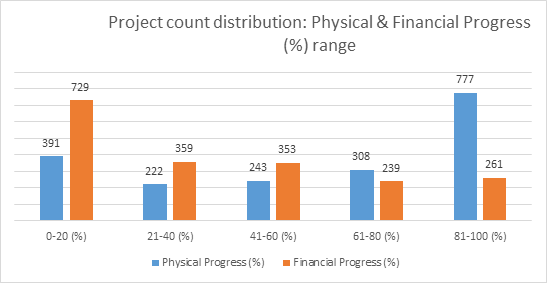
  • A significant proportion of projects are at advanced stages, with 777 projects (~40%) achieving over 80% physical progress, while 261 (~13%) have crossed 80% financial completion. The data also reflects a balanced pipeline, with projects distributed across early and advanced stages of implementation.
  • The Transport & Logistics sector (as per the DEA’s Harmonized Master List) accounts for the highest number of ongoing projects (1428 projects), with revised estimates of ₹22.66 lakh crore underscoring priority to connectivity-driven infrastructure growth.
  • 1,941 ongoing infrastructure projects include 786 Mega projects (project cost of ₹1,000 crore & above) with an original cost of ₹30.48 lakh crore, and 1,155 Major projects (project cost below ₹1,000 crore and up to ₹150 crore) amounting to ₹5.41 lakh crore.
  • Physical and financial progress broadly move in tandem, with a large number of projects clustered at the initial (0–20%) and advanced (81–100%) stages, indicating a pipeline of newly-started projects alongside many nearing completions. While physical progress exceeds financial progress in the 81–100% range, financial progress is relatively higher in the early stages, reflecting upfront expenditure patterns in project implementation.
2.   Ministry/ Departments-wise progress of Infrastructure Projects

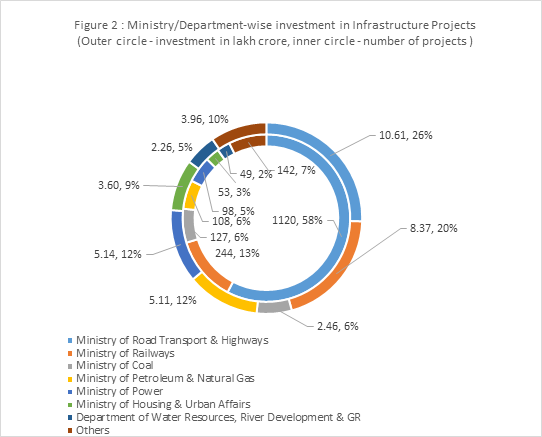
  • Ministry of Road Transport & Highways accounts for the highest number of projects, with 1120 projects (58%), and a share of total revised project cost of ₹10.61 lakh crore (26%), highlighting its central role in national infrastructure development.
  • Ministry of Railways is implementing 244 projects (13%), and also commands the largest share of total revised project cost at ₹8.37 lakh crore (20%).
  • Ministry of Coal accounts for implementing 127 projects (6%), with a total revised project cost of ₹2.46 lakh crore (6%).
  • The Ministry of Petroleum & Natural Gas, Ministry of Power, Ministry of Housing & Urban Affairs, and the Department of Water Resources, River Development & GR are implementing 108, 98, 53, and 49 projects, with associated revised costs of ₹5.11 lakh crore, ₹5.14 lakh crore, ₹3.6 lakh crore, and ₹2.26 lakh crore, respectively.
  • The remaining 142 projects (7%), with a total revised cost of ₹3.96 lakh crore (10%), are distributed across various Ministries/Departments including Higher Education, Civil Aviation, Steel, Telecommunications, Labour & Employment, Ports, Shipping & Waterways, Health & Family Welfare, Mines, DPIIT, and Sports. (Refer Annexure I)
3.   Sector-wise (as per DEA’s Harmonized Master List of Infrastructure) Progress of Infrastructure Projects

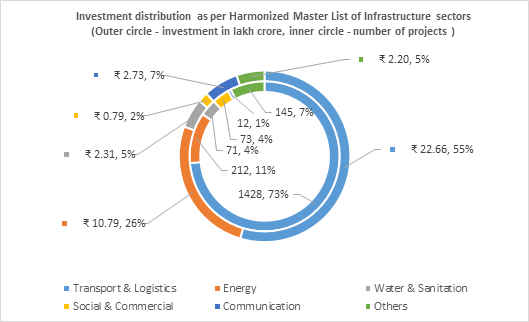
  • Transport & Logistics remains the dominant sector, accounting for 55% of total revised cost (₹22.66 lakh crore) across 1,428 projects (73 % of the total Projects), underscoring the central role of Roads & Highways, Railways, Aviation, Urban Public Transport, Shipping, and Inland Waterways in economic integration and logistics efficiency.
  • The Energy sector follows with 26% of aggregated revised cost (₹10.79 lakh crore) across 212 projects, reflecting sustained emphasis on Oil & Gas infrastructure, electricity generation, transmission and distribution networks, and energy storage systems.
  • Communication infrastructure, with a revised cost of ₹2.73 lakh crore (7%) across 12 projects, represents targeted interventions aimed at strengthening digital connectivity.
  • Water & Sanitation projects account for ₹2.31 lakh crore (5%) across 71 projects, highlighting continued focus on essential urban services.
  • Social & Commercial infrastructure, comprising 73 projects with a revised cost of ₹0.79 lakh crore (2%), reflects selective investments in education, healthcare, real estate, and tourism, hospitality and wellness.
  • Projects classified under ‘Others’, amounting to ₹2.20 lakh crore (5%) across 145 projects, indicate diversification across sectors such as coal, steel, metals, and mining.

(Refer Annexure II)
4.   Completed Projects and New Additions

  • During March 2026, 25 projects were commissioned, including major assets in Road Transport & Highways, Petroleum & Natural Gas, Housing & Urban Affairs, Railways, Power, Ports, Shipping and Waterways, Telecommunications, Steel and Labour and Employment. Notable commissioned projects include the “Delhi-Ghaziabad-Meerut Regional Rapid Transit System [RRTS] corridor” (₹ 30,274 crore) from Ministry of Housing & Urban Affairs, and the “Tehri Pumped Storage Plant Project [4x250 MW] (₹ 8,339 crore) from Ministry of Power.
  • During March 2026, 12 additional projects from MoRTH were brought under the monitoring of PAIMANA.

5.    Next date of Press Release: Flash Report for the month of April 2026 would be released on 25th May 2026.

Note

  1. The press release summarizes highlights from the MoSPI’s Flash Report (March 2026) on Central Sector Infrastructure Projects (₹150 crore and above), available at https://www.ipm.mospi.gov.in/ or via the QR code.

 

  1. PAIMANA is a centralized web-based portal for monitoring of Central Sector Infrastructure Projects worth ₹150 crore and above. Operating on the "one data, one entry" principle, it integrates with DPIIT’s IPMP portal via APIs to automatically update more than 70% of project data from various Ministries/Departments. PAIMANA also serves as a national repository designed to standardize infrastructure monitoring and support informed decision-making for nation-building.

Annexure I

Ministry/ Departments-wise progress of Central Sector Infrastructure Projects

S. No

Ministry/ Department

Project Count

Revised Cost

(₹ Lakh cr.)

Cumulative Expenditure           (₹ Lakh cr.)

1

Ministry of Road Transport & Highways

1120

10.61

3.52

2

Ministry of Railways

244

8.37

5.69

3

Ministry of Coal

127

2.46

0.80

4

Ministry of Petroleum & Natural Gas

108

5.11

2.99

5

Ministry of Power

98

5.14

1.94

6

Ministry of Housing & Urban Affairs

53

3.60

1.98

7

Department of Water Resources, River Development & GR

49

2.26

1.61

8

Department of Higher Education

29

0.14

0.08

9

Ministry of Civil Aviation

26

0.23

0.11

10

Ministry of Health & Family Welfare

23

0.21

0.08

11

Ministry of Steel

19

0.23

0.10

12

Ministry of Labour and Employment

12

0.03

0.02

13

Department of Telecommunications

12

2.73

0.77

14

Ministry of Ports, Shipping and Waterways

11

0.22

0.15

15

Ministry of Mines

6

0.10

0.07

16

Department for Promotion of Industry & Internal Trade

3

0.05

0.01

17

Department of Sports

1

0.01

0.01


Total

1941

41.50

19.93


Annexure II

Sector-wise (as per DEA’s Harmonized Master List of Infrastructure) progress of Central Sector Infrastructure Projects

S. No

HML Category

Project Count

Revised Cost      (₹ Lakh cr.)

Cumulative Expenditure      (₹ Lakh cr.)

1

Transport & Logistics

1428

22.66

11.28

2

Energy

212

10.79

5.21

3

Water & Sanitation

71

2.31

1.65

4

Communication

12

2.73

0.77

5

Social & Commercial

73

0.79

0.34

6

Others

145

2.21

0.67


Total

1941

41.50

19.93


Topics

Acts Income Tax

